This comprehensive guide compares RAY and GMX, two leading decentralized exchange protocols with distinct market positioning. RAY operates as an automated market maker (AMM) on Solana, generating value through buyback mechanisms and transaction volume, currently trading at $1.1948. GMX functions as a decentralized perpetual exchange distributing 30% of platform fees to token holders, currently priced at $8.045. The article analyzes critical investment factors including tokenomics sustainability, ecosystem adoption, technical infrastructure, and competitive dynamics within the DeFi landscape. RAY demonstrates stronger trading volume ($1,016,307.28 daily) and established dominance in Solana token launches, while GMX offers revenue-sharing characteristics but faces increased competition and recent security challenges. Investors receive tailored strategies based on risk profiles: conservative allocation favors GMX's stability, while aggressive portfolios prioritize RAY's ecosystem growth potential. The comparison
Introduction: Investment Comparison Between RAY and GMX
In the cryptocurrency market, the comparison between RAY vs GMX has been a topic that investors cannot avoid. The two not only have significant differences in market cap rankings, application scenarios, and price performance, but also represent different crypto asset positioning.
Raydium (RAY): Since its launch in 2021, it has gained market recognition with its positioning as an automated market maker (AMM) and liquidity provider built on the Solana blockchain for decentralized exchanges (DEX). As a first-mover AMM in the Serum ecosystem, Raydium plays a key role in introducing new and existing projects into the Solana ecosystem.
GMX (GMX): A decentralized perpetual exchange where the GMX token serves as both a utility and governance token, accruing 30% of platform-generated fees. GMX represents a different approach to decentralized trading with its perpetual exchange model.
This article will comprehensively analyze the investment value comparison of RAY vs GMX around historical price trends, supply mechanisms, institutional adoption, technical ecosystems, and future predictions, and attempt to answer the question that investors care about most:
"Which is the better buy right now?"
I. Historical Price Comparison and Current Market Status
RAY (Coin A) and GMX (Coin B) Historical Price Trends
- 2021: RAY experienced price growth following its launch on the Solana blockchain, benefiting from the broader DeFi expansion and its integration with the Serum DEX ecosystem.
- 2023: GMX saw notable price movements related to its adoption on Arbitrum and Avalanche networks, with its decentralized perpetual trading platform attracting liquidity providers seeking fee-sharing opportunities.
- Comparative analysis: During the 2021-2023 market cycle, RAY moved from its all-time high of $16.83 to lower levels amid broader market corrections, while GMX experienced fluctuations from its peak of $91.07, reflecting differences in protocol adoption patterns and market positioning.
Current Market Situation (2026-01-15)
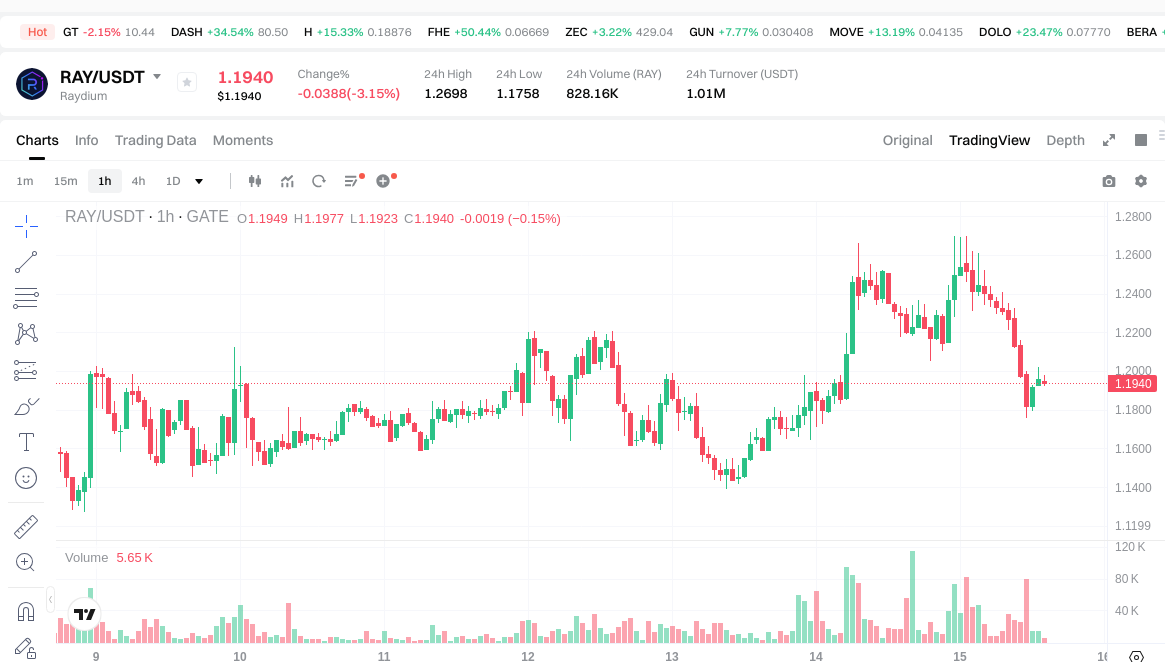
- RAY current price: $1.1948
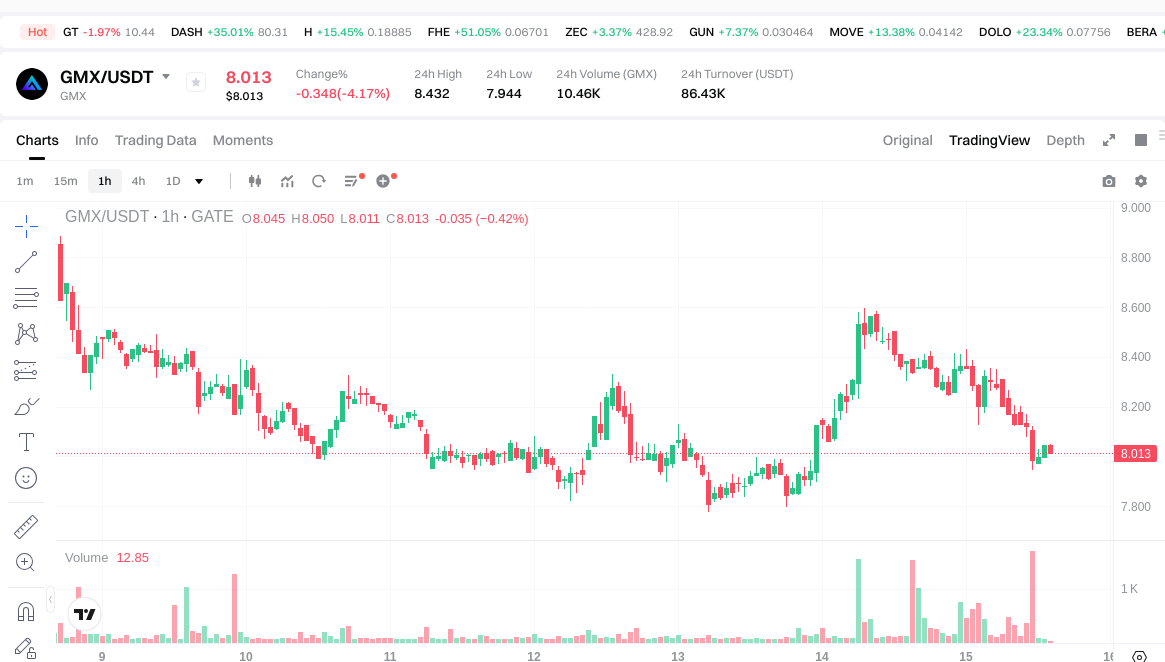
- GMX current price: $8.045
- 24-hour trading volume: RAY $1,016,307.28 vs GMX $86,620.66
- Market sentiment index (Fear & Greed Index): 61 (Greed)
View real-time prices:
II. Core Factors Influencing RAY vs GMX Investment Value
Supply Mechanism Comparison (Tokenomics)
-
RAY: Raydium employs a token model where 0.03% of standard AMM trading fees and 12% of CPMM fees are allocated to RAY buybacks, creating deflationary pressure through protocol revenue reinvestment. The protocol captures value through transaction volume rather than relying solely on emission schedules.
-
GMX: GMX implements a fee-sharing mechanism where the protocol generates revenue from trading activities. However, reference materials indicate that GMX faces relatively weaker competitive moats compared to other DeFi projects, with frequent emergence of new derivatives platforms impacting its market position.
-
📌 Historical Pattern: DeFi protocols with sustainable revenue models and buyback mechanisms have demonstrated stronger correlation with underlying business growth, while those heavily dependent on token emissions face dilution pressure during bear markets.
Institutional Adoption and Market Application
-
Institutional Holdings: Reference materials suggest increased institutional interest in established DeFi protocols, particularly following regulatory clarity initiatives such as the FIT21 Act. Traditional financial institutions like BlackRock have shown willingness to engage with blockchain-based financial products, potentially benefiting mature DeFi platforms.
-
Enterprise Adoption: RAY has established itself as the primary liquidity venue for meme tokens on Solana due to its standard AMM model's suitability for high-volume token deployments. GMX operates in the derivatives trading space, facing intensified competition from emerging platforms in recent years.
-
Regulatory Environment: The FIT21 Act passage in May 2024 provides clearer regulatory frameworks for digital asset markets, potentially facilitating both entrepreneurial ventures and traditional financial participation in DeFi investments.
Technology Development and Ecosystem Building
-
RAY Technical Infrastructure: Raydium benefits from Solana's high-performance architecture, enabling low-cost, high-speed transactions. The protocol offers both standard AMM pools (0.25% fee structure) and concentrated liquidity CPMM pools with flexible fee tiers, serving diverse liquidity provision needs.
-
GMX Technical Evolution: GMX operates as a derivatives trading platform with established infrastructure. However, the protocol encounters sustained competitive pressure from newer derivatives platforms, indicating an increasingly crowded market segment.
-
Ecosystem Comparison: RAY demonstrated transaction volume growth from October 2023, reaching $47.5 billion in March 2024 (approximately 52.7% of Uniswap's monthly volume). The Solana ecosystem experienced substantial growth with stablecoin market capitalization expanding from $883.9 million to $97.5 billion. GMX faced security challenges, including a July 2025 reentrancy vulnerability exploit resulting in approximately $42 million losses.
Macroeconomic Factors and Market Cycles
-
Performance in Inflationary Environments: DeFi protocols with demonstrated product-market fit and organic user demand show stronger resilience during macroeconomic volatility. Protocols generating sustainable revenue independent of token emissions typically exhibit better risk-adjusted returns.
-
Monetary Policy Impact: Federal Reserve liquidity injection expectations, continuous Bitcoin spot ETF capital inflows, and increasingly transparent regulatory landscapes constitute core catalysts for market movements. Interest rate policies and dollar index fluctuations affect risk appetite across crypto markets.
-
Geopolitical Considerations: Cross-border transaction demand and international regulatory developments influence decentralized exchange adoption. Multi-chain deployment strategies (as employed by established protocols like Aave and Uniswap) provide geographic diversification benefits, though RAY's Solana-exclusive positioning concentrates exposure to that ecosystem's development trajectory.
III. 2026-2031 Price Forecast: RAY vs GMX
Short-term Forecast (2026)
- RAY: Conservative $0.88-$1.19 | Optimistic $1.19-$1.31
- GMX: Conservative $6.82-$8.02 | Optimistic $8.02-$11.15
Mid-term Forecast (2028-2029)
- RAY may enter a consolidation phase with projected prices ranging from $0.79 to $1.87 in 2028, potentially expanding to $0.94-$1.76 by 2029
- GMX may enter an expansion phase with projected prices ranging from $5.55 to $14.36 in 2028, potentially reaching $7.95-$15.89 by 2029
- Key drivers: institutional capital flows, ETF developments, ecosystem expansion
Long-term Forecast (2030-2031)
- RAY: Base scenario $1.25-$2.38 (2030) | Optimistic scenario $1.82-$2.12 (2031)
- GMX: Base scenario $12.54-$17.82 (2030) | Optimistic scenario $10.74-$20.05 (2031)
View detailed price predictions for RAY and GMX
Disclaimer
RAY:
| Year |
Predicted High Price |
Predicted Average Price |
Predicted Low Price |
Price Change |
| 2026 |
1.31263 |
1.1933 |
0.883042 |
0 |
| 2027 |
1.29055395 |
1.252965 |
0.66407145 |
4 |
| 2028 |
1.86948642825 |
1.271759475 |
0.7884908745 |
6 |
| 2029 |
1.75909770582 |
1.570622951625 |
0.942373770975 |
31 |
| 2030 |
2.380750270073175 |
1.6648603287225 |
1.248645246541875 |
39 |
| 2031 |
2.123945564367729 |
2.022805299397837 |
1.820524769458053 |
69 |
GMX:
| Year |
Predicted High Price |
Predicted Average Price |
Predicted Low Price |
Price Change |
| 2026 |
11.14502 |
8.018 |
6.8153 |
0 |
| 2027 |
12.1685177 |
9.58151 |
8.9108043 |
19 |
| 2028 |
14.355018282 |
10.87501385 |
5.5462570635 |
35 |
| 2029 |
15.89492024316 |
12.615016066 |
7.94746012158 |
56 |
| 2030 |
17.818710193225 |
14.25496815458 |
12.5443719760304 |
77 |
| 2031 |
20.046048967378125 |
16.0368391739025 |
10.744682246514675 |
99 |
IV. Investment Strategy Comparison: RAY vs GMX
Long-term vs Short-term Investment Strategies
-
RAY: Suitable for investors focused on DeFi infrastructure growth within high-performance blockchain ecosystems. The protocol's integration with Solana's expanding ecosystem and its role as the primary liquidity venue for new token launches positions it for potential value accrual tied to network activity growth. Investors seeking exposure to AMM-based DEX models with deflationary tokenomics through buyback mechanisms may find alignment with RAY's value proposition.
-
GMX: Suitable for investors interested in decentralized derivatives trading platforms with established fee-sharing models. The protocol's revenue distribution mechanism (30% of platform fees to token holders) provides cash flow characteristics. However, investors should consider the intensified competitive landscape in decentralized perpetual exchanges and recent security incidents when evaluating long-term positioning.
Risk Management and Asset Allocation
-
Conservative Investors: RAY 30-40% vs GMX 60-70%. This allocation reflects GMX's relatively higher price stability and established revenue model, though investors must weigh recent security vulnerabilities against RAY's ecosystem growth potential.
-
Aggressive Investors: RAY 60-70% vs GMX 30-40%. Higher RAY allocation captures potential upside from Solana ecosystem expansion and meme token launch activity, accepting increased volatility associated with platform-specific risk concentration.
-
Hedging Tools: Stablecoin reserves (USDC/USDT) for rebalancing during volatility, options strategies where available, cross-protocol diversification including established DeFi blue-chips (Uniswap, Aave) to mitigate single-protocol exposure.
V. Potential Risk Comparison
Market Risks
-
RAY: Concentration risk tied to Solana network performance and adoption trajectory. Protocol revenue depends on sustained trading volume, which correlates with broader DeFi market cycles and meme token issuance trends. Limited multi-chain deployment creates dependency on single ecosystem health.
-
GMX: Competitive displacement risk from emerging derivatives platforms offering improved capital efficiency or user experience. Market share erosion potential as newer protocols capture liquidity. Revenue sustainability depends on maintaining trading volume amid growing alternatives in perpetual exchange space.
Technical Risks
-
RAY: Scalability tied to Solana network capacity and stability. Historical network outages affecting the underlying blockchain could impact trading activity and user confidence. Smart contract risks inherent to AMM models, though mitigated by operational track record since 2021.
-
GMX: Security vulnerabilities demonstrated by July 2025 reentrancy exploit resulting in approximately $42 million losses. Protocol complexity in derivatives trading creates expanded attack surface. Dependency on oracle infrastructure for price feeds introduces additional technical dependencies.
Regulatory Risks
- Regulatory frameworks continue evolving globally, with developments like the FIT21 Act providing increased clarity in certain jurisdictions. RAY's AMM model may face different regulatory treatment compared to GMX's derivatives-focused platform, particularly as authorities distinguish between spot and leveraged trading venues. Both protocols operate in decentralized architectures that may receive varying interpretations across jurisdictions regarding securities classification and compliance requirements.
VI. Conclusion: Which Is the Better Buy?
📌 Investment Value Summary:
-
RAY Advantages: Established position as primary AMM on high-performance Solana blockchain, deflationary tokenomics through buyback mechanisms funded by protocol revenue, demonstrated transaction volume growth reaching $47.5 billion monthly (March 2024), integration with expanding Solana DeFi ecosystem including stablecoin adoption growth from $883.9 million to $97.5 billion market capitalization.
-
GMX Advantages: Revenue-sharing model providing cash flow characteristics through 30% platform fee distribution to token holders, established presence in decentralized derivatives trading segment, multi-chain deployment (Arbitrum, Avalanche) providing geographic diversification.
✅ Investment Recommendations:
-
Novice Investors: Consider starting with smaller position sizes in either protocol, prioritizing understanding of underlying mechanisms (AMM vs perpetual exchanges) before capital commitment. Allocate majority holdings to established cryptocurrencies with longer track records while using RAY or GMX as tactical DeFi exposure (10-20% of crypto portfolio).
-
Experienced Investors: Evaluate RAY for exposure to Solana ecosystem growth and AMM infrastructure, particularly if bullish on continued DeFi adoption and meme token launch activity. Consider GMX for derivatives trading platform exposure with fee-sharing characteristics, while monitoring competitive dynamics and security improvements following recent exploit. Implement position sizing reflecting risk tolerance and portfolio diversification objectives.
-
Institutional Investors: Conduct thorough due diligence on smart contract audits, team backgrounds, and governance structures. RAY offers exposure to DeFi infrastructure with demonstrated product-market fit in specific segment (Solana AMM). GMX provides derivatives platform exposure with established revenue model, though recent security incidents warrant enhanced risk assessment. Consider both protocols as tactical allocations within broader DeFi infrastructure thesis rather than core holdings.
⚠️ Risk Warning: Cryptocurrency markets exhibit high volatility. This article does not constitute investment advice.
VII. FAQ
Q1: What is the primary difference between RAY and GMX's revenue models?
RAY employs a buyback mechanism where 0.03% of standard AMM trading fees and 12% of CPMM fees are allocated to token buybacks, creating deflationary pressure. GMX implements a direct fee-sharing model where 30% of platform-generated trading fees are distributed to token holders. RAY's model focuses on reducing token supply through protocol revenue reinvestment, while GMX provides cash flow characteristics to token holders through regular fee distributions, representing fundamentally different value accrual mechanisms for investors.
Q2: Which protocol faces higher technical risk exposure?
GMX faces higher technical risk exposure. The protocol suffered a reentrancy vulnerability exploit in July 2025 resulting in approximately $42 million losses, demonstrating security weaknesses in its derivatives trading infrastructure. Additionally, GMX's protocol complexity in perpetual exchange operations creates an expanded attack surface and dependency on oracle infrastructure for price feeds. While RAY faces smart contract risks inherent to AMM models, it benefits from operational track record since 2021 and simpler technical architecture compared to derivatives platforms.
Q3: How does ecosystem concentration affect RAY's investment profile?
RAY's exclusive deployment on Solana creates significant concentration risk tied to the network's performance and adoption trajectory. The protocol's success depends entirely on Solana ecosystem health, including network stability (historical outages pose concerns), DeFi activity levels, and stablecoin adoption growth. While this concentration enables RAY to capture Solana's ecosystem expansion (stablecoin market cap grew from $883.9 million to $97.5 billion), it lacks the geographic diversification that multi-chain protocols like GMX (deployed on Arbitrum and Avalanche) provide for risk mitigation.
Q4: What competitive advantages does RAY maintain in its market segment?
RAY holds established position as the primary liquidity venue for new token launches on Solana, particularly dominating the meme token deployment market due to its standard AMM model's suitability for high-volume launches. The protocol demonstrated substantial transaction volume growth, reaching $47.5 billion in March 2024 (approximately 52.7% of Uniswap's monthly volume). RAY's first-mover advantage in the Serum ecosystem and integration with Solana's high-performance infrastructure (enabling low-cost, high-speed transactions) create network effects that newer AMM competitors struggle to replicate.
Q5: How do current market conditions favor one protocol over the other?
Current market sentiment (Fear & Greed Index: 61 - Greed) and institutional interest following regulatory clarity initiatives like the FIT21 Act generally favor established DeFi protocols with demonstrated product-market fit. RAY benefits from Solana ecosystem momentum and sustained meme token launch activity, reflected in its higher 24-hour trading volume ($1,016,307.28 vs GMX's $86,620.66). However, GMX's revenue-sharing model may appeal to income-focused investors during consolidation phases. RAY appears better positioned for growth-oriented strategies in current conditions, while GMX suits defensive allocation seeking cash flow characteristics.
Q6: What allocation strategy balances exposure to both protocols' strengths?
Conservative investors should consider 30-40% RAY and 60-70% GMX allocation, prioritizing GMX's established revenue model and relative price stability while maintaining RAY exposure for Solana ecosystem growth potential. Aggressive investors may reverse this ratio (60-70% RAY, 30-40% GMX) to capture higher upside from AMM infrastructure expansion and meme token activity, accepting increased volatility. Both strategies should maintain stablecoin reserves (15-25% of DeFi allocation) for rebalancing opportunities and include established DeFi blue-chips (Uniswap, Aave) for protocol-specific risk mitigation, ensuring neither RAY nor GMX exceeds 40% of total DeFi portfolio exposure.
Q7: How should investors interpret the 2026-2031 price forecast differences?
RAY's price forecasts show more conservative growth trajectory (2026: $0.88-$1.31; 2031: $1.82-$2.12) compared to GMX's projections (2026: $6.82-$11.15; 2031: $10.74-$20.05), reflecting different maturity stages and market positioning. RAY's lower projected price points indicate higher percentage gain potential from current levels but also greater uncertainty regarding adoption acceleration. GMX's higher absolute prices suggest market recognition of established revenue model, though slower percentage growth expectations. Investors should evaluate these forecasts considering GMX's recent security incidents potentially constraining upside, while RAY's projections depend heavily on sustained Solana ecosystem expansion and continued dominance in new token launch liquidity provision.
Q8: What regulatory considerations differentiate RAY and GMX investment risk profiles?
RAY's AMM model may face different regulatory treatment compared to GMX's derivatives-focused platform, particularly as authorities distinguish between spot and leveraged trading venues. Derivatives platforms like GMX typically encounter more stringent regulatory scrutiny regarding investor protection, leverage limitations, and licensing requirements across jurisdictions. The FIT21 Act provides increased clarity for digital asset markets, potentially benefiting both protocols, but GMX's perpetual exchange operations may require additional compliance measures compared to RAY's spot trading infrastructure. Investors should monitor jurisdiction-specific developments, as regulatory classification differences could significantly impact operational requirements and market access for each protocol.
* The information is not intended to be and does not constitute financial advice or any other recommendation of any sort offered or endorsed by Gate.