This comprehensive analysis compares RBNT and BNB tokens, examining their distinct market positions, investment potential, and performance metrics. RBNT, launched in December 2024 as a formally verified blockchain infrastructure project from University of Sydney and CSIRO, targets digital registries and tokenized assets. BNB, Binance's established ecosystem token since 2017, demonstrates proven utility across multiple functions with presence in over 180 countries. The article evaluates historical price trends, supply mechanisms, institutional adoption patterns, and technological ecosystems to address investor decision-making. Price forecasts through 2031 project BNB reaching $1,107-$1,499 while RBNT ranges $0.0055-$0.0105, reflecting their different market maturity levels. Investment recommendations vary by risk tolerance: conservative investors should favor BNB's stability, while experienced investors may allocate strategically to RBNT's early-stage growth potential. Real-time prices and detailed analysis av
Introduction: Investment Comparison Between RBNT and BNB
In the cryptocurrency market, the comparison between RBNT vs BNB remains a topic of ongoing discussion among investors. These two assets exhibit notable differences in market capitalization ranking, application scenarios, and price performance, representing distinct positioning within the crypto asset landscape.
RBNT (Redbelly Network Token): Launched in 2024, this project emerged from a collaboration between the University of Sydney, CSIRO, and the Australian National Science Agency. It positions itself as a formally verified blockchain focused on enabling asset issuers to build digital registries and facilitate the creation of structured financial products from tokenized assets.
BNB (Binance Coin): Introduced in 2017, BNB has established itself as the native token of the Binance ecosystem. It serves multiple functions including transaction fee discounts and various payment applications, maintaining a position among the leading cryptocurrencies by market capitalization and trading volume.
This article will examine the investment value comparison between RBNT vs BNB through analysis of historical price movements, supply mechanisms, institutional adoption patterns, technological ecosystems, and future outlook, attempting to address the question investors frequently consider:
"Which asset presents a more suitable investment opportunity based on current market conditions?"
I. Historical Price Comparison and Market Status
RBNT (Redbelly) and BNB (Binance Coin) Historical Price Trends
- 2024: RBNT launched in December 2024 with an initial offering price of $0.19, subsequently experiencing significant volatility in its early trading period.
- 2017-2024: BNB, issued by Binance with an initial price of $0.15, demonstrated substantial growth over multiple years, supported by its utility within the Binance ecosystem and quarterly token burn mechanisms.
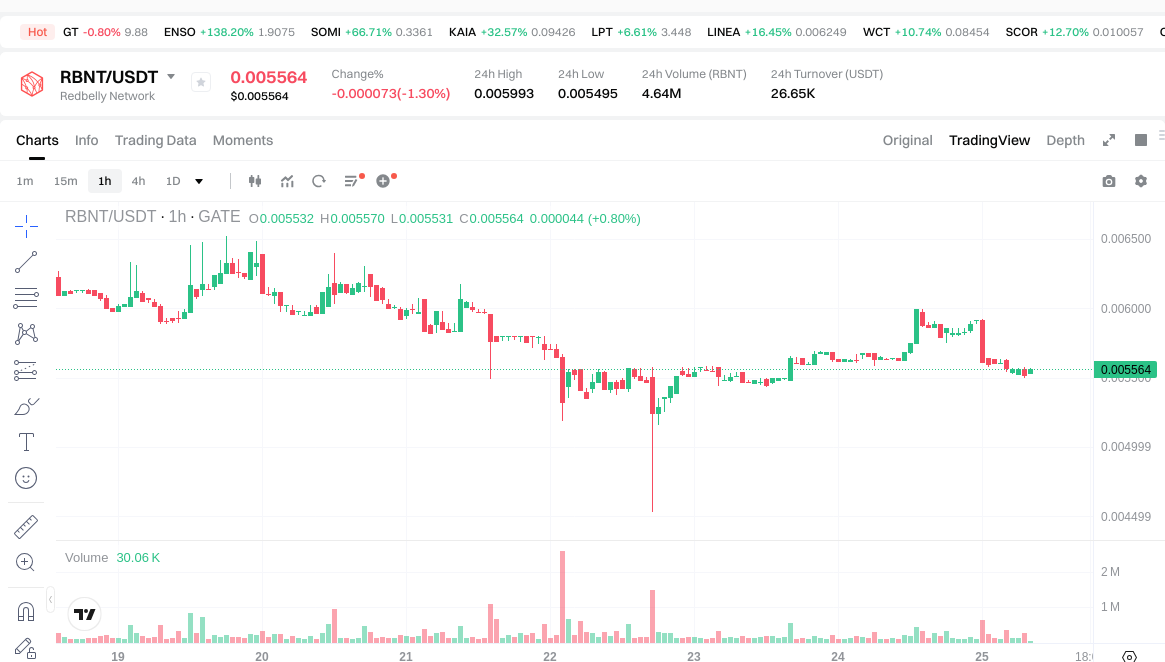
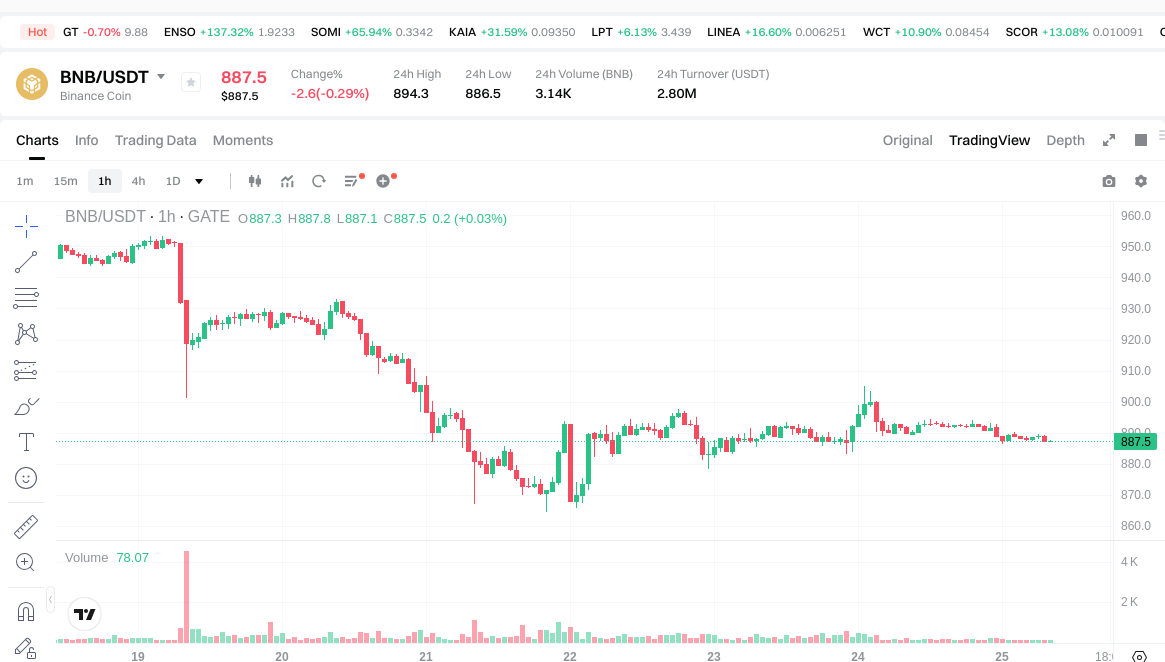
- Comparative Analysis: During recent market cycles, RBNT declined from its peak of $0.449 (recorded on December 29, 2024) to a low of $0.00453 (recorded on January 22, 2026), representing a notable contraction. In contrast, BNB has shown relative resilience, with its price range spanning from an all-time high of $1,369.99 (October 13, 2025) to an all-time low of $0.0398177 (October 19, 2017), reflecting its longer market presence and established user base across over 180 countries.
Current Market Status (January 25, 2026)
- RBNT current price: $0.00552
- BNB current price: $887.3
- 24-hour trading volume: RBNT at $26,579.73 vs BNB at $2,769,818.01
- Market sentiment index (Fear & Greed Index): 25 (Extreme Fear)
View real-time prices:
II. Core Factors Affecting RBNT vs BNB Investment Value
Supply Mechanism Comparison (Tokenomics)
Due to limited available data on RBNT's supply mechanism in the reference materials, a comprehensive comparison cannot be provided at this time.
Institutional Adoption and Market Application
Institutional Holdings
Specific institutional holding data for RBNT and BNB is not available in the current materials.
Enterprise Adoption
Detailed information regarding enterprise-level adoption of RBNT and BNB in cross-border payments, settlements, or investment portfolios is not provided in the reference materials.
National Policies
The reference materials do not contain sufficient information on different countries' regulatory attitudes toward RBNT and BNB.
Technology Development and Ecosystem Building
RBNT Technology
Technical upgrade information for RBNT is not available in the provided materials.
BNB Technology
Specific technical development details for BNB are not included in the reference materials.
Ecosystem Comparison
Comparative data on DeFi, NFT, payment systems, and smart contract implementations for RBNT and BNB is not available in the current materials.
Macroeconomic Environment and Market Cycles
The reference materials do not provide sufficient data to evaluate the inflation-hedging properties of RBNT versus BNB.
Macroeconomic Monetary Policy
Analysis of how interest rates and the US Dollar Index affect RBNT and BNB is not available in the provided materials.
Geopolitical Factors
Information regarding cross-border transaction demand and international developments affecting these assets is not present in the reference materials.
III. 2026-2031 Price Forecast: RBNT vs BNB
Short-term Forecast (2026)
- RBNT: Conservative $0.00373 - $0.00556 | Optimistic $0.00556 - $0.00662
- BNB: Conservative $505.88 - $887.50 | Optimistic $887.50 - $914.13
Medium-term Forecast (2028-2029)
- RBNT may enter a growth consolidation phase, with projected price range of $0.00322 - $0.00763
- BNB may enter an expansion phase, with projected price range of $744.79 - $1,384.55
- Key drivers: institutional capital inflows, ETF developments, ecosystem growth
Long-term Forecast (2030-2031)
- RBNT: Baseline scenario $0.00553 - $0.00765 | Optimistic scenario $0.00746 - $0.01053
- BNB: Baseline scenario $1,107.25 - $1,350.31 | Optimistic scenario $1,350.31 - $1,498.84
View detailed price predictions for RBNT and BNB
Disclaimer
RBNT:
| Year |
Predicted High Price |
Predicted Average Price |
Predicted Low Price |
Price Change |
| 2026 |
0.00662116 |
0.005564 |
0.00372788 |
0 |
| 2027 |
0.0065190606 |
0.00609258 |
0.003960177 |
10 |
| 2028 |
0.00756698436 |
0.0063058203 |
0.003215968353 |
14 |
| 2029 |
0.007630042563 |
0.00693640233 |
0.0040231133514 |
25 |
| 2030 |
0.007647383568825 |
0.0072832224465 |
0.006045074630595 |
31 |
| 2031 |
0.010526077240804 |
0.007465303007662 |
0.00552432422567 |
35 |
BNB:
| Year |
Predicted High Price |
Predicted Average Price |
Predicted Low Price |
Price Change |
| 2026 |
914.125 |
887.5 |
505.875 |
0 |
| 2027 |
1008.91 |
900.8125 |
522.47125 |
1 |
| 2028 |
1384.5488125 |
954.86125 |
744.791775 |
7 |
| 2029 |
1263.28143375 |
1169.70503125 |
725.217119375 |
31 |
| 2030 |
1484.12174365 |
1216.4932325 |
1094.84390925 |
37 |
| 2031 |
1498.84131176325 |
1350.307488075 |
1107.2521402215 |
52 |
IV. Investment Strategy Comparison: RBNT vs BNB
Long-term vs Short-term Investment Strategies
- RBNT: May appeal to investors with higher risk tolerance seeking early-stage blockchain infrastructure projects, though its recent price volatility and limited market history suggest careful consideration of timing and position sizing.
- BNB: May suit investors seeking exposure to established exchange ecosystems with demonstrated multi-year performance, though market conditions and regulatory developments warrant ongoing monitoring.
Risk Management and Asset Allocation
- Conservative investors: RBNT 5-10% vs BNB 15-20% (as part of a diversified crypto portfolio)
- Aggressive investors: RBNT 15-25% vs BNB 25-35% (with appropriate risk management protocols)
- Hedging tools: stablecoin allocation, options strategies, cross-asset portfolio diversification
V. Potential Risk Comparison
Market Risk
- RBNT: Recent launch in December 2024 presents limited price history for analysis; significant price decline from peak of $0.449 to $0.00453 indicates substantial volatility exposure. Current 24-hour trading volume of $26,579.73 suggests lower liquidity compared to established assets.
- BNB: Price range from all-time high of $1,369.99 (October 2025) to current price of $887.3 reflects market cycle sensitivity; 24-hour trading volume of $2,769,818.01 indicates relatively higher market depth, though concentration risk within the Binance ecosystem remains a consideration.
Technical Risk
- RBNT: Originated from collaboration between University of Sydney, CSIRO, and Australian National Science Agency; network scalability and operational stability require further observation given recent launch timeline.
- BNB: Network performance dependent on Binance infrastructure; technical developments and security protocols require ongoing evaluation as ecosystem evolves.
Regulatory Risk
- Global regulatory frameworks continue to evolve, potentially affecting both assets differently based on their respective use cases, operational jurisdictions, and institutional adoption patterns. Exchange-related tokens and blockchain infrastructure projects may face distinct regulatory considerations across various jurisdictions.
VI. Conclusion: Which Is the Better Buy?
📌 Investment Value Summary:
- RBNT advantages: Early-stage positioning in formally verified blockchain infrastructure with academic and institutional origins; potential for development in digital registry and tokenized asset sectors.
- BNB advantages: Established market presence since 2017 with demonstrated ecosystem utility; broader user base across over 180 countries; relatively higher trading volume and market liquidity.
✅ Investment Recommendations:
- New investors: Consider starting with assets demonstrating longer market history and established use cases; thorough research and risk assessment essential before allocation decisions.
- Experienced investors: Evaluate portfolio diversification strategies considering risk tolerance, time horizon, and market cycle positioning; monitor technical developments and ecosystem growth indicators.
- Institutional investors: Assess regulatory compliance frameworks, custody solutions, and liquidity requirements; consider phased allocation approaches with appropriate risk management protocols.
⚠️ Risk Disclosure: The cryptocurrency market exhibits significant volatility. This content does not constitute investment advice. Market participants should conduct independent research and consult qualified financial advisors before making investment decisions.
VII. FAQ
Q1: What is the main difference between RBNT and BNB in terms of market positioning?
RBNT is an early-stage blockchain infrastructure project launched in December 2024, focusing on formally verified blockchain technology for digital registries and tokenized assets, while BNB is an established exchange ecosystem token since 2017 with proven utility across multiple functions including transaction fee discounts and payment applications. RBNT represents a newer academic-institutional collaboration from the University of Sydney and CSIRO, targeting specialized use cases in structured financial products. In contrast, BNB has achieved broad market adoption across over 180 countries with significantly higher trading volume ($2.77 million vs $26,580 in 24-hour volume as of January 25, 2026) and maintains a position among leading cryptocurrencies by market capitalization.
Q2: Which asset shows greater price volatility between RBNT and BNB?
RBNT demonstrates significantly greater price volatility, having declined approximately 98.8% from its peak of $0.449 (December 29, 2024) to its low of $0.00453 (January 22, 2026) within just over one year. BNB, while experiencing market cycles, shows relatively more stable price movements with its range spanning from an all-time high of $1,369.99 (October 2025) to its current price of $887.3, representing a more moderate correction. The substantial difference in price stability reflects RBNT's early-stage market dynamics and limited trading history compared to BNB's seven-year market presence and established liquidity patterns.
Q3: What are the price predictions for RBNT and BNB through 2031?
For RBNT, short-term 2026 projections range from $0.00373-$0.00662 (conservative to optimistic scenarios), with long-term 2031 forecasts reaching $0.00553-$0.01053. BNB projections show a short-term 2026 range of $505.88-$914.13, expanding to $1,107.25-$1,498.84 by 2031 in various scenarios. These forecasts suggest BNB may experience a potential 52% price increase by 2031 (based on predicted average price growth), while RBNT shows a projected 35% increase over the same period. However, these predictions depend on numerous factors including institutional adoption, ecosystem development, regulatory frameworks, and broader market conditions, which remain subject to significant uncertainty.
Q4: How should investors allocate between RBNT and BNB based on risk tolerance?
Conservative investors might consider allocating 5-10% to RBNT and 15-20% to BNB as part of a diversified cryptocurrency portfolio, while aggressive investors could allocate 15-25% to RBNT and 25-35% to BNB with appropriate risk management protocols. The allocation strategy reflects RBNT's higher risk profile due to its recent launch, significant price volatility, and limited market history, whereas BNB's established ecosystem and longer track record suggest relatively lower (though still substantial) risk exposure. All allocations should be considered within the context of overall portfolio diversification, individual risk tolerance, investment time horizon, and the understanding that cryptocurrency markets carry inherent volatility regardless of asset selection.
Q5: What are the primary risks associated with investing in RBNT versus BNB?
RBNT faces higher market risk due to extremely limited price history (launched December 2024), dramatic volatility (98.8% decline from peak), and significantly lower liquidity ($26,580 daily volume), plus technical uncertainty regarding network scalability given its recent operational timeline. BNB's primary risks include concentration within the Binance ecosystem, dependence on exchange infrastructure performance, and exposure to market cycle fluctuations, though these are somewhat mitigated by seven years of operational history and higher liquidity ($2.77 million daily volume). Both assets face evolving regulatory frameworks globally, though they may encounter different regulatory considerations based on their distinct use cases—RBNT as blockchain infrastructure for tokenized assets and BNB as an exchange-related utility token.
Q6: Is RBNT or BNB more suitable for new cryptocurrency investors?
BNB may be more suitable for new cryptocurrency investors due to its established market presence since 2017, demonstrated ecosystem utility, broader user adoption across over 180 countries, and relatively higher trading liquidity. New investors generally benefit from starting with assets that have longer market histories, proven use cases, and greater market depth for easier entry and exit positions. RBNT, while potentially offering early-stage growth opportunities, presents challenges for newcomers including extreme price volatility, limited historical performance data, lower liquidity, and higher uncertainty regarding future development. Regardless of choice, new investors should conduct thorough independent research, understand their risk tolerance, start with conservative position sizes, and consider consulting qualified financial advisors before making investment decisions.
Q7: What drives the price forecast differences between RBNT and BNB?
The price forecast differences stem from fundamentally different market positions and development stages: BNB's projections (reaching $1,350-$1,499 by 2031) are supported by its established ecosystem utility, proven track record, institutional adoption potential, and possible ETF developments that could drive sustained demand. RBNT's more modest projections ($0.0055-$0.0105 by 2031) reflect its early-stage status, need to prove technological capabilities, requirements for ecosystem building, and necessity to establish market credibility over time. Key drivers affecting both include institutional capital inflows, regulatory clarity, technological advancement, and broader cryptocurrency market cycles, though BNB benefits from existing infrastructure while RBNT must demonstrate its value proposition in formally verified blockchain technology and tokenized asset applications to achieve projected growth.
* The information is not intended to be and does not constitute financial advice or any other recommendation of any sort offered or endorsed by Gate.