This comprehensive comparison analyzes RBNT and ICP, two emerging blockchain networks with distinct positioning in the crypto landscape. RBNT, launched in 2024 as a formally verified blockchain for asset tokenization, contrasts with ICP's 2021-established decentralized cloud infrastructure. The article examines historical price trends, current market status, tokenomics, institutional adoption, and technical ecosystems. RBNT currently trades at $0.005565 with limited volume, while ICP trades at $3.493 with significantly higher liquidity. The analysis provides price predictions through 2031, investment strategies tailored for different investor profiles, and risk assessments covering market, technical, and regulatory factors. The conclusion offers guidance for novice, experienced, and institutional investors, emphasizing that while RBNT represents early-stage high-risk exposure, ICP provides more established market presence. Complete price data and real-time quotes are available on Gate.
Introduction: RBNT vs ICP Investment Comparison
In the cryptocurrency market, the comparison between RBNT and ICP has become a topic that investors cannot overlook. Both exhibit significant differences in market cap rankings, application scenarios, and price performance, representing distinct positioning within the crypto asset landscape.
Redbelly (RBNT): Launched in 2024, it has gained market attention as the world's first formally verified blockchain developed through collaboration between the University of Sydney and CSIRO. The project focuses on enabling asset issuers to establish digital registries and facilitate the creation of structured financial products from tokenized assets.
Internet Computer (ICP): Since its launch in 2021, it has positioned itself as a decentralized cloud blockchain capable of hosting secure applications, websites, and enterprise systems while supporting trustless multi-chain interactions. It represents an innovative approach as a "self-writing cloud" where AI can create applications based on user instructions.
This article will provide a comprehensive analysis of the investment value comparison between RBNT and ICP, covering historical price trends, supply mechanisms, institutional adoption, technical ecosystems, and future predictions. We aim to address the question that investors care about most:
"Which presents a more informed investment consideration at this time?"
I. Historical Price Comparison and Market Status
RBNT (Coin A) and ICP (Coin B) Historical Price Trends
- 2021: ICP experienced significant price movements during its initial trading period, reaching a peak of $700.65 in May 2021.
- 2024-2025: RBNT launched on exchanges in December 2024 with an initial price of $0.19, and subsequently saw considerable price volatility in its early trading months.
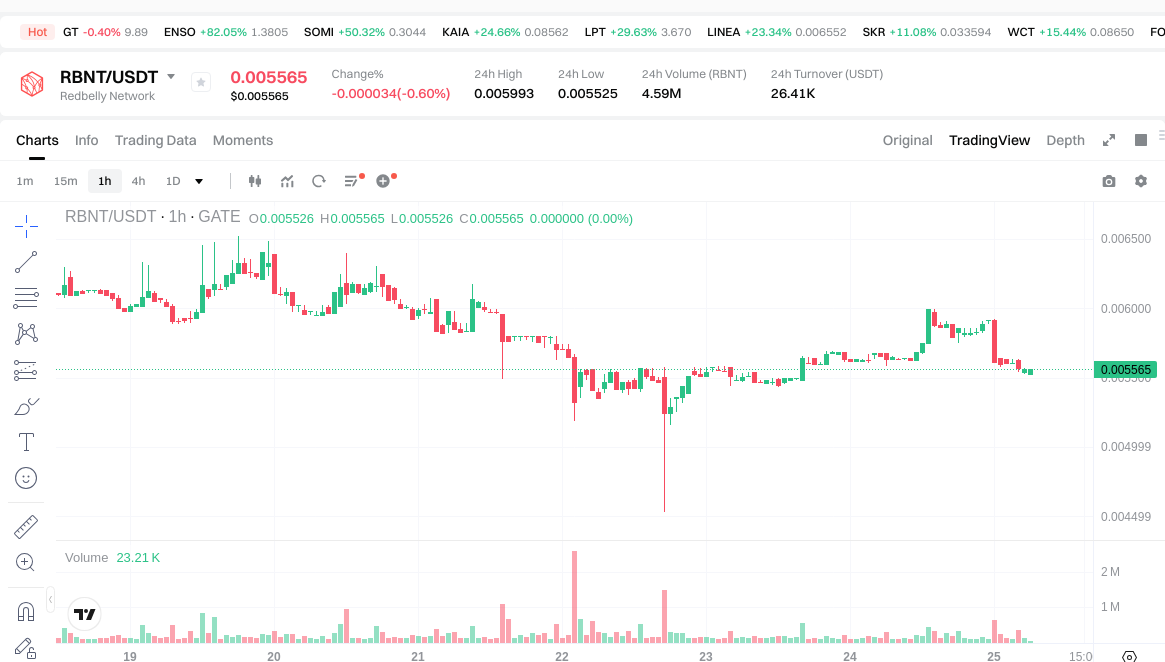
- Comparative Analysis: During the market cycle from late 2024 to early 2026, RBNT declined from its historical high of $0.449 (recorded in December 2024) to a low of $0.00453, while ICP experienced a decline from its 2021 peak to a low of $2.23 recorded in October 2025.
Current Market Status (2026-01-25)
- RBNT Current Price: $0.005565
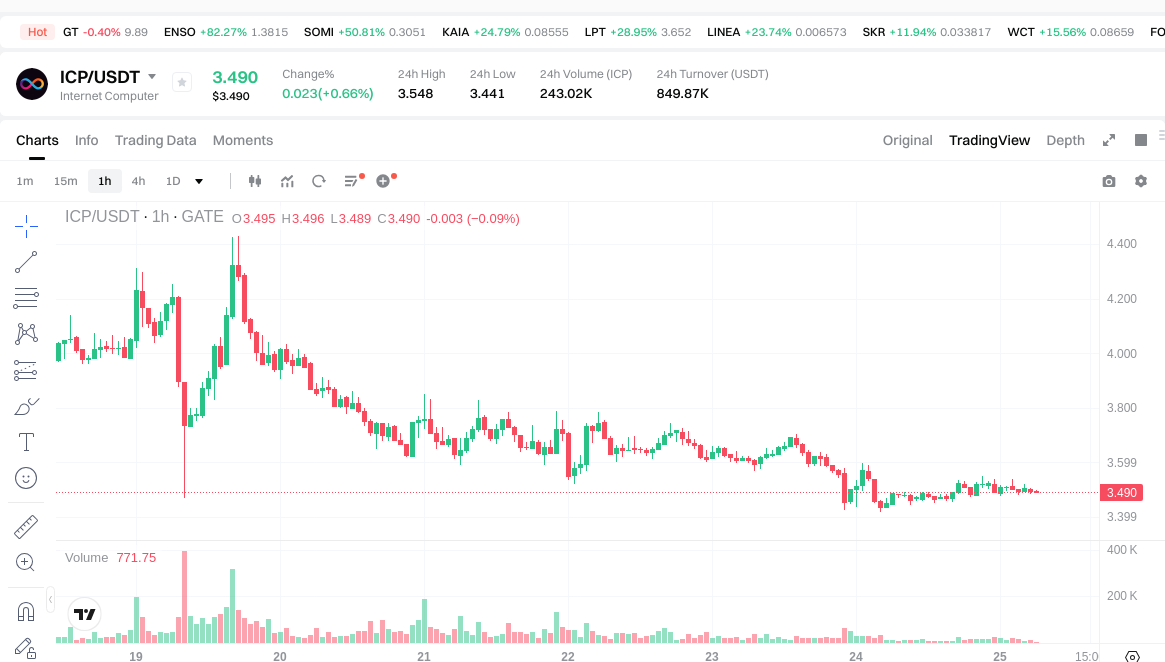
- ICP Current Price: $3.493
- 24-Hour Trading Volume: RBNT $26,870.39 vs ICP $849,502.40
- Market Sentiment Index (Fear & Greed Index): 25 (Extreme Fear)
View real-time prices:
II. Core Factors Influencing RBNT vs ICP Investment Value
Supply Mechanism Comparison (Tokenomics)
Due to limited available data on the supply mechanisms of RBNT and ICP, a comprehensive comparison cannot be provided at this time. Generally speaking, supply mechanisms such as fixed supply caps, deflationary models, or halving events can significantly influence price cycles by affecting token scarcity and market dynamics.
Institutional Adoption and Market Applications
Institutional Holdings: Specific data regarding institutional preferences between RBNT and ICP is not available in the provided materials.
Enterprise Adoption: Information on the comparative adoption of RBNT and ICP in cross-border payments, settlements, or investment portfolios is not documented in the available resources.
National Policies: Regulatory attitudes toward these assets vary across jurisdictions, though specific comparative analysis between RBNT and ICP regulatory frameworks is not available in the current dataset.
Technical Development and Ecosystem Building
RBNT Technical Development: Detailed information about recent technical upgrades or roadmap developments for RBNT is not available in the provided materials.
ICP Technical Development: Specific details regarding ICP's recent technical advancements and their potential impact are not documented in the available resources.
Ecosystem Comparison: A comparative analysis of DeFi integrations, NFT platforms, payment solutions, and smart contract implementations between RBNT and ICP ecosystems cannot be conducted based on the current materials.
Macroeconomic Environment and Market Cycles
Performance in Inflationary Environments: While both digital assets may exhibit characteristics relevant to inflation hedging, specific comparative performance data is not available.
Macroeconomic Monetary Policy: Interest rate movements, US Dollar Index fluctuations, and other monetary policy factors can influence cryptocurrency valuations, though specific impacts on RBNT and ICP cannot be detailed without additional data.
Geopolitical Factors: Cross-border transaction demand and international developments may affect adoption patterns, though specific implications for RBNT versus ICP require further analysis beyond the scope of available materials.
III. 2026-2031 Price Prediction: RBNT vs ICP
Short-term Forecast (2026)
- RBNT: Conservative $0.00384 - $0.00557 | Optimistic $0.00557 - $0.00829
- ICP: Conservative $3.39 - $3.49 | Optimistic $3.49 - $5.13
Mid-term Forecast (2028-2029)
- RBNT may enter a gradual growth phase, with projected price range of $0.00568 - $0.01179
- ICP may enter a moderate expansion phase, with projected price range of $3.91 - $6.15
- Key drivers: institutional capital flows, ETF developments, ecosystem expansion
Long-term Forecast (2030-2031)
- RBNT: Base scenario $0.00528 - $0.01185 | Optimistic scenario $0.01025 - $0.01592
- ICP: Base scenario $5.17 - $7.92 | Optimistic scenario $6.57 - $7.65
View detailed price predictions for RBNT and ICP
Disclaimer
RBNT:
| Year |
Predicted High Price |
Predicted Average Price |
Predicted Low Price |
Price Change |
| 2026 |
0.00829185 |
0.005565 |
0.00383985 |
0 |
| 2027 |
0.00727484625 |
0.006928425 |
0.00367206525 |
24 |
| 2028 |
0.00916110995625 |
0.007101635625 |
0.0056813085 |
27 |
| 2029 |
0.011790490546406 |
0.008131372790625 |
0.006261157048781 |
46 |
| 2030 |
0.011853508685533 |
0.009960931668515 |
0.005279293784313 |
78 |
| 2031 |
0.015924541458455 |
0.010907220177024 |
0.010252786966403 |
95 |
ICP:
| Year |
Predicted High Price |
Predicted Average Price |
Predicted Low Price |
Price Change |
| 2026 |
5.1303 |
3.49 |
3.3853 |
0 |
| 2027 |
4.568759 |
4.31015 |
2.241278 |
23 |
| 2028 |
5.726896305 |
4.4394545 |
3.90671996 |
27 |
| 2029 |
6.150642237025 |
5.0831754025 |
3.507391027725 |
45 |
| 2030 |
7.919841435865125 |
5.6169088197625 |
5.1675561141815 |
60 |
| 2031 |
7.648263894429608 |
6.768375127813812 |
6.565323873979398 |
93 |
IV. Investment Strategy Comparison: RBNT vs ICP
Long-term vs Short-term Investment Strategies
- RBNT: May appeal to investors interested in emerging blockchain infrastructure with focus on asset tokenization and digital registry applications, though its early-stage development carries higher volatility considerations.
- ICP: May suit investors seeking exposure to decentralized cloud computing infrastructure with established market presence and broader ecosystem development, though subject to ongoing market dynamics.
Risk Management and Asset Allocation
- Conservative Investors: RBNT 10-15% vs ICP 20-30% (within overall crypto portfolio allocation)
- Aggressive Investors: RBNT 20-30% vs ICP 30-40% (within overall crypto portfolio allocation)
- Hedging Instruments: Stablecoin allocations, options strategies, cross-asset portfolio diversification
V. Potential Risk Comparison
Market Risk
- RBNT: Limited trading volume ($26,870.39 as of 2026-01-25) and recent launch date may contribute to increased price volatility and liquidity considerations. The token has experienced substantial price fluctuations since its December 2024 launch.
- ICP: While showing higher trading volume ($849,502.40 as of 2026-01-25), the asset has experienced notable price movements from its historical levels, reflecting broader market sentiment shifts and competitive dynamics in the decentralized computing sector.
Technical Risk
- RBNT: As a recently launched platform, considerations include network maturity, scalability testing under various load conditions, and ongoing development of the formally verified blockchain infrastructure.
- ICP: Considerations include network complexity management, decentralized node distribution patterns, and ongoing maintenance of its multi-chain interaction capabilities.
Regulatory Risk
- Global regulatory frameworks continue to evolve for digital assets, with varying approaches across jurisdictions. Both RBNT and ICP may face different regulatory considerations based on their respective use cases—asset tokenization platforms versus decentralized cloud infrastructure—though specific regulatory treatments remain subject to ongoing policy developments.
VI. Conclusion: Which Is the Better Buy?
📌 Investment Value Summary:
- RBNT Characteristics: Represents early-stage exposure to formally verified blockchain technology with focus on asset tokenization infrastructure; supported by academic and research institution collaboration; exhibits higher volatility profile with price predictions suggesting modest growth trajectories.
- ICP Characteristics: Offers exposure to established decentralized cloud computing infrastructure with broader market recognition; demonstrates higher trading volumes and liquidity; price forecasts indicate potential for moderate expansion over the forecast period.
✅ Investment Considerations:
- Novice Investors: Consider starting with more established assets showing higher liquidity, combined with thorough research into fundamental blockchain concepts and risk management principles before allocating capital.
- Experienced Investors: May evaluate portfolio diversification opportunities across different blockchain infrastructure categories, balancing exposure between emerging platforms and established networks while maintaining appropriate position sizing relative to risk tolerance.
- Institutional Investors: Assessment approaches may include due diligence on technical architecture, ecosystem development metrics, regulatory compliance frameworks, and liquidity profiles suitable for larger capital allocations.
⚠️ Risk Disclosure: Cryptocurrency markets exhibit substantial volatility. This content does not constitute investment advice. All investment decisions should be made following independent research and professional consultation appropriate to individual circumstances.
VII. FAQ
Q1: What are the main differences between RBNT and ICP in terms of their core technology and use cases?
RBNT focuses on formally verified blockchain infrastructure for asset tokenization and digital registries, while ICP positions itself as a decentralized cloud computing platform. RBNT emerged in 2024 as a collaboration between the University of Sydney and CSIRO, specifically designed to enable asset issuers to establish digital registries and create structured financial products from tokenized assets. In contrast, ICP launched in 2021 as a broader infrastructure solution capable of hosting secure applications, websites, and enterprise systems while supporting trustless multi-chain interactions and AI-driven application development.
Q2: How do the current trading volumes and market liquidity compare between RBNT and ICP?
ICP demonstrates significantly higher liquidity with a 24-hour trading volume of $849,502.40 compared to RBNT's $26,870.39 as of January 25, 2026. This substantial difference reflects ICP's more established market presence since its 2021 launch and broader exchange adoption. RBNT's limited trading volume, being a recently launched token in December 2024, may present liquidity considerations for investors seeking to execute larger positions or requiring quick market exits during volatile periods.
Q3: What are the projected price trajectories for RBNT and ICP through 2031?
RBNT's conservative forecast ranges from $0.00384-$0.00557 in 2026 to $0.00528-$0.01185 by 2031, while ICP projects from $3.39-$3.49 in 2026 to $5.17-$7.92 by 2031 in base scenarios. The optimistic scenarios suggest RBNT could reach $0.01025-$0.01592 and ICP $6.57-$7.65 by 2031. These projections reflect different growth trajectories, with RBNT representing a higher-risk, early-stage investment showing modest absolute price growth, while ICP presents potential for moderate expansion from a higher baseline price point.
Q4: Which asset presents higher volatility considerations for investors?
RBNT exhibits higher volatility characteristics, having declined from its historical high of $0.449 in December 2024 to a low of $0.00453, representing a substantial percentage decrease. This extreme price movement reflects its early-stage development, limited trading history, and lower market liquidity. While ICP also experienced significant historical volatility from its $700.65 peak in May 2021 to $2.23 in October 2025, its current trading patterns benefit from more established market depth and broader investor participation, potentially offering relatively more stable price action.
Q5: What portfolio allocation strategies are suggested for RBNT versus ICP?
Conservative investors might consider allocating 10-15% to RBNT and 20-30% to ICP within their overall cryptocurrency portfolio, while aggressive investors could allocate 20-30% to RBNT and 30-40% to ICP. These recommendations reflect RBNT's higher-risk, early-stage profile versus ICP's more established market position. The allocation differences account for RBNT's increased volatility and liquidity constraints, suggesting smaller position sizes to manage downside risk, while ICP's higher suggested allocation reflects its greater market maturity and liquidity depth.
Q6: How do institutional adoption patterns differ between RBNT and ICP?
Specific institutional adoption data for both assets is limited in available materials. However, structural differences exist: RBNT's focus on formally verified blockchain infrastructure and asset tokenization may attract institutional interest from financial services seeking regulatory-compliant digital asset solutions. ICP's positioning as decentralized cloud infrastructure targets enterprises requiring alternatives to traditional cloud computing platforms. The absence of detailed institutional holding data for both assets suggests investors should conduct independent research into institutional engagement patterns before making allocation decisions.
Q7: What are the primary risk factors investors should consider when choosing between RBNT and ICP?
RBNT's primary risks include limited trading volume, early-stage platform maturity, untested scalability under various conditions, and extreme historical price volatility since launch. ICP faces considerations around network complexity management, competitive dynamics in the decentralized computing sector, and recovery from significant historical price declines. Both assets face evolving regulatory frameworks that may impact their respective use cases differently—asset tokenization platforms versus decentralized cloud infrastructure. Additionally, the current market sentiment index of 25 (Extreme Fear) suggests broader market uncertainty affecting all cryptocurrency investments.
Q8: For novice investors, which asset represents a more suitable entry point into blockchain infrastructure investments?
ICP may represent a relatively more accessible entry point for novice investors due to its higher trading volumes ($849,502.40 versus RBNT's $26,870.39), more established market presence since 2021, and broader liquidity enabling easier position management. However, novice investors should prioritize comprehensive education on blockchain fundamentals, risk management principles, and market dynamics before allocating capital to either asset. Starting with smaller position sizes, maintaining appropriate portfolio diversification, and seeking professional guidance appropriate to individual circumstances remains essential regardless of asset selection.
* The information is not intended to be and does not constitute financial advice or any other recommendation of any sort offered or endorsed by Gate.