This comprehensive article compares REN and DYDX, two prominent decentralized finance protocols operating on Gate exchange. REN functions as a distributed dark pool trading protocol for cross-chain encrypted assets since February 2018, while DYDX operates as a decentralized perpetual contract exchange on Layer 2 infrastructure since August 2021. The analysis examines historical price trends, tokenomics differences, institutional adoption patterns, and technology ecosystems to address which protocol offers better investment value. DYDX demonstrates stronger institutional backing from Paradigm and A16Z, higher trading liquidity ($283,950.91 vs $16,307.16), and clearer token distribution mechanisms. Price forecasts through 2031 suggest DYDX ranging from $0.164-$0.375 while REN projects $0.0063-$0.0171. The article provides tailored investment strategies for conservative, aggressive, and beginner investors, comprehensive risk assessments, and detailed FAQ addressing key investor concerns about functionality, toke
Introduction: Investment Comparison Between REN and DYDX
In the cryptocurrency market, the comparison between REN vs DYDX has consistently been a topic that investors cannot avoid. The two not only exhibit significant differences in market cap ranking, application scenarios, and price performance, but also represent distinct positioning within the crypto asset landscape.
REN (REN): Launched in February 2018, it has gained market recognition through its positioning as a distributed dark pool trading protocol for cross-chain encrypted assets between BTC/ETH, BTC/ERC20, and ETH/ERC20 pairs.
DYDX (DYDX): Since its launch in August 2021, it has been recognized as a decentralized perpetual contract exchange operating on Layer 2 blockchain infrastructure, offering governance and fee discount utilities.
This article will comprehensively analyze the investment value comparison between REN vs DYDX around historical price trends, supply mechanisms, institutional adoption, technical ecosystems, and future forecasts, attempting to answer the question investors care about most:
"Which is the better buy right now?"
I. Historical Price Comparison and Current Market Status
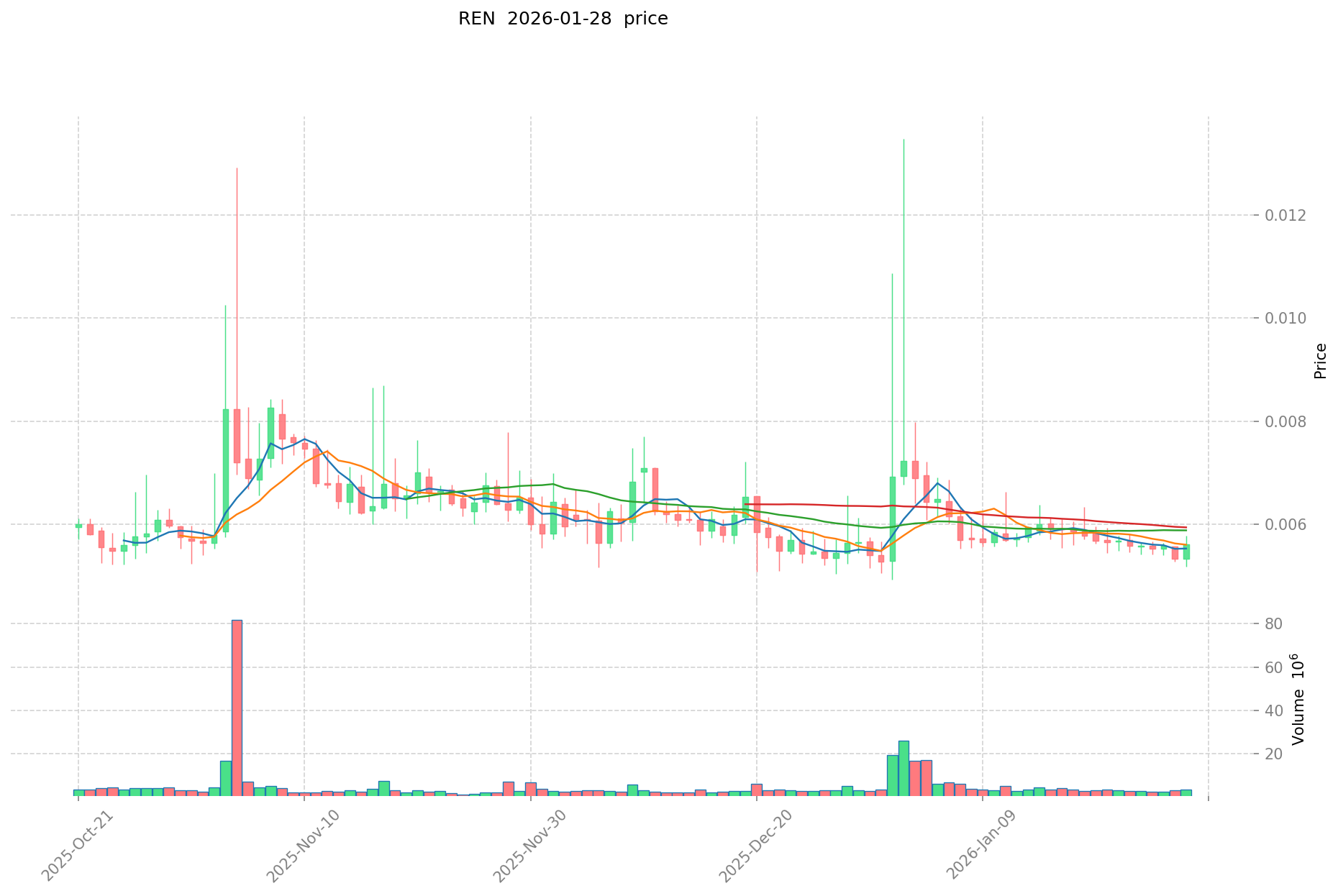
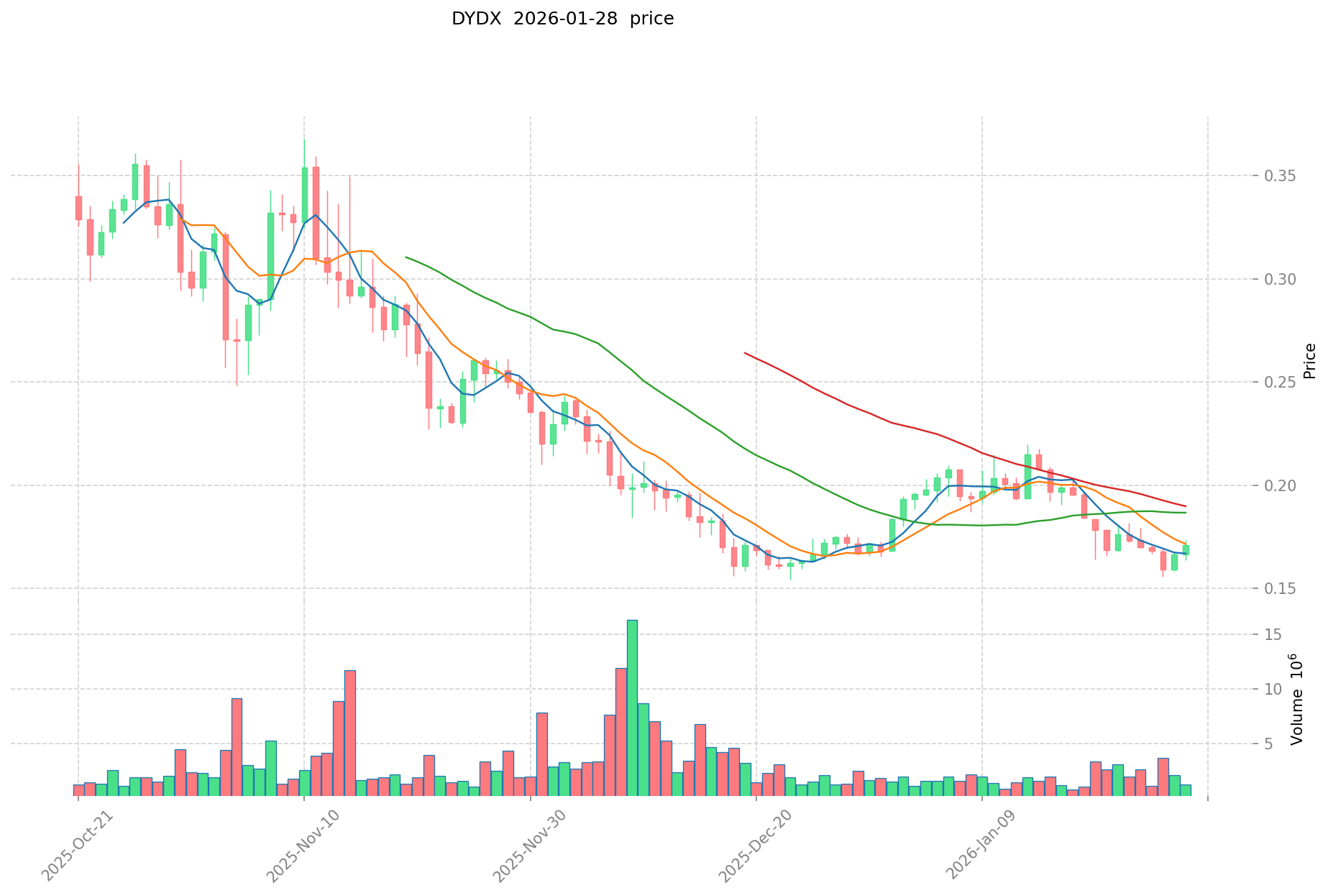
Historical Price Trends of REN (Coin A) and DYDX (Coin B)
- 2021: REN experienced price fluctuations during the bull market cycle, with its price reaching $1.8 in February 2021.
- 2024: DYDX recorded significant price movement, reaching $4.52 in March 2024.
- Comparative Analysis: During the recent market cycle, REN declined from its all-time high of $1.8 to a low of $0.00506349, while DYDX experienced a decrease from its peak of $4.52 to $0.126201.
Current Market Status (2026-01-29)
- REN current price: $0.005322
- DYDX current price: $0.1696
- 24-hour trading volume: REN $16,307.16 vs DYDX $283,950.91
- Market Sentiment Index (Fear & Greed Index): 29 (Fear)
View real-time prices:
II. Core Factors Influencing REN vs DYDX Investment Value
Tokenomics Comparison
- REN: Information regarding REN's supply mechanism is not available in the provided materials.
- DYDX: The token has a total supply of 1 billion tokens, distributed over five years to ecosystem participants including community users, investors, and the dYdX team. After five years, the community can vote on future token distribution decisions.
- 📌 Historical Pattern: Token distribution mechanisms and buyback programs can influence price cycles. DYDX's buyback strategy allocates a portion of protocol revenue to purchase DYDX tokens, which may align interests among developers, investors, and governance participants.
Institutional Adoption and Market Application
- Institutional Holdings: DYDX has received backing from notable institutions including Paradigm and A16Z across four funding rounds.
- Enterprise Adoption: DYDX operates as a decentralized perpetual exchange integrating lending, leveraged trading, and perpetual contracts. The protocol's revenue distribution mechanism links token value with protocol performance, potentially creating alignment between protocol profitability and token holder returns.
- Regulatory Environment: Information regarding specific national policies toward these tokens is not available in the provided materials.
Technology Development and Ecosystem Building
- REN Technology Upgrades: Information is not available in the provided materials.
- DYDX Technology Development: The protocol emphasizes its core product and value proposition, maintaining commitment to its core mission without pursuing incentives on alternative blockchain platforms. The development strategy highlights resilience, team collaboration, and community engagement, with focus on cash flow management.
- Ecosystem Comparison: DYDX operates within the decentralized derivatives trading space. The protocol's focus remains on perpetual contracts and leveraged trading mechanisms. Specific comparisons regarding DeFi, NFT, payment, and smart contract implementations are not available in the provided materials.
Macroeconomic Factors and Market Cycles
- Performance in Inflationary Environments: Information is not available in the provided materials.
- Macroeconomic Monetary Policy: Information regarding the specific impact of interest rates and dollar index movements on these tokens is not available in the provided materials.
- Geopolitical Factors: Information is not available in the provided materials.
III. 2026-2031 Price Forecast: REN vs DYDX
Short-term Forecast (2026)
- REN: Conservative $0.0027-$0.0053 | Optimistic $0.0053-$0.0068
- DYDX: Conservative $0.164-$0.170 | Optimistic $0.170-$0.219
Mid-term Forecast (2028-2029)
- REN may enter a growth phase, with projected prices ranging from $0.0038 to $0.0099 in 2028, potentially reaching $0.0044 to $0.0126 by 2029
- DYDX may enter an expansion phase, with projected prices ranging from $0.180 to $0.292 in 2028, potentially reaching $0.250 to $0.304 by 2029
- Key drivers: institutional capital inflows, ETF developments, ecosystem expansion
Long-term Forecast (2030-2031)
- REN: Baseline scenario $0.0063-$0.0126 | Optimistic scenario $0.0106-$0.0171
- DYDX: Baseline scenario $0.144-$0.370 | Optimistic scenario $0.282-$0.375
View detailed price predictions for REN and DYDX
Disclaimer
REN:
| Year |
Predicted High Price |
Predicted Average Price |
Predicted Low Price |
Price Change |
| 2026 |
0.00675894 |
0.005322 |
0.00271422 |
0 |
| 2027 |
0.0082150392 |
0.00604047 |
0.005436423 |
13 |
| 2028 |
0.009907578894 |
0.0071277546 |
0.003848987484 |
33 |
| 2029 |
0.01260614678556 |
0.008517666747 |
0.00442918670844 |
60 |
| 2030 |
0.012568669051873 |
0.01056190676628 |
0.008872001683675 |
98 |
| 2031 |
0.017116626105433 |
0.011565287909076 |
0.006245255470901 |
117 |
DYDX:
| Year |
Predicted High Price |
Predicted Average Price |
Predicted Low Price |
Price Change |
| 2026 |
0.218655 |
0.1695 |
0.164415 |
0 |
| 2027 |
0.262004625 |
0.1940775 |
0.137795025 |
14 |
| 2028 |
0.29189256 |
0.2280410625 |
0.180152439375 |
34 |
| 2029 |
0.3041611691625 |
0.25996681125 |
0.2495681388 |
53 |
| 2030 |
0.369503827170187 |
0.28206399020625 |
0.143852635005187 |
66 |
| 2031 |
0.374651494991451 |
0.325783908688218 |
0.211759540647342 |
92 |
IV. Investment Strategy Comparison: REN vs DYDX
Long-term vs Short-term Investment Strategies
- REN: May appeal to investors focused on cross-chain asset protocols and dark pool trading mechanisms, with potential interest from those exploring distributed liquidity solutions across blockchain networks.
- DYDX: May suit investors interested in decentralized derivatives trading platforms, particularly those focused on perpetual contracts and leveraged trading mechanisms within Layer 2 infrastructure.
Risk Management and Asset Allocation
- Conservative Investors: REN 30% vs DYDX 70% - allocation may favor DYDX given its institutional backing and established exchange infrastructure
- Aggressive Investors: REN 45% vs DYDX 55% - moderate allocation allowing exposure to both cross-chain protocols and derivatives platforms
- Hedging Tools: stablecoin allocation, options strategies, cross-asset portfolio diversification
V. Potential Risk Comparison
Market Risk
- REN: Price volatility reflected in historical decline from $1.8 to $0.005322, with current 24-hour trading volume of $16,307.16 indicating relatively lower liquidity levels
- DYDX: Price fluctuations demonstrated through movement from $4.52 to $0.1696, with 24-hour trading volume of $283,950.91 suggesting comparatively higher market activity
Technical Risk
- REN: Scalability and network stability considerations apply to cross-chain asset transfer protocols
- DYDX: Platform stability factors relevant to Layer 2 infrastructure and derivatives exchange operations
Regulatory Risk
- Global regulatory frameworks may influence both tokens differently, with decentralized exchange protocols and cross-chain mechanisms potentially facing varying degrees of regulatory scrutiny across jurisdictions
VI. Conclusion: Which Is the Better Buy?
📌 Investment Value Summary:
- REN Characteristics: Cross-chain asset protocol positioning, dark pool trading mechanism, established presence since February 2018
- DYDX Characteristics: Institutional backing from Paradigm and A16Z, decentralized perpetual exchange infrastructure, revenue distribution mechanism linking token value with protocol performance
✅ Investment Considerations:
- Beginner Investors: Consider starting with smaller positions and conducting thorough research into both protocols' mechanisms, given the technical complexity of cross-chain systems and derivatives platforms
- Experienced Investors: May evaluate portfolio allocation based on individual risk tolerance, market cycle positioning, and specific interest in cross-chain protocols versus derivatives infrastructure
- Institutional Investors: Assessment may include institutional adoption patterns, liquidity metrics, and alignment with broader portfolio strategies in decentralized finance
⚠️ Risk Disclosure: Cryptocurrency markets exhibit significant volatility. This content does not constitute investment advice.
VII. FAQ
Q1: What are the main differences between REN and DYDX in terms of their core functionality?
REN operates as a distributed dark pool trading protocol for cross-chain encrypted assets, while DYDX functions as a decentralized perpetual contract exchange on Layer 2 infrastructure. REN focuses on enabling cross-chain asset transfers between BTC/ETH, BTC/ERC20, and ETH/ERC20 pairs through distributed liquidity mechanisms. In contrast, DYDX specializes in derivatives trading, offering perpetual contracts, leveraged trading, and lending services within a single platform, with governance and fee discount utilities built into its token economics.
Q2: Which token has stronger institutional backing and what impact does this have on investment potential?
DYDX demonstrates stronger institutional backing, having secured funding from notable venture capital firms including Paradigm and A16Z across four funding rounds. This institutional support provides DYDX with enhanced credibility, potential strategic partnerships, and access to resources for protocol development. The institutional involvement may contribute to greater market confidence and potentially more stable long-term growth prospects. In contrast, the provided materials do not indicate comparable institutional backing for REN, suggesting a different risk-reward profile for investors considering institutional adoption as a key factor.
Q3: How do the tokenomics of REN and DYDX differ in terms of supply and distribution mechanisms?
DYDX has a clearly defined tokenomics structure with a total supply of 1 billion tokens distributed over five years to community users, investors, and the development team, with community governance determining future distribution after this period. The protocol implements a buyback strategy using a portion of protocol revenue to purchase DYDX tokens, creating potential alignment between protocol performance and token value. For REN, the provided materials do not contain specific information regarding supply mechanisms, maximum supply, or distribution schedules, making direct tokenomics comparison challenging for investors seeking detailed supply-side analysis.
Q4: What are the projected price ranges for REN and DYDX through 2031?
Based on forecasting models, REN shows projected price ranges from $0.0027-$0.0068 in 2026, potentially reaching $0.0063-$0.0171 by 2031 under various scenarios. DYDX exhibits higher absolute price projections, with estimates ranging from $0.164-$0.219 in 2026, potentially expanding to $0.144-$0.375 by 2031. These forecasts suggest REN may experience growth of approximately 117% by 2031, while DYDX could see growth of around 92% over the same period. However, these projections carry inherent uncertainty and should not be interpreted as guaranteed outcomes, as cryptocurrency markets are subject to numerous unpredictable factors.
Q5: What are the primary risk factors investors should consider when choosing between REN and DYDX?
Both tokens present distinct risk profiles requiring careful evaluation. REN's primary risks include its significantly lower trading volume ($16,307.16 over 24 hours), which indicates limited liquidity and potential for higher price volatility during transactions. The token has also experienced substantial price decline from its all-time high of $1.8 to current levels around $0.005322. DYDX faces risks related to Layer 2 infrastructure stability, derivatives market competition, and platform operational challenges, though its higher trading volume ($283,950.91) suggests relatively better liquidity. Both tokens operate in evolving regulatory environments where decentralized exchange protocols and cross-chain mechanisms may face varying degrees of scrutiny across different jurisdictions.
Q6: How should different investor types approach allocation between REN and DYDX?
Conservative investors might consider a portfolio allocation favoring DYDX (70%) over REN (30%), given DYDX's institutional backing, higher liquidity, and established exchange infrastructure. This approach reflects lower risk tolerance and preference for more established protocols. Aggressive investors may opt for a more balanced allocation of REN (45%) versus DYDX (55%), allowing exposure to both cross-chain protocol opportunities and derivatives platform growth potential. Beginner investors should start with smaller positions in either token and conduct thorough research into the technical mechanisms, as both protocols involve complex functionality requiring understanding of cross-chain systems or derivatives trading. All allocations should incorporate appropriate risk management tools including stablecoin reserves and portfolio diversification.
Q7: What technological developments differentiate REN and DYDX in terms of ecosystem growth potential?
DYDX emphasizes its core product focus on decentralized perpetual contracts and leveraged trading mechanisms, maintaining commitment to its primary mission without pursuing incentives on alternative blockchain platforms. The protocol's development strategy highlights resilience, team collaboration, community engagement, and cash flow management, suggesting a disciplined approach to sustainable growth. For REN, the provided materials do not contain specific information regarding recent technology upgrades, scalability improvements, or ecosystem expansion initiatives, making it difficult to assess its technological trajectory relative to DYDX. Investors evaluating ecosystem growth potential may find more documented evidence of strategic direction and development priorities within DYDX's publicly available information.
Q8: How do current market conditions and sentiment indicators affect the investment case for REN versus DYDX?
As of January 29, 2026, the market sentiment index stands at 29, indicating a "Fear" environment that typically presents both risks and opportunities for cryptocurrency investments. In such conditions, REN's current price of $0.005322 represents a substantial decline from historical highs, potentially offering higher risk-reward ratios for investors willing to accept elevated volatility and lower liquidity. DYDX's current price of $0.1696, while also below historical peaks, benefits from comparatively higher trading volume and institutional backing that may provide some stability during fearful market conditions. Both tokens have experienced significant drawdowns, but their recovery potential depends on broader market cycle progression, institutional capital flows, and protocol-specific developments that may unfold differently for cross-chain versus derivatives-focused platforms.
* The information is not intended to be and does not constitute financial advice or any other recommendation of any sort offered or endorsed by Gate.