This comprehensive analysis compares RIF and SAND, two distinct blockchain gaming tokens representing different market segments in the metaverse era. RIF operates as a blockchain infrastructure framework launched in 2018, while SAND functions as a virtual gaming world token since 2020, with current prices at $0.0355 and $0.1471 respectively. The article examines historical price trends, tokenomics, institutional adoption, technical ecosystems, and macroeconomic factors affecting both tokens. Price projections through 2031 show RIF potentially reaching $0.0686 and SAND up to $0.4282, with SAND demonstrating superior trading volume and market liquidity. Investment recommendations differentiate between novice investors favoring SAND and experienced investors diversifying across both assets. The analysis addresses critical risk factors including market volatility, liquidity constraints, technical development uncertainties, and evolving regulatory landscapes affecting cryptocurrency adoption across the gaming and
Introduction: Investment Comparison Between RIF and SAND
In the cryptocurrency market, the comparison between RIF vs SAND has consistently been a topic investors cannot overlook. Both exhibit notable differences in market cap ranking, application scenarios, and price performance, representing distinct positioning within the crypto asset landscape.
RIF (RIF): Since its launch in 2018, it has gained market recognition through its positioning as an integrated blockchain infrastructure framework, designed to provide utility services compatible with the RIF operating system architecture.
SAND (SAND): Since its introduction in 2020, it has been positioned as a virtual gaming world token, becoming one of the widely recognized cryptocurrencies in the metaverse and gaming sectors with substantial trading volume.
This article will comprehensively analyze the investment value comparison of RIF vs SAND, focusing on historical price trends, supply mechanisms, adoption patterns, technical ecosystems, and future outlook, attempting to address the question investors care about most:
"Which is the better buy right now?"
I. Historical Price Comparison and Current Market Status
Historical Price Trends of RIF (Coin A) and SAND (Coin B)
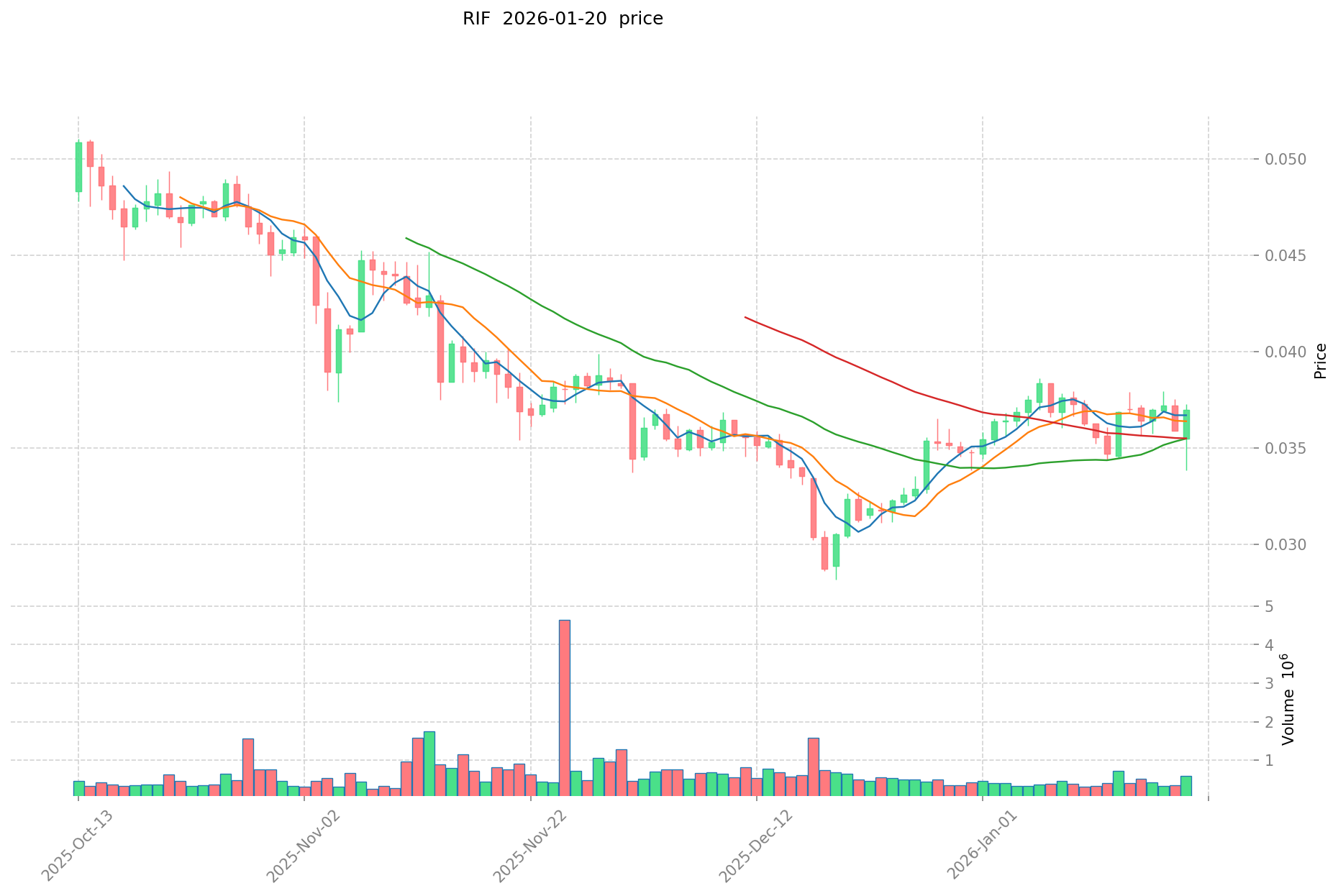
- April 2021: RIF reached a notable price level of $0.455938, marking a significant point in its trading history.
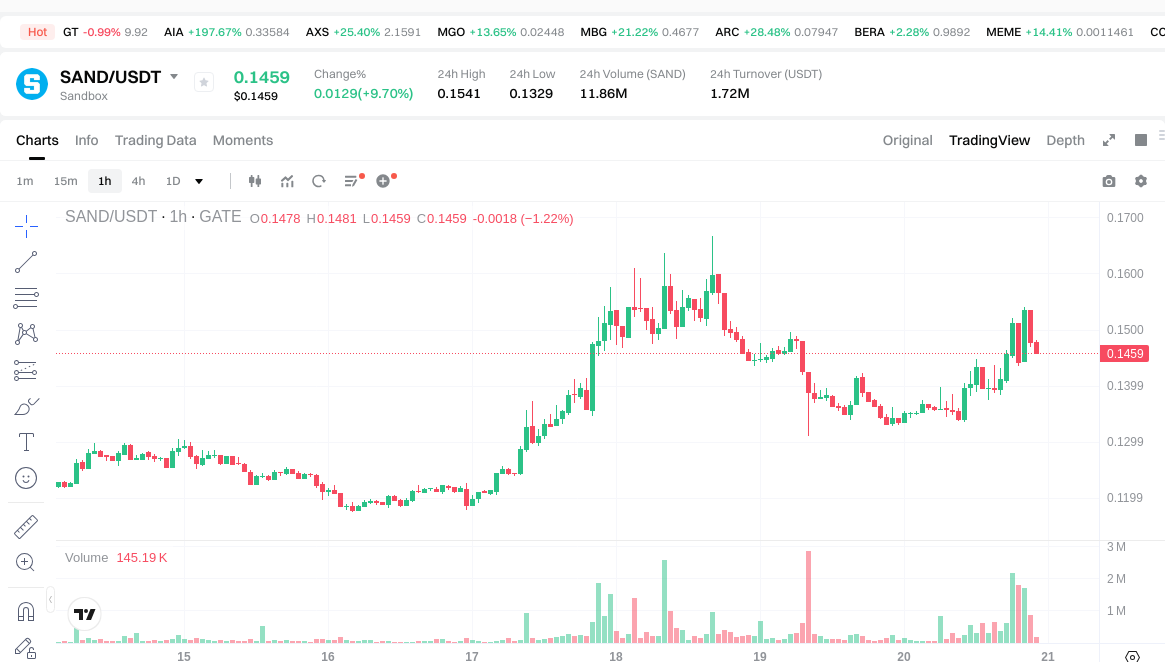
- November 2021: SAND experienced substantial price movement, reaching $8.4 during a period of heightened market activity.
- Comparative Analysis: During the market cycle from 2021 to present, RIF declined from $0.455938 to its current level of $0.0355, while SAND decreased from $8.4 to $0.1471.
Current Market Status (2026-01-20)
- RIF Current Price: $0.0355
- SAND Current Price: $0.1471
- 24-Hour Trading Volume: RIF $16,760.51 vs SAND $1,708,353.46
- Market Sentiment Index (Fear & Greed Index): 32 (Fear)
View real-time prices:
II. Core Factors Affecting RIF vs SAND Investment Value
Supply Mechanism Comparison (Tokenomics)
Due to insufficient reference materials, detailed supply mechanism information for RIF and SAND cannot be provided at this time.
Institutional Adoption and Market Application
Institutional Holdings
Based on available information, institutional preference trends between RIF and SAND cannot be determined with certainty.
Enterprise Adoption
Specific enterprise adoption cases for RIF and SAND in cross-border payments, settlement, or investment portfolios are not documented in the provided materials.
National Policies
Regulatory attitudes toward RIF and SAND vary across jurisdictions, though specific policy frameworks are not detailed in the reference materials.
Technology Development and Ecosystem Building
Technology Upgrades
Detailed technical upgrade roadmaps and their potential impacts for both RIF and SAND are not available in the provided materials.
Ecosystem Comparison
Comprehensive data regarding DeFi integration, NFT implementation, payment solutions, and smart contract deployment for RIF and SAND ecosystems cannot be established from current reference materials.
Macroeconomic Environment and Market Cycles
Historical performance data comparing RIF and SAND's anti-inflation characteristics is not available in the provided materials.
Macroeconomic Monetary Policy
The specific correlation between interest rates, US Dollar Index movements, and the performance of RIF versus SAND requires additional data for accurate analysis.
Geopolitical Factors
While geopolitical factors may influence cross-border transaction demand and international market dynamics, specific impacts on RIF and SAND cannot be determined from the available reference materials.
III. 2026-2031 Price Prediction: RIF vs SAND
Short-term Prediction (2026)
- RIF: Conservative $0.0235 - $0.0356 | Optimistic $0.0356 - $0.0374
- SAND: Conservative $0.0938 - $0.1466 | Optimistic $0.1466 - $0.1510
Mid-term Prediction (2028-2029)
- RIF may enter a gradual growth phase, with estimated price ranging from $0.0361 to $0.0686
- SAND may enter an expansion phase, with estimated price ranging from $0.1232 to $0.3158
- Key drivers: institutional capital inflows, ETF developments, ecosystem expansion
Long-term Prediction (2030-2031)
- RIF: Baseline scenario $0.0345 - $0.0618 | Optimistic scenario $0.0618 - $0.0686
- SAND: Baseline scenario $0.1733 - $0.3149 | Optimistic scenario $0.3149 - $0.4282
View detailed price predictions for RIF and SAND
Disclaimer
RIF:
| Year |
Predicted High Price |
Predicted Average Price |
Predicted Low Price |
Price Change |
| 2026 |
0.0373695 |
0.03559 |
0.0234894 |
0 |
| 2027 |
0.047423675 |
0.03647975 |
0.0222526475 |
2 |
| 2028 |
0.050761572125 |
0.0419517125 |
0.03607847275 |
18 |
| 2029 |
0.0686078306225 |
0.0463566423125 |
0.036621747426875 |
30 |
| 2030 |
0.066104571937625 |
0.0574822364675 |
0.0344893418805 |
61 |
| 2031 |
0.068590678664844 |
0.061793404202562 |
0.046962987193947 |
74 |
SAND:
| Year |
Predicted High Price |
Predicted Average Price |
Predicted Low Price |
Price Change |
| 2026 |
0.150998 |
0.1466 |
0.093824 |
0 |
| 2027 |
0.2083186 |
0.148799 |
0.08779141 |
0 |
| 2028 |
0.248196732 |
0.1785588 |
0.123205572 |
21 |
| 2029 |
0.31579909368 |
0.213377766 |
0.1173577713 |
44 |
| 2030 |
0.3651320331792 |
0.26458842984 |
0.1746283636944 |
79 |
| 2031 |
0.428209914853056 |
0.3148602315096 |
0.17317312733028 |
113 |
IV. Investment Strategy Comparison: RIF vs SAND
Long-term vs Short-term Investment Strategies
- RIF: May appeal to investors focused on blockchain infrastructure development and utility-driven ecosystems, particularly those seeking exposure to foundational technology layers with longer development horizons.
- SAND: May suit investors interested in metaverse and gaming sector growth, targeting opportunities in virtual world economies and digital entertainment adoption trends.
Risk Management and Asset Allocation
- Conservative Investors: RIF 30% vs SAND 70% - Allocating greater weight to SAND given its established market presence and trading liquidity.
- Aggressive Investors: RIF 45% vs SAND 55% - Balanced exposure reflecting different sector positioning and growth trajectories.
- Hedging Tools: Stablecoin allocation for portfolio stability, options strategies for downside protection, cross-asset diversification across different blockchain sectors.
V. Potential Risk Comparison
Market Risk
- RIF: Trading volume of $16,760.51 indicates limited liquidity conditions, which may result in elevated price volatility and execution challenges during market stress periods.
- SAND: While demonstrating higher trading volume at $1,708,353.46, exposure to metaverse sector sentiment fluctuations and gaming adoption cycles presents sector-specific volatility considerations.
Technical Risk
- RIF: Infrastructure development dependencies and ecosystem expansion timelines present execution uncertainties.
- SAND: Platform scalability requirements, user experience optimization, and virtual world technical architecture evolution represent ongoing technical considerations.
Regulatory Risk
- Global regulatory frameworks continue evolving for both infrastructure tokens and gaming-focused digital assets, with differing policy approaches across jurisdictions potentially affecting adoption patterns, exchange listings, and institutional participation for both RIF and SAND.
VI. Conclusion: Which Is the Better Buy?
📌 Investment Value Summary:
- RIF Advantages: Positioned in blockchain infrastructure sector with potential utility applications, currently trading at lower absolute price levels relative to historical ranges.
- SAND Advantages: Established presence in metaverse and gaming sectors with substantially higher trading volume, broader market recognition, and demonstrated liquidity characteristics.
✅ Investment Recommendations:
- Novice Investors: Consider SAND for its higher liquidity and established market infrastructure, allowing easier entry and exit positions. Start with smaller position sizes and dollar-cost averaging approach.
- Experienced Investors: Evaluate portfolio diversification benefits of holding both assets, with allocation weights adjusted according to individual risk tolerance, sector preferences, and market cycle positioning.
- Institutional Investors: Conduct comprehensive due diligence on custody solutions, counterparty risks, and regulatory compliance frameworks for both assets, with consideration for liquidity requirements and portfolio rebalancing mechanisms.
⚠️ Risk Warning: Cryptocurrency markets exhibit substantial volatility. This content does not constitute investment advice. Investors should conduct independent research and consult qualified financial advisors before making investment decisions.
VII. FAQ
Q1: What are the main differences between RIF and SAND in terms of their market positioning?
RIF is positioned as a blockchain infrastructure framework designed to provide utility services compatible with the RIF operating system architecture, while SAND is a virtual gaming world token focused on the metaverse and gaming sectors. RIF targets foundational technology layers with longer development horizons, whereas SAND appeals to investors interested in virtual world economies and digital entertainment adoption. The most significant difference lies in their trading volumes: SAND demonstrates substantially higher liquidity at $1,708,353.46 compared to RIF's $16,760.51, indicating broader market recognition and easier entry/exit opportunities.
Q2: Which asset showed better resilience during the 2021-2026 market cycle?
In relative terms, RIF showed slightly better price retention, declining approximately 92% from its April 2021 peak of $0.455938 to the current $0.0355, while SAND experienced a larger decline of approximately 98% from its November 2021 peak of $8.4 to the current $0.1471. However, SAND maintained significantly higher trading volume throughout this period, suggesting sustained market interest despite the price decline. Both assets experienced substantial corrections during this cycle, reflecting broader cryptocurrency market trends and sector-specific challenges.
Q3: What are the projected growth rates for RIF vs SAND through 2031?
According to the prediction models, RIF is projected to achieve approximately 74% growth from current levels by 2031, with prices ranging from $0.046962987 to $0.068590678. SAND demonstrates more aggressive growth projections at approximately 113% by 2031, with estimated prices between $0.17317312 and $0.428209914. The mid-term outlook (2028-2029) shows RIF potentially ranging from $0.0361 to $0.0686, while SAND may expand from $0.1232 to $0.3158, driven by institutional capital inflows, ETF developments, and ecosystem expansion.
Q4: What are the primary risk factors investors should consider when choosing between RIF and SAND?
RIF faces liquidity risk due to its low trading volume of $16,760.51, which may result in elevated price volatility and execution challenges during market stress. Infrastructure development dependencies and ecosystem expansion timelines present additional execution uncertainties. SAND, while demonstrating higher liquidity, faces exposure to metaverse sector sentiment fluctuations and gaming adoption cycles. Both assets are subject to evolving global regulatory frameworks, with differing policy approaches across jurisdictions potentially affecting adoption patterns, exchange listings, and institutional participation.
Q5: Which asset is more suitable for different investor profiles?
For novice investors, SAND is recommended due to its higher liquidity, established market infrastructure, and easier entry/exit capabilities. Beginning with smaller position sizes and dollar-cost averaging approach is advisable. Experienced investors may benefit from portfolio diversification by holding both assets, with allocation weights adjusted according to risk tolerance and sector preferences—suggested conservative allocation is RIF 30% vs SAND 70%, while aggressive allocation could be RIF 45% vs SAND 55%. Institutional investors should conduct comprehensive due diligence on custody solutions, counterparty risks, and regulatory compliance frameworks for both assets.
Q6: How do the current market conditions affect investment decisions for RIF vs SAND?
The current market sentiment index stands at 32 (Fear), indicating heightened caution among investors. This environment typically favors assets with higher liquidity and established market presence, which benefits SAND over RIF. However, fear-driven markets can also present accumulation opportunities for longer-term investors willing to withstand volatility. Both assets are trading significantly below their historical peaks, with RIF at approximately 8% of its 2021 high and SAND at roughly 2% of its peak, suggesting potential upside if market conditions improve, though past performance does not guarantee future results.
Q7: What role should portfolio allocation play when investing in both RIF and SAND?
Portfolio allocation should reflect individual risk tolerance, investment horizon, and sector exposure preferences. Conservative investors should consider a 30% RIF / 70% SAND allocation, emphasizing SAND's established market presence and liquidity advantages. Aggressive investors might adopt a 45% RIF / 55% SAND split for balanced exposure to both infrastructure and metaverse sectors. Regardless of allocation strategy, implementing hedging tools such as stablecoin reserves for portfolio stability, options strategies for downside protection, and cross-asset diversification across different blockchain sectors can help manage overall portfolio risk in volatile market conditions.
Q8: What are the key catalysts that could drive future price appreciation for RIF vs SAND?
For RIF, potential catalysts include successful infrastructure development milestones, ecosystem expansion through developer adoption, strategic partnerships with blockchain platforms, and utility integration across the RIF operating system architecture. For SAND, key drivers include metaverse adoption acceleration, major brand partnerships in virtual worlds, gaming platform user growth, NFT integration developments, and institutional investment in digital entertainment sectors. Both assets could benefit from broader market catalysts such as regulatory clarity, institutional ETF approvals, macroeconomic stability returning to risk assets, and mainstream adoption of blockchain technology across various industries.
* The information is not intended to be and does not constitute financial advice or any other recommendation of any sort offered or endorsed by Gate.