This comprehensive analysis compares RLS and XTZ, two distinct blockchain platforms serving different market segments. RLS, launched in 2025, positions itself as a compliant bridge between traditional finance and DeFi with institutional-grade infrastructure, currently trading at $0.007787 on Gate. XTZ, operational since 2017, offers formal verification capabilities and on-chain governance mechanisms, currently at $0.5842. The article examines historical price trends, institutional adoption, technology ecosystems, and risk profiles to guide investment decisions across conservative to aggressive strategies. Through 2031, predictions suggest RLS may reach $0.0072-$0.0159 while XTZ ranges $0.30-$1.59, reflecting different risk-return profiles suited to various investor profiles and portfolio allocation strategies.
Introduction: Investment Comparison Between RLS and XTZ
In the cryptocurrency market, the comparison between RLS vs XTZ has consistently been a topic investors cannot overlook. The two differ significantly in market capitalization ranking, application scenarios, and price performance, representing distinct positioning within the crypto asset landscape.
Rayls (RLS): Launched in 2025, it has gained market recognition by positioning itself as a compliant bridge connecting Traditional Finance and DeFi, offering institution-grade liquidity and privacy-preserving infrastructure.
Tezos (XTZ): Since its launch in 2017, it has been recognized as a self-evolving blockchain platform, known for formal verification capabilities and on-chain governance mechanisms, ranking among cryptocurrencies with substantial global trading volume.
This article will comprehensively analyze the investment value comparison between RLS vs XTZ around historical price trends, supply mechanisms, institutional adoption, technical ecosystems, and future projections, attempting to answer the question investors care about most:
"Which is the better buy right now?"
I. Historical Price Comparison and Current Market Status
Historical Price Trends of RLS (Coin A) and XTZ (Coin B)
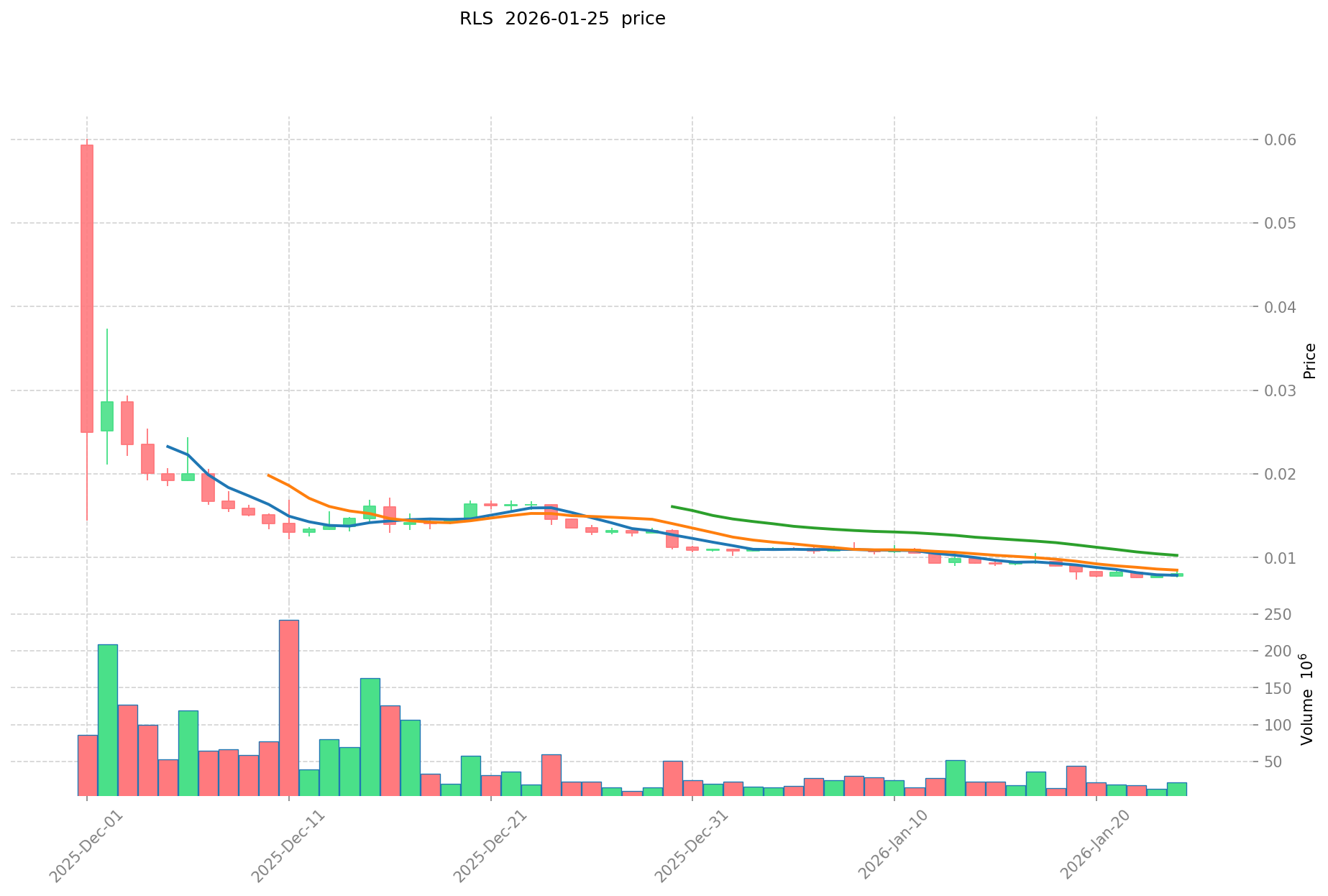
- 2025: RLS experienced a period of volatility following its launch, with the price reaching a peak of $0.0601 in December 2025.
- 2018-2021: XTZ saw significant price movements during this period, hitting an all-time low of $0.350476 in December 2018, then climbing to an all-time high of $9.12 in October 2021.
- 2026: RLS recorded its lowest price of $0.007353 in January 2026, reflecting a substantial decline from its previous peak.
- Comparative Analysis: During recent market cycles, RLS moved from its high of $0.0601 to a low of $0.007353, representing a considerable correction. In contrast, XTZ has demonstrated longer-term price stability following its 2021 peak, though it has experienced a decline of approximately 48.98% over the past year.
Current Market Status (2026-01-25)
- RLS Current Price: $0.007787
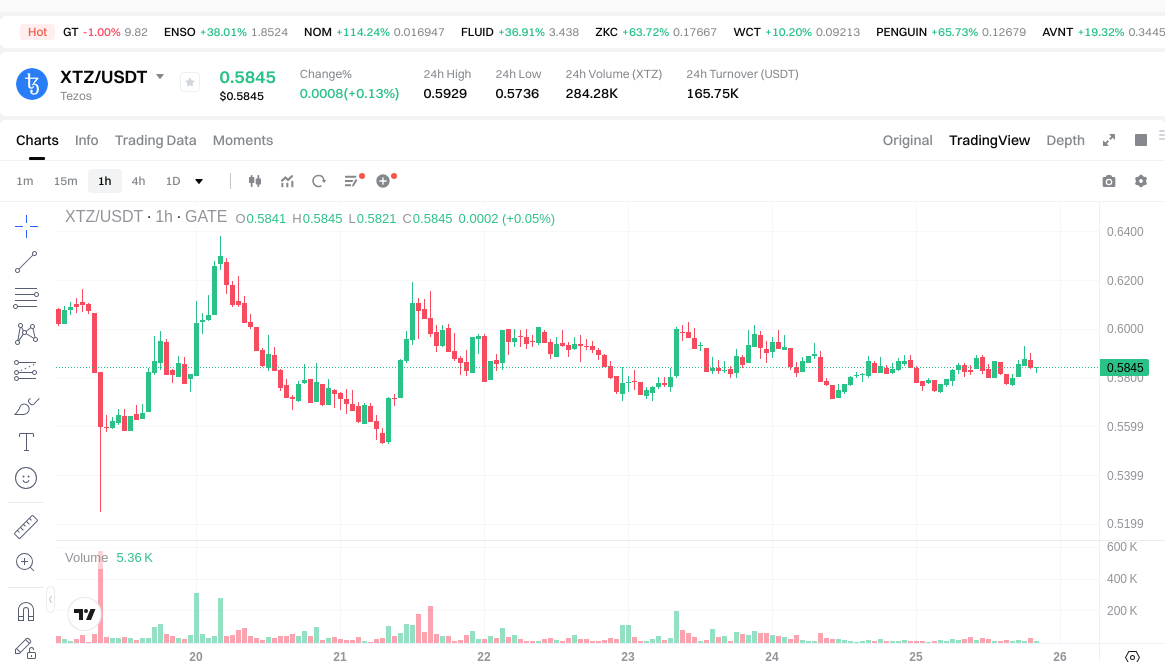
- XTZ Current Price: $0.5842
- 24-Hour Trading Volume: RLS recorded $159,833.67 compared to XTZ's $163,446.78
- Market Sentiment Index (Fear & Greed Index): 25 (Extreme Fear)
Click to view real-time prices:
II. Core Factors Affecting RLS vs XTZ Investment Value
Supply Mechanism Comparison (Tokenomics)
Due to insufficient reference materials regarding the supply mechanisms of RLS and XTZ, this section cannot provide detailed comparative analysis at this time.
Institutional Adoption and Market Applications
Without available data on institutional holdings, enterprise adoption cases, or regulatory attitudes across different jurisdictions for RLS and XTZ, a comprehensive comparison of their market applications cannot be presented in this analysis.
Technology Development and Ecosystem Building
The reference materials do not contain sufficient information regarding technical upgrades, development roadmaps, or ecosystem deployment (including DeFi, NFT, payment solutions, and smart contract implementations) for either RLS or XTZ to support a meaningful comparison.
Macroeconomic Environment and Market Cycles
Given the absence of historical performance data under various macroeconomic conditions, including inflationary environments, monetary policy shifts, interest rate fluctuations, US dollar index movements, and geopolitical factors, this section cannot provide evidence-based insights into how RLS and XTZ respond to different market cycles.
III. 2026-2031 Price Prediction: RLS vs XTZ
Short-term Forecast (2026)
- RLS: Conservative $0.0072-$0.0078 | Optimistic $0.0078-$0.0088
- XTZ: Conservative $0.30-$0.58 | Optimistic $0.58-$0.75
Mid-term Forecast (2028-2029)
- RLS may enter a consolidation phase, with estimated prices ranging from $0.0075 to $0.0147
- XTZ may enter a growth phase, with estimated prices ranging from $0.37 to $1.11
- Key drivers: institutional capital inflows, ETF developments, ecosystem expansion
Long-term Forecast (2030-2031)
- RLS: Baseline scenario $0.0087-$0.0130 | Optimistic scenario $0.0121-$0.0159
- XTZ: Baseline scenario $0.61-$0.97 | Optimistic scenario $0.97-$1.59
View detailed price predictions for RLS and XTZ
Disclaimer
RLS:
| Year |
Predicted High Price |
Predicted Average Price |
Predicted Low Price |
Price Change |
| 2026 |
0.0088253 |
0.00781 |
0.0071852 |
0 |
| 2027 |
0.0102307095 |
0.00831765 |
0.005489649 |
6 |
| 2028 |
0.01335481884 |
0.00927417975 |
0.008346761775 |
19 |
| 2029 |
0.0147088490835 |
0.011314499295 |
0.0074675695347 |
45 |
| 2030 |
0.014703191833852 |
0.01301167418925 |
0.008717821706797 |
67 |
| 2031 |
0.015936047963283 |
0.013857433011551 |
0.012055966720049 |
77 |
XTZ:
| Year |
Predicted High Price |
Predicted Average Price |
Predicted Low Price |
Price Change |
| 2026 |
0.754005 |
0.5845 |
0.30394 |
0 |
| 2027 |
0.76294785 |
0.6692525 |
0.595634725 |
14 |
| 2028 |
0.93809122925 |
0.716100175 |
0.36521108925 |
22 |
| 2029 |
1.1083082408475 |
0.827095702125 |
0.57069603446625 |
41 |
| 2030 |
1.27736660236185 |
0.96770197148625 |
0.609652242036337 |
65 |
| 2031 |
1.593998687432151 |
1.12253428692405 |
0.572492486331265 |
92 |
IV. Investment Strategy Comparison: RLS vs XTZ
Long-term vs Short-term Investment Strategies
- RLS: May be suitable for investors seeking exposure to emerging DeFi infrastructure projects with higher risk tolerance, particularly those interested in the convergence of traditional finance and decentralized systems
- XTZ: May appeal to investors looking for established blockchain platforms with proven governance mechanisms and longer operational history
Risk Management and Asset Allocation
- Conservative Investors: RLS: 10-15% vs XTZ: 20-30%
- Aggressive Investors: RLS: 25-35% vs XTZ: 30-40%
- Hedging Tools: Stablecoin allocation, options strategies, cross-currency portfolio diversification
V. Potential Risk Comparison
Market Risk
- RLS: As a project launched in 2025, RLS has demonstrated considerable price volatility, with the token experiencing a significant correction from its December 2025 peak of $0.0601 to a low of $0.007353 in January 2026. The relatively low 24-hour trading volume of $159,833.67 may indicate limited liquidity
- XTZ: Despite being established since 2017, XTZ has experienced a decline of approximately 48.98% over the past year, with current trading at $0.5842. The current market sentiment index of 25 (Extreme Fear) suggests broader market uncertainty affecting established cryptocurrencies
Technical Risk
- RLS: Limited operational history since 2025 may present uncertainties regarding network scalability and long-term stability
- XTZ: Network performance considerations and potential security vulnerabilities inherent in any blockchain platform
Regulatory Risk
- Global regulatory developments may impact both assets differently, with newer projects potentially facing increased scrutiny regarding compliance frameworks, while established platforms may benefit from regulatory clarity in certain jurisdictions
VI. Conclusion: Which Is the Better Buy?
📌 Investment Value Summary:
- RLS Characteristics: Represents exposure to emerging DeFi infrastructure with institutional-grade positioning, though accompanied by higher volatility and limited price history. Price predictions suggest potential ranges from $0.0072-$0.0159 through 2031
- XTZ Characteristics: Offers exposure to an established self-evolving blockchain platform with formal verification capabilities and on-chain governance, supported by longer operational track record. Price predictions indicate potential ranges from $0.30-$1.59 through 2031
✅ Investment Considerations:
- Novice Investors: May consider focusing on established assets with longer track records and higher liquidity, implementing dollar-cost averaging strategies, and limiting exposure to any single asset to 5-10% of portfolio
- Experienced Investors: Could evaluate portfolio diversification across both emerging and established projects, with position sizing based on individual risk tolerance and investment objectives
- Institutional Investors: May assess both assets within the context of broader digital asset allocation strategies, considering factors such as liquidity requirements, regulatory compliance, and correlation with traditional portfolio holdings
⚠️ Risk Disclosure: Cryptocurrency markets exhibit substantial volatility. This content does not constitute investment advice, and all investment decisions should be made based on individual circumstances and thorough due diligence.
VII. FAQ
Q1: What are the key differences between RLS and XTZ in terms of market maturity?
RLS is a newly launched project from 2025 focusing on bridging traditional finance and DeFi, while XTZ is an established blockchain platform operational since 2017. XTZ has a longer operational history with proven on-chain governance mechanisms and formal verification capabilities, whereas RLS represents an emerging infrastructure project with limited price history. XTZ currently trades at $0.5842 with established market presence, while RLS trades at $0.007787, reflecting its early-stage positioning in the cryptocurrency landscape.
Q2: How do the price volatility patterns differ between RLS and XTZ?
RLS demonstrates significantly higher short-term volatility, experiencing a dramatic correction from $0.0601 in December 2025 to $0.007353 in January 2026. In contrast, XTZ exhibits more moderate price movements despite experiencing a 48.98% decline over the past year. The 24-hour trading volumes are comparable ($159,833.67 for RLS vs $163,446.78 for XTZ), but RLS's shorter operational timeframe makes its volatility pattern less predictable compared to XTZ's established multi-year trading history.
Q3: Which cryptocurrency offers better long-term growth potential through 2031?
Based on price predictions, XTZ shows higher absolute price appreciation potential, with forecasts ranging from $0.30-$1.59 by 2031, representing a potential 92% increase. RLS predictions range from $0.0072-$0.0159 through 2031, indicating a 77% potential increase. However, percentage-based returns should be evaluated alongside risk factors, market maturity, and individual investment objectives. XTZ's established ecosystem may offer more predictable growth trajectories, while RLS represents higher-risk, potentially higher-reward exposure to emerging DeFi infrastructure.
Q4: What should conservative investors consider when choosing between RLS and XTZ?
Conservative investors should prioritize established track records and higher liquidity profiles. The recommended allocation suggests 20-30% portfolio weight for XTZ compared to 10-15% for RLS in conservative strategies. XTZ's longer operational history since 2017, formal verification capabilities, and proven governance mechanisms align better with risk-averse investment approaches. Conservative investors should implement dollar-cost averaging strategies, limit single-asset exposure to 5-10% of total portfolio, and consider XTZ's relative stability advantages over RLS's higher volatility profile.
Q5: How does the current market sentiment affect investment decisions for RLS vs XTZ?
The current Fear & Greed Index reading of 25 (Extreme Fear) indicates broader cryptocurrency market uncertainty affecting both assets. This environment may present accumulation opportunities for investors with sufficient risk tolerance and long-term perspectives. However, extreme fear conditions typically suggest continued volatility potential. For RLS, this environment compounds the inherent risks of a newly launched project, while XTZ may benefit from its established market position during recovery phases. Investors should evaluate whether current market conditions align with their risk tolerance and investment timeline.
Q6: What are the primary risk factors differentiating RLS from XTZ investments?
RLS carries higher risks associated with limited operational history, lower liquidity demonstrated by recent price movements, and uncertainties regarding long-term network scalability. XTZ faces risks related to network performance considerations and competitive pressures from newer blockchain platforms. Both assets are subject to regulatory uncertainties, though RLS may face increased scrutiny as an emerging project connecting traditional finance and DeFi. Market risk manifests differently: RLS through extreme short-term volatility, XTZ through established but declining price trends reflecting broader market conditions.
Q7: Which investment strategy is more suitable for experienced cryptocurrency investors comparing RLS and XTZ?
Experienced investors might consider portfolio diversification strategies incorporating both assets based on distinct risk-return profiles. Aggressive allocation strategies suggest 25-35% for RLS and 30-40% for XTZ within cryptocurrency portfolio segments. This approach captures exposure to both emerging DeFi infrastructure (RLS) and established blockchain platforms (XTZ). Experienced investors should implement sophisticated risk management including stablecoin allocations, options strategies, and cross-currency diversification. Position sizing should reflect individual assessments of each project's technological development, ecosystem growth potential, and correlation with broader portfolio holdings.
Q8: How should institutional investors approach the RLS vs XTZ investment decision?
Institutional investors should evaluate both assets within comprehensive digital asset allocation frameworks considering liquidity requirements, regulatory compliance obligations, and correlation with traditional portfolio holdings. XTZ may better satisfy institutional criteria for established operational history, governance transparency, and higher liquidity profiles. RLS represents exposure to emerging institutional-grade DeFi infrastructure but requires thorough due diligence regarding compliance frameworks and long-term viability. Institutional strategies should incorporate rigorous risk assessment protocols, allocation limits based on asset maturity profiles, and ongoing monitoring of regulatory developments affecting both established platforms and emerging DeFi projects.
* The information is not intended to be and does not constitute financial advice or any other recommendation of any sort offered or endorsed by Gate.