This comprehensive investment analysis compares RON and ADA tokens, two fundamentally different blockchain assets targeting distinct markets in 2024-2026. RON, Ronin Network's gaming-focused sidechain launched in 2022, specializes in play-to-earn infrastructure and NFT gaming with current price of $0.1547 and lower trading volume. ADA, Cardano's research-driven platform since 2017, offers broader financial applications with current price of $0.3962 and substantially higher liquidity at Gate. The article evaluates historical price trends, tokenomics differences, institutional adoption, technical ecosystems, and macroeconomic factors influencing both assets. Price forecasts through 2031 suggest ADA may offer stronger growth potential, though RON provides concentrated gaming sector exposure. Investment recommendations stratify by investor type, from conservative ADA-focused allocations to aggressive balanced portfolios, addressing risk management, regulatory considerations, and staking opportunities for differen
Introduction: RON vs ADA Investment Comparison
In the cryptocurrency market, the comparison between RON and ADA remains a topic that investors cannot bypass. The two differ significantly in market cap ranking, application scenarios, and price performance, representing different positioning within the crypto asset space.
RON (Ronin Network): Launched in January 2022, this Ethereum sidechain has gained market recognition through its positioning as a dedicated gaming infrastructure, specifically developed by Sky Mavis for Axie Infinity. By migrating primary operations from Ethereum to an application-specific chain, it has reduced user costs by orders of magnitude while improving response speeds.
ADA (Cardano): Since its launch in October 2017, Cardano has been recognized as a layered blockchain platform designed to run financial applications used daily by individuals, organizations, and governments worldwide. Its layered architecture provides system flexibility for easier maintenance and allows upgrades through soft forks.
This article will comprehensively analyze the investment value comparison between RON and ADA through historical price trends, supply mechanisms, institutional adoption, technical ecosystems, and future predictions, attempting to answer the question investors care about most:
"Which is the better buy right now?"
I. Historical Price Comparison and Current Market Status
RON (Coin A) and ADA (Coin B) Historical Price Trends
- 2024: RON experienced notable price movements, reaching a peak of $4.45 in March 2024, reflecting heightened market interest in gaming-focused blockchain solutions.
- 2021: ADA saw substantial growth during the broader cryptocurrency market expansion, achieving an all-time high of $3.09 in September 2021, driven by major network upgrades and increased adoption.
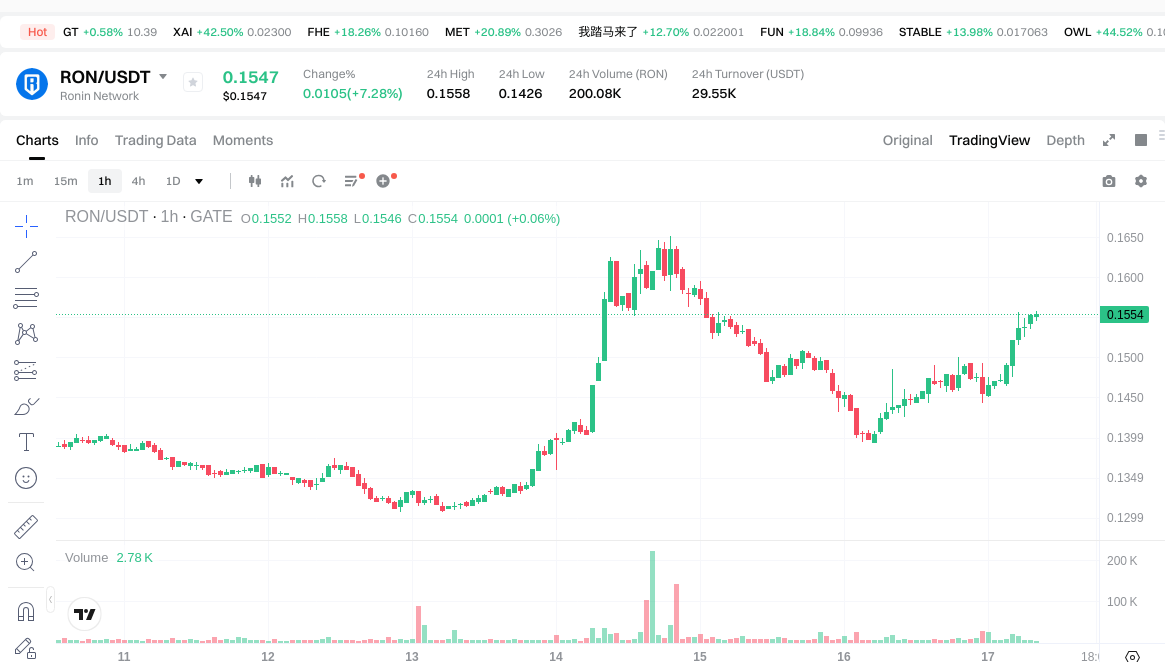
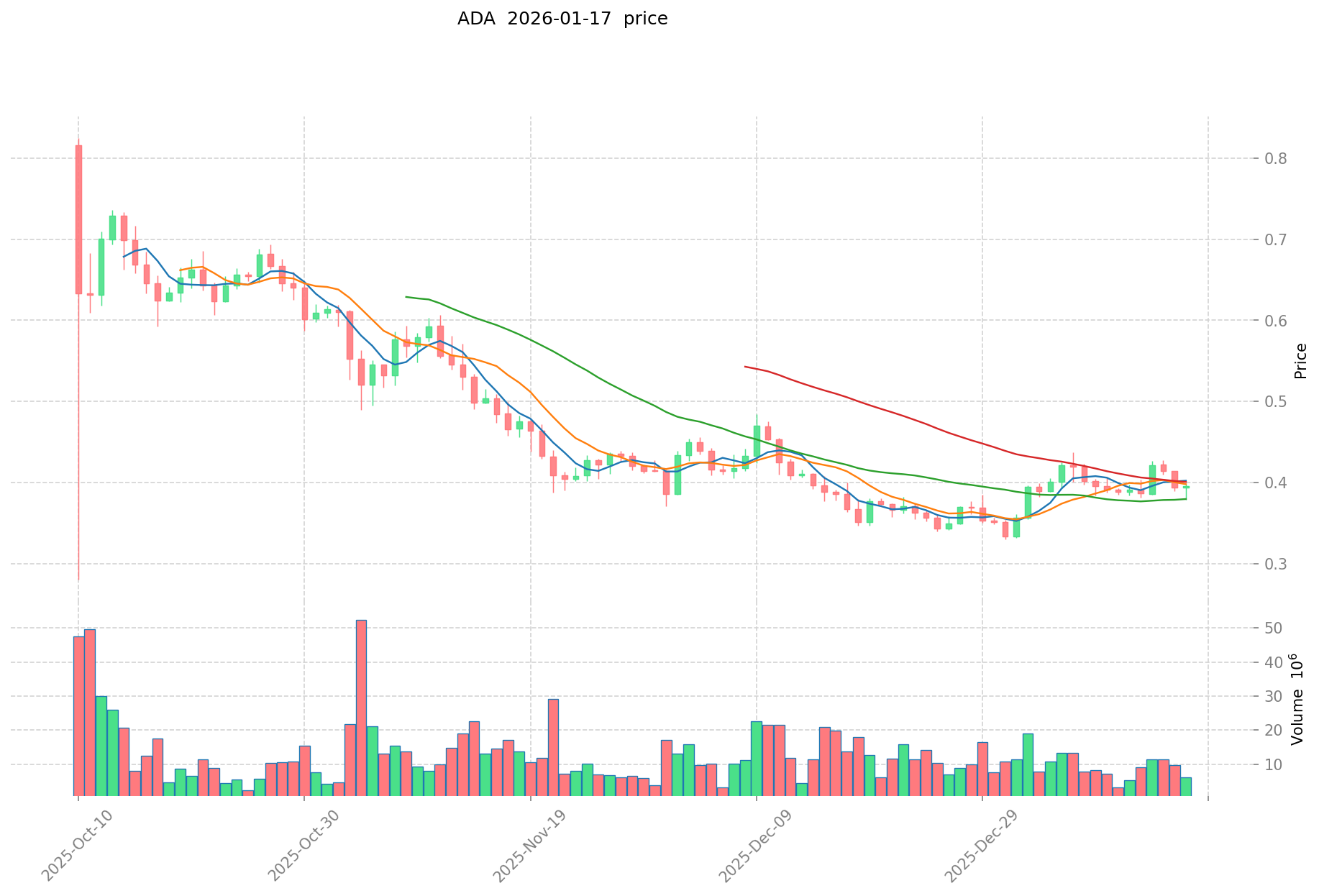
- Comparative Analysis: During recent market cycles, RON declined from its peak of $4.45 to a low of $0.126795 in December 2025, representing significant volatility. Meanwhile, ADA demonstrated relatively more stability, declining from its all-time high of $3.09 to a low of $0.01925275 during the 2020 market downturn, though it has experienced considerable price pressure in recent periods.
Current Market Status (January 17, 2026)
- RON Current Price: $0.1547
- ADA Current Price: $0.3962
- 24-Hour Trading Volume: RON recorded $29,436.55 compared to ADA's substantially higher $2,363,582.73
- Market Sentiment Index (Fear & Greed Index): 49 (Neutral)
View real-time prices:
- Check RON current price Market Price
- Check ADA current price Market Price
II. Core Factors Influencing RON vs ADA Investment Value
Supply Mechanism Comparison (Tokenomics)
-
RON: Ronin operates with a dynamic supply model tied to its network's gaming ecosystem, particularly Axie Infinity. The token supply adjusts based on ecosystem demand and staking requirements for network validators.
-
ADA: Cardano employs a fixed maximum supply of 45 billion ADA tokens with a deflationary mechanism through staking rewards that gradually decrease over time, following a predetermined emission schedule.
-
📌 Historical Pattern: Supply mechanisms drive price cycles through scarcity dynamics. Fixed-supply models like ADA tend to exhibit long-term deflationary pressure, while ecosystem-dependent models like RON show volatility aligned with platform adoption rates.
Institutional Adoption and Market Application
-
Institutional Holdings: ADA demonstrates stronger institutional presence through its academic research foundation and partnerships with educational institutions. RON remains primarily focused on gaming sector investors and Web3 gaming funds.
-
Enterprise Adoption: ADA has explored applications in identity verification and supply chain management through partnerships in developing markets. RON concentrates on gaming payment infrastructure and NFT marketplace integration within the Ronin ecosystem.
-
Regulatory Environment: Different jurisdictions view these assets through distinct lenses—ADA benefits from its proof-of-stake mechanism and research-oriented approach in regulatory discussions, while RON faces scrutiny typical of gaming-related tokens.
Technology Development and Ecosystem Construction
-
RON Technical Upgrades: The Ronin network focuses on optimizing transaction throughput for gaming applications, implementing sidechain solutions that prioritize speed and low costs for microtransactions in play-to-earn environments.
-
ADA Technical Development: Cardano progresses through systematic upgrades including the Ouroboros consensus protocol refinements and smart contract capabilities through the Plutus platform, emphasizing peer-reviewed research and formal verification methods.
-
Ecosystem Comparison: ADA supports diverse DeFi protocols, NFT marketplaces, and decentralized governance mechanisms across multiple sectors. RON maintains concentrated focus on gaming infrastructure, with established presence in GameFi, NFT gaming assets, and play-to-earn reward systems.
Macroeconomic Conditions and Market Cycles
-
Performance in Inflationary Environments: ADA's staking mechanism provides yield generation that may offset inflation effects, while RON's value correlates more directly with gaming sector health and player activity levels than broad economic conditions.
-
Monetary Policy Impact: Interest rate changes and dollar strength traditionally affect risk assets including both tokens. ADA, with broader institutional recognition, may demonstrate correlation with traditional crypto market movements. RON exhibits sensitivity to Web3 gaming sector trends and blockchain gaming adoption rates.
-
Geopolitical Factors: Cross-border transaction demand influences both assets differently—ADA positions itself for emerging market financial applications, while RON benefits from gaming globalization and digital asset ownership trends in regions with active gaming communities.
III. 2026-2031 Price Forecast: RON vs ADA
Short-term Forecast (2026)
- RON: Conservative $0.11-$0.15 | Optimistic $0.15-$0.18
- ADA: Conservative $0.21-$0.40 | Optimistic $0.40-$0.57
Mid-term Forecast (2028-2029)
- RON may enter a consolidation phase, with estimated price range of $0.13-$0.21 in 2028 and $0.17-$0.24 in 2029
- ADA may enter a growth phase, with estimated price range of $0.40-$0.67 in 2028 and $0.47-$0.69 in 2029
- Key drivers: institutional capital inflows, ETF developments, ecosystem expansion
Long-term Forecast (2030-2031)
- RON: Baseline scenario $0.18-$0.22 (2030), $0.14-$0.25 (2031) | Optimistic scenario $0.22-$0.29 (2030), $0.25-$0.36 (2031)
- ADA: Baseline scenario $0.54-$0.64 (2030), $0.51-$0.72 (2031) | Optimistic scenario $0.64-$0.81 (2030), $0.72-$0.89 (2031)
View detailed price predictions for RON and ADA
Disclaimer: Price predictions are subject to market volatility and various factors. This information is for reference purposes only and does not constitute investment advice.
RON:
| Year |
Predicted High Price |
Predicted Average Price |
Predicted Low Price |
Price Change |
| 2026 |
0.180999 |
0.1547 |
0.112931 |
0 |
| 2027 |
0.182955955 |
0.1678495 |
0.159457025 |
8 |
| 2028 |
0.20697521845 |
0.1754027275 |
0.131552045625 |
13 |
| 2029 |
0.244721885408 |
0.191188972975 |
0.168246296218 |
23 |
| 2030 |
0.28770116653278 |
0.2179554291915 |
0.180903006228945 |
40 |
| 2031 |
0.356487899985617 |
0.25282829786214 |
0.144112129781419 |
63 |
ADA:
| Year |
Predicted High Price |
Predicted Average Price |
Predicted Low Price |
Price Change |
| 2026 |
0.567281 |
0.3967 |
0.206284 |
0 |
| 2027 |
0.592848315 |
0.4819905 |
0.37595259 |
21 |
| 2028 |
0.6664000653 |
0.5374194075 |
0.39769036155 |
35 |
| 2029 |
0.686177099496 |
0.6019097364 |
0.469489594392 |
52 |
| 2030 |
0.805054272435 |
0.644043417948 |
0.54099647107632 |
62 |
| 2031 |
0.891195079585545 |
0.7245488451915 |
0.50718419163405 |
83 |
IV. Investment Strategy Comparison: RON vs ADA
Long-term vs Short-term Investment Strategies
-
RON: Suitable for investors focused on gaming sector growth and Web3 entertainment infrastructure. The token demonstrates alignment with play-to-earn ecosystem expansion and NFT gaming asset development. Short-term positions may capitalize on gaming sector volatility, while long-term holders should monitor gaming adoption rates and Ronin ecosystem development.
-
ADA: Suitable for investors seeking exposure to research-driven blockchain platforms with diverse application potential. The token appeals to those interested in proof-of-stake mechanisms and systematic network upgrades. Long-term strategies may benefit from staking rewards and gradual ecosystem maturation, while short-term approaches should consider broader crypto market cycles.
Risk Management and Asset Allocation
-
Conservative Investors: RON 20-30% vs ADA 70-80%. This allocation emphasizes ADA's relatively established position and institutional recognition while maintaining limited exposure to gaming-focused infrastructure.
-
Aggressive Investors: RON 40-50% vs ADA 50-60%. This approach balances gaming sector volatility with broader platform adoption potential, suitable for those comfortable with higher risk profiles.
-
Hedging Tools: Stablecoin reserves for rebalancing opportunities, diversification across multiple blockchain ecosystems, consideration of correlation patterns during market stress periods.
V. Potential Risk Comparison
Market Risks
-
RON: Price volatility correlates strongly with gaming sector health and Axie Infinity ecosystem activity. Trading volume at $29,436.55 reflects lower liquidity compared to major assets, potentially amplifying price movements. Gaming market sentiment shifts and competition from alternative GameFi platforms present concentration risks.
-
ADA: Market performance demonstrates sensitivity to broader cryptocurrency cycles and proof-of-stake narrative developments. With 24-hour trading volume of $2,363,582.73, the asset maintains stronger liquidity profiles. Competition from established smart contract platforms and ecosystem adoption pace relative to competitors constitute ongoing market considerations.
Technical Risks
-
RON: Network scalability depends on maintaining gaming transaction efficiency while expanding beyond Axie Infinity. Sidechain architecture requires ongoing security validation and validator network decentralization. Gaming-specific infrastructure faces technical challenges in maintaining uptime during high-activity periods.
-
ADA: Development timeline adherence for protocol upgrades and smart contract functionality expansion present technical execution challenges. The peer-reviewed research approach, while thorough, may result in slower feature implementation compared to competitors. Network activity growth must match infrastructure capabilities as ecosystem applications increase.
Regulatory Risks
- Gaming-related tokens like RON face scrutiny regarding play-to-earn mechanics and potential classification as gaming revenue in certain jurisdictions. ADA's academic foundation and proof-of-stake mechanism may provide advantages in regulatory discussions, though both assets remain subject to evolving cryptocurrency regulations globally. Jurisdictional differences in treatment of staking rewards, NFT transactions, and cross-border transfers affect both tokens differently based on their primary use cases.
VI. Conclusion: Which Is the Better Buy?
📌 Investment Value Summary:
-
RON Advantages: Concentrated focus on gaming infrastructure provides clear use case alignment. Lower current price point at $0.1547 compared to historical peak offers potential entry opportunity for gaming sector believers. Direct exposure to Web3 gaming growth and play-to-earn model evolution.
-
ADA Advantages: Established market presence since 2017 with systematic development approach. Current price of $0.3962 reflects broader institutional recognition. Staking mechanism provides yield generation potential. Diverse ecosystem applications beyond single sector reduce concentration risk.
✅ Investment Recommendations:
-
New Investors: Consider starting with ADA for exposure to established blockchain infrastructure with academic research foundation. Smaller position in RON appropriate for those specifically interested in gaming sector developments. Emphasis on understanding fundamental differences between gaming-focused and general-purpose platforms.
-
Experienced Investors: Portfolio allocation based on gaming sector outlook and broader blockchain adoption views. Those bullish on GameFi expansion may weight RON higher, while those favoring diversified smart contract platforms may emphasize ADA. Monitor ecosystem development metrics and adoption indicators for both assets.
-
Institutional Investors: ADA presents more established institutional pathway through staking infrastructure and research partnerships. RON exposure appropriate for funds specifically targeting gaming and entertainment sectors. Consider liquidity requirements and regulatory frameworks applicable to intended holding structures.
⚠️ Risk Warning: Cryptocurrency markets exhibit high volatility. This content does not constitute investment advice.
VII. FAQ
Q1: What is the main difference between RON and ADA's market positioning?
RON is a gaming-focused Ethereum sidechain specifically designed for blockchain gaming infrastructure, particularly for Axie Infinity, while ADA is a research-driven, general-purpose blockchain platform designed for diverse financial applications. RON concentrates on optimizing gaming transactions and play-to-earn mechanics with lower costs and faster speeds, whereas ADA employs a layered architecture and peer-reviewed research approach to support broader use cases including DeFi, NFTs, and enterprise solutions across multiple sectors.
Q2: Which token has better liquidity for trading purposes?
ADA demonstrates significantly better liquidity with a 24-hour trading volume of $2,363,582.73 compared to RON's $29,436.55. This substantial difference means ADA trades can be executed with lower slippage and price impact, making it more suitable for larger position entries and exits. RON's lower liquidity reflects its niche focus on the gaming sector and may result in amplified price movements during periods of increased buying or selling pressure.
Q3: How do the supply mechanisms of RON and ADA differ?
ADA operates with a fixed maximum supply of 45 billion tokens and a deflationary staking reward mechanism that decreases over time following a predetermined schedule. RON employs a dynamic supply model tied to its gaming ecosystem demand and network validator staking requirements, adjusting based on platform activity. This fundamental difference means ADA follows long-term deflationary pressure, while RON's supply shows volatility aligned with gaming adoption rates and ecosystem growth.
Q4: What are the price predictions for RON and ADA through 2031?
According to forecasts, RON's price may range from $0.11-$0.18 in 2026, potentially reaching $0.14-$0.36 by 2031 depending on gaming sector adoption. ADA shows stronger growth projections, ranging from $0.21-$0.57 in 2026 and potentially reaching $0.51-$0.89 by 2031. These predictions suggest ADA may offer more substantial appreciation potential, though both remain subject to significant market volatility and ecosystem development success.
Q5: Which token is more suitable for staking rewards?
ADA provides a more established staking infrastructure with systematic yield generation through its proof-of-stake mechanism, offering investors passive income potential while holding. RON's staking focuses primarily on network validator requirements within its gaming ecosystem rather than broad retail staking programs. For investors seeking staking rewards as part of their investment strategy, ADA presents clearer opportunities with its mature staking framework and deflationary reward schedule.
Q6: How do regulatory risks differ between RON and ADA?
RON faces scrutiny typical of gaming-related tokens, particularly regarding play-to-earn mechanics and potential classification as gaming revenue in certain jurisdictions. ADA benefits from its academic research foundation and proof-of-stake mechanism in regulatory discussions, potentially providing advantages in compliance frameworks. However, both assets remain subject to evolving global cryptocurrency regulations, with jurisdictional differences affecting treatment of staking rewards, NFT transactions, and cross-border transfers based on their primary use cases.
Q7: What portfolio allocation strategy is recommended for these two tokens?
Conservative investors should consider allocating 20-30% to RON and 70-80% to ADA, emphasizing ADA's established position and institutional recognition. Aggressive investors comfortable with higher risk may allocate 40-50% to RON and 50-60% to ADA, balancing gaming sector volatility with broader platform adoption potential. The allocation should reflect individual risk tolerance, gaming sector outlook, and belief in Web3 gaming versus general-purpose blockchain platform adoption.
Q8: Which token performed better during previous market cycles?
ADA demonstrated significant growth during the 2021 bull market, reaching an all-time high of $3.09 in September 2021, driven by network upgrades and increased adoption. RON, launched in January 2022, peaked at $4.45 in March 2024 during heightened gaming blockchain interest but experienced greater volatility, declining to $0.126795 by December 2025. ADA has shown relatively more stability across market cycles, though both tokens have experienced considerable price pressure during bear markets, reflecting broader cryptocurrency market dynamics.
* The information is not intended to be and does not constitute financial advice or any other recommendation of any sort offered or endorsed by Gate.