This comprehensive guide compares RPL and ATOM, two leading blockchain staking tokens with distinct market positions. RPL focuses on Ethereum's liquid staking infrastructure, while ATOM powers Cosmos' cross-chain interoperability ecosystem. As of January 2026, RPL trades at $2.065 with a $45.67M market cap, while ATOM trades at $2.37 with a $1.16B market cap. Both tokens have declined over 95% from historical peaks, presenting different risk-reward profiles. ATOM offers superior liquidity ($770K daily volume vs RPL's $90K) and market stability, making it suitable for conservative investors allocating 60-70% to ATOM and 30-40% to RPL. The article analyzes tokenomics, technical ecosystems, price forecasts through 2031, and risk management strategies, concluding that ATOM better suits new investors while RPL appeals to those bullish on Ethereum staking adoption. Access real-time pricing on Gate.
Introduction: Investment Comparison Between RPL and ATOM
In the cryptocurrency market, the comparison between RPL vs ATOM has consistently been a topic that investors cannot avoid. The two differ significantly not only in market cap ranking, application scenarios, and price performance, but also represent distinct positioning within the crypto asset landscape.
Rocket Pool (RPL): Since its launch, it has gained market recognition by positioning itself as an Ethereum PoS infrastructure service, enabling individuals and organizations to participate in staking through a decentralized node operation network.
Cosmos (ATOM): Since its inception in 2019, it has been regarded as a blockchain internet infrastructure, emerging as one of the prominent cryptocurrencies with substantial trading volume and ecosystem development.
This article will comprehensively analyze the investment value comparison of RPL vs ATOM, focusing on historical price trends, supply mechanisms, adoption patterns, technological ecosystems, and future outlook, attempting to address the question investors care about most:
"Which is the better buy right now?"
I. Historical Price Comparison and Current Market Status
RPL (Coin A) and ATOM (Coin B) Historical Price Trends
- 2023: RPL experienced a significant price peak in April, reaching its all-time high of $61.9 on April 17, 2023, following developments in Ethereum's Proof-of-Stake infrastructure adoption.
- 2017: ATOM launched through an Initial Coin Offering (ICO) in 2017, establishing Cosmos as a decentralized blockchain ecosystem focused on interoperability.
- 2022: ATOM reached its all-time high of $44.45 on January 17, 2022, driven by increasing interest in cross-chain communication protocols and the growth of the Cosmos ecosystem.
- Comparative Analysis: During the 2023-2026 market cycle, RPL declined from its peak of $61.9 to approximately $2.07, representing a decline of over 96%, while ATOM dropped from its high of $44.45 to around $2.37, marking a decline of approximately 95%.
Current Market Status (2026-01-19)
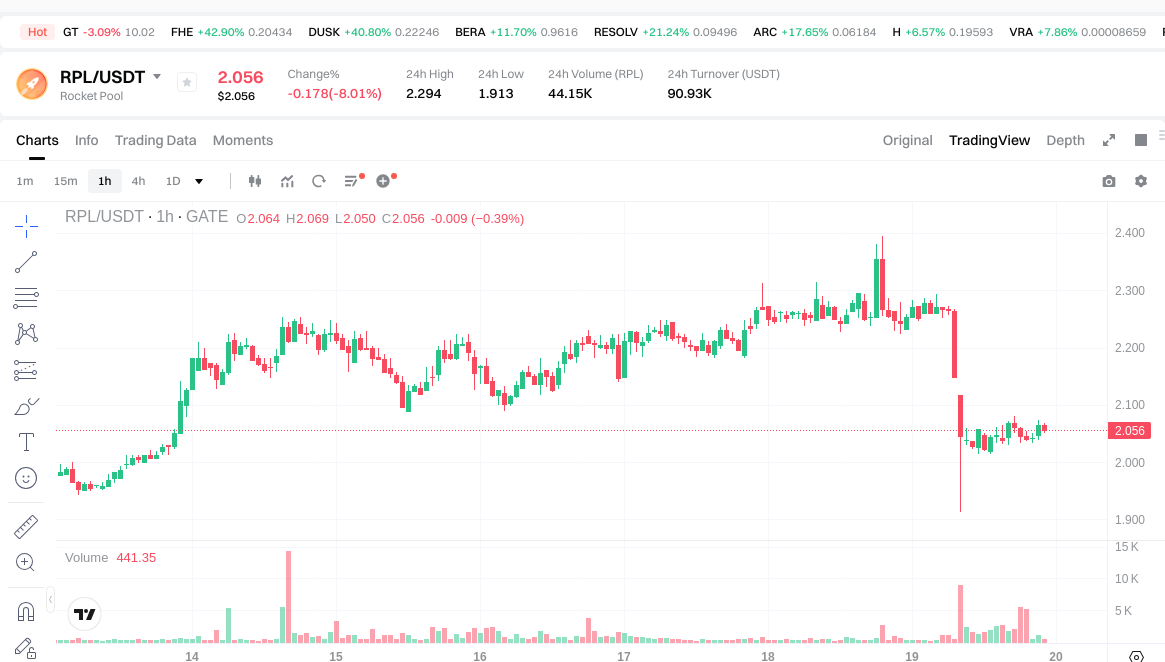
- RPL current price: $2.065
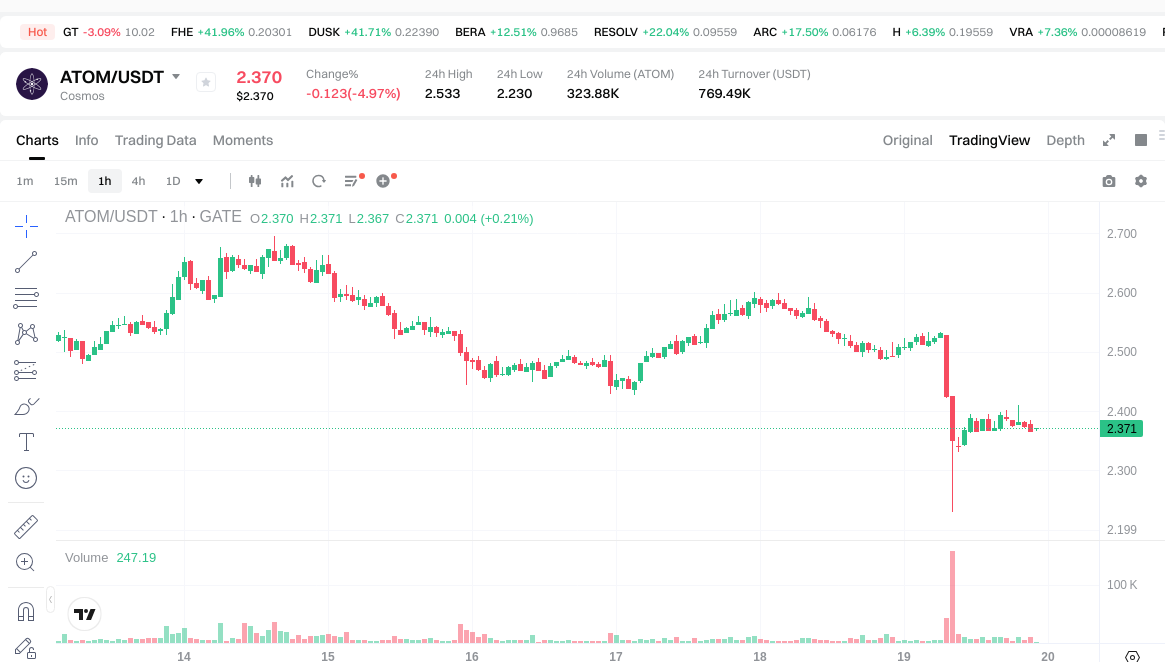
- ATOM current price: $2.37
- 24-hour trading volume: RPL recorded $90,357.08 compared to ATOM's $770,343.64
- Market Sentiment Index (Fear & Greed Index): 44 (Fear)
- RPL 24-hour price change: -8.1%
- ATOM 24-hour price change: -5.05%
- RPL market capitalization: $45.67 million
- ATOM market capitalization: $1.16 billion
View real-time prices:
- View RPL current price Market Price
- View ATOM current price Market Price
II. Core Factors Influencing RPL vs ATOM Investment Value
Tokenomics Comparison
- RPL: Functions within a liquid staking framework where node operators can earn additional RPL rewards through participation in the staking mechanism, creating an incentive structure tied to network validation activities.
- ATOM: Serves as the native token of the Cosmos network, participating in the Proof-of-Stake (PoS) consensus mechanism where tokens are staked to validators to maintain network security.
- 📌 Historical Pattern: Supply mechanisms in staking-based models tend to influence price cycles through reward distribution dynamics and staking participation rates.
Institutional Adoption and Market Applications
- Institutional Holdings: Current reference materials do not provide specific data on institutional preference between RPL and ATOM.
- Enterprise Adoption: ATOM benefits from its role in the Cosmos ecosystem, which facilitates interoperability through the IBC protocol, potentially supporting cross-chain applications. RPL operates within the Ethereum staking infrastructure.
- Regulatory Environment: Reference materials do not contain information regarding specific governmental policies toward these tokens.
Technical Development and Ecosystem Building
- RPL Technical Position: Integrated into liquid staking solutions that address liquidity challenges in PoS systems, allowing participants to maintain asset flexibility while earning staking rewards.
- ATOM Technical Development: Built on Cosmos SDK, ATOM participates in an ecosystem designed for blockchain interoperability. The Picasso project mentioned in materials utilizes Cosmos SDK for cross-chain restaking solutions.
- Ecosystem Comparison: ATOM's ecosystem emphasizes cross-chain connectivity and interoperability infrastructure. RPL focuses on Ethereum's staking layer, particularly within liquid staking protocols that have gained attention in the DeFi sector.
Macroeconomic Factors and Market Cycles
- Performance in Inflationary Environments: Reference materials do not contain specific analysis of anti-inflation properties for either token.
- Macroeconomic Monetary Policy: Materials do not provide information on how interest rates or dollar index movements specifically affect RPL or ATOM.
- Geopolitical Factors: The Cosmos network's interoperability features may provide utility in cross-border blockchain communication scenarios, though specific geopolitical impact data is not available in the provided materials.
III. 2026-2031 Price Forecast: RPL vs ATOM
Short-term Forecast (2026)
- RPL: Conservative $1.31-$2.05 | Optimistic $2.05-$3.04
- ATOM: Conservative $1.28-$2.37 | Optimistic $2.37-$3.10
Mid-term Forecast (2028-2029)
- RPL may enter a consolidation phase, with estimated price range of $2.39-$3.54
- ATOM may enter a growth phase, with estimated price range of $1.97-$3.90
- Key drivers: institutional capital inflows, ETF developments, ecosystem expansion
Long-term Forecast (2031)
- RPL: Baseline scenario $3.33-$3.88 | Optimistic scenario $3.88-$5.54
- ATOM: Baseline scenario $2.16-$3.80 | Optimistic scenario $3.80-$4.03
View detailed price predictions for RPL and ATOM
Disclaimer
RPL:
| Year |
Predicted High Price |
Predicted Average Price |
Predicted Low Price |
Price Change |
| 2026 |
3.03548 |
2.051 |
1.31264 |
0 |
| 2027 |
3.1536176 |
2.54324 |
1.8057004 |
23 |
| 2028 |
3.047818816 |
2.8484288 |
2.392680192 |
37 |
| 2029 |
3.5377485696 |
2.948123808 |
2.62383018912 |
42 |
| 2030 |
4.507681302432 |
3.2429361888 |
2.561919589152 |
57 |
| 2031 |
5.54169150623088 |
3.875308745616 |
3.33276552122976 |
87 |
ATOM:
| Year |
Predicted High Price |
Predicted Average Price |
Predicted Low Price |
Price Change |
| 2026 |
3.1047 |
2.37 |
1.2798 |
0 |
| 2027 |
3.3121935 |
2.73735 |
1.64241 |
15 |
| 2028 |
3.9019555575 |
3.02477175 |
2.8130377275 |
27 |
| 2029 |
3.6018981999 |
3.46336365375 |
1.9741172826375 |
46 |
| 2030 |
4.06252556584875 |
3.532630926825 |
3.391325689752 |
49 |
| 2031 |
4.025432941117087 |
3.797578246336875 |
2.164619600412018 |
60 |
IV. Investment Strategy Comparison: RPL vs ATOM
Long-term vs Short-term Investment Strategies
- RPL: May suit investors focused on Ethereum staking infrastructure development and liquid staking protocol adoption, particularly those monitoring developments in the PoS validation ecosystem.
- ATOM: May suit investors interested in cross-chain interoperability infrastructure and blockchain communication protocols, particularly those tracking ecosystem expansion through Cosmos SDK implementations.
Risk Management and Asset Allocation
- Conservative Investors: RPL 30-40% vs ATOM 60-70% (based on market capitalization differential and trading volume patterns)
- Aggressive Investors: RPL 50-60% vs ATOM 40-50% (higher allocation to smaller market cap assets with potential recovery scenarios)
- Hedging Tools: Stablecoin allocation for portfolio balance, derivatives for downside protection, cross-asset diversification across staking protocols
V. Potential Risk Comparison
Market Risks
- RPL: Lower trading volume ($90,357.08 in 24 hours) may present liquidity challenges during market stress periods; significant decline from historical peak suggests elevated volatility potential.
- ATOM: Higher trading volume ($770,343.64 in 24 hours) provides better liquidity conditions; market performance remains tied to broader cross-chain ecosystem adoption rates.
Technical Risks
- RPL: Dependence on Ethereum network development trajectory and liquid staking protocol adoption; scalability tied to Layer 1 infrastructure improvements.
- ATOM: Interoperability protocol complexity may present technical challenges; network security dependent on validator distribution and staking participation rates.
Regulatory Risks
- Both tokens operate in evolving regulatory environments where staking mechanisms and cross-chain protocols may face varying interpretations across jurisdictions; institutional adoption patterns may shift based on regulatory clarity developments.
VI. Conclusion: Which Is the Better Buy?
📌 Investment Value Summary:
- RPL Characteristics: Positioned within Ethereum staking infrastructure with focus on liquid staking solutions; smaller market capitalization ($45.67 million) presents higher volatility profile; current price ($2.065) represents significant decline from historical peak.
- ATOM Characteristics: Established position in cross-chain interoperability infrastructure; larger market capitalization ($1.16 billion) suggests broader market acceptance; current price ($2.37) maintains relative stability within ecosystem development context.
✅ Investment Considerations:
- New Investors: Consider starting with smaller position sizes given current market sentiment (Fear & Greed Index: 44) and recent price declines; dollar-cost averaging approach may help navigate volatility.
- Experienced Investors: Evaluate portfolio allocation based on risk tolerance and conviction in respective ecosystems (Ethereum staking vs cross-chain protocols); monitor trading volume patterns and ecosystem development metrics.
- Institutional Investors: Assess liquidity requirements and regulatory considerations; ATOM's higher trading volume may better accommodate larger position sizes; both tokens require evaluation within broader portfolio context.
⚠️ Risk Disclosure: Cryptocurrency markets demonstrate extreme volatility. This content does not constitute investment advice. Both assets have experienced significant price declines from historical peaks. Investors should conduct independent research and consider personal risk tolerance before making investment decisions.
VII. FAQ
Q1: What is the main difference between RPL and ATOM in terms of their core functionality?
RPL operates as a liquid staking protocol within the Ethereum ecosystem, while ATOM functions as the native token of the Cosmos network focusing on blockchain interoperability. RPL enables node operators and stakers to participate in Ethereum's Proof-of-Stake validation while maintaining liquidity through decentralized staking pools. In contrast, ATOM serves as the governance and staking token for the Cosmos Hub, which facilitates cross-chain communication through the Inter-Blockchain Communication (IBC) protocol, allowing different blockchains to transfer data and assets seamlessly.
Q2: Which token has better liquidity for trading purposes?
ATOM demonstrates significantly better liquidity with a 24-hour trading volume of $770,343.64 compared to RPL's $90,357.08 as of January 19, 2026. This 8.5x difference in trading volume indicates that ATOM offers easier entry and exit positions with lower slippage risk. Additionally, ATOM's market capitalization of $1.16 billion compared to RPL's $45.67 million further confirms stronger market depth and institutional participation, making it more suitable for investors requiring immediate liquidity or managing larger position sizes.
Q3: How have both tokens performed since their all-time highs?
Both tokens have experienced substantial declines from their historical peaks. RPL declined approximately 96% from its all-time high of $61.9 (April 17, 2023) to the current price of $2.065. ATOM dropped approximately 95% from its peak of $44.45 (January 17, 2022) to $2.37. These parallel decline patterns reflect broader market cycle corrections rather than project-specific failures, though investors should note that recovery trajectories may differ based on ecosystem development momentum and adoption rates in their respective sectors.
Q4: What are the price forecasts for RPL and ATOM through 2031?
For 2026, RPL's conservative forecast ranges from $1.31-$2.05, with an optimistic scenario of $2.05-$3.04, while ATOM's conservative forecast spans $1.28-$2.37, with an optimistic range of $2.37-$3.10. By 2031, RPL's baseline scenario projects $3.33-$3.88 (optimistic: $3.88-$5.54), representing potential growth of 87% from current levels. ATOM's 2031 baseline forecast shows $2.16-$3.80 (optimistic: $3.80-$4.03), suggesting potential 60% growth. These projections assume continued ecosystem development, though actual performance will depend on adoption rates, technical advancements, and market conditions.
Q5: Which token is more suitable for conservative investors?
ATOM appears more suitable for conservative investors based on several factors. Its larger market capitalization ($1.16 billion vs $45.67 million) provides greater stability and reduced manipulation risk. Higher trading volume ensures better liquidity for position management. The established Cosmos ecosystem with multiple blockchain integrations offers broader diversification compared to RPL's concentrated focus on Ethereum staking. A suggested conservative allocation would be 60-70% ATOM versus 30-40% RPL, allowing exposure to both ecosystems while emphasizing the more established cross-chain infrastructure platform.
Q6: What are the primary risks associated with investing in RPL versus ATOM?
RPL faces liquidity risks due to low trading volume ($90,357.08 daily), making it vulnerable to price volatility during market stress. Its dependence on Ethereum's development trajectory and liquid staking protocol adoption creates concentrated risk exposure. Technical scalability remains tied to Layer 1 infrastructure improvements. ATOM's risks include technical complexity in interoperability protocols, security dependence on validator distribution, and adoption rates of cross-chain solutions. Both tokens face regulatory uncertainty regarding staking mechanisms and cross-chain protocols, with potential varying interpretations across jurisdictions affecting institutional adoption patterns.
Q7: How do the tokenomics models differ between RPL and ATOM?
RPL operates within a liquid staking framework where node operators earn additional RPL rewards through participation in Ethereum validation activities, creating an incentive structure directly tied to network security contributions. This model focuses on distributing rewards to active participants who maintain infrastructure. ATOM utilizes a Proof-of-Stake consensus mechanism where token holders stake ATOM to validators for network security, earning staking rewards proportional to their contribution. The Cosmos model emphasizes broader participation through delegated staking, while RPL concentrates rewards among node operators providing infrastructure services.
Q8: What investment strategy should beginners adopt when considering RPL vs ATOM?
Beginners should consider a dollar-cost averaging approach given current market sentiment (Fear & Greed Index: 44) and recent price declines for both assets. Start with smaller position sizes to manage risk exposure, potentially allocating a higher percentage to ATOM (60-70%) due to its better liquidity and larger market capitalization. Monitor ecosystem developments, particularly Ethereum staking adoption for RPL and cross-chain protocol implementations for ATOM. Maintain stablecoin reserves for portfolio balance and avoid over-concentration in either asset. Conduct independent research on both ecosystems before committing significant capital, and only invest amounts that align with personal risk tolerance levels.
* The information is not intended to be and does not constitute financial advice or any other recommendation of any sort offered or endorsed by Gate.