This comprehensive analysis compares RSR and XRP, two major cryptocurrency tokens with distinct market positioning. RSR, launched in 2019, operates as a decentralized stablecoin mechanism targeting regions with unstable financial systems, currently trading at $0.002689. XRP, established since 2011, serves cross-border payment solutions with institutional adoption, currently at $2.068 and significantly higher trading volume on Gate. The article examines historical price trends, tokenomics differences, institutional adoption levels, technical ecosystems, and macroeconomic factors influencing both assets. It provides investment strategies tailored to different investor profiles—conservative investors favor XRP's established infrastructure with 70-80% allocation, while aggressive investors may balance exposure between both tokens. Long-term price forecasts through 2031 suggest distinct growth trajectories based on protocol adoption and market adoption rates.
Introduction: RSR vs XRP Investment Comparison
In the cryptocurrency market, the comparison between RSR vs XRP has always been a topic that investors cannot avoid. The two differ significantly in market cap ranking, application scenarios, and price performance, representing different crypto asset positioning.
RSR (Reserve Rights): Launched in 2019, it has gained market recognition through its positioning as a stablecoin stabilization mechanism and value storage medium, particularly targeting regions with unreliable financial infrastructure.
XRP: Since its launch in 2011, it has been recognized for its cross-border payment efficiency and is one of the cryptocurrencies with the highest trading volume and market cap globally.
This article will provide a comprehensive analysis of the investment value comparison between RSR vs XRP, focusing on historical price trends, supply mechanisms, institutional adoption, technical ecosystem, and future predictions, attempting to answer the question investors care about most:
"Which is the better buy right now?"
I. Historical Price Comparison and Current Market Status
Historical Price Trends of RSR (Coin A) and XRP (Coin B)
- 2021: RSR reached its all-time high of $0.117424 in April 2021, coinciding with a broader market rally in digital assets during that period.
- 2025: XRP achieved its all-time high of $3.65 in July 2025, reflecting significant market momentum and increased attention to payment-focused digital assets.
- Comparative Analysis: During various market cycles, RSR has experienced significant volatility, declining from its peak of $0.117424 to levels around $0.002689, while XRP has shown relatively stronger resilience with its current trading level maintaining closer proximity to recent highs.
Current Market Status (2026-01-16)
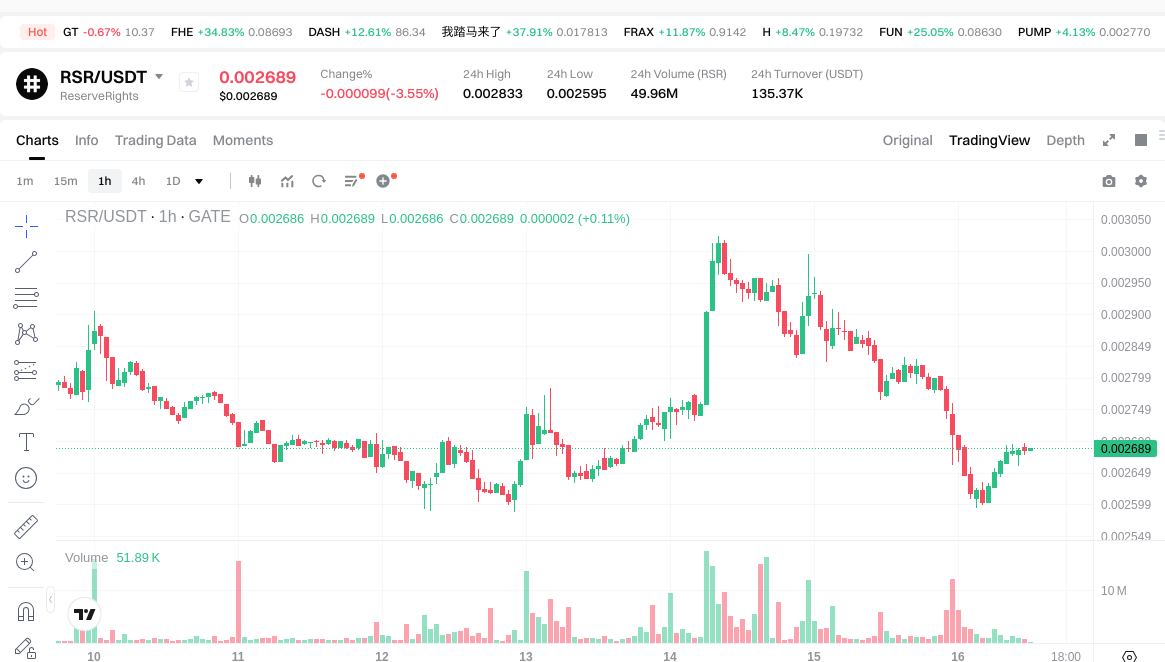
- RSR Current Price: $0.002689
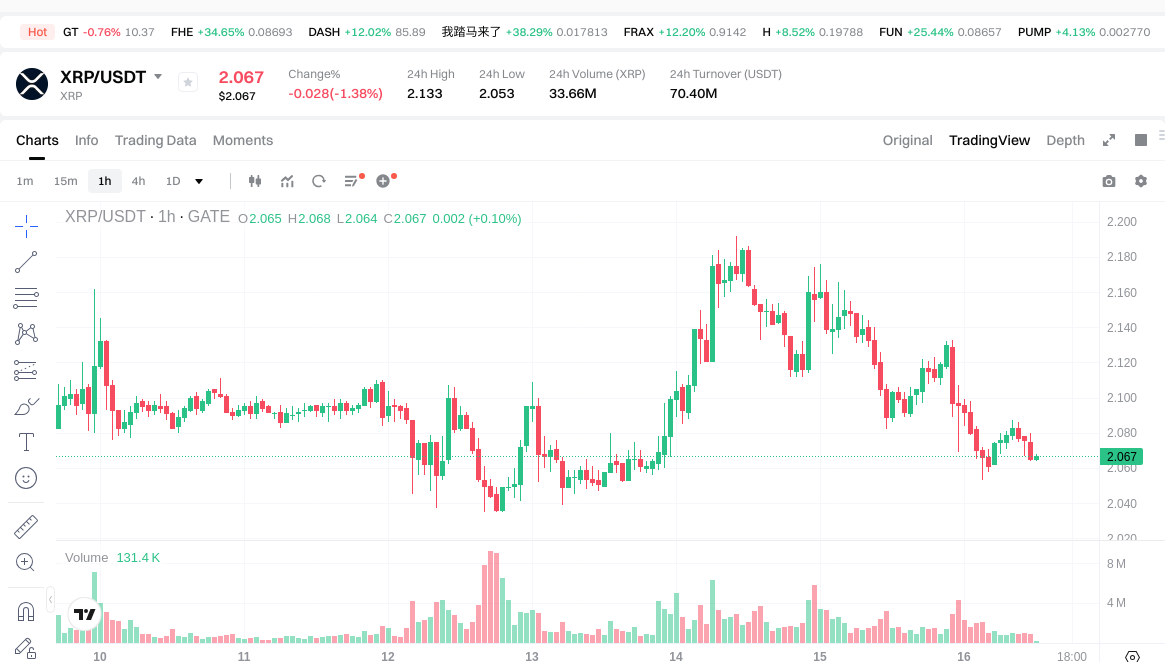
- XRP Current Price: $2.068
- 24-Hour Trading Volume: RSR at $137,394.25 vs XRP at $70,802,610.39
- Market Sentiment Index (Fear & Greed Index): 49 (Neutral)
View real-time prices:
II. Core Factors Influencing RSR vs XRP Investment Value
Supply Mechanism Comparison (Tokenomics)
- RSR: The price of Reserve Rights is influenced by market demand and overall cryptocurrency market trends, with token supply dynamics tied to the Reserve Protocol's dual-token system designed to maintain stablecoin stability.
- XRP: Features a pre-mined supply with periodic releases from escrow, creating a controlled supply mechanism that impacts long-term price dynamics.
- 📌 Historical Pattern: Supply mechanisms influence price cycles through demand-supply dynamics, with XRP's controlled release schedule and RSR's reserve stabilization model creating distinct volatility patterns.
Institutional Adoption and Market Application
- Institutional Holdings: XRP has gained notable institutional attention due to its compliance narrative and established cross-border payment use cases, while RSR remains more focused on decentralized stablecoin infrastructure.
- Enterprise Adoption: XRP has been positioned for cross-border payment solutions, addressing enterprise demand for faster forex settlement times. RSR's application centers on supporting algorithmic stablecoins within the Reserve ecosystem.
- National Policy: XRP carries a compliance narrative that may attract capital in environments favoring regulatory clarity. Market sentiment suggests potential inflow from anti-regulatory sentiment funds. RSR's regulatory positioning remains less defined in mainstream policy discussions.
Technology Development and Ecosystem Building
- RSR Technology: Development focuses on the Reserve Protocol platform, supporting decentralized stablecoin mechanisms with ongoing platform evolution.
- XRP Technology: Continues to advance its payment settlement infrastructure with emphasis on cross-border transaction efficiency.
- Ecosystem Comparison: XRP has established applications in payment and settlement networks, while RSR's ecosystem concentrates on DeFi stablecoin infrastructure with limited broader ecosystem visibility compared to major platforms.
Macroeconomic and Market Cycles
- Performance in Inflationary Environments: Both assets demonstrate sensitivity to broader cryptocurrency market trends and macroeconomic factors, though specific inflation-hedging characteristics vary based on use case and adoption.
- Macroeconomic Monetary Policy: Interest rates and dollar index movements impact both assets through general cryptocurrency market correlation, with XRP showing additional sensitivity to cross-border payment demand fluctuations.
- Geopolitical Factors: XRP may benefit from increased cross-border transaction demand driven by international settlement needs, while RSR's exposure to geopolitical factors operates primarily through general cryptocurrency market sentiment and regulatory news affecting stablecoin frameworks.
III. 2026-2031 Price Forecast: RSR vs XRP
Short-term Forecast (2026)
- RSR: Conservative $0.00190848 - $0.002688 | Optimistic $0.00292992
- XRP: Conservative $1.67508 - $2.068 | Optimistic $2.93656
Medium-term Forecast (2028-2029)
- RSR may enter a gradual growth phase, with projected price range of $0.002421604416 - $0.004777760064 in 2028, potentially reaching $0.00495087205536 by 2029
- XRP may enter a consolidation and expansion phase, with projected price range of $1.954781136 - $4.045310962 in 2028, potentially reaching $4.25897940006 by 2029
- Key drivers: institutional capital inflows, ETF developments, ecosystem growth
Long-term Forecast (2030-2031)
- RSR: Baseline scenario $0.004084066935748 - $0.005408022700634 | Optimistic scenario $0.006328059757588
- XRP: Baseline scenario $2.951756656201584 - $4.2779081973936 | Optimistic scenario $5.090710754898384
View detailed price predictions for RSR and XRP
Disclaimer
RSR:
| Year |
Predicted High Price |
Predicted Average Price |
Predicted Low Price |
Price Change |
| 2026 |
0.00292992 |
0.002688 |
0.00190848 |
0 |
| 2027 |
0.0037359168 |
0.00280896 |
0.0014887488 |
4 |
| 2028 |
0.004777760064 |
0.0032724384 |
0.002421604416 |
21 |
| 2029 |
0.00495087205536 |
0.004025099232 |
0.0024150595392 |
49 |
| 2030 |
0.006328059757588 |
0.00448798564368 |
0.004084066935748 |
66 |
| 2031 |
0.005570263381653 |
0.005408022700634 |
0.002866252031336 |
101 |
XRP:
| Year |
Predicted High Price |
Predicted Average Price |
Predicted Low Price |
Price Change |
| 2026 |
2.93656 |
2.068 |
1.67508 |
0 |
| 2027 |
2.9276676 |
2.50228 |
1.9017328 |
21 |
| 2028 |
4.045310962 |
2.7149738 |
1.954781136 |
31 |
| 2029 |
4.25897940006 |
3.380142381 |
2.46750393813 |
63 |
| 2030 |
4.7362555042572 |
3.81956089053 |
3.2466267569505 |
84 |
| 2031 |
5.090710754898384 |
4.2779081973936 |
2.951756656201584 |
106 |
IV. Investment Strategy Comparison: RSR vs XRP
Long-term vs Short-term Investment Strategies
- RSR: Suitable for investors focused on decentralized stablecoin infrastructure and DeFi ecosystem participation, with higher risk tolerance for emerging protocol development
- XRP: Suitable for investors seeking exposure to established cross-border payment solutions and regulatory compliance narratives, with preference for assets demonstrating institutional adoption momentum
Risk Management and Asset Allocation
- Conservative Investors: RSR: 20-30% vs XRP: 70-80%
- Aggressive Investors: RSR: 40-50% vs XRP: 50-60%
- Hedging Tools: Stablecoin allocation, options strategies, cross-asset portfolio diversification
V. Potential Risk Comparison
Market Risk
- RSR: Exposure to higher volatility patterns given lower market capitalization and liquidity depth, with price sensitivity to broader DeFi sector sentiment and stablecoin regulatory developments
- XRP: Subject to volatility driven by ongoing regulatory developments, litigation outcomes, and institutional adoption cycles, though generally demonstrates relatively lower volatility compared to smaller-cap assets
Technical Risk
- RSR: Scalability considerations tied to Reserve Protocol infrastructure evolution, network stability dependent on dual-token mechanism effectiveness
- XRP: Network centralization concerns related to validator distribution, though overall technical infrastructure has demonstrated operational stability over extended timeframes
Regulatory Risk
- Global regulatory frameworks impact both assets differently, with XRP facing direct scrutiny in payment and securities classification discussions, while RSR encounters regulatory considerations within stablecoin and DeFi governance contexts
VI. Conclusion: Which Is the Better Buy?
Investment Value Summary:
- RSR Advantages: Positioned within decentralized stablecoin infrastructure with potential growth tied to DeFi adoption in regions with unstable financial systems; lower entry price point may attract speculative capital
- XRP Advantages: Established institutional recognition and cross-border payment use cases; compliance narrative may attract risk-averse capital; higher liquidity facilitates larger position management
Investment Recommendations:
- New Investors: Consider XRP for exposure to more established infrastructure with higher liquidity and broader market recognition, allocating smaller experimental positions to RSR if interested in DeFi stablecoin mechanisms
- Experienced Investors: Evaluate portfolio diversification through differentiated exposure—XRP for payment infrastructure positioning, RSR for speculative DeFi protocol upside—while maintaining disciplined risk management across allocations
- Institutional Investors: XRP may align better with compliance frameworks and liquidity requirements for treasury management and cross-border settlement exploration, while RSR exposure would constitute higher-risk innovation allocation
⚠️ Risk Disclosure: Cryptocurrency markets exhibit extreme volatility. This content does not constitute investment advice.
VII. FAQ
Q1: What are the main differences between RSR and XRP in terms of use cases?
XRP is primarily designed for cross-border payment solutions and enterprise forex settlement, while RSR serves as a stabilization mechanism within the Reserve Protocol's stablecoin ecosystem. XRP targets financial institutions seeking faster international transaction processing, whereas RSR focuses on providing decentralized stablecoin infrastructure for regions with unstable financial systems. The fundamental distinction lies in XRP's payment settlement orientation versus RSR's DeFi-focused stablecoin stability mechanism.
Q2: Which asset has higher liquidity and why does it matter?
XRP demonstrates significantly higher liquidity with 24-hour trading volume of $70,802,610.39 compared to RSR's $137,394.25 as of January 16, 2026. Higher liquidity matters because it enables easier entry and exit from positions, reduces slippage on large orders, and typically indicates broader market acceptance. For institutional investors and traders managing substantial capital, XRP's superior liquidity provides more efficient execution and lower transaction costs.
Q3: How do regulatory considerations differ between RSR and XRP?
XRP carries a more defined regulatory narrative due to its positioning in cross-border payments and ongoing securities classification discussions, which may attract compliance-focused institutional capital. RSR operates within the less-defined regulatory framework surrounding stablecoins and DeFi protocols. Investors prioritizing regulatory clarity may favor XRP's established compliance discussions, while those comfortable with emerging DeFi regulations might consider RSR's potential within evolving stablecoin frameworks.
Q4: What are the historical price volatility patterns for RSR vs XRP?
RSR has experienced extreme volatility, declining approximately 97.7% from its April 2021 all-time high of $0.117424 to current levels around $0.002689. XRP has demonstrated relatively stronger price resilience, with its current price of $2.068 maintaining closer proximity to its July 2025 all-time high of $3.65 (approximately 43.3% below peak). RSR's higher volatility reflects its smaller market capitalization and lower liquidity, while XRP's established market presence contributes to relatively more stable price behavior.
Q5: Which asset is more suitable for conservative versus aggressive investors?
Conservative investors should consider higher XRP allocation (70-80%) with smaller RSR exposure (20-30%) due to XRP's established infrastructure, higher liquidity, and institutional recognition. Aggressive investors might adopt more balanced positioning (40-50% RSR, 50-60% XRP) to capture potential upside from RSR's DeFi protocol growth while maintaining XRP exposure for payment infrastructure positioning. Portfolio allocation should align with individual risk tolerance, investment timeframe, and conviction in each asset's respective value proposition.
Q6: What factors could drive price appreciation for each asset through 2031?
RSR's price appreciation potential depends on Reserve Protocol adoption in emerging markets, DeFi ecosystem expansion, and successful stablecoin implementation in regions with financial instability. Price forecasts suggest potential growth from $0.002688 (2026 average) to $0.005408 (2031 average). XRP's value drivers include institutional adoption of cross-border payment solutions, regulatory clarity outcomes, potential ETF approvals, and enterprise integration for forex settlement. Projections indicate potential growth from $2.068 (2026 average) to $4.278 (2031 average), though all forecasts carry substantial uncertainty.
Q7: How do supply mechanisms impact long-term investment value?
XRP operates with a pre-mined supply and controlled escrow release schedule, creating predictable supply dynamics that influence price through scheduled token distribution. RSR's supply mechanism ties to the Reserve Protocol's dual-token system designed for stablecoin stabilization, where supply dynamics respond to protocol stability requirements. XRP's structured supply schedule provides more transparency for modeling long-term supply pressure, while RSR's mechanism-dependent supply creates less predictable tokenomics dependent on protocol usage and stabilization needs.
Q8: What are the key technical risks investors should monitor?
For RSR, monitor Reserve Protocol development progress, dual-token mechanism effectiveness, network stability metrics, and stablecoin adoption rates in target markets. For XRP, track validator distribution patterns (centralization concerns), network performance metrics, ongoing litigation outcomes, and institutional integration announcements. Both assets require monitoring of broader cryptocurrency market conditions, regulatory developments affecting their respective sectors, and competitive positioning within payment infrastructure (XRP) or DeFi stablecoin protocols (RSR).
* The information is not intended to be and does not constitute financial advice or any other recommendation of any sort offered or endorsed by Gate.