This comprehensive guide compares RUNE and STX, two leading Bitcoin Layer-2 solutions reshaping cryptocurrency investment landscapes. RUNE operates as a Bitcoin-native asset issuance standard built on Taproot upgrades, while STX functions as a Layer-2 smart contract platform using Proof of Transfer consensus. The article analyzes historical price trends, tokenomics, institutional adoption, and technical ecosystems to help investors understand their distinct value propositions. Current market data shows RUNE at $0.68 and STX at $0.3824, with differing risk profiles and growth trajectories through 2031. Whether you're a conservative, aggressive, or institutional investor, this guide provides strategic frameworks for evaluating these Bitcoin ecosystem assets on Gate, including detailed price forecasts, portfolio allocation strategies, and critical risk factors influencing investment outcomes.
Introduction: RUNE vs STX Investment Comparison
In the cryptocurrency market, the comparison between RUNE vs STX has been a topic that investors cannot avoid. The two not only have significant differences in market cap ranking, application scenarios, and price performance, but also represent different crypto asset positioning.
RUNE: Since its launch in 2019, it has gained market recognition with its positioning as a liquidity protocol for cross-chain asset swaps within the THORChain ecosystem.
STX (Stacks): Since its launch in 2019, it has been positioned as a decentralized application platform that enables smart contracts and applications on Bitcoin, representing a new approach to blockchain infrastructure.
This article will comprehensively analyze the investment value comparison of RUNE vs STX around historical price trends, supply mechanisms, institutional adoption, technical ecosystem, and future predictions, and attempt to answer the question that investors are most concerned about:
"Which is the better buy right now?"
I. Historical Price Comparison and Current Market Status
RUNE and STX Historical Price Trends
- 2021: RUNE reached a notable price level of $20.87 on May 19, 2021, during a period of broader market expansion.
- 2024: STX experienced significant price movement, reaching $3.86 on April 1, 2024, reflecting increased market activity.
- Comparative analysis: During the recent market cycle, RUNE declined from its previous elevated levels to $0.68, while STX adjusted from its peak to $0.3824.
Current Market Status (January 15, 2026)
- RUNE current price: $0.68
- STX current price: $0.3824
- 24-hour trading volume: RUNE $755,612.70 vs STX $579,743.90
- Market sentiment index (Fear & Greed Index): 61 (Greed)
View real-time prices:
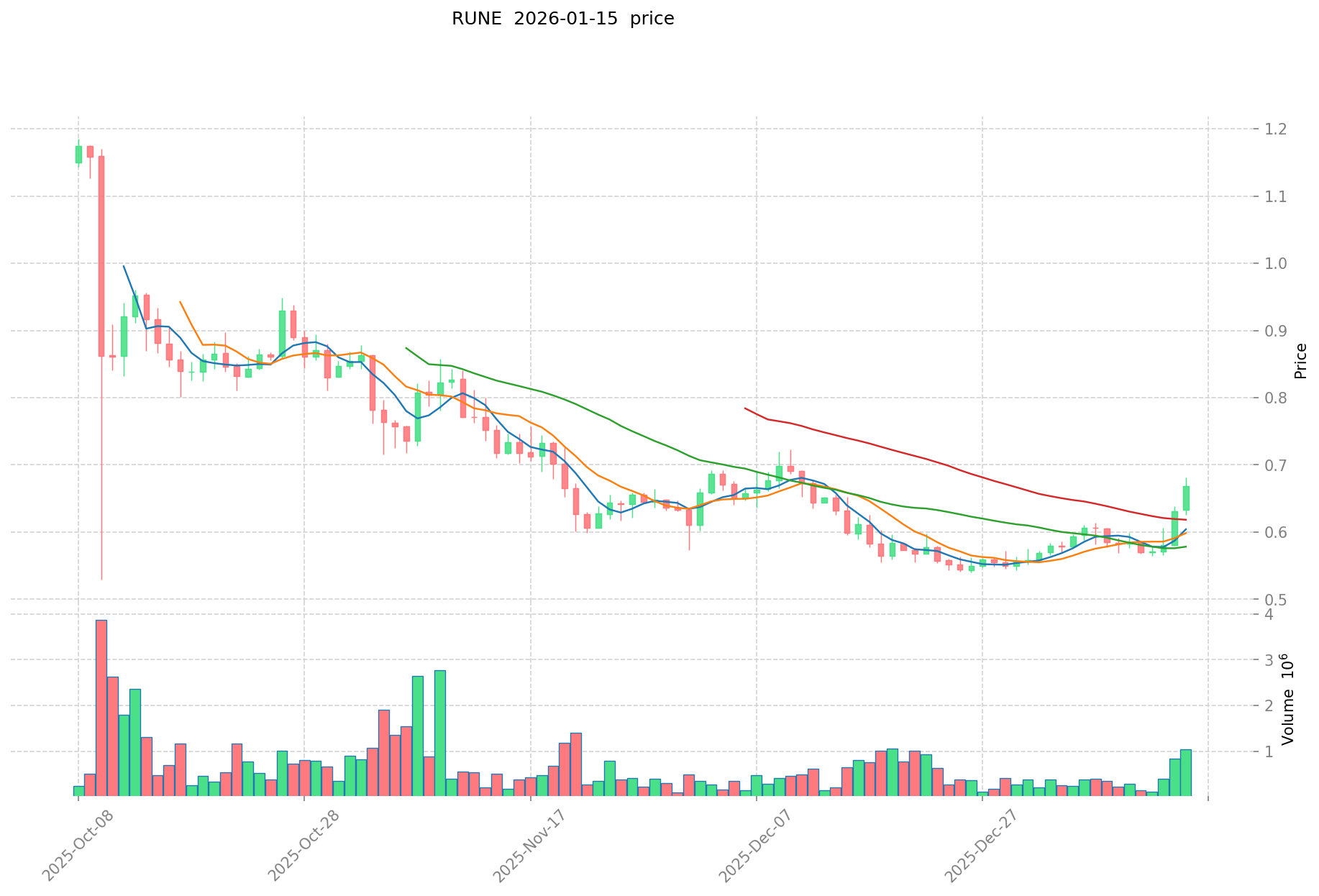
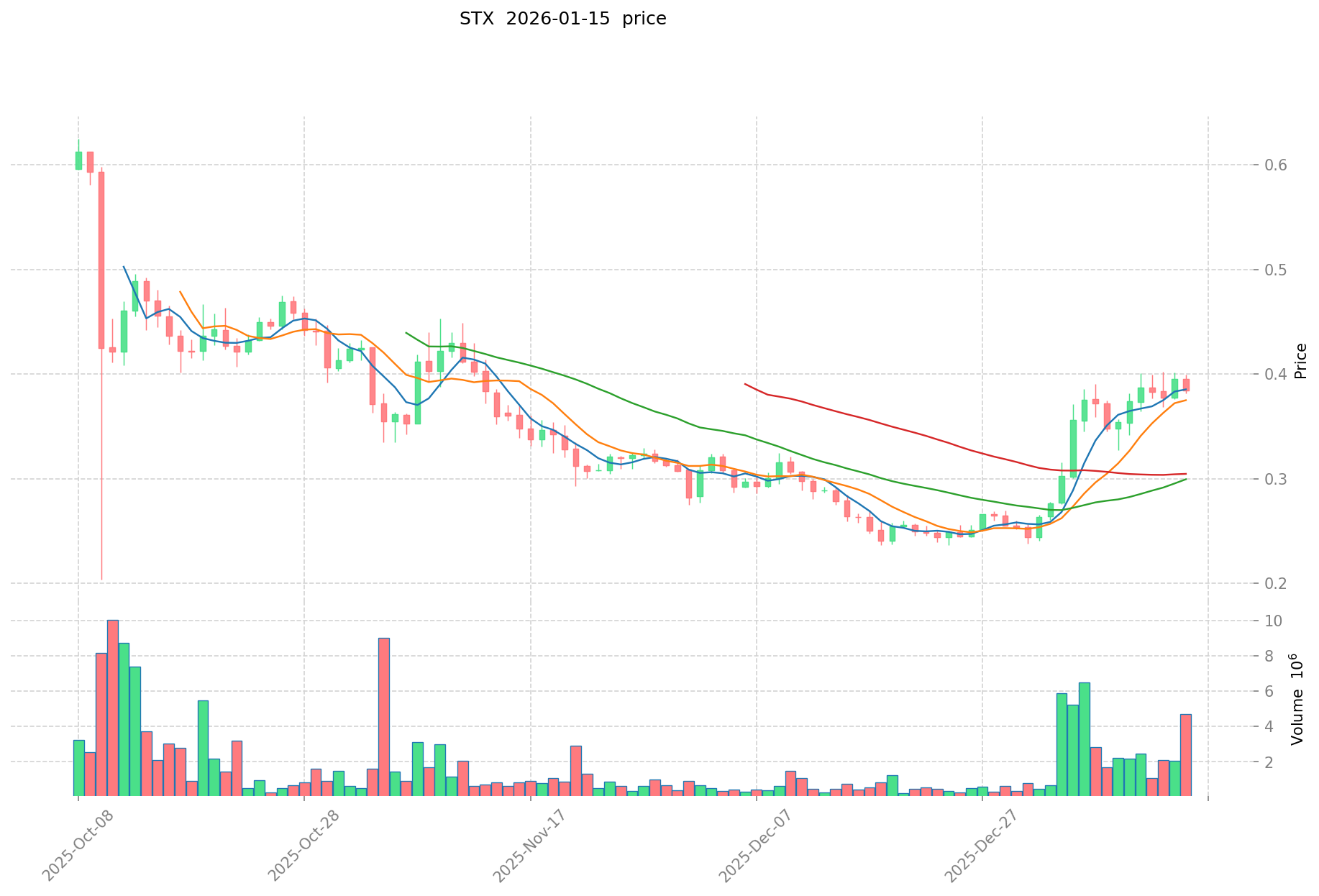
II. Core Factors Influencing RUNE vs STX Investment Value
Tokenomics Comparison
-
RUNE: Operates within Bitcoin's UTXO model through the Runes protocol, designed as a fungible token standard that addresses limitations of earlier BRC-20 implementations. The protocol aims to reduce blockchain bloat while maintaining compatibility with Bitcoin's native transaction structure.
-
STX: Features a Proof of Transfer (PoX) consensus mechanism where miners stake BTC on the Bitcoin mainchain to mine STX, while transaction validators stake STX to earn BTC rewards. This dual-token economic model creates a direct correlation between STX value and Bitcoin network activity.
-
📌 Historical Pattern: STX demonstrates higher beta correlation with overall market movements, experiencing independent price action primarily during specific catalysts such as regulatory narratives or ecosystem developments.
Institutional Adoption and Market Applications
-
Institutional Positioning: STX serves as a primary vehicle for Bitcoin Layer 2 exposure in secondary markets, offering accessible entry points for retail participants during Bitcoin ecosystem expansion periods. The staking mechanism allowing STX holders to earn BTC yields positions it as a "proxy" for Bitcoin exposure.
-
Enterprise Application: Stacks ecosystem supports DeFi protocols including ALEX and Arkadiko, which have issued tokens and could benefit from capital inflows if Bitcoin Layer 2 development accelerates. The platform enables smart contract functionality while maintaining connection to Bitcoin's security model.
-
Regulatory Environment: Both protocols navigate evolving regulatory frameworks, with their positioning within Bitcoin's ecosystem influencing how different jurisdictions approach their classification and treatment.
Technical Development and Ecosystem Building
-
RUNE Technical Evolution: Built on Bitcoin's Taproot upgrade (BIP 340, 341, 342), incorporating Schnorr signatures for enhanced privacy and efficiency. The protocol operates as an asset issuance standard within the broader category including Ordinals, Atomicals, PIPE, and Taproot Assets.
-
STX Technical Progress: Functions as a Bitcoin Layer 2 solution with smart contract capabilities through sidechains connected to the Bitcoin blockchain. The platform enables more complex functionality including Turing-complete smart contracts while maintaining Bitcoin mainchain security properties.
-
Ecosystem Comparison: Stacks demonstrates more mature infrastructure with established DeFi protocols and lower-market-cap projects that could experience substantial growth with ecosystem expansion. The platform addresses Bitcoin's scalability challenges while providing developers with tools for building decentralized applications. RUNE focuses on improving Bitcoin's native asset issuance capabilities with lighter-weight implementation compared to predecessor standards.
Macroeconomic Context and Market Cycles
-
Performance in Economic Environments: Both assets operate within Bitcoin's broader ecosystem dynamics, with their value influenced by Bitcoin adoption trends, halving cycles, and institutional interest in blockchain technology. The relationship between Bitcoin mining economics and fee generation affects long-term sustainability considerations.
-
Monetary Policy Impact: Interest rate changes, dollar strength fluctuations, and broader cryptocurrency market sentiment influence both assets through their connection to Bitcoin price movements and overall risk appetite in digital asset markets.
-
Market Structure Factors: Bitcoin ecosystem development faces challenges related to network efficiency, transaction costs, and balancing innovation with maintaining core security properties. Solutions addressing these challenges through Layer 2 technologies and alternative asset standards compete for adoption and network effects.
III. 2026-2031 Price Forecast: RUNE vs STX
Short-term Forecast (2026)
- RUNE: Conservative $0.570276 - $0.6789 | Optimistic $0.6789 - $0.828258
- STX: Conservative $0.332601 - $0.3823 | Optimistic $0.3823 - $0.489344
Mid-term Forecast (2028-2029)
- RUNE may enter a consolidation phase, with projected price range of $0.6725692575 - $1.33706768391
- STX may enter a growth phase, with projected price range of $0.2831099712 - $0.6882501024
- Key drivers: institutional capital inflows, ETF developments, ecosystem expansion
Long-term Forecast (2030-2031)
- RUNE: Baseline scenario $0.5959501676856 - $1.14605801478 | Optimistic scenario $1.14605801478 - $1.72367125422912
- STX: Baseline scenario $0.5895087882852 - $0.620535566616 | Optimistic scenario $0.76636142477076 - $1.011597080697403
View detailed price predictions for RUNE and STX
Disclaimer
RUNE:
| Year |
Predicted High Price |
Predicted Average Price |
Predicted Low Price |
Price Change |
| 2026 |
0.828258 |
0.6789 |
0.570276 |
0 |
| 2027 |
1.03993902 |
0.753579 |
0.46721898 |
10 |
| 2028 |
1.0133376813 |
0.89675901 |
0.6725692575 |
31 |
| 2029 |
1.33706768391 |
0.95504834565 |
0.6780843254115 |
40 |
| 2030 |
1.547178319953 |
1.14605801478 |
0.5959501676856 |
68 |
| 2031 |
1.72367125422912 |
1.3466181673665 |
1.05036217054587 |
98 |
STX:
| Year |
Predicted High Price |
Predicted Average Price |
Predicted Low Price |
Price Change |
| 2026 |
0.489344 |
0.3823 |
0.332601 |
0 |
| 2027 |
0.54041928 |
0.435822 |
0.22226922 |
13 |
| 2028 |
0.6882501024 |
0.48812064 |
0.2831099712 |
27 |
| 2029 |
0.652885762032 |
0.5881853712 |
0.570539810064 |
53 |
| 2030 |
0.91218728292552 |
0.620535566616 |
0.5895087882852 |
62 |
| 2031 |
1.011597080697403 |
0.76636142477076 |
0.597761911321192 |
100 |
IV. Investment Strategy Comparison: RUNE vs STX
Long-term vs Short-term Investment Strategies
-
RUNE: May appeal to investors focused on Bitcoin-native asset standards and protocol-level infrastructure development within the Bitcoin ecosystem. The token's positioning within Bitcoin's UTXO model and connection to Taproot technical upgrades suggests alignment with long-term Bitcoin adoption trends.
-
STX: May suit investors seeking exposure to Bitcoin Layer 2 development and smart contract functionality expansion. The PoX mechanism enabling BTC yield generation through STX staking offers a distinct value proposition combining growth potential with income generation characteristics.
Risk Management and Asset Allocation
-
Conservative Investors: Consider balanced exposure with emphasis on correlation analysis—RUNE 40% vs STX 60%, acknowledging STX's more established ecosystem infrastructure and institutional positioning as Bitcoin Layer 2 proxy.
-
Aggressive Investors: May explore higher RUNE allocation at 60% vs STX 40%, capitalizing on potential upside from Bitcoin asset standard development and lower current price levels relative to historical ranges.
-
Hedging Instruments: Stablecoin reserves for market volatility management, correlation-based portfolio construction with Bitcoin and broader crypto market indices, periodic rebalancing based on ecosystem development milestones.
V. Potential Risk Comparison
Market Risks
-
RUNE: Exposure to Bitcoin ecosystem adoption velocity, competition from alternative asset issuance standards (Ordinals, Atomicals, Taproot Assets), liquidity constraints in secondary markets, and correlation with broader cryptocurrency market sentiment shifts.
-
STX: Beta correlation with Bitcoin price movements creates amplified volatility, dependency on Layer 2 narrative strength within institutional and retail markets, competition from alternative Bitcoin scaling solutions, and sensitivity to changes in staking participation rates affecting tokenomics.
Technical Risks
-
RUNE: Protocol maturity considerations relative to competing Bitcoin asset standards, network effect challenges in achieving widespread adoption, technical implementation complexity within Bitcoin's conservative upgrade environment.
-
STX: Sidechain security model dependencies, complexity in maintaining Bitcoin mainchain connection while enabling smart contract functionality, potential technical trade-offs between decentralization and performance optimization.
Regulatory Risks
- Both protocols face evolving regulatory frameworks surrounding cryptocurrency assets, with their positioning within Bitcoin's ecosystem potentially influencing classification approaches. Staking mechanisms, yield generation features, and smart contract capabilities introduce varied regulatory considerations across different jurisdictions. Changes in securities law interpretation, DeFi regulation, and cross-border transaction policies could impact adoption trajectories and institutional participation levels differently for each protocol.
VI. Conclusion: Which Is the Better Buy?
📌 Investment Value Summary:
-
RUNE Characteristics: Positioned as Bitcoin-native asset standard with technical foundation in Taproot upgrades, addressing blockchain efficiency concerns through lighter-weight implementation compared to predecessor protocols. Current price levels reflect substantial adjustment from previous market cycle peaks, with projected recovery scenarios ranging from conservative consolidation to optimistic growth trajectories through 2031.
-
STX Characteristics: Established Bitcoin Layer 2 infrastructure with smart contract capabilities and mature DeFi ecosystem components including ALEX and Arkadiko. PoX consensus mechanism creates direct Bitcoin correlation while enabling staking yields, positioning the asset as accessible vehicle for Bitcoin ecosystem exposure with institutional adoption supporting secondary market liquidity.
✅ Investment Considerations:
-
New Investors: May prioritize understanding fundamental differences between Bitcoin asset standards and Layer 2 solutions before allocation decisions. STX offers more established infrastructure and clearer institutional positioning, while RUNE represents exposure to evolving Bitcoin-native protocol development. Consider starting with smaller position sizes and gradual accumulation strategies aligned with risk tolerance.
-
Experienced Investors: Could evaluate relative value based on ecosystem development momentum, technical roadmap execution, and correlation analysis with broader Bitcoin adoption trends. Portfolio construction may incorporate both assets with weighting adjusted for conviction levels regarding Bitcoin Layer 2 growth versus native asset standard adoption. Monitor ecosystem metrics including developer activity, protocol usage, and institutional participation indicators.
-
Institutional Participants: May assess STX's more mature market structure and established positioning as Bitcoin Layer 2 proxy against RUNE's earlier-stage protocol development. Due diligence considerations include regulatory classification implications, liquidity depth for position sizing, custody solution availability, and alignment with institutional mandate parameters regarding blockchain infrastructure exposure.
⚠️ Risk Disclosure: Cryptocurrency markets exhibit substantial volatility with potential for significant capital loss. This analysis does not constitute investment advice. Conduct independent research and consult qualified financial advisors before making investment decisions.
VII. FAQ
Q1: What is the fundamental difference between RUNE and STX in terms of their Bitcoin ecosystem positioning?
RUNE operates as a Bitcoin-native asset issuance standard within the UTXO model, while STX functions as a Bitcoin Layer 2 smart contract platform with sidechains. RUNE was built on Bitcoin's Taproot upgrade (BIP 340, 341, 342) and focuses on improving fungible token standards to reduce blockchain bloat compared to earlier BRC-20 implementations. It operates at the protocol level within Bitcoin's conservative technical environment. Conversely, STX employs a Proof of Transfer (PoX) consensus mechanism that creates a dual-token economic model—miners stake BTC to mine STX, while validators stake STX to earn BTC rewards. This architecture enables Turing-complete smart contracts and supports DeFi protocols like ALEX and Arkadiko, addressing Bitcoin's scalability challenges while maintaining connection to mainchain security properties.
Q2: How do the tokenomics of RUNE and STX differ, and what implications does this have for investors?
STX features a unique PoX mechanism creating direct Bitcoin correlation with yield generation capabilities, while RUNE operates within Bitcoin's native UTXO structure as a fungible token standard. The STX tokenomics model allows holders to earn BTC yields through staking, positioning it as both a growth asset and income-generating instrument. This dual functionality makes STX sensitive to staking participation rates and Bitcoin network activity levels. RUNE's tokenomics align more directly with Bitcoin's native transaction structure and Taproot technical implementations, focusing on protocol-level efficiency improvements. For investors, STX offers clearer yield generation mechanisms and established institutional positioning as a Bitcoin Layer 2 proxy, while RUNE represents exposure to evolving Bitcoin-native protocol development with potential upside tied to asset standard adoption rates.
Q3: Which asset demonstrates better price performance potential between 2026-2031?
Based on forecasting models, RUNE shows higher potential percentage gains with projected ranges from $0.570276-$0.828258 in 2026 to $1.05036217-$1.72367125 by 2031 (approximately 98% growth from 2026 baseline). STX forecasts indicate growth from $0.332601-$0.489344 in 2026 to $0.597761911-$1.011597080 by 2031 (approximately 100% growth from 2026 baseline). However, these projections depend heavily on ecosystem development momentum—RUNE's upside correlates with Bitcoin asset standard adoption velocity and competition with alternative protocols like Ordinals and Atomicals, while STX growth ties to Layer 2 narrative strength, institutional capital inflows, and DeFi ecosystem expansion within Stacks infrastructure. Historical patterns show STX demonstrates higher beta correlation with overall market movements, suggesting amplified volatility in both directions.
Q4: What are the primary risk factors investors should consider when choosing between RUNE and STX?
RUNE faces protocol maturity risks including competition from alternative Bitcoin asset standards (Ordinals, Atomicals, Taproot Assets), network effect challenges in achieving widespread adoption, and liquidity constraints in secondary markets due to its earlier development stage. STX encounters different risk vectors including sidechain security model dependencies, complexity in maintaining Bitcoin mainchain connection while enabling smart contracts, and sensitivity to changes in Layer 2 narrative strength. Both assets face regulatory uncertainties—STX's staking mechanisms and yield generation features introduce varied regulatory considerations across jurisdictions, while RUNE's positioning as a Bitcoin-native protocol may influence classification approaches differently. Market risk profiles differ substantially: STX exhibits amplified volatility through Bitcoin beta correlation, while RUNE correlates more closely with Bitcoin ecosystem adoption velocity and technical development milestones.
Q5: How should different investor profiles approach allocation between RUNE and STX?
Conservative investors may consider balanced exposure with emphasis on STX (60%) versus RUNE (40%), acknowledging STX's more established ecosystem infrastructure, mature DeFi protocols, and institutional positioning as a Bitcoin Layer 2 proxy with clearer liquidity profiles. Aggressive investors could explore higher RUNE allocation (60%) versus STX (40%), capitalizing on potential upside from Bitcoin asset standard development and lower current price levels relative to historical ranges ($0.68 versus $20.87 peak). New investors should prioritize understanding fundamental differences between Bitcoin asset standards and Layer 2 solutions before allocation decisions, potentially starting with smaller position sizes in STX given its more established market structure. Experienced investors could evaluate relative value through ecosystem metrics including developer activity, protocol usage, and institutional participation indicators, incorporating both assets with weighting adjusted for conviction levels regarding Bitcoin Layer 2 growth versus native asset standard adoption trajectories.
Q6: What role do macroeconomic factors play in RUNE vs STX investment decisions?
Both assets operate within Bitcoin's broader ecosystem dynamics, making them sensitive to Bitcoin adoption trends, halving cycles, and institutional interest in blockchain technology. Interest rate changes and dollar strength fluctuations influence risk appetite in digital asset markets, affecting both protocols through their connection to Bitcoin price movements. However, their sensitivities differ—STX's established positioning as a Bitcoin Layer 2 proxy means it responds more directly to institutional capital flows and ETF developments, while RUNE's correlation ties more closely to Bitcoin ecosystem technical development momentum and native protocol adoption rates. The relationship between Bitcoin mining economics and fee generation affects long-term sustainability considerations for both protocols, particularly impacting STX's PoX mechanism which relies on Bitcoin network activity for its dual-token economic model functionality.
Q7: How does the current market sentiment (Fear & Greed Index: 61) affect RUNE and STX investment timing?
The current Fear & Greed Index reading of 61 indicates "Greed" sentiment in cryptocurrency markets, suggesting elevated risk appetite among participants. In this environment, STX may benefit more immediately due to its higher beta correlation with overall market movements and established institutional positioning—greedy market conditions typically amplify capital flows into recognized Layer 2 narratives. RUNE's response may be more muted initially but could demonstrate stronger momentum if the sentiment translates into increased Bitcoin ecosystem development activity and asset standard adoption. For investment timing considerations, greedy market conditions warrant enhanced risk management—conservative investors might delay new position entries or reduce allocation sizes, while aggressive investors could view current price levels ($0.68 RUNE, $0.3824 STX) as entry opportunities with tight stop-loss parameters. Both assets have experienced substantial adjustments from previous cycle peaks, offering potential value relative to historical ranges, though elevated sentiment indices historically precede increased volatility periods.
Q8: What ecosystem development factors should investors monitor to evaluate RUNE vs STX investment theses?
For STX, key monitoring factors include DeFi protocol growth metrics within Stacks ecosystem (ALEX, Arkadiko TVL and user adoption), institutional participation indicators in Bitcoin Layer 2 markets, staking participation rates affecting tokenomics, and smart contract deployment activity demonstrating developer engagement. Regulatory developments regarding staking mechanisms and yield generation features across different jurisdictions will influence institutional adoption trajectories. For RUNE, critical factors include adoption velocity relative to competing Bitcoin asset standards (Ordinals, Atomicals, Taproot Assets market share comparisons), protocol implementation progress within Bitcoin's conservative upgrade environment, liquidity depth improvements in secondary markets, and technical milestone achievements tied to Taproot functionality expansion. Both assets require monitoring of Bitcoin mainchain developments including fee dynamics, network congestion patterns, and Layer 2 scaling solution competition, as these ecosystem-level factors fundamentally impact value propositions for Bitcoin-native protocols and sidechain infrastructures.
* The information is not intended to be and does not constitute financial advice or any other recommendation of any sort offered or endorsed by Gate.