This comprehensive analysis compares Ravencoin (RVN) and Cronos (CRO), two established cryptocurrency projects with distinct use cases and market positioning. RVN focuses on decentralized asset transfer through a community-driven peer-to-peer network, while CRO functions as an exchange-backed token integrated within Crypto.com's ecosystem serving over 100 million users. The article examines historical price performance, tokenomics differences, institutional adoption levels, and technical development trajectories. Current prices stand at $0.007479 for RVN and $0.10155 for CRO as of January 2026, with forecasts through 2031 provided. Investment recommendations differentiate by investor type, with conservative investors favoring CRO's established infrastructure and liquidity, while experienced investors may diversify across both assets. Risk analysis addresses market volatility, regulatory uncertainties, and platform-specific concerns for comprehensive decision-making guidance.
Introduction: Investment Comparison Between RVN and CRO
In the cryptocurrency market, the comparison between Ravencoin and Cronos has been a topic of interest among investors. The two projects demonstrate notable differences in market capitalization ranking, application scenarios, and price performance, representing distinct positioning within the crypto asset landscape.
Ravencoin (RVN): Launched in 2018, this digital peer-to-peer network focuses on asset transfer functionality, operating as an open-source project without ICO or masternodes. It has built a community-driven ecosystem centered on efficient asset movement between parties.
Cronos (CRO): Established in 2018, this blockchain ecosystem has partnered with Crypto.com and over 500 application developers, serving an addressable user base of more than 100 million people globally. Its mission centers on unlocking the future of finance through self-custody and Web3 adoption, with emphasis on decentralized finance and gaming.
This article will provide a comprehensive analysis of the investment value comparison between Ravencoin and Cronos, examining historical price trends, supply mechanisms, institutional adoption, technological ecosystems, and future projections, while addressing the key question investors frequently consider:
"Which is the better buy right now?"
I. Historical Price Comparison and Current Market Status
RVN and CRO Historical Price Trends
-
2021: RVN reached a peak price of $0.285218 in February 2021 during the broader cryptocurrency market rally. This represented a significant appreciation from earlier price levels.
-
2021: CRO achieved its historical high of $0.965407 in November 2021, benefiting from increased adoption of the Crypto.com platform and expanding ecosystem partnerships.
-
Comparative Analysis: During the 2021-2025 market cycle, RVN declined from its high of $0.285218 to a low of $0.00607508 recorded in October 2025, representing a substantial correction. In comparison, CRO dropped from its peak of $0.965407 to $0.0121196 in February 2019, though it has shown relative resilience with price levels around $0.10 as of January 2026.
Current Market Status (2026-01-17)
- RVN Current Price: $0.007479
- CRO Current Price: $0.10155
- 24-Hour Trading Volume: RVN recorded $86,537.96 compared to CRO's $428,552.14
- Market Sentiment Index (Fear & Greed Index): 49 (Neutral)
View real-time prices:

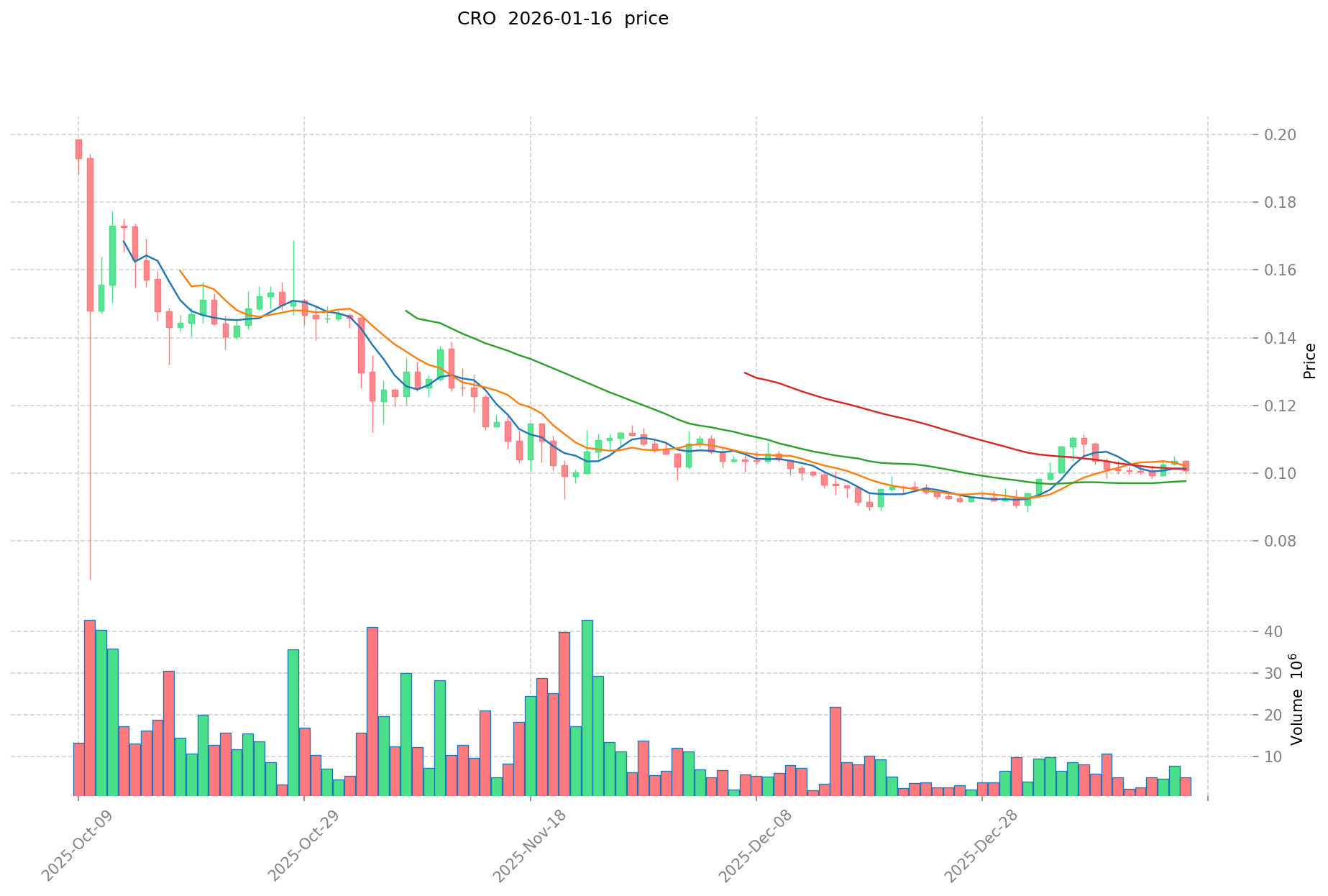
II. Core Factors Influencing RVN vs CRO Investment Value
Tokenomics Comparison
- RVN: Features a proof-of-work consensus mechanism with a capped supply model designed to ensure network security through mining incentives.
- CRO: Operates within the Crypto.com ecosystem with a deflationary mechanism through token burns and staking rewards to maintain network participation.
- 📌 Historical Pattern: Supply mechanisms influence price cycles through miner rewards, staking yields, and token burn events that affect circulating supply.
Institutional Adoption and Market Application
- Institutional Holdings: Both assets demonstrate varying levels of institutional interest, with adoption patterns tied to their respective ecosystem developments and use cases.
- Enterprise Adoption: RVN focuses on asset transfer and tokenization applications, while CRO integrates into payment solutions and DeFi services within the Crypto.com platform.
- Regulatory Environment: Both cryptocurrencies face evolving regulatory frameworks across different jurisdictions, affecting their adoption trajectories.
Technical Development and Ecosystem Building
- RVN Technical Evolution: Continues development on blockchain infrastructure focused on asset creation and transfer capabilities.
- CRO Technical Progress: Advances through integration with DeFi protocols and expansion of payment network functionalities.
- Ecosystem Comparison: RVN emphasizes decentralized asset management, while CRO develops within a centralized exchange ecosystem with DeFi and payment applications.
Macroeconomic Factors and Market Cycles
- Inflation Environment Performance: Both assets respond to macroeconomic conditions through different mechanisms—RVN through mining economics and CRO through platform utility demand.
- Monetary Policy Impact: Interest rate changes and currency fluctuations affect investment flows into both cryptocurrencies through risk appetite shifts.
- Geopolitical Considerations: Cross-border transaction demands and regulatory developments influence adoption patterns for both assets in different market contexts.
III. 2026-2031 Price Forecast: RVN vs CRO
Short-term Forecast (2026)
- RVN: Conservative $0.00667411 - $0.007499 | Optimistic $0.007499 - $0.00802393
- CRO: Conservative $0.0752654 - $0.10171 | Optimistic $0.10171 - $0.1190007
Mid-term Forecast (2028-2029)
- RVN may enter a gradual expansion phase, with estimated price range of $0.0048392734275 - $0.012130723510762
- CRO may enter a moderate growth phase, with estimated price range of $0.070726743815 - $0.16096431351
- Key drivers: institutional capital inflows, ETF developments, ecosystem expansion
Long-term Forecast (2030-2031)
- RVN: Baseline scenario $0.007341142704785 - $0.010591751125068 | Optimistic scenario $0.012657142594457 - $0.016580856798738
- CRO: Baseline scenario $0.113791038697336 - $0.1475506207175 | Optimistic scenario $0.177798497964587 - $0.208046375211675
View detailed price predictions for RVN and CRO
Disclaimer
RVN:
| Year |
Predicted High Price |
Predicted Average Price |
Predicted Low Price |
Price Change |
| 2026 |
0.00802393 |
0.007499 |
0.00667411 |
0 |
| 2027 |
0.00892568475 |
0.007761465 |
0.0065196306 |
3 |
| 2028 |
0.00976198260375 |
0.008343574875 |
0.0048392734275 |
11 |
| 2029 |
0.012130723510762 |
0.009052778739375 |
0.008781195377193 |
21 |
| 2030 |
0.014722534063845 |
0.010591751125068 |
0.00932074099006 |
41 |
| 2031 |
0.016580856798738 |
0.012657142594457 |
0.007341142704785 |
69 |
CRO:
| Year |
Predicted High Price |
Predicted Average Price |
Predicted Low Price |
Price Change |
| 2026 |
0.1190007 |
0.10171 |
0.0752654 |
0 |
| 2027 |
0.1335299735 |
0.11035535 |
0.0805594055 |
8 |
| 2028 |
0.1463311941 |
0.12194266175 |
0.070726743815 |
20 |
| 2029 |
0.16096431351 |
0.134136927925 |
0.1153577580155 |
32 |
| 2030 |
0.208046375211675 |
0.1475506207175 |
0.128369040024225 |
45 |
| 2031 |
0.208024242618567 |
0.177798497964587 |
0.113791038697336 |
75 |
IV. Investment Strategy Comparison: RVN vs CRO
Long-term vs Short-term Investment Strategies
-
RVN: Suitable for investors focused on asset tokenization and decentralized transfer mechanisms, with a community-driven development approach that may appeal to those seeking alternative blockchain applications beyond mainstream financial services.
-
CRO: Suitable for investors interested in ecosystem integration within centralized exchange platforms, DeFi applications, and payment solutions, particularly those who value the backing of established infrastructure and a large addressable user base.
Risk Management and Asset Allocation
-
Conservative Investors: RVN 20-30% vs CRO 70-80% - This allocation reflects CRO's relatively established ecosystem and higher trading volumes, which may provide more liquidity options.
-
Aggressive Investors: RVN 40-50% vs CRO 50-60% - A more balanced approach for those seeking exposure to both asset transfer technologies and exchange-backed ecosystems.
-
Hedging Tools: Stablecoin allocation for liquidity management, options contracts where available, and cross-asset portfolio diversification to mitigate cryptocurrency market volatility.
V. Potential Risk Comparison
Market Risks
-
RVN: Exposure to mining profitability fluctuations, lower liquidity compared to major cryptocurrencies with 24-hour trading volume of $86,537.96, and dependency on continued community development without institutional backing.
-
CRO: Platform-specific risks tied to Crypto.com operational performance, regulatory scrutiny facing centralized exchanges, and potential impact from competitive pressure in the exchange-backed token sector.
Technical Risks
-
RVN: Network scalability considerations for asset transfer applications, dependency on proof-of-work mining infrastructure, and potential security considerations inherent to blockchain networks.
-
CRO: Integration complexity across multiple DeFi protocols and payment networks, dependency on centralized exchange infrastructure reliability, and potential technical challenges in maintaining interoperability across expanding ecosystem partnerships.
Regulatory Risks
- Regulatory frameworks continue to evolve across different jurisdictions, with potential differential impact on decentralized asset transfer protocols like RVN versus exchange-backed tokens like CRO. Centralized exchange tokens may face heightened regulatory scrutiny regarding securities classification, while asset-focused blockchains encounter varying approaches to digital asset regulation across markets.
VI. Conclusion: Which Is the Better Buy?
📌 Investment Value Summary:
-
RVN Advantages: Focuses on decentralized asset transfer and tokenization capabilities, operates as a community-driven open-source project, and maintains a specific use case in blockchain-based asset management.
-
CRO Advantages: Benefits from integration within an established exchange ecosystem with over 100 million addressable users, demonstrates higher trading volumes ($428,552.14 in 24-hour volume), and offers multiple utility applications across DeFi and payment sectors.
✅ Investment Recommendations:
-
Novice Investors: Consider starting with CRO due to its established ecosystem infrastructure, higher liquidity profiles, and integration within a recognized platform that may provide more accessible entry points and educational resources.
-
Experienced Investors: May explore diversified exposure to both assets based on investment thesis - RVN for asset tokenization trends and CRO for exchange ecosystem growth, while maintaining appropriate position sizing relative to overall portfolio risk tolerance.
-
Institutional Investors: Should conduct comprehensive due diligence on regulatory implications, liquidity depth for position management, and alignment with institutional investment mandates before considering allocation to either asset class.
⚠️ Risk Disclaimer: Cryptocurrency markets exhibit substantial volatility characteristics. This analysis does not constitute investment advice. Market participants should conduct independent research and consult qualified financial advisors before making investment decisions.
VII. FAQ
Q1: What is the main difference between RVN and CRO in terms of use cases?
RVN focuses on decentralized asset transfer and tokenization, while CRO operates as an exchange-backed token with DeFi and payment applications. RVN operates as a peer-to-peer network specifically designed for efficient asset movement and creation without centralized infrastructure, making it suitable for blockchain-based asset management applications. In contrast, CRO functions within the Crypto.com ecosystem, providing utility across payment solutions, staking rewards, and DeFi protocols, benefiting from integration with over 500 application developers and an addressable user base exceeding 100 million people globally.
Q2: Which cryptocurrency has shown better price resilience since the 2021 market peak?
CRO has demonstrated relatively stronger price resilience compared to RVN. While RVN declined from its February 2021 peak of $0.285218 to approximately $0.007479 (as of January 2026), representing a significant correction to $0.00607508 at its October 2025 low, CRO has maintained price levels around $0.10155 despite falling from its November 2021 high of $0.965407. This relative stability reflects CRO's ecosystem integration and higher trading volumes ($428,552.14 versus RVN's $86,537.96 in 24-hour volume), which may provide better liquidity cushions during market downturns.
Q3: What are the key risk factors investors should consider when comparing RVN and CRO?
RVN faces risks related to mining profitability fluctuations, lower liquidity, and dependency on community-driven development without institutional backing. CRO encounters platform-specific risks tied to Crypto.com's operational performance and regulatory scrutiny of centralized exchanges. Additionally, both assets face evolving regulatory frameworks across jurisdictions, with CRO potentially subject to heightened scrutiny regarding securities classification, while RVN encounters varying approaches to digital asset regulation in different markets. Market participants should also consider technical risks including RVN's network scalability and CRO's integration complexity across multiple protocols.
Q4: How do the tokenomics differ between RVN and CRO?
RVN employs a proof-of-work consensus mechanism with a capped supply model designed to ensure network security through mining incentives. CRO operates with a deflationary mechanism involving token burns and staking rewards to maintain network participation within the Crypto.com ecosystem. These fundamental differences mean that RVN's price dynamics are influenced by mining economics and hash rate considerations, while CRO's value proposition relates to platform utility demand, staking yields, and periodic token burn events that reduce circulating supply over time.
Q5: What is the projected price outlook for RVN and CRO through 2031?
Short-term forecasts for 2026 project RVN between $0.00667411-$0.00802393 and CRO between $0.0752654-$0.1190007. By 2031, baseline scenarios estimate RVN ranging from $0.007341142704785 to $0.010591751125068, with optimistic scenarios reaching $0.012657142594457-$0.016580856798738. For CRO, baseline 2031 projections range from $0.113791038697336 to $0.1475506207175, with optimistic scenarios estimating $0.177798497964587-$0.208046375211675. These projections depend on various factors including institutional capital inflows, ecosystem expansion, ETF developments, and broader cryptocurrency market cycles.
Q6: Which asset is more suitable for conservative versus aggressive investors?
Conservative investors may consider allocating 20-30% to RVN and 70-80% to CRO, reflecting CRO's established ecosystem, higher trading volumes, and greater liquidity options. Aggressive investors might pursue a more balanced approach with 40-50% RVN and 50-60% CRO to gain exposure to both asset transfer technologies and exchange-backed ecosystems. The allocation reflects CRO's relatively lower volatility profile due to its integration within established infrastructure, while RVN offers exposure to alternative blockchain applications that may carry higher risk-reward characteristics for those seeking diversification beyond mainstream financial services.
Q7: What regulatory considerations should investors be aware of when choosing between RVN and CRO?
Regulatory frameworks continue evolving with differential impacts on decentralized protocols versus exchange-backed tokens. CRO may face heightened regulatory scrutiny as centralized exchange tokens encounter questions regarding securities classification, compliance requirements, and jurisdictional restrictions on exchange operations. RVN, operating as a decentralized asset transfer protocol, encounters varying regulatory approaches to digital asset classification across different markets but may benefit from its community-driven, non-ICO origin. Investors should monitor regulatory developments in their respective jurisdictions and consider how changing compliance landscapes might affect the operational viability and market access of each asset.
Q8: How do the ecosystems and institutional adoption levels compare between RVN and CRO?
CRO demonstrates significantly stronger institutional integration through its partnership with Crypto.com and over 500 application developers, providing access to an addressable user base exceeding 100 million people globally. This ecosystem includes DeFi protocols, payment networks, and gaming applications that drive utility demand. RVN maintains a community-driven ecosystem focused on asset tokenization and decentralized transfer mechanisms, with adoption patterns tied to specific use cases in blockchain-based asset management rather than broad institutional backing. The difference in ecosystem maturity and user base accessibility represents a key consideration for investors evaluating network effects and potential adoption trajectories.
* The information is not intended to be and does not constitute financial advice or any other recommendation of any sort offered or endorsed by Gate.