Discover an in-depth comparison between Astra Nova ($RVV) and Tezos ($XTZ) blockchain platforms. Understand their investment viability, historical price trends, and technical ecosystems. The article addresses key questions, offering analysis useful for both beginner and experienced investors seeking to navigate the crypto market complexities. Explore risks, supply dynamics, and strategic asset allocation tailored to current market sentiment. For up-to-date market metrics, visit Gate for real-time data on both RVV and XTZ.
Introduction: RVV vs XTZ Investment Comparison
In the cryptocurrency market, the comparison between Astra Nova and Tezos has always been a topic that investors cannot avoid. The two not only show obvious differences in market cap ranking, application scenarios, and price performance, but also represent different positioning of crypto assets.
Astra Nova ($RVV): As a Web3 MetaRPG project, it has gained market recognition through its gaming ecosystem and NFT utility features, including in-game transactions, NFT marketplace operations, and event participation mechanisms.
Tezos (XTZ): Since its launch in 2017, it has been recognized as a decentralized blockchain platform that simplifies formal verification and improves smart contract security through a self-evolving digital ledger architecture capable of absorbing best practices from various blockchain implementations.
This article will comprehensively analyze the investment value comparison between RVV and XTZ from the perspectives of historical price trends, supply mechanisms, market positioning, technical ecosystems, and provide insights to address investors' most pressing questions:
"Which is the better buy right now?"
Comparative Analysis Report: Astra Nova (RVV) vs. Tezos (XTZ)
I. Price History Comparison and Current Market Status
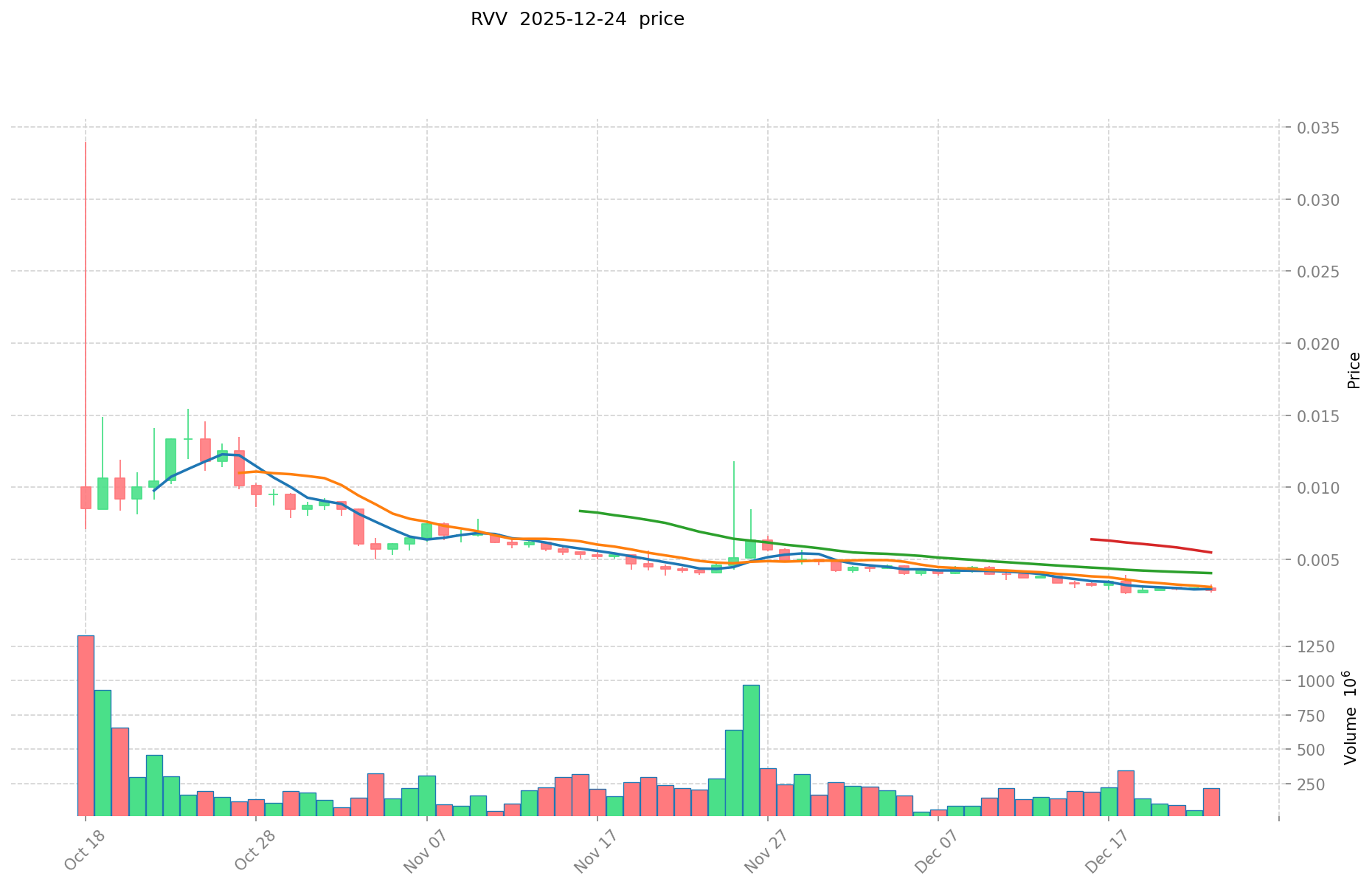
Historical Price Trends of RVV and XTZ
Astra Nova (RVV) Price Performance:
- All-time high: $0.0265727 (October 18, 2025)
- All-time low: $0.00256401 (December 25, 2025)
- Current price: $0.00262673 (as of December 25, 2025)
- Market ranking: #1712
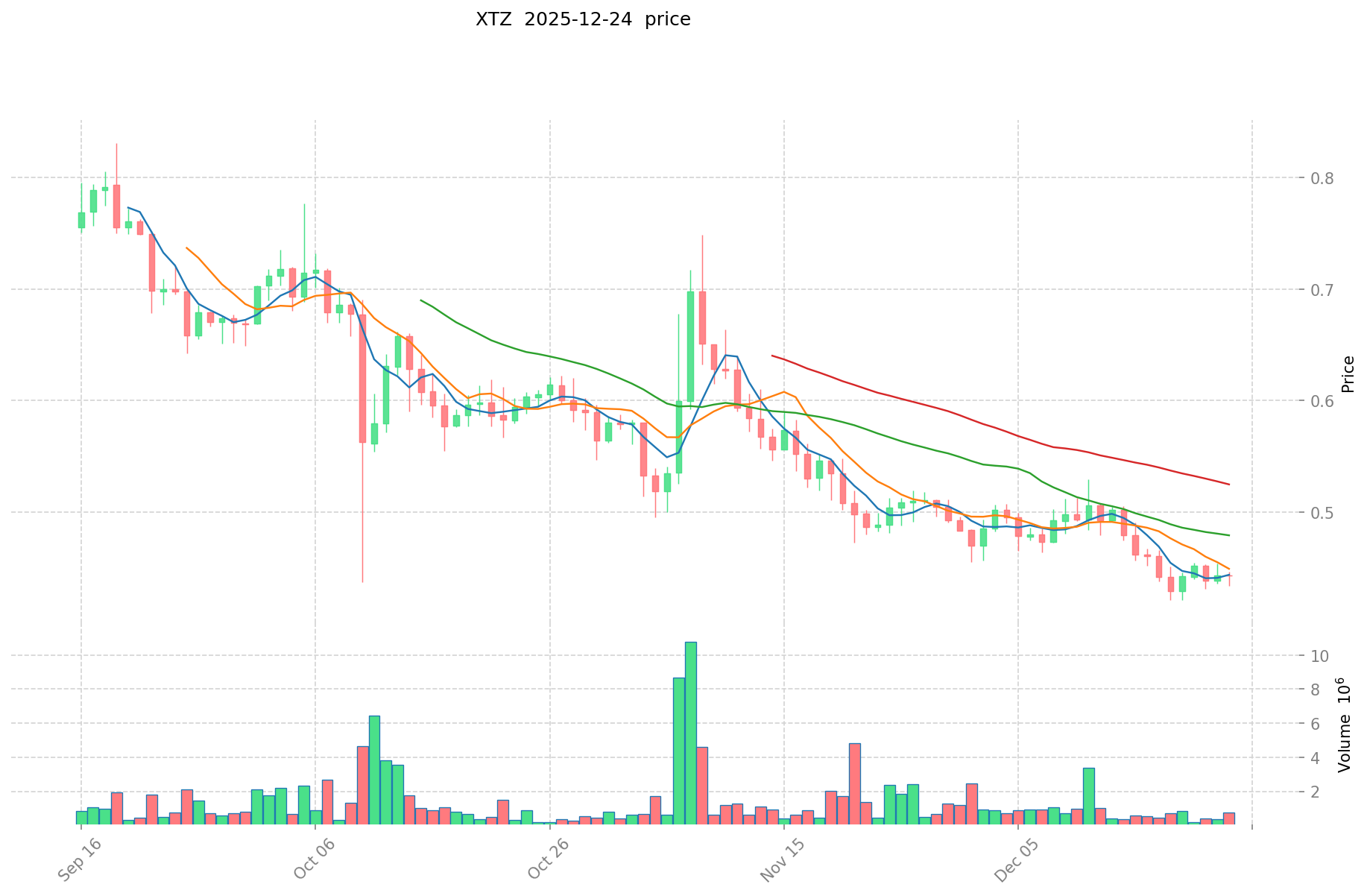
Tezos (XTZ) Price Performance:
- All-time high: $9.12 (October 4, 2021)
- All-time low: $0.350476 (December 7, 2018)
- Current price: $0.4348 (as of December 25, 2025)
- Market ranking: #125
- 1-year price change: -67.86%
Comparative Analysis
RVV demonstrates extreme volatility with a rapid decline from its peak of $0.0265727 in October 2025 to near its all-time low by December 2025, representing a decline of approximately 90% within a two-month period. In contrast, XTZ, as a more established platform, exhibits a longer price history spanning multiple market cycles, with its current price representing a significant discount from its 2021 peak of $9.12.
Current Market Status (December 25, 2025)
RVV Market Metrics:
- Current price: $0.00262673
- 24-hour trading volume: $5,626,199
- Market capitalization: $26,267,300
- Circulating supply: 1,436,171,705.7 RVV (14.36% of total supply)
- Total supply: 10,000,000,000 RVV
- 24-hour price change: -14.10%
- 7-day price change: -11.93%
- 30-day price change: -42.49%
XTZ Market Metrics:
- Current price: $0.4348
- 24-hour trading volume: $106,938.01
- Market capitalization: $473,875,192
- Circulating supply: 1,069,808,118 XTZ (98.16% of total supply)
- 24-hour price change: -1.27%
- 7-day price change: -2.01%
- 30-day price change: -14.54%
- 1-year price change: -67.86%
Market Sentiment Indicator:
- Crypto Fear & Greed Index: 24 (Extreme Fear)
For real-time price updates:
II. Project Overview and Fundamentals
Astra Nova (RVV)
Astra Nova is positioned as a Web3-native MetaRPG (Metaverse Role-Playing Game) platform created in collaboration with gaming communities. The project aims to provide an immersive gaming experience set within an interplanetary narrative universe.
RVV Token Utilities:
- All in-game transactions
- NFT Marketplace (buying and selling)
- NFT upgrades and power-ups
- Participation in events and tournaments
- Purchase, lease, or rental of land NFTs
- Governance fees (e.g., advertising, gaming licenses)
Project Information:
Tezos (XTZ)
Tezos is a decentralized, self-evolving blockchain platform designed to enable smart contracts and decentralized applications with emphasis on formal verification and governance.
Core Features:
- Self-amending protocol (no hard forks required for updates)
- Liquid Proof of Stake (LPoS) consensus mechanism
- Formal verification capabilities for contract validation
- On-chain governance allowing stakeholder voting
- Michelson smart contract language designed for security
XTZ Token Utilities:
- Value storage and P2P payments
- Transaction validation through "baking" (staking)
- Governance participation
- staking rewards while maintaining custody
Ecosystem Components:
- NFT marketplaces and projects
- DeFi (Decentralized Finance) platforms
- P2E (Play-to-Earn) gaming applications
- Smart contract verification platforms
- Multi-currency wallets
Project Information:
III. Technical and Market Comparison
Market Position and Adoption
RVV:
- Relatively new project with limited market penetration
- Market cap: $26.27 million (rank #1712)
- Limited exchange availability
- Concentrated trading activity
- Early-stage ecosystem development
XTZ:
- Established platform launched in 2018
- Market cap: $473.88 million (rank #125)
- Trading on 43+ exchanges
- 20,481 token holders
- Mature ecosystem with diverse applications
Price Volatility Analysis
RVV exhibits significantly higher volatility compared to XTZ:
- RVV 30-day decline: -42.49%
- XTZ 30-day decline: -14.54%
RVV's recent sharp decline to near all-time lows suggests heightened market risk, while XTZ's more gradual depreciation reflects broader market headwinds affecting the cryptocurrency sector over an extended period.
Token Supply and Circulation
RVV:
- Total supply: 10 billion tokens
- Circulating supply: ~1.44 billion tokens (14.36% circulating)
- Significant dilution potential as remaining tokens enter circulation
XTZ:
- Total supply: ~1.09 billion tokens
- Circulating supply: ~1.07 billion tokens (98.16% circulating)
- Limited supply expansion anticipated
IV. Risk Assessment and Market Context
RVV Risk Factors
- Extreme volatility: 90% decline from recent peak indicates instability
- Liquidity concerns: 24-hour volume of $5.6 million relative to market cap raises questions about trading depth
- Early-stage risk: Limited project history and operational track record
- Supply dilution: Significant percentage of tokens not yet in circulation
- Current sentiment: Operating during "Extreme Fear" market conditions
XTZ Risk Factors
- Market-wide headwinds: 67.86% 1-year decline reflects broader cryptocurrency sector challenges
- Competitive landscape: DeFi and smart contract platform competition intensifying
- Long-term underperformance: Significant gap between historical high ($9.12) and current price ($0.4348)
Market Sentiment Context
The current Crypto Fear & Greed Index reading of 24 ("Extreme Fear") indicates heightened market risk aversion, typically associated with:
- Increased price volatility across assets
- Reduced institutional participation
- Higher liquidation risks for leveraged positions
- Potential buying opportunities for contrarian investors
V. Key Observations
-
Scale Differential: XTZ operates at an institutional scale with 18x larger market capitalization and significantly broader exchange availability.
-
Risk-Return Profile: RVV offers higher potential returns but with substantially elevated volatility and execution risk, while XTZ represents a more conservative positioning within the crypto sector.
-
Maturity Gap: XTZ's established infrastructure, community, and multi-year operational history contrast sharply with RVV's nascent stage.
-
Liquidity Considerations: XTZ's substantially higher 24-hour trading volume ($106.9K) compared to RVV ($5.6M) indicates deeper market liquidity and lower slippage for larger trades.
-
Market Timing: Both assets are experiencing downward pressure within a market characterized by extreme fear sentiment, suggesting systemic factors beyond project-specific dynamics.
Disclaimer: This report is for informational purposes only and does not constitute investment advice, recommendations to buy or sell, or solicitations to engage in specific trading strategies. Cryptocurrency markets are highly volatile and speculative. Past performance does not guarantee future results. Investors should conduct comprehensive due diligence and consult with qualified financial advisors before making investment decisions.
RVV Investment Value Analysis Report
I. Executive Summary
RVV is the core token of Astra Nova, an AI-driven Web3 entertainment ecosystem. The token serves multiple functions including rewards, governance, and incentives. Market sentiment toward RVV presents both positive fundamental factors and potential risks, with long-term sustainability dependent on ecosystem development and platform adoption.
II. Core Factors Influencing RVV Investment Value
Supply Mechanism (Tokenomics)
-
RVV: The tokenomics framework is designed to ensure long-term sustainability. Token supply management includes partial token burning mechanisms to reduce circulating supply and increase demand pressure. Platform-generated revenue is shared among token holders, developers, and the community, creating a multi-stakeholder value distribution model.
-
📌 Sustainability Model: The deflationary supply mechanism combined with shared revenue streams creates incentive alignment between stakeholders and theoretically supports sustained token value over extended periods.
-
Core Functions: RVV serves as a utility token within the Astra Nova platform, providing diverse participation pathways and value creation mechanisms for users through rewards, governance participation, and incentive programs.
-
Ecosystem Focus: Astra Nova positions itself as an AI-driven entertainment platform within Web3, suggesting integration of artificial intelligence with entertainment and gaming applications.
-
Revenue Sharing Model: The platform generates revenue that is distributed among token holders, developers, and the community, establishing a profit-sharing mechanism that links token value to platform performance.
Market Sentiment & Fundamental Assessment
-
Positive Factors: Market analysis indicates RVV benefits from positive fundamental sentiment regarding its ecosystem development and revenue-sharing model architecture.
-
Risk Considerations: Potential risks exist in the current market environment, though specific risk factors require further detailed analysis from market sources.
Ecosystem Development Stage
- Current Status: RVV's long-term viability and investment attractiveness depend significantly on:
- Continued development and expansion of the Astra Nova platform
- Successful ecosystem adoption and user growth
- Effective execution of the revenue-sharing and token burn mechanisms
- Community engagement and governance participation levels
III. Investment Consideration Framework
Value Drivers
The investment value of RVV is contingent upon:
- Platform Development: Success of Astra Nova in delivering AI-driven entertainment services and achieving user adoption
- Token Utility: Active utilization of RVV across rewards, governance, and incentive functions
- Sustainable Economics: Effectiveness of the deflationary mechanism and revenue-sharing model in supporting token price appreciation
- Community Growth: Expansion of the user base and ecosystem participants
Risk Factors
- Ecosystem execution risk and product-market fit achievement
- Competition within the Web3 entertainment segment
- Market adoption challenges for AI-driven applications
- Token holder dilution risks during platform growth phases
IV. Conclusion
RVV presents a value proposition centered on its role within the Astra Nova AI-driven Web3 entertainment ecosystem. The combination of deflationary supply mechanics, revenue-sharing architecture, and multi-function token utility creates a framework designed for long-term sustainability. However, realization of this potential depends on successful platform development, ecosystem adoption, and effective community engagement. Investors should conduct thorough due diligence on Astra Nova's technical progress, competitive positioning, and execution capability before making investment decisions.
III. 2025-2030 Price Forecast: Asset Analysis
Short-term Forecast (2025)
- Predicted Range: $0.352188 - $0.552196
- Average Price: $0.4348
- Price Change: 0%
Mid-term Forecast (2026-2028)
- 2026: Predicted Range $0.37505848 - $0.71063712 | Average $0.493498 | Change +13%
- 2027: Predicted Range $0.3130751312 - $0.6502329648 | Average $0.60206756 | Change +38%
- 2028: Predicted Range $0.544750728288 - $0.807733838496 | Average $0.6261502624 | Change +44%
Key Drivers: Market sentiment shifts, ecosystem development, potential regulatory clarity, increased adoption
Long-term Forecast (2029-2030)
- 2029: Baseline Scenario $0.60223132237632 - $1.0037188706272 | Average $0.716942050448 | Change +64%
- 2030: Baseline Scenario $0.765694109878464 - $1.152842817120384 | Average $0.8603304605376 | Change +97%
Disclaimer: This analysis is based on available forecast data as of December 25, 2025. Cryptocurrency markets are highly volatile and subject to numerous unpredictable factors. These price predictions should not be considered as investment advice. Past performance does not guarantee future results. Investors should conduct their own research and consult with financial advisors before making investment decisions.
RVV:
| 年份 |
预测最高价 |
预测平均价格 |
预测最低价 |
涨跌幅 |
XTZ:
| 年份 |
预测最高价 |
预测平均价格 |
预测最低价 |
涨跌幅 |
| 2025 |
0.552196 |
0.4348 |
0.352188 |
0 |
| 2026 |
0.71063712 |
0.493498 |
0.37505848 |
13 |
| 2027 |
0.6502329648 |
0.60206756 |
0.3130751312 |
38 |
| 2028 |
0.807733838496 |
0.6261502624 |
0.544750728288 |
44 |
| 2029 |
1.0037188706272 |
0.716942050448 |
0.60223132237632 |
64 |
| 2030 |
1.152842817120384 |
0.8603304605376 |
0.765694109878464 |
97 |
Comparative Investment Analysis Report: Astra Nova (RVV) vs. Tezos (XTZ)
IV. Investment Strategy Comparison: RVV vs XTZ
Long-term vs Short-term Investment Strategy
-
RVV: Suited for growth-oriented investors seeking exposure to early-stage Web3 entertainment ecosystems with higher volatility tolerance and longer investment horizons to weather short-term price fluctuations. Appropriate for those willing to accept elevated execution risk in exchange for potential asymmetric returns contingent on platform adoption.
-
XTZ: Suited for investors seeking established blockchain infrastructure with proven operational history, lower volatility characteristics, and visibility into competitive positioning within the smart contract platform landscape. Appropriate for those prioritizing portfolio stability and dividend-like staking rewards over speculative growth potential.
Risk Management and Asset Allocation
Conservative Investors:
- RVV: 5-10% vs XTZ: 90-95%
- Rationale: Minimal exposure to early-stage project risk while maintaining core allocation to established platform with staking capability
Aggressive Investors:
- RVV: 30-40% vs XTZ: 60-70%
- Rationale: Elevated allocation to asymmetric return potential while maintaining meaningful exposure to lower-volatility platform infrastructure
Hedging Tools:
- Stablecoin positioning (15-25% of total crypto allocation) for downside protection during extreme fear market conditions
- Cross-asset diversification beyond RVV/XTZ pair to reduce concentration risk
- Staking rewards from XTZ as inflation hedge mechanism
V. Potential Risk Comparison
Market Risk
-
RVV: Extreme volatility (90% decline from peak to near all-time low within two months) represents significant liquidation risk. Limited 24-hour trading volume ($5.6M) relative to market capitalization creates slippage concerns for meaningful position sizing. Dependency on continued market enthusiasm for early-stage gaming tokens.
-
XTZ: Prolonged underperformance (67.86% 1-year decline) reflects structural challenges within smart contract platform competitive landscape. Broader cryptocurrency sector headwinds affecting entire asset class rather than project-specific dynamics. More gradual price deterioration suggests lower acute liquidation risk but extended bear market exposure.
Technical Risk
-
RVV: Early-stage platform development carries execution risk for AI-driven entertainment features. Unproven ability to achieve meaningful user adoption and sustain ecosystem growth. Revenue-sharing model effectiveness untested at scale.
-
XTZ: Established protocol with multi-year operational track record mitigates technical implementation risk. Formal verification capabilities provide theoretical smart contract security advantages. Competition from Ethereum, Solana, and other platforms may limit market share expansion.
Regulatory Risk
-
RVV: Gaming and NFT regulatory frameworks remain uncertain across jurisdictions. Potential restrictions on in-game transactions or NFT trading mechanisms could impair token utility and value proposition.
-
XTZ: Established blockchain platform with greater regulatory clarity as foundational infrastructure layer. Staking mechanism may face regulatory scrutiny regarding securities classification in certain jurisdictions.
VI. Conclusion: Which Is the Better Buy?
Investment Value Summary
RVV Strengths:
- Web3 entertainment ecosystem positioning with growing market interest in metaverse applications
- Deflationary token supply mechanism theoretically supporting long-term value appreciation
- Revenue-sharing model aligning stakeholder incentives
- Significantly higher potential upside (given depressed valuation at present)
XTZ Strengths:
- Established market position (rank #125) with institutional adoption and 43+ exchange listings
- Proven operational capability across multiple market cycles since 2018 launch
- Liquid Proof of Stake providing tangible staking rewards and participation mechanism
- Substantially lower volatility and broader ecosystem development across DeFi, NFT, and gaming sectors
Investment Recommendations
Beginner Investors:
Prioritize XTZ allocation (70-80% weighting) for lower volatility, staking rewards, and established infrastructure. Minimal RVV exposure (0-10%) to limit early-stage execution risk. Focus on long-term holding strategy rather than active trading given current extreme fear market sentiment.
Experienced Investors:
Consider balanced allocation reflecting risk tolerance and portfolio objectives. RVV suitable for 20-30% tactical allocation as contrarian positioning during extreme fear conditions, with clear stop-loss discipline. XTZ appropriate for core 50-60% holdings benefiting from staking rewards and institutional adoption trends. Implement dynamic rebalancing based on volatility readings and Fear & Greed Index extremes.
Institutional Investors:
XTZ represents primary allocation vehicle due to superior liquidity depth, regulatory clarity, and operational maturity. RVV may warrant limited allocation (5-10%) only for specialized funds with gaming/metaverse thesis. Implement formal risk management frameworks including position sizing limits, counterparty exposure monitoring, and derivative hedging strategies.
⚠️ Risk Disclaimer: Cryptocurrency markets exhibit extreme volatility and speculative characteristics. This report provides analytical comparison without constituting investment advice, recommendations to buy or sell, or solicitations for specific trading activities. Past price performance does not guarantee future results. The Crypto Fear & Greed Index reading of 24 (Extreme Fear) indicates heightened systematic risk affecting both assets. Investors must conduct comprehensive due diligence, understand their risk tolerance, and consult qualified financial advisors before committing capital to either asset.
None
Comparative Investment Analysis FAQ: Astra Nova (RVV) vs. Tezos (XTZ)
VII. FAQ
Q1: Which asset demonstrates better risk-adjusted return potential for a typical investor in December 2025?
A: XTZ presents superior risk-adjusted returns for most investors due to its established market position, lower volatility, and staking rewards mechanism. While RVV offers theoretically higher upside potential, its 90% decline from peak valuation and extreme market volatility (42.49% 30-day decline vs. XTZ's 14.54%) create elevated execution risk. The current Crypto Fear & Greed Index reading of 24 (Extreme Fear) amplifies this risk differential. XTZ's institutional adoption across 43+ exchanges and $473.88 million market capitalization provides deeper liquidity and lower slippage for position establishment compared to RVV's concentrated trading environment.
Q2: What are the primary token utility differences between RVV and XTZ that affect long-term investment viability?
A: RVV functions as a Web3 entertainment ecosystem token enabling in-game transactions, NFT marketplace operations, governance participation, and event participation within the Astra Nova gaming platform. Its value depends entirely on platform adoption and sustained user engagement. XTZ operates as foundational blockchain infrastructure supporting smart contracts, decentralized applications, value transfers, and validator participation through Liquid Proof of Stake. XTZ utility spans multiple use cases (DeFi, NFTs, gaming) across diverse projects, providing broader ecosystem integration and reducing dependency on single platform success.
Q3: How does token supply dynamics impact the long-term investment thesis for each asset?
A: RVV exhibits significant dilution risk with only 14.36% of its 10 billion total supply currently circulating, indicating potential 6x supply expansion as remaining tokens enter circulation. This dilution pressure creates substantial downward price pressure unless platform revenue and adoption grow proportionally. Conversely, XTZ maintains 98.16% supply circulation with ~1.09 billion total tokens, eliminating meaningful dilution concerns. XTZ's mature supply structure provides greater price stability and more predictable inflation dynamics through staking rewards, supporting clearer long-term valuation modeling.
Q4: Given the current market conditions (Extreme Fear sentiment), which asset presents a more attractive entry point?
A: Current extreme fear conditions present asymmetric opportunities for different investor profiles. XTZ offers established downside protection through staking rewards and institutional adoption, making it suitable for entry building during fear periods. RVV's 90% decline from peak and current near all-time low positioning creates potential contrarian opportunity for specialized investors with high risk tolerance, but warrants disciplined position sizing (5-10% portfolio allocation maximum) and clear stop-loss discipline. The depressed valuations of both assets reflect systemic cryptocurrency sector weakness rather than project-specific deterioration, suggesting both present potential accumulation points for patient capital with extended time horizons.
Q5: What specific ecosystem metrics should investors monitor to evaluate RVV investment thesis validity over the next 12-24 months?
A: Critical monitoring metrics include: (1) Astra Nova monthly active users and quarterly user growth rates demonstrating platform traction, (2) in-game transaction volume and NFT marketplace trading activity indicating RVV utility adoption, (3) circulating supply expansion schedule and actual token burn rates validating deflationary mechanics effectiveness, (4) developer ecosystem growth through new project launches on the platform, (5) revenue generation and distribution to token holders demonstrating revenue-sharing model functionality, and (6) community governance participation rates reflecting stakeholder engagement. Significant deterioration in any metric would invalidate the investment thesis and warrant position reduction.
Q6: How do the staking and reward mechanisms differ between these assets, and what implications exist for long-term holding?
A: XTZ's Liquid Proof of Stake mechanism enables token holders to earn meaningful staking rewards (typically 4-7% annual yield) while maintaining token custody and liquidity through delegation. This creates tangible income generation justifying long-term holding regardless of price appreciation. RVV lacks formalized staking mechanisms; value accrual depends entirely on platform adoption, revenue distribution through governance mechanisms, and price appreciation through supply reduction. XTZ's staking rewards provide inflation hedge and portfolio income enhancement, making it particularly suitable for buy-and-hold strategies. RVV requires active participation in platform activities and governance to capture value, necessitating greater engagement overhead.
Q7: What is the realistic price appreciation scenario for each asset through 2030 based on current forecasts?
A: XTZ forecasts project gradual recovery with predicted average prices of $0.49 (2026), $0.60 (2027), $0.63 (2028), $0.72 (2029), and $0.86 (2030), representing approximately 97% appreciation from current $0.4348 levels by 2030. This trajectory reflects recovery toward historical price levels rather than establishing new all-time highs, suggesting market participants expect structural limitations on smart contract platform valuations. RVV forecasts are unavailable in provided materials, but recovery scenarios would require platform achieving significant user adoption and revenue generation to justify current market capitalization expansion. Both projections assume cryptocurrency sector normalization from current extreme fear conditions and absence of adverse regulatory developments.
Q8: Should investors consider dollar-cost averaging or lump-sum allocation strategies given current market volatility?
A: Current extreme fear sentiment (Fear & Greed Index: 24) argues strongly for dollar-cost averaging over 6-12 months for both assets to reduce timing risk and psychological pressure during continued volatility. XTZ's lower volatility and staking rewards make it particularly suitable for systematic accumulation, with monthly allocation ensuring average cost reduction during potential price recoveries. RVV's extreme volatility (90% peak-to-trough swings) warrants longer accumulation timeframes (12-24 months) with smaller position increments to establish meaningful exposure while limiting downside concentration risk. Lump-sum allocation appropriate only for investors demonstrating high conviction in long-term recovery thesis and genuine indifference to near-term price fluctuations, with sufficient portfolio diversification insulating RVV/XTZ positions from forced liquidation scenarios.
Disclaimer: This FAQ analysis is provided for informational purposes and does not constitute investment advice, recommendations to buy or sell, or solicitations for specific trading strategies. Cryptocurrency markets are highly volatile and speculative. Past performance does not guarantee future results. Investors must conduct comprehensive independent research and consult with qualified financial advisors before making investment decisions.
* The information is not intended to be and does not constitute financial advice or any other recommendation of any sort offered or endorsed by Gate.