This comprehensive analysis compares SANTOS, a BEP-20 fan token for Santos FC, with DOT, a blockchain infrastructure asset, examining their investment potential on Gate exchange. SANTOS currently trades at $2.17 with 24.27% monthly gains, while DOT sits at $1.94 with higher trading liquidity. The article evaluates historical price trends, tokenomics, ecosystem utility, and risk factors across both assets. SANTOS offers specialized sports entertainment sector exposure for investors seeking niche opportunities, whereas DOT provides broader cryptocurrency infrastructure positioning. Price forecasts through 2031 suggest SANTOS ranging $2.84-$5.94 and DOT $3.27-$4.40 under optimistic scenarios. Investment recommendations vary by risk profile: conservative investors favor DOT dominance, while experienced investors can balance both assets based on portfolio diversification goals and sector preferences.
Introduction: SANTOS Investment Value, Price Prediction and Risk Analysis
In the cryptocurrency market, fan tokens represent a unique category of digital assets that bridge the gap between sports entertainment and blockchain technology. Among these, Santos FC Fan Token (SANTOS) has emerged as a BEP-20 utility token designed to transform the fan experience for Santos Football Club supporters.
SANTOS, launched in November 2021, serves as the official Binance fan token for Santos FC, enabling holders to participate in club-related voting, access exclusive rewards, collect digital memorabilia, and engage with gamified features on the Binance Fan Token platform. The token's utility extends beyond traditional fan engagement, offering potential integration into e-commerce ecosystems for merchandise purchases, match tickets, and membership subscriptions through Binance Pay.
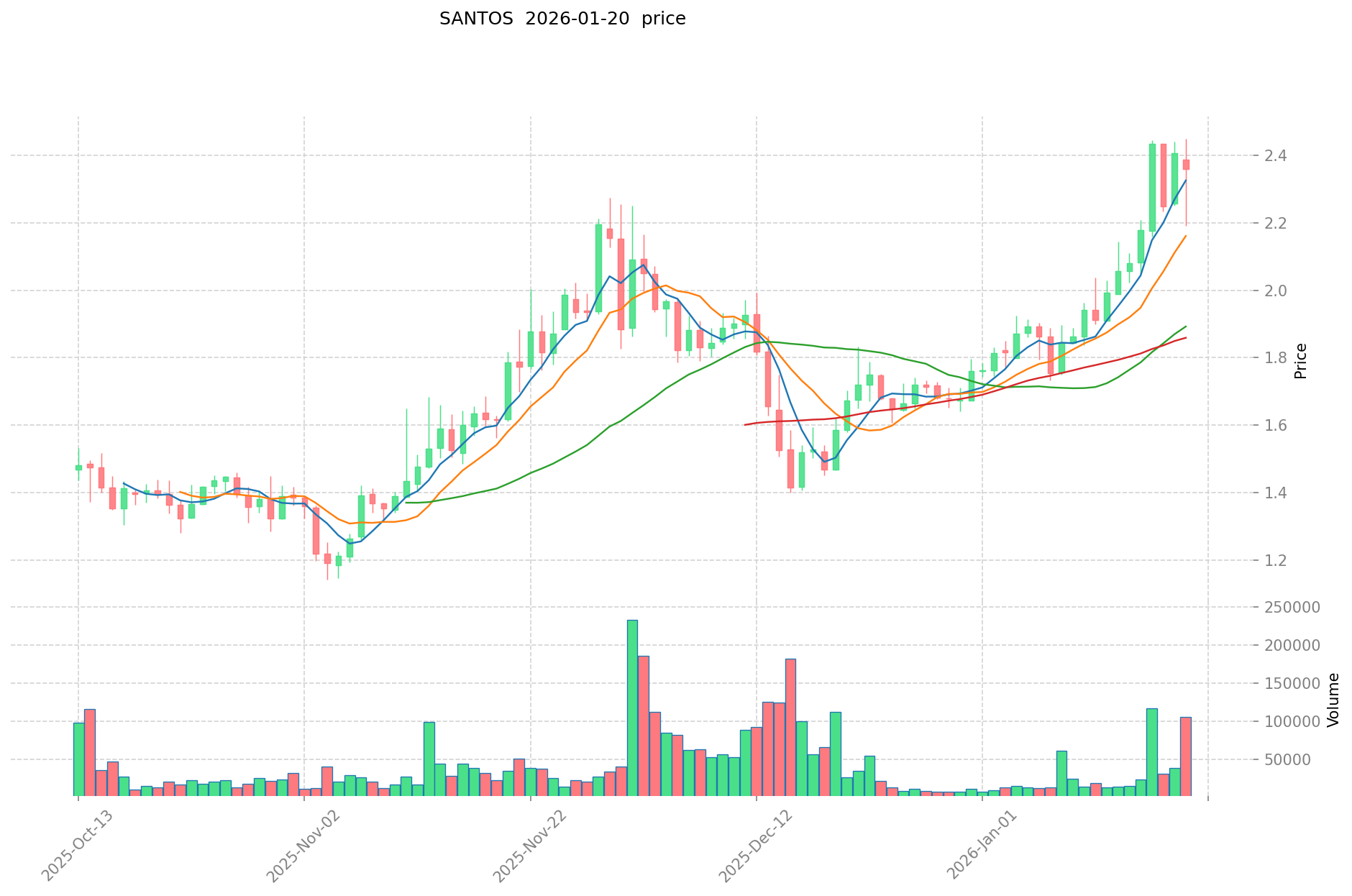
As of January 21, 2026, SANTOS is priced at 2.17 USD with a market capitalization of approximately 34.93 million USD, ranking 647th among cryptocurrencies. The token has demonstrated notable price volatility, with a 30-day performance increase of 24.27%, though experiencing a decline of 19.86% over the past year. With a circulating supply of 16.09 million tokens out of a maximum supply of 30 million, SANTOS maintains a circulation ratio of approximately 53.65%.
This analysis will examine the following key dimensions of SANTOS:
I. Historical price trends and market performance patterns
II. Token economics and supply distribution mechanisms
III. Ecosystem utility and real-world application scenarios
IV. Risk factors and future price outlook considerations
Through comprehensive evaluation of these factors, this report aims to provide investors with an objective framework for assessing SANTOS's position within the fan token sector and its potential role in a diversified cryptocurrency portfolio.
I. Historical Price Comparison and Market Status
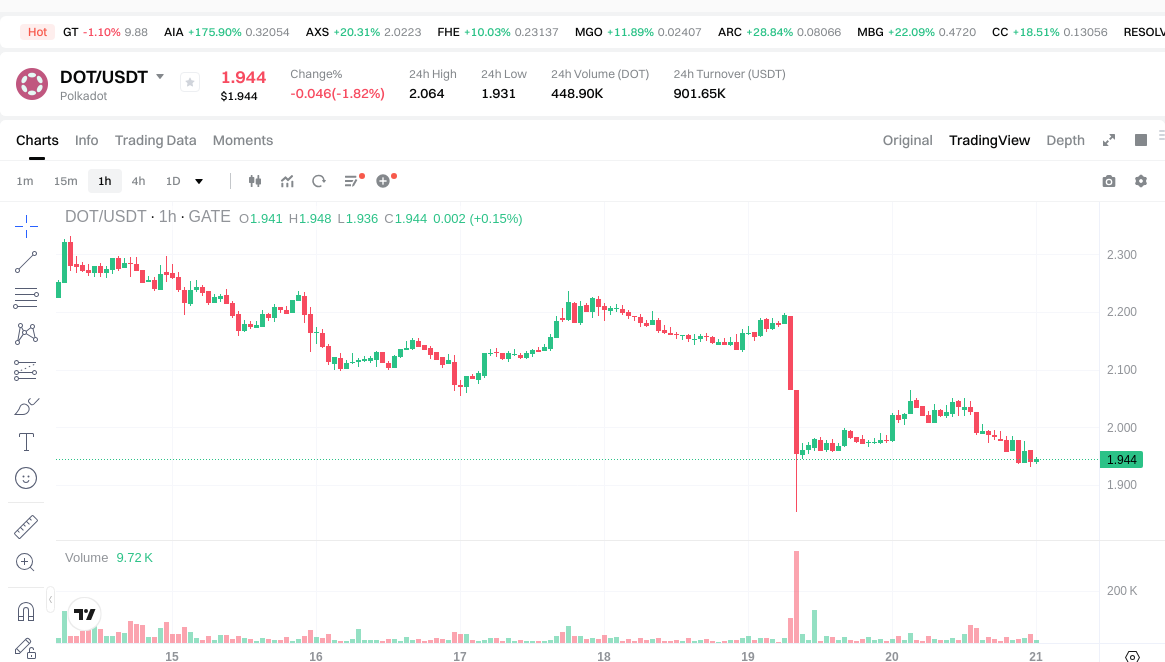
SANTOS (Coin A) and DOT (Coin B) Historical Price Trends
- 2022: SANTOS reached a notable price level on September 25, 2022, when it hit $22.34.
- 2021: DOT experienced significant price movement on November 4, 2021, reaching $54.98.
- Comparative Analysis: During the recent market cycle, SANTOS declined from its high of $22.34 to a low of $0.734 recorded on October 11, 2025, while DOT decreased from $54.98 to $1.66 on December 26, 2025.
Current Market Status (January 21, 2026)
- SANTOS current price: $2.1702
- DOT current price: $1.943
- 24-hour trading volume: SANTOS $127,613.15 vs DOT $887,332.39
- Market Sentiment Index (Fear & Greed Index): 32 (Fear)
Click to view real-time prices:
II. Core Factors Affecting SANTOS vs DOT Investment Value
Supply Mechanism Comparison (Tokenomics)
Due to insufficient reference materials, specific supply mechanism details for SANTOS and DOT cannot be provided at this time.
Institutional Adoption and Market Application
Institutional Holdings
Without available data on institutional holdings for SANTOS and DOT, a comparative analysis cannot be conducted.
Enterprise Adoption
Reference materials do not contain information regarding the adoption of SANTOS or DOT in cross-border payments, settlements, or investment portfolios.
National Policies
Specific regulatory attitudes of different countries toward SANTOS and DOT are not available in the provided materials.
Technology Development and Ecosystem Building
SANTOS Technology Development
The reference materials do not include information on SANTOS technology upgrades or their potential impacts.
DOT Technology Development
No data regarding DOT's technical development or potential impacts is available in the provided materials.
Ecosystem Comparison
Comparative information on DeFi, NFT, payment systems, and smart contract implementations for SANTOS and DOT is not available.
Macroeconomic Environment and Market Cycles
Without relevant data, the anti-inflation characteristics of SANTOS versus DOT cannot be evaluated.
Macroeconomic Monetary Policy
The impact of interest rates and the US Dollar Index on SANTOS and DOT cannot be assessed based on the available materials.
Geopolitical Factors
Information regarding cross-border transaction demand and international situations affecting SANTOS and DOT is not provided in the reference materials.
III. 2026-2031 Price Forecast: SANTOS vs DOT
Short-term Forecast (2026)
- SANTOS: Conservative $1.86-$1.94 | Optimistic $2.17-$2.80
- DOT: Conservative $1.89-$2.17 | Optimistic $2.44-$2.80
Medium-term Forecast (2028-2029)
- SANTOS may enter a growth phase, with estimated price range of $2.10-$3.99
- DOT may enter a consolidation phase, with estimated price range of $1.19-$3.26
- Key drivers: institutional capital inflows, ETF developments, ecosystem expansion
Long-term Forecast (2030-2031)
- SANTOS: Base scenario $2.00-$4.44 | Optimistic scenario $2.84-$5.94
- DOT: Base scenario $2.45-$3.55 | Optimistic scenario $3.27-$4.40
View detailed price predictions for SANTOS and DOT
Disclaimer
SANTOS:
| Year |
Predicted High Price |
Predicted Average Price |
Predicted Low Price |
Price Change |
| 2026 |
2.799816 |
2.1704 |
1.888248 |
0 |
| 2027 |
2.83302312 |
2.485108 |
2.18689504 |
14 |
| 2028 |
3.6695104728 |
2.65906556 |
2.1006617924 |
22 |
| 2029 |
3.987002900664 |
3.1642880164 |
3.037716495744 |
45 |
| 2030 |
5.29195527862736 |
3.575645458532 |
2.00236145677792 |
64 |
| 2031 |
5.941292493896771 |
4.43380036857968 |
2.837632235890995 |
104 |
DOT:
| Year |
Predicted High Price |
Predicted Average Price |
Predicted Low Price |
Price Change |
| 2026 |
2.44062 |
1.937 |
1.85952 |
0 |
| 2027 |
2.4733553 |
2.18881 |
1.2476217 |
12 |
| 2028 |
3.2402048835 |
2.33108265 |
1.1888521515 |
19 |
| 2029 |
3.2592032070975 |
2.78564376675 |
2.7020744537475 |
43 |
| 2030 |
4.080271707347062 |
3.02242348692375 |
2.448163024408237 |
55 |
| 2031 |
4.403671020447903 |
3.551347597135406 |
3.267239789364573 |
82 |
IV. Investment Strategy Comparison: SANTOS vs DOT
Long-term vs Short-term Investment Strategies
- SANTOS: Suitable for investors focused on fan engagement ecosystems and niche utility applications within the sports entertainment sector
- DOT: Suitable for investors seeking exposure to interoperability infrastructure and cross-chain ecosystem development
Risk Management and Asset Allocation
- Conservative investors: SANTOS 20-30% vs DOT 70-80%
- Aggressive investors: SANTOS 40-50% vs DOT 50-60%
- Hedging instruments: stablecoin allocation, options strategies, cross-asset diversification
V. Potential Risk Comparison
Market Risk
- SANTOS: Subject to high volatility associated with fan token sector sentiment, limited liquidity with 24-hour trading volume of $127,613.15, and dependency on sports industry performance
- DOT: Exposed to broader cryptocurrency market cycles, with trading volume of $887,332.39 indicating relatively higher liquidity but still vulnerable to market-wide corrections
Technical Risk
- SANTOS: Scalability considerations related to BEP-20 infrastructure, platform integration dependencies
- DOT: Network upgrade execution, cross-chain security considerations
Regulatory Risk
- Global regulatory frameworks may impact both assets differently, with SANTOS facing potential sports-related token regulations and DOT subject to broader cryptocurrency infrastructure policies
VI. Conclusion: Which Is the Better Buy?
📌 Investment Value Summary:
- SANTOS advantages: Specialized utility in fan engagement sector, demonstrated short-term momentum with 24.27% increase over 30 days, targeted application within sports entertainment ecosystem
- DOT advantages: Broader cryptocurrency infrastructure positioning, higher trading liquidity, more established market presence
✅ Investment Recommendations:
- Novice investors: Consider DOT for relatively higher liquidity and broader market acceptance, with limited allocation to SANTOS for sector diversification
- Experienced investors: Evaluate portfolio positioning based on sector exposure preferences, balancing fan token niche opportunities against infrastructure-focused assets
- Institutional investors: Assess allocation strategies considering liquidity requirements, with potential tactical positions in both assets based on market cycle positioning
⚠️ Risk Warning: The cryptocurrency market exhibits extreme volatility. This content does not constitute investment advice.
VII. FAQ
Q1: What is SANTOS and how does it differ from traditional cryptocurrencies like DOT?
SANTOS is a BEP-20 fan token specifically designed for Santos FC supporters, enabling club-related voting, exclusive rewards, and gamified engagement features. Unlike DOT, which serves as a blockchain infrastructure token focused on interoperability and cross-chain communication, SANTOS operates within the niche sports entertainment sector. While DOT targets broader cryptocurrency ecosystem development with technical solutions for network connectivity, SANTOS provides utility primarily for fan engagement, merchandise purchases, and sports-related digital experiences through the Binance Fan Token platform.
Q2: Why has SANTOS experienced higher short-term gains compared to DOT recently?
SANTOS showed a 24.27% increase over 30 days, while DOT's performance has been more moderate. This disparity stems from SANTOS's specialized positioning within the fan token sector, which can experience rapid sentiment-driven rallies tied to sports events, team performance, or platform announcements. However, this comes with significantly lower liquidity ($127,613.15 24-hour volume) compared to DOT ($887,332.39), making SANTOS more susceptible to volatile price movements from smaller trading volumes. DOT's infrastructure-focused utility typically results in more stable but potentially slower price appreciation outside of major network upgrades or ecosystem developments.
Q3: What are the main risks associated with investing in SANTOS versus DOT?
SANTOS faces concentrated sector risk tied to sports entertainment industry performance, limited liquidity concerns, and dependency on the Binance Fan Token platform ecosystem. Its niche market positioning means fewer alternative use cases if fan engagement demand declines. DOT, while exposed to broader cryptocurrency market cycles, benefits from higher liquidity and diversified applications across cross-chain infrastructure. Both assets face regulatory uncertainty, but SANTOS may encounter additional sports-related token regulations. The Market Sentiment Index at 32 (Fear) indicates current market caution affecting both assets, though SANTOS's lower liquidity amplifies downside risk during market corrections.
Q4: How do the supply mechanisms of SANTOS and DOT impact their long-term value potential?
SANTOS has a maximum supply of 30 million tokens with approximately 16.09 million currently circulating (53.65% circulation ratio), creating a defined scarcity model that could support price appreciation as adoption increases. The remaining 13.91 million tokens represent potential future supply pressure if released. Unfortunately, specific supply mechanism details for DOT are not available in the reference materials, limiting direct comparison. However, price forecasts suggest SANTOS may reach $2.84-$5.94 by 2031 under optimistic scenarios, while DOT is projected at $3.27-$4.40, indicating different growth trajectories influenced by their respective supply dynamics and market positioning.
Q5: Which asset is more suitable for portfolio diversification?
For portfolio diversification purposes, the choice depends on existing cryptocurrency holdings. If an investor already holds infrastructure-focused tokens, SANTOS offers exposure to the specialized fan token sector with distinct market drivers tied to sports entertainment. Conversely, investors heavily concentrated in niche tokens may benefit from DOT's broader market positioning and higher liquidity. Conservative investors should consider a 20-30% SANTOS and 70-80% DOT allocation, while aggressive investors might balance at 40-50% SANTOS and 50-60% DOT. The key consideration is that SANTOS provides sector-specific diversification but with higher volatility risk, whereas DOT offers more mainstream cryptocurrency market exposure.
Q6: What institutional adoption factors should investors consider for SANTOS versus DOT?
Based on available information, specific institutional adoption data for both SANTOS and DOT is limited in the reference materials. However, SANTOS's integration with the Binance Fan Token platform suggests institutional backing from a major cryptocurrency exchange, providing platform stability and access to Binance's user base. DOT's positioning as blockchain infrastructure typically attracts institutional interest from projects requiring cross-chain solutions. Investors should monitor announcements regarding institutional holdings, enterprise partnerships, and regulatory developments, as these factors significantly influence long-term value. The absence of detailed institutional data in current materials highlights the need for ongoing due diligence beyond this analysis.
Q7: How do macroeconomic conditions currently affect SANTOS and DOT investment prospects?
The current Market Sentiment Index at 32 (Fear) reflects cautious market conditions affecting both assets. While specific macroeconomic impact data for SANTOS and DOT is not available in the reference materials, general cryptocurrency market principles apply. During inflationary periods or interest rate changes, infrastructure tokens like DOT may attract institutional capital seeking technology-driven assets, while specialized tokens like SANTOS could experience more volatility tied to discretionary spending in sports entertainment. The 2026 short-term forecasts showing SANTOS at $2.17-$2.80 (optimistic) and DOT at $2.44-$2.80 (optimistic) suggest both assets are navigating similar macroeconomic headwinds, though their sector-specific sensitivities differ.
Q8: What technical developments should investors monitor for SANTOS and DOT?
For SANTOS, investors should track Binance Fan Token platform updates, new partnership announcements with Santos FC, expansion of utility features (such as e-commerce integration via Binance Pay), and token burn mechanisms that could affect circulating supply. Unfortunately, specific technical development roadmaps for both SANTOS and DOT are not detailed in the reference materials. For DOT, typical monitoring points would include network upgrade implementations, cross-chain bridge security enhancements, and parachain ecosystem growth. The lack of detailed technical information in current materials emphasizes the importance of consulting official project documentation and development repositories for comprehensive technical assessment before making investment decisions.
* The information is not intended to be and does not constitute financial advice or any other recommendation of any sort offered or endorsed by Gate.