This comprehensive guide examines SCR and BNB investment potential through multiple analytical dimensions. SCR, a Layer 2 Ethereum scaling solution launched in October 2024, demonstrates extreme volatility with a 97% decline from peak values, while BNB, established since 2017, maintains stronger market resilience as the Binance ecosystem's utility token. The article analyzes historical price trends, supply mechanisms, institutional adoption, technical ecosystems, and risk profiles to address investors' critical question regarding optimal asset selection. Price projections through 2031 indicate divergent growth trajectories, with SCR ranging from $0.1368-$0.1810 and BNB from $988.80-$1,730.40. Investment strategies span conservative allocations favoring BNB (85-90%) through aggressive diversification (60-70% BNB, 30-40% SCR), accommodating varying risk tolerances and market experience levels. The analysis emphasizes regulatory considerations, technical risks, and market dynamics affecting both assets within cu
Introduction: Investment Comparison Between SCR and BNB
In the cryptocurrency market, the comparison between SCR vs BNB continues to be a significant topic for investors. These two assets demonstrate notable differences in market cap ranking, application scenarios, and price performance, representing distinct positioning within the crypto asset landscape.
SCR (Scroll): Launched in October 2024, this Layer 2 rollup solution leverages zero-knowledge proof technology to scale the Ethereum blockchain, aiming to bring billions of users into the Ethereum ecosystem through secure and trusted infrastructure.
BNB (Binance Coin): Since its launch in July 2017, BNB has established itself as a fundamental utility token within the Binance ecosystem, supported by users across over 180 countries and regions, consistently ranking among the top cryptocurrencies globally.
This article will analyze the investment value comparison between SCR vs BNB across multiple dimensions including historical price trends, supply mechanisms, institutional adoption, technical ecosystem, and future outlook, attempting to address investors' key question:
"Which is the better buy right now?"
I. Historical Price Comparison and Current Market Status
SCR (Coin A) and BNB (Coin B) Historical Price Trends
- 2024: SCR launched in October 2024 with a publish price of $1.8, reaching an all-time high of $2.45 on October 11, 2024.
- 2025: SCR experienced significant volatility, declining to an all-time low of $0.0662 on December 19, 2025.
- 2017-2025: BNB demonstrated substantial growth from its all-time low of $0.0398177 on October 19, 2017, reaching an all-time high of $1369.99 on October 13, 2025.
- Comparative Analysis: During the recent market cycle, SCR declined from its peak of $2.45 to $0.0662, representing an approximate 97% decrease, while BNB maintained relatively stronger performance despite experiencing a 7.10% decline over the past 7 days.
Current Market Status (2026-01-25)
- SCR Current Price: $0.07474
- BNB Current Price: $889.2
- 24-Hour Trading Volume: SCR $283,543.19 vs BNB $3,735,464.69
- Market Sentiment Index (Fear & Greed Index): 25 (Extreme Fear)
View real-time prices:
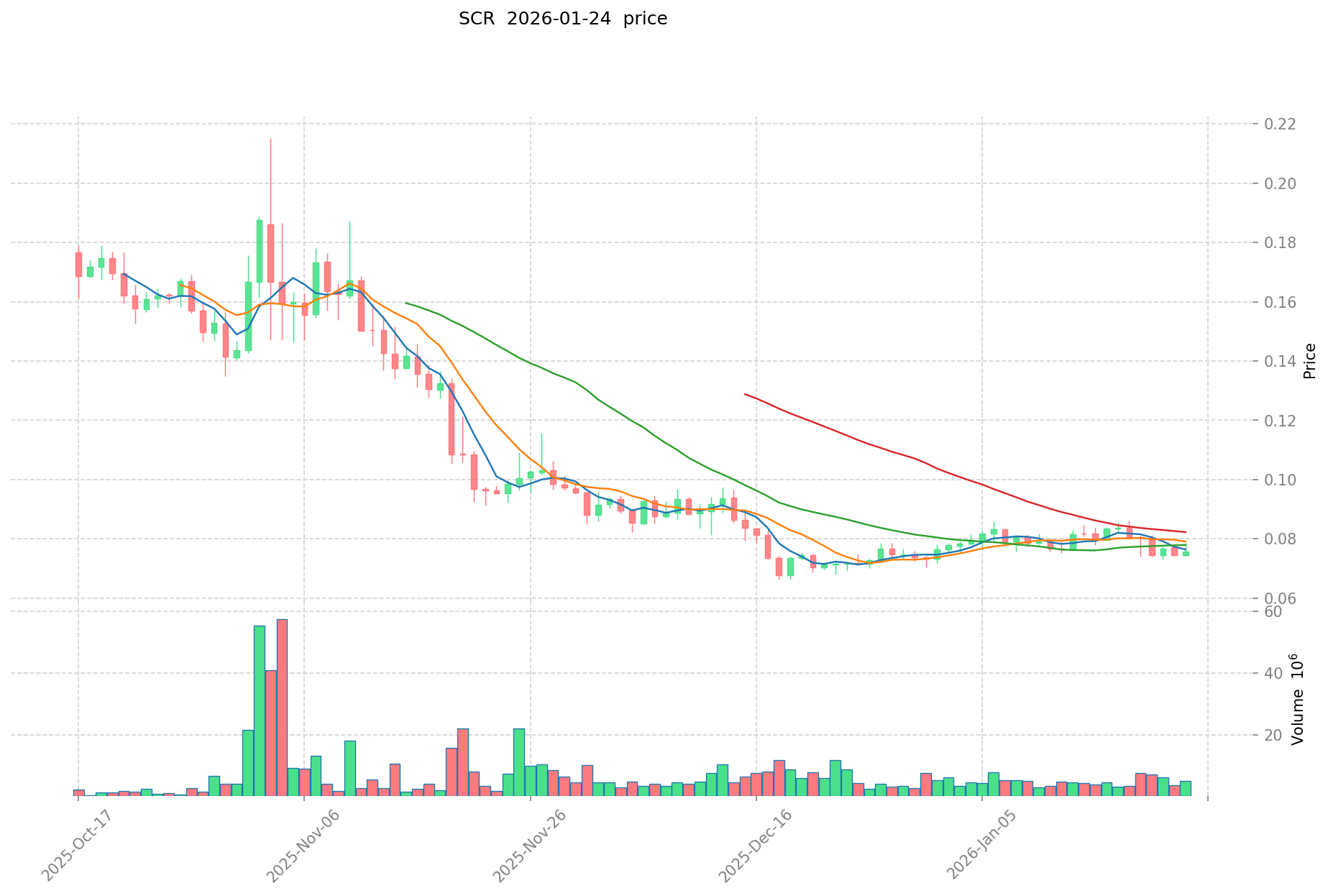
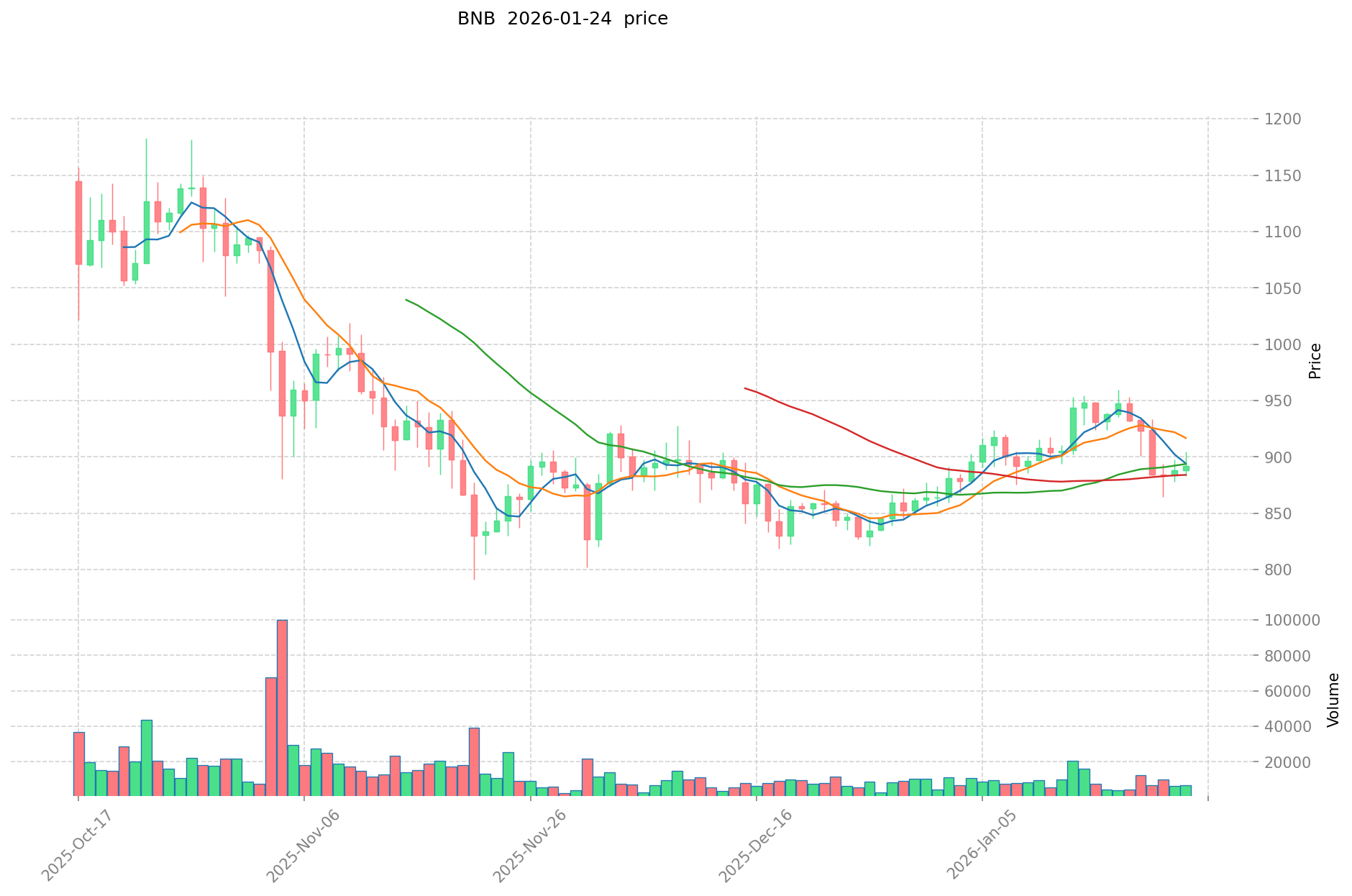
II. Core Factors Affecting SCR vs BNB Investment Value
Supply Mechanism Comparison (Tokenomics)
Due to limited available data on SCR's supply mechanism in the provided materials, a comprehensive comparison cannot be established at this time.
Institutional Adoption and Market Application
Institutional Holdings
Currently, there is insufficient data to determine which asset receives greater institutional preference between SCR and BNB.
Enterprise Adoption
The enterprise adoption patterns for SCR and BNB in cross-border payments, settlements, and investment portfolios remain unclear based on available information.
National Policies
Regulatory attitudes toward both assets vary across jurisdictions, though specific policy positions cannot be detailed without additional reference materials.
Technical Development and Ecosystem Building
SCR Technical Development
Specific technical upgrades and their potential impacts on SCR require further documentation.
BNB Technical Development
BNB's technical advancement trajectory and ecosystem implications need additional context for proper analysis.
Ecosystem Comparison
A detailed comparison of DeFi, NFT, payment systems, and smart contract implementations between SCR and BNB ecosystems cannot be provided without comprehensive data.
Macroeconomic Conditions and Market Cycles
The relative anti-inflation properties of SCR versus BNB require market data analysis that is not currently available.
Macroeconomic Monetary Policy
The effects of interest rates and dollar index movements on both assets depend on market dynamics that need further examination.
Geopolitical Factors
Cross-border transaction demand and international situation impacts on SCR and BNB would benefit from additional research data.
III. 2026-2031 Price Prediction: SCR vs BNB
Short-term Forecast (2026)
- SCR: Conservative $0.0463 - $0.0746 | Optimistic $0.0746 - $0.0888
- BNB: Conservative $630.05 - $887.40 | Optimistic $887.40 - $1,295.60
Mid-term Forecast (2028-2029)
- SCR may enter a consolidation phase, with estimated price range of $0.0933 - $0.1525
- BNB may enter a growth phase, with estimated price range of $797.67 - $1,819.68
- Key drivers: institutional capital inflows, ETF developments, ecosystem expansion
Long-term Forecast (2031)
- SCR: Baseline scenario $0.1368 - $0.1425 | Optimistic scenario $0.1425 - $0.1810
- BNB: Baseline scenario $988.80 - $1,648.00 | Optimistic scenario $1,648.00 - $1,730.40
View detailed price predictions for SCR and BNB
Disclaimer
SCR:
| Year |
Predicted High Price |
Predicted Average Price |
Predicted Low Price |
Price Change |
| 2026 |
0.0887978 |
0.07462 |
0.0462644 |
0 |
| 2027 |
0.112758282 |
0.0817089 |
0.05719623 |
9 |
| 2028 |
0.10890162192 |
0.097233591 |
0.09334424736 |
30 |
| 2029 |
0.1525400575608 |
0.10306760646 |
0.0948221979432 |
37 |
| 2030 |
0.157198713372792 |
0.1278038320104 |
0.08946268240728 |
70 |
| 2031 |
0.180976616318326 |
0.142501272691596 |
0.136801221783932 |
90 |
BNB:
| Year |
Predicted High Price |
Predicted Average Price |
Predicted Low Price |
Price Change |
| 2026 |
1295.604 |
887.4 |
630.054 |
0 |
| 2027 |
1364.3775 |
1091.502 |
895.03164 |
22 |
| 2028 |
1264.7779425 |
1227.93975 |
1191.1015575 |
37 |
| 2029 |
1819.683915525 |
1246.35884625 |
797.6696616 |
40 |
| 2030 |
1762.974588020625 |
1533.0213808875 |
827.83154567925 |
72 |
| 2031 |
1730.397883676765625 |
1647.9979844540625 |
988.7987906724375 |
85 |
IV. Investment Strategy Comparison: SCR vs BNB
Long-term vs Short-term Investment Strategies
- SCR: May be suitable for investors with higher risk tolerance who are interested in emerging Layer 2 scaling solutions and early-stage blockchain infrastructure projects. Given the significant price volatility observed since launch, this asset requires careful consideration of timing and position sizing.
- BNB: May appeal to investors seeking exposure to established exchange ecosystems with demonstrated long-term growth patterns. The asset has shown resilience across multiple market cycles since 2017, though recent 7-day performance indicates ongoing market volatility.
Risk Management and Asset Allocation
- Conservative Investors: A potential allocation framework might consider SCR 10-15% vs BNB 85-90%, emphasizing the more established asset while maintaining limited exposure to emerging opportunities.
- Aggressive Investors: A more balanced approach could explore SCR 30-40% vs BNB 60-70%, accepting increased volatility in exchange for potential upside from newer technology platforms.
- Hedging Tools: Consideration of stablecoin reserves, options strategies for downside protection, and cross-asset diversification across multiple blockchain ecosystems.
V. Potential Risk Comparison
Market Risk
- SCR: Demonstrates elevated volatility characteristics, having experienced an approximate 97% decline from its peak value. The relatively recent launch in October 2024 means limited historical data for assessing behavior across full market cycles. Current 24-hour trading volume of $283,543.19 suggests developing liquidity conditions.
- BNB: While maintaining stronger relative performance compared to newer assets, recent 7-day decline of 7.10% indicates susceptibility to broader market movements. The current Fear & Greed Index reading of 25 (Extreme Fear) reflects challenging sentiment conditions affecting established assets.
Technical Risk
- SCR: As a Layer 2 rollup solution utilizing zero-knowledge proof technology, considerations include the maturity of scaling infrastructure, network stability during high-traffic periods, and the ongoing development of the technical roadmap.
- BNB: Evaluation factors include the security architecture of the associated exchange ecosystem, smart contract implementations, and the maintenance of network operations across diverse use cases.
Regulatory Risk
- Global regulatory frameworks continue to evolve regarding cryptocurrency assets, with varying approaches across jurisdictions. Both SCR and BNB may face different regulatory considerations based on their respective classifications, use cases, and ecosystem positioning. Investors should monitor developments in key markets including the United States, European Union, and Asia-Pacific regions.
VI. Conclusion: Which Is the Better Buy?
📌 Investment Value Summary:
- SCR Characteristics: Represents exposure to Layer 2 scaling technology and zero-knowledge proof infrastructure. Price predictions suggest potential ranges from $0.0463-$0.0888 in 2026, extending to $0.1368-$0.1810 by 2031 under various scenarios. The asset carries significant volatility characteristics and requires tolerance for substantial price fluctuations.
- BNB Characteristics: Offers participation in an established exchange ecosystem with demonstrated longevity since 2017. Forecast ranges span from $630.05-$1,295.60 in 2026 to $988.80-$1,730.40 by 2031. Historical performance indicates resilience across multiple market cycles, though subject to ongoing market dynamics.
✅ Investment Considerations:
- Beginning Investors: May benefit from initial focus on more established assets with longer track records, allowing for gradual learning about market dynamics before exploring emerging technologies. Consider starting with smaller position sizes and emphasizing risk management principles.
- Experienced Investors: Could evaluate portfolio diversification strategies that balance exposure to established infrastructure with selective allocation to emerging Layer 2 solutions. Assessment of individual risk tolerance, investment timeframes, and market cycle positioning remains essential.
- Institutional Investors: Might examine both assets through frameworks considering liquidity requirements, volatility tolerance, regulatory compliance considerations, and strategic alignment with portfolio objectives across different time horizons.
⚠️ Risk Disclosure: Cryptocurrency markets demonstrate extreme volatility characteristics. Historical performance does not guarantee future results. This analysis does not constitute investment advice, financial guidance, or recommendations to buy, sell, or hold any assets. Investors should conduct independent research, assess personal risk tolerance, and consult qualified financial advisors before making investment decisions.
VII. FAQ
Q1: What are the main differences between SCR and BNB in terms of their core functions?
SCR is a Layer 2 rollup solution focused on scaling Ethereum through zero-knowledge proof technology, while BNB serves as the fundamental utility token within the Binance exchange ecosystem. SCR, launched in October 2024, represents emerging blockchain infrastructure technology designed to bring billions of users into Ethereum, whereas BNB, established since July 2017, has evolved into a multi-purpose token supporting trading fee discounts, payment systems, and various DeFi applications across the Binance ecosystem serving users in over 180 countries.
Q2: How do the price volatility patterns differ between SCR and BNB?
SCR exhibits extremely high volatility, experiencing approximately 97% decline from its all-time high of $2.45 to its low of $0.0662 within roughly one year of launch. BNB demonstrates relatively more stable performance despite market fluctuations, maintaining resilience across multiple market cycles since 2017, though it recently experienced a 7.10% decline over 7 days. The 24-hour trading volumes further illustrate this difference, with BNB recording $3,735,464.69 compared to SCR's $283,543.19, indicating substantially different liquidity profiles and market maturity levels.
Q3: Which asset is more suitable for conservative investors?
BNB may be more appropriate for conservative investors seeking lower volatility and established market presence. A suggested allocation framework for conservative portfolios considers 85-90% BNB with only 10-15% SCR exposure. BNB's longer operational history since 2017, stronger liquidity metrics, and demonstrated resilience across multiple market cycles provide characteristics typically preferred by risk-averse investors. However, conservative investors should still acknowledge the inherent volatility of all cryptocurrency assets and maintain appropriate risk management strategies.
Q4: What are the projected price ranges for both assets by 2031?
According to the forecasts, SCR's 2031 price range spans from $0.1368 to $0.1810 under baseline and optimistic scenarios, representing potential growth from current levels of approximately $0.07474. BNB's 2031 projections range from $988.80 to $1,730.40, suggesting potential appreciation from the current price of $889.2. These projections incorporate various scenarios including institutional capital inflows, ecosystem expansion, and technological developments. However, cryptocurrency price predictions carry significant uncertainty, and actual outcomes may differ substantially from these estimates.
Q5: How does the current market sentiment affect both SCR and BNB?
The current Fear & Greed Index reading of 25 (Extreme Fear) as of January 25, 2026, indicates challenging market conditions affecting both assets. This extreme fear sentiment typically correlates with increased selling pressure, higher volatility, and potential buying opportunities for long-term investors. SCR, as a newer asset with limited market history, may experience more pronounced effects from negative sentiment shifts, while BNB's established position may provide some buffer against extreme market psychology, though both remain susceptible to broader cryptocurrency market dynamics and investor sentiment fluctuations.
Q6: What are the key technical risks associated with each asset?
SCR's technical risks center on the maturity and stability of Layer 2 rollup technology utilizing zero-knowledge proofs, including potential challenges in network scalability during high-traffic periods and the execution of its technical development roadmap. BNB's technical considerations involve the security architecture of the broader Binance ecosystem, smart contract implementations across diverse applications, and the maintenance of network operations supporting multiple use cases. Both assets face ongoing technical development requirements, though SCR's newer technology carries inherent uncertainties associated with emerging infrastructure solutions.
Q7: Should investors consider both assets simultaneously or choose between them?
Portfolio allocation strategy depends on individual risk tolerance, investment timeframe, and market expertise. Experienced investors might consider diversified exposure combining both assets—for example, 60-70% BNB with 30-40% SCR for aggressive portfolios, or 85-90% BNB with 10-15% SCR for conservative approaches. This diversification provides exposure to both established exchange infrastructure and emerging Layer 2 scaling solutions. Beginning investors may benefit from initially focusing on the more established BNB before gradually exploring higher-volatility assets like SCR as market knowledge and risk management capabilities develop.
Q8: What regulatory considerations should investors monitor for both assets?
Regulatory frameworks for cryptocurrency assets continue evolving globally, with varying approaches across major jurisdictions including the United States, European Union, and Asia-Pacific regions. Both SCR and BNB face different regulatory considerations based on their classifications, use cases, and ecosystem positioning. Investors should monitor developments regarding exchange token regulations affecting BNB, infrastructure and scaling solution classifications impacting SCR, securities law interpretations, cross-border transaction regulations, and taxation policies. Regulatory changes can significantly impact both asset valuations and operational capabilities, making ongoing compliance monitoring essential for informed investment decisions.
* The information is not intended to be and does not constitute financial advice or any other recommendation of any sort offered or endorsed by Gate.