This comprehensive analysis compares SFUND and ZIL, two distinct blockchain tokens with different market positions and use cases. SFUND, a gaming launchpad and project incubator launched in 2021, currently ranks 1661 by market capitalization with a fixed 100 million token supply, while ZIL, a high-throughput scalability platform since 2018, ranks 353 with superior trading volume and market stability. The article examines historical price trends, tokenomics mechanisms, current market status, and detailed price predictions through 2031 for both tokens on Gate. Investment strategy recommendations vary by investor profile: conservative investors favor ZIL's established infrastructure focus, while experienced investors may diversify across both assets based on gaming ecosystem or scalability thesis. Risk analysis covers market volatility, technical dependencies, and regulatory considerations, alongside FAQ addressing key differentiators in project focus, supply mechanisms, and allocation strategies for informed cr
Introduction: SFUND vs ZIL Investment Comparison
In the cryptocurrency market, the comparison between SFUND vs ZIL has consistently been a topic of interest for investors. The two projects demonstrate notable differences in market capitalization ranking, application scenarios, and price performance, representing distinct positioning within the crypto asset landscape.
SFUND (Seedify.fund): Launched in March 2021, this project has established itself as an incubator and seed fund supporting innovative development within the blockchain ecosystem through decentralized mechanisms. Currently ranked 1661 by market capitalization, SFUND has experienced substantial volatility, with its current price at approximately $0.047.
ZIL (Zilliqa): Since its launch in January 2018, Zilliqa has positioned itself as a high-throughput public blockchain platform capable of processing thousands of transactions per second. Ranked 353 by market capitalization, ZIL addresses scalability challenges through innovative sharding technology, trading at around $0.0045.
This article will provide a comprehensive analysis of SFUND vs ZIL investment value comparison, examining historical price trends, supply mechanisms, technical ecosystems, and future projections. We aim to address the question many investors are asking:
"Which is the better buy right now?"
By evaluating key metrics such as circulating supply (83 million SFUND vs 19.9 billion ZIL), market performance (SFUND down 96.67% year-over-year vs ZIL down 74.46%), and fundamental project characteristics, this analysis seeks to provide investors with data-driven insights for informed decision-making in the evolving cryptocurrency landscape.
I. Historical Price Comparison and Current Market Status
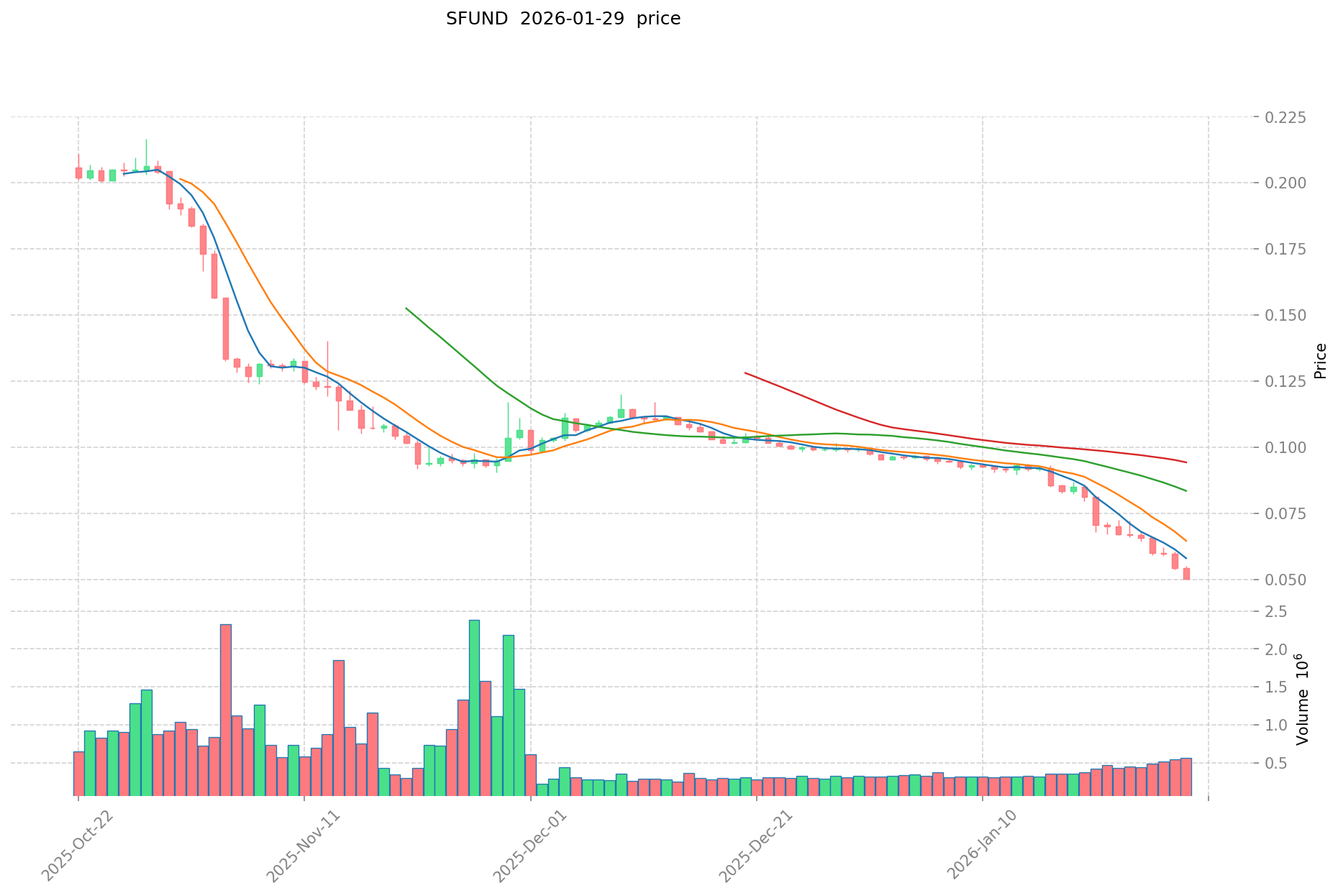
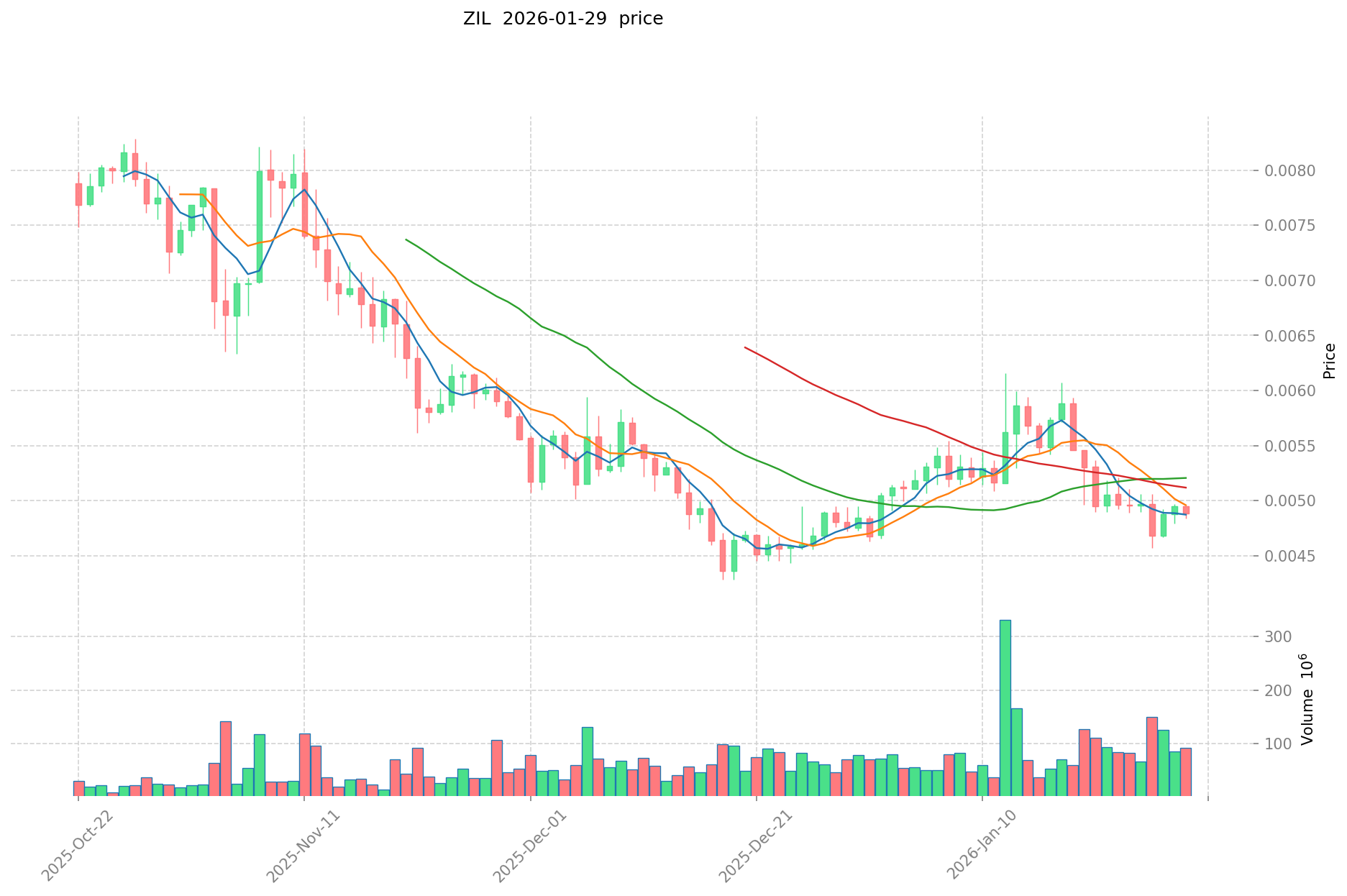
SFUND (Seedify.fund) and ZIL (Zilliqa) Historical Price Trends
- 2021: SFUND experienced significant price appreciation, reaching a high of $16.79 in November 2021 during the broader crypto market bull run.
- 2021: ZIL reached its all-time high of $0.255376 in May 2021, benefiting from increased interest in blockchain scalability solutions.
- Comparative Analysis: During the market downturn, SFUND declined from its peak of $16.79 to a low of $0.04736744 (recorded on January 30, 2026), while ZIL dropped from $0.255376 to $0.00239616 (recorded on March 13, 2020).
Current Market Status (January 30, 2026)
- SFUND current price: $0.04742
- ZIL current price: $0.004535
- 24-hour trading volume: SFUND $20,951.79 vs ZIL $599,763.52
- Market Sentiment Index (Fear & Greed Index): 26 (Fear)
View real-time prices:
II. Core Factors Influencing SFUND vs ZIL Investment Value
Supply Mechanism Comparison (Tokenomics)
- SFUND: Fixed supply model with a total supply of 100 million tokens, creating scarcity as a fundamental value driver
- ZIL: Supply mechanism details not available in the provided materials
- 📌 Historical Pattern: Scarcity mechanisms tend to create supply-side pressure that may influence price dynamics during market cycles
Institutional Adoption and Market Application
- Institutional Holdings: SFUND's value proposition includes institutional adoption potential through its launchpad mechanism
- Enterprise Application: SFUND operates as a gaming launchpad token, facilitating emerging blockchain projects through bonding curve sales, tiered staking, and builder programs
- Policy Environment: Information regarding regulatory attitudes toward these assets across different jurisdictions was not available in the provided materials
Technology Development and Ecosystem Building
- SFUND Technology Development: The platform features launchpad mechanisms including bonding curve sales, tiered staking systems, and builder programs designed to attract quality projects
- ZIL Technology Development: Network activity and technical development information was not available in the provided materials
- Ecosystem Comparison: SFUND focuses on assisting emerging blockchain projects, particularly in gaming sectors. Comparative analysis of DeFi, NFT, payment systems, and smart contract implementations was not detailed in the available materials
Macroeconomic Environment and Market Cycles
- Performance Under Inflation: Information regarding anti-inflation characteristics of either asset was not available in the provided materials
- Macroeconomic Monetary Policy: Both assets may be influenced by broader macroeconomic factors, though specific correlations were not detailed in the available materials
- Geopolitical Factors: The role of cross-border transaction demand and international developments was not specifically addressed in the provided materials
III. 2026-2031 Price Prediction: SFUND vs ZIL
Short-term Forecast (2026)
- SFUND: Conservative $0.0316-$0.0471 | Optimistic $0.0471-$0.0504
- ZIL: Conservative $0.00318-$0.00454 | Optimistic $0.00454-$0.00535
Mid-term Forecast (2028-2029)
- SFUND may enter a consolidation phase, with estimated price range of $0.0368-$0.0773 in 2028, potentially reaching $0.0550-$0.0726 in 2029
- ZIL may enter a gradual growth phase, with estimated price range of $0.00525-$0.00682 in 2028, potentially reaching $0.00553-$0.00810 in 2029
- Key drivers: institutional capital inflows, ETF developments, ecosystem expansion
Long-term Forecast (2030-2031)
- SFUND: Baseline scenario $0.0456-$0.0702 (2030), $0.0580-$0.0829 (2031) | Optimistic scenario $0.0955 (2030), $0.109 (2031)
- ZIL: Baseline scenario $0.00407-$0.00726 (2030), $0.00768-$0.00882 (2031) | Optimistic scenario $0.0104 (2030), $0.0105 (2031)
View detailed price predictions for SFUND and ZIL
Disclaimer
SFUND:
| Year |
Predicted High Price |
Predicted Average Price |
Predicted Low Price |
Price Change |
| 2026 |
0.0503863 |
0.04709 |
0.0315503 |
0 |
| 2027 |
0.06823341 |
0.04873815 |
0.034116705 |
2 |
| 2028 |
0.0772012296 |
0.05848578 |
0.0368460414 |
23 |
| 2029 |
0.072592550136 |
0.0678435048 |
0.054953238888 |
43 |
| 2030 |
0.09549651735648 |
0.070218027468 |
0.0456417178542 |
48 |
| 2031 |
0.108543026860034 |
0.08285727241224 |
0.058000090688568 |
74 |
ZIL:
| Year |
Predicted High Price |
Predicted Average Price |
Predicted Low Price |
Price Change |
| 2026 |
0.00535484 |
0.004538 |
0.0031766 |
0 |
| 2027 |
0.0071228448 |
0.00494642 |
0.0031657088 |
9 |
| 2028 |
0.006819134612 |
0.0060346324 |
0.005250130188 |
33 |
| 2029 |
0.00809787321756 |
0.006426883506 |
0.00552711981516 |
41 |
| 2030 |
0.010385201057345 |
0.00726237836178 |
0.004066931882596 |
60 |
| 2031 |
0.010500309754379 |
0.008823789709562 |
0.007676697047319 |
94 |
IV. Investment Strategy Comparison: SFUND vs ZIL
Long-term vs Short-term Investment Strategies
- SFUND: Suitable for investors focusing on blockchain gaming ecosystem potential and launchpad mechanisms, particularly those with higher risk tolerance seeking exposure to emerging project incubation platforms
- ZIL: Suitable for investors interested in blockchain scalability solutions and high-throughput infrastructure technology, particularly those focused on fundamental technological innovation
Risk Management and Asset Allocation
- Conservative Investors: SFUND 30% vs ZIL 70%
- Aggressive Investors: SFUND 60% vs ZIL 40%
- Hedging Tools: stablecoin allocation, options strategies, cross-asset portfolio diversification
V. Potential Risk Comparison
Market Risk
- SFUND: Market volatility influenced by gaming sector trends, launchpad platform competition, and relatively lower trading volume ($20,951.79 in 24-hour volume) which may impact liquidity during market stress
- ZIL: Price fluctuations related to blockchain scalability narrative cycles, public chain competition dynamics, and market sentiment toward infrastructure projects
Technical Risk
- SFUND: Platform development dependencies, quality and success rate of incubated projects, and sustainability of bonding curve and staking mechanisms
- ZIL: Network scalability implementation, sharding technology stability, and ongoing technical maintenance requirements
Regulatory Risk
- Global regulatory policies may impact both assets differently, with SFUND potentially facing scrutiny related to token sales and launchpad operations, while ZIL may encounter regulatory considerations regarding public blockchain infrastructure and transaction processing
VI. Conclusion: Which Is the Better Buy?
📌 Investment Value Summary:
- SFUND Advantages: Fixed supply model (100 million tokens) creating scarcity dynamics, positioning in the blockchain gaming and project incubation sector, launchpad mechanism providing utility beyond speculation
- ZIL Advantages: Established presence since 2018, focus on addressing blockchain scalability through sharding technology, higher market capitalization ranking (353 vs 1661) indicating relatively stronger market position
✅ Investment Recommendations:
- Beginner Investors: Consider ZIL for its more established market presence and infrastructure focus, with smaller position sizing and emphasis on fundamental research before commitment
- Experienced Investors: Evaluate portfolio diversification benefits by considering both assets based on individual thesis regarding gaming ecosystems (SFUND) versus scalability infrastructure (ZIL), employing proper risk management techniques
- Institutional Investors: Conduct comprehensive due diligence on both projects' technology roadmaps, regulatory compliance frameworks, and market positioning before determining allocation strategies aligned with institutional investment criteria
⚠️ Risk Warning: Cryptocurrency markets exhibit high volatility. This article does not constitute investment advice.
VII. FAQ
Q1: What are the main differences between SFUND and ZIL in terms of project focus?
SFUND operates as a blockchain gaming launchpad and project incubator with a fixed supply of 100 million tokens, while ZIL is a high-throughput public blockchain platform focused on scalability solutions through sharding technology. SFUND's core functionality centers around facilitating emerging blockchain projects through bonding curve sales and tiered staking mechanisms, primarily targeting the gaming sector. In contrast, ZIL addresses fundamental blockchain infrastructure challenges by enabling thousands of transactions per second, positioning itself as a scalability-focused platform since its 2018 launch.
Q2: Which cryptocurrency has demonstrated better market stability based on current rankings?
ZIL demonstrates relatively stronger market stability with a market capitalization ranking of 353, compared to SFUND's ranking of 1661. ZIL's higher ranking indicates greater market capitalization, broader market recognition, and potentially deeper liquidity. Additionally, ZIL's 24-hour trading volume of $599,763.52 significantly exceeds SFUND's $20,951.79, suggesting more robust trading activity and market participation. However, both assets have experienced substantial declines from their all-time highs, with SFUND down 96.67% year-over-year and ZIL down 74.46%.
Q3: How do the supply mechanisms of SFUND and ZIL affect their investment potential?
SFUND features a fixed supply model with a total supply capped at 100 million tokens, creating inherent scarcity that may influence long-term value dynamics during market cycles. This limited supply mechanism can potentially create supply-side pressure, particularly during periods of increased demand. While specific details about ZIL's supply mechanism were not available in the analyzed materials, SFUND's clearly defined scarcity model represents a fundamental value driver that differentiates it from many other crypto assets. Investors should consider how supply dynamics align with their investment thesis when comparing these assets.
Q4: What are the price prediction ranges for SFUND and ZIL through 2031?
Based on analytical forecasts, SFUND's predicted price ranges from $0.0316-$0.0504 in 2026 (conservative to optimistic scenarios), potentially reaching $0.0580-$0.109 by 2031 depending on market conditions. ZIL's predictions indicate ranges from $0.00318-$0.00535 in 2026, with potential growth to $0.00768-$0.0105 by 2031. Both assets show potential for gradual appreciation in baseline scenarios, with optimistic scenarios suggesting higher growth trajectories. However, these predictions depend on multiple factors including institutional adoption, ecosystem development, and broader macroeconomic conditions. Investors should treat these forecasts as reference points rather than guaranteed outcomes.
Q5: What investment allocation strategy is recommended for different investor profiles?
Conservative investors may consider a 30% SFUND and 70% ZIL allocation, emphasizing ZIL's more established market position and infrastructure focus. Aggressive investors seeking higher risk-reward profiles might consider a 60% SFUND and 40% ZIL allocation, capitalizing on SFUND's exposure to the emerging blockchain gaming sector. Beginner investors should start with ZIL due to its longer operational history and more established presence since 2018, while experienced investors can evaluate both assets based on their specific thesis regarding gaming ecosystems versus scalability infrastructure. All allocations should be complemented with proper risk management techniques including stablecoin reserves and portfolio diversification.
Q6: What are the primary risks associated with investing in SFUND versus ZIL?
SFUND faces market risks related to gaming sector trends, launchpad platform competition, and lower trading volume ($20,951.79 in 24 hours) which may impact liquidity during market stress. Technical risks include dependencies on platform development and the success rate of incubated projects. ZIL encounters market risks tied to blockchain scalability narrative cycles and public chain competition, with technical risks involving sharding technology stability and network maintenance. Both assets face regulatory risks, though SFUND may experience scrutiny related to token sales and launchpad operations, while ZIL faces considerations regarding public blockchain infrastructure compliance. Investors should assess their risk tolerance against these specific factors when making allocation decisions.
* The information is not intended to be and does not constitute financial advice or any other recommendation of any sort offered or endorsed by Gate.