This comprehensive analysis compares SGB (Songbird) and SNX (Synthetix), two distinct protocols serving different roles in the cryptocurrency ecosystem. SGB operates as Flare's Canary network testing ground for oracle and cross-chain technologies, ranked 670 with a current price of $0.002061, while SNX functions as an established decentralized synthetic asset platform since 2018, ranked 276 at $0.4137. The article examines historical price movements, market capitalization, trading volumes, tokenomics, institutional adoption, technological ecosystems, and risk factors to help investors determine optimal allocation strategies. Through detailed price analysis, supply mechanism comparison, and investment scenario modeling across conservative and aggressive approaches, this guide addresses which asset aligns better with different investor profiles. Both assets demonstrate distinct risk-return characteristics, with SNX offering established market presence and SNX higher liquidity, while SGB presents experimental te
Introduction: SGB vs SNX Investment Comparison
In the cryptocurrency market, the comparison between SGB and SNX has consistently drawn investor attention. These two assets exhibit notable differences in market capitalization ranking, application scenarios, and price performance, representing distinct positioning within the crypto asset landscape.
Songbird (SGB): Launched as Flare's Canary network, this token serves as a testing ground for the Flare Time Series Oracle, StateConnector, and F-Asset systems. Currently ranked 670 by market capitalization, SGB operates with a circulating supply of approximately 16.04 billion tokens and a price of $0.002061.
Synthetix (SNX): Since its launch in March 2018 (formerly Havven), this protocol has positioned itself as a decentralized synthetic asset platform. Ranked 276 by market cap, SNX supports various synthetic assets including fiat currencies pegged to USD, precious metals, indices, and other cryptocurrencies, with a current price of $0.4137 and circulating supply of 343.47 million tokens.
This article will provide a comprehensive analysis of SGB vs SNX investment value through examining historical price movements, supply mechanisms, institutional adoption, technological ecosystems, and future outlook, attempting to address investors' most pressing question:
"Which presents a more compelling investment case under current market conditions?"
I. Historical Price Comparison and Current Market Status
SGB (Songbird) and SNX (Synthetix) Historical Price Trends
- 2021: SGB reached a notable price level of $0.71334 on September 30, 2021, shortly after its network launch as Flare's Canary network.
- 2021: SNX experienced significant price movement, reaching $28.53 on February 14, 2021, driven by growth in decentralized finance applications.
- Comparative Analysis: Throughout market cycles, SGB declined from its September 2021 peak of $0.71334 to $0.00192389 recorded on January 1, 2026, while SNX decreased from its February 2021 high of $28.53 to $0.0347864 observed on January 6, 2019.
Current Market Status (January 21, 2026)
- SGB Current Price: $0.002061
- SNX Current Price: $0.4137
- 24-Hour Trading Volume: SGB $26,304.92 vs SNX $957,050.99
- Market Sentiment Index (Fear & Greed Index): 32 (Fear)
View real-time prices:
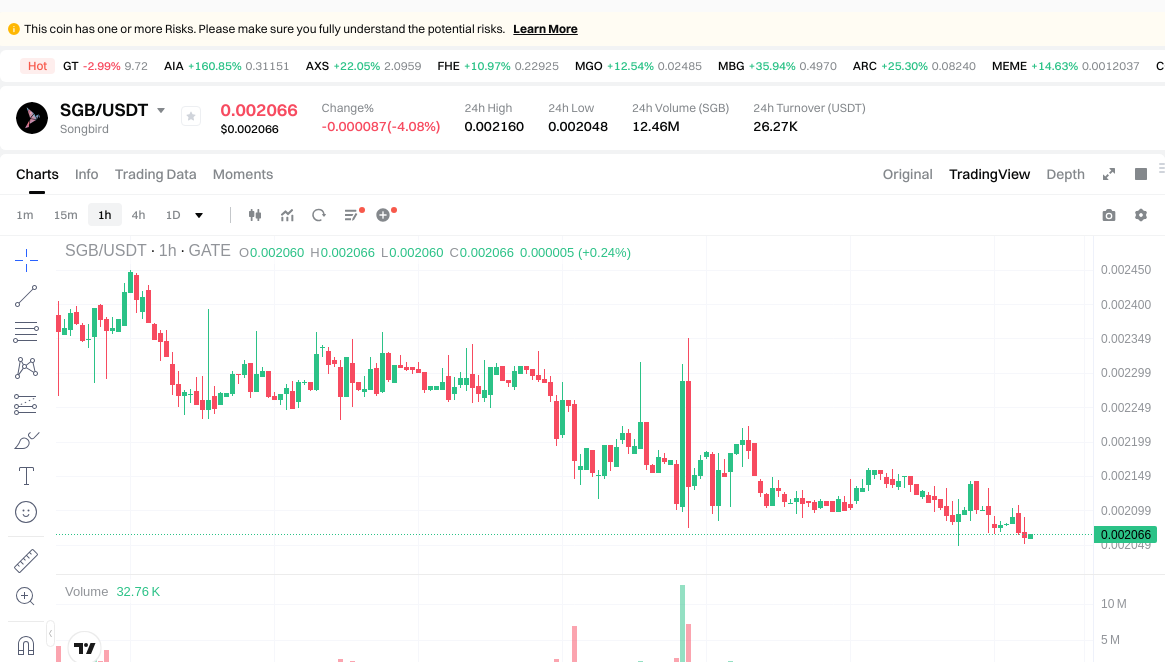
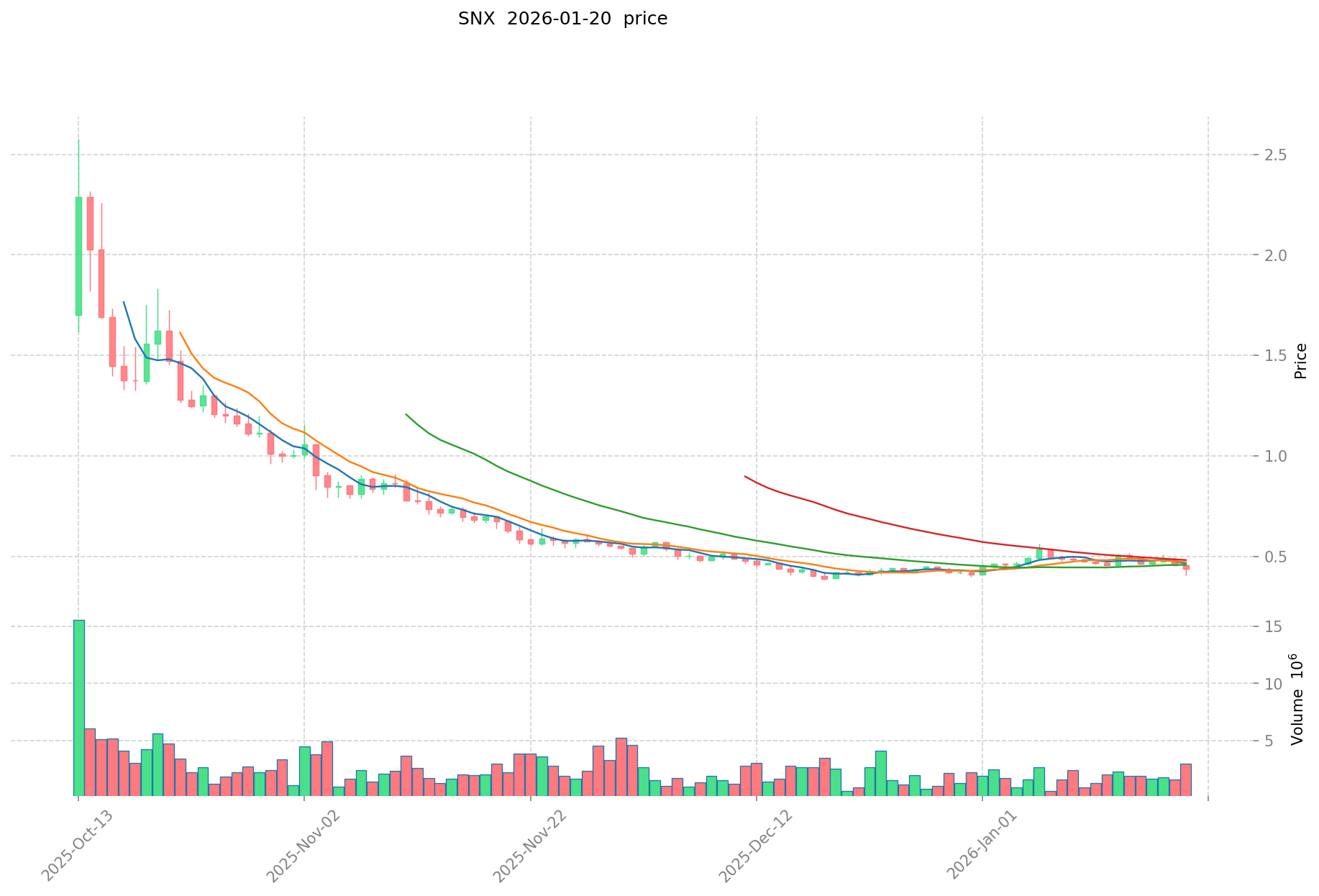
II. Core Factors Influencing SGB vs SNX Investment Value
Supply Mechanism Comparison (Tokenomics)
Due to insufficient reference materials, detailed supply mechanism information for both SGB and SNX cannot be provided at this time.
Institutional Adoption and Market Application
Without available data on institutional holdings, enterprise adoption cases, or regulatory policies across different jurisdictions for SGB and SNX, a comparative analysis cannot be conducted.
Technical Development and Ecosystem Construction
Reference materials do not contain information regarding technical upgrades, ecosystem developments, or application scenarios in DeFi, NFT, payment systems, or smart contract implementations for either SGB or SNX.
Macroeconomic Factors and Market Cycles
Insufficient data exists in the provided materials to analyze the performance characteristics of SGB and SNX under inflationary conditions, their responses to monetary policy shifts, interest rate changes, US Dollar Index movements, or geopolitical factors affecting cross-border transaction demands.
III. 2026-2031 Price Prediction: SGB vs SNX
Short-term Prediction (2026)
- SGB: Conservative $0.0015495 - $0.002066 | Optimistic $0.002066 - $0.00266514
- SNX: Conservative $0.347592 - $0.4138 | Optimistic $0.4138 - $0.591734
Medium-term Prediction (2028-2029)
- SGB may enter a gradual growth phase, with projected price range of $0.001955631503812 - $0.003676587227167
- SNX may enter an expansion phase, with projected price range of $0.40761834525 - $0.883173081375
- Key drivers: institutional capital flow, ETF developments, ecosystem expansion
Long-term Prediction (2031)
- SGB: Baseline scenario $0.003581934662383 | Optimistic scenario $0.004907250487464
- SNX: Baseline scenario $0.871114371994687 | Optimistic scenario $1.202137833352668
View detailed price predictions for SGB and SNX
Disclaimer
SGB:
| Year |
Predicted High Price |
Predicted Average Price |
Predicted Low Price |
Price Change |
| 2026 |
0.00266514 |
0.002066 |
0.0015495 |
0 |
| 2027 |
0.0025311599 |
0.00236557 |
0.0014903091 |
14 |
| 2028 |
0.0027666523935 |
0.00244836495 |
0.002252495754 |
18 |
| 2029 |
0.003676587227167 |
0.00260750867175 |
0.001955631503812 |
26 |
| 2030 |
0.004021821375307 |
0.003142047949458 |
0.00185380829018 |
52 |
| 2031 |
0.004907250487464 |
0.003581934662383 |
0.00318792184952 |
73 |
SNX:
| Year |
Predicted High Price |
Predicted Average Price |
Predicted Low Price |
Price Change |
| 2026 |
0.591734 |
0.4138 |
0.347592 |
0 |
| 2027 |
0.67873545 |
0.502767 |
0.44243496 |
21 |
| 2028 |
0.7679765925 |
0.590751225 |
0.44306341875 |
42 |
| 2029 |
0.883173081375 |
0.67936390875 |
0.40761834525 |
64 |
| 2030 |
0.960960248926875 |
0.7812684950625 |
0.601576741198125 |
88 |
| 2031 |
1.202137833352668 |
0.871114371994687 |
0.487824048317025 |
110 |
IV. Investment Strategy Comparison: SGB vs SNX
Long-term vs Short-term Investment Strategies
- SGB: May appeal to investors interested in exploring experimental network technologies and canary network testing environments, particularly those focused on oracle systems and cross-chain asset mechanisms.
- SNX: May suit investors seeking exposure to decentralized synthetic asset platforms and decentralized finance infrastructure with established market presence.
Risk Management and Asset Allocation
- Conservative Investors: SGB 20-30% vs SNX 70-80%
- Aggressive Investors: SGB 40-50% vs SNX 50-60%
- Hedging Tools: stablecoin allocation, options strategies, cross-asset portfolio diversification
V. Potential Risk Comparison
Market Risk
- SGB: Lower market capitalization (ranked 670) may result in higher price volatility and limited liquidity, with 24-hour trading volume of $26,304.92 indicating relatively modest market activity.
- SNX: While ranked higher at 276 by market cap, the asset still demonstrates volatility characteristics common to cryptocurrency markets, with 24-hour trading volume of $957,050.99.
Technical Risk
- SGB: As a canary network, potential considerations include network scalability testing outcomes and stability during experimental protocol implementations.
- SNX: Platform considerations may include smart contract security, synthetic asset peg stability, and protocol upgrade execution.
Regulatory Risk
- Both assets operate in evolving regulatory environments where policy developments regarding decentralized protocols, synthetic assets, and oracle systems may affect their respective operational frameworks and market accessibility across different jurisdictions.
VI. Conclusion: Which Is the Better Buy?
📌 Investment Value Summary:
- SGB Characteristics: Operates as a testing environment for emerging oracle and cross-chain technologies, positioned at an earlier development stage with a current price of $0.002061.
- SNX Characteristics: Established presence in decentralized synthetic asset protocols since 2018, with a current price of $0.4137 and broader market recognition.
✅ Investment Considerations:
- Beginning Investors: Consider focusing on assets with established track records and higher liquidity levels, while maintaining diversified portfolio allocation and implementing appropriate risk management measures.
- Experienced Investors: May evaluate both assets within a diversified cryptocurrency portfolio framework, considering risk tolerance levels, investment timeframes, and market cycle positioning.
- Institutional Investors: Assessment may involve detailed due diligence on protocol fundamentals, liquidity parameters, regulatory compliance frameworks, and alignment with institutional investment mandates.
⚠️ Risk Disclaimer: Cryptocurrency markets exhibit significant volatility. This content does not constitute investment advice. Investors should conduct independent research and consult qualified financial professionals before making investment decisions.
VII. FAQ
Q1: What are the main differences between SGB and SNX in terms of project positioning?
SGB (Songbird) serves as Flare's Canary network, functioning as a testing ground for experimental technologies including the Flare Time Series Oracle, StateConnector, and F-Asset systems. SNX (Synthetix), established in March 2018, operates as a decentralized synthetic asset platform enabling the creation and trading of synthetic assets including fiat currencies, precious metals, indices, and cryptocurrencies. The fundamental distinction lies in SGB's role as a testing environment for emerging cross-chain technologies versus SNX's position as an established protocol for synthetic asset generation and trading.
Q2: How do the current market capitalizations and rankings of SGB and SNX compare?
SGB ranks 670 by market capitalization with approximately 16.04 billion tokens in circulation and trades at $0.002061, while SNX ranks significantly higher at 276 with 343.47 million circulating tokens priced at $0.4137. The substantial difference in market cap rankings reflects SNX's more established market presence since 2018 compared to SGB's position as a newer experimental network. Additionally, SNX demonstrates considerably higher trading volume at $957,050.99 versus SGB's $26,304.92 over a 24-hour period, indicating stronger liquidity and market activity.
Q3: What are the price performance histories for SGB and SNX from their respective peaks?
SGB reached its notable high of $0.71334 on September 30, 2021, shortly after network launch, declining to $0.00192389 by January 1, 2026—a substantial decrease from its peak. SNX achieved its historical high of $28.53 on February 14, 2021, during the DeFi expansion period, subsequently experiencing significant retracement to $0.0347864 on January 6, 2019. Both assets have demonstrated considerable volatility across market cycles, with price movements reflecting broader cryptocurrency market trends and sector-specific developments.
Q4: What are the projected price ranges for SGB and SNX through 2031?
For SGB, conservative 2026 projections range from $0.0015495 to $0.002066, with optimistic scenarios reaching $0.00266514. By 2031, baseline projections suggest $0.003581934662383, while optimistic scenarios estimate $0.004907250487464. SNX conservative 2026 estimates range from $0.347592 to $0.4138, with optimistic projections reaching $0.591734. Long-term 2031 baseline scenarios project $0.871114371994687, with optimistic estimates reaching $1.202137833352668. These projections assume various market conditions including institutional adoption trends, ecosystem development, and broader cryptocurrency market cycles.
Q5: How should investors approach portfolio allocation between SGB and SNX based on risk tolerance?
Conservative investors might consider allocating 20-30% to SGB and 70-80% to SNX, prioritizing the more established protocol with higher liquidity. Aggressive investors could explore 40-50% SGB and 50-60% SNX allocation, accepting higher volatility for potential experimental technology exposure. Both strategies should incorporate comprehensive risk management including stablecoin reserves, options hedging strategies, and cross-asset diversification. Investment decisions should align with individual risk tolerance levels, investment timeframes, and thorough understanding of each protocol's technological foundation and market positioning.
Q6: What are the primary risk considerations when comparing SGB and SNX investments?
SGB's primary risks stem from its lower market capitalization (rank 670), resulting in higher price volatility and limited liquidity with modest 24-hour trading volume. As a canary network, technical risks include experimental protocol stability and network scalability testing outcomes. SNX, while more established at rank 276, faces considerations including smart contract security, synthetic asset peg maintenance, and protocol upgrade execution. Both assets operate within evolving regulatory frameworks where policy developments regarding decentralized protocols, synthetic assets, and oracle systems may impact operational parameters and market accessibility across jurisdictions.
Q7: Which asset is more suitable for beginning versus experienced cryptocurrency investors?
Beginning investors should prioritize assets with established track records and higher liquidity levels, suggesting SNX may present more suitable characteristics given its longer operational history since 2018 and higher market cap ranking. However, comprehensive portfolio diversification and appropriate risk management measures remain essential regardless of asset selection. Experienced investors may evaluate both assets within a diversified framework, assessing SGB's experimental technology exposure against SNX's established synthetic asset protocol positioning. Investment suitability ultimately depends on individual risk tolerance, market knowledge depth, investment timeframes, and alignment with specific portfolio objectives.
Q8: What factors should investors monitor when evaluating long-term prospects for SGB versus SNX?
Key monitoring factors include protocol development milestones, ecosystem expansion indicators, institutional adoption trends, and regulatory framework evolution across major jurisdictions. For SGB, developments in oracle technology, cross-chain asset mechanisms, and Flare network advancement warrant attention. For SNX, synthetic asset platform expansion, DeFi integration progress, and protocol governance decisions represent important considerations. Broader market factors including cryptocurrency market cycles, macroeconomic conditions, and sector-specific trends in DeFi and oracle technologies should inform ongoing assessment. Regular evaluation of trading volume trends, liquidity parameters, and community development activity provides additional insight into each protocol's market positioning evolution.
* The information is not intended to be and does not constitute financial advice or any other recommendation of any sort offered or endorsed by Gate.