This comprehensive analysis compares SIREN and XRP, two distinct digital assets in the cryptocurrency market. SIREN, launched in 2025, is an AI-powered token on BNB Chain offering innovative crypto services through artificial intelligence integration, currently trading at $0.0751. XRP, established since 2011, serves as a payment infrastructure asset with proven institutional adoption, currently at $1.989. The article examines price trajectories, supply mechanisms, institutional adoption patterns, and technological ecosystems. While XRP demonstrates higher liquidity ($55M daily volume) and lower volatility suitable for conservative investors seeking payment solutions, SIREN presents emerging opportunities in the AI sector with higher growth potential but increased risk. Investment recommendations vary by investor profile: conservative allocations favor XRP 85-90%, while aggressive strategies increase SIREN to 30-40%. Price projections through 2031 suggest XRP ranging $1.11-$3.92 and SIREN $0.058-$0.18. Both as
Introduction: Investment Comparison Between SIREN and XRP
In the cryptocurrency market, the comparison between SIREN and XRP remains a topic of significant interest among investors. These two assets exhibit notable differences in market capitalization ranking, application scenarios, and price performance, representing distinct positions within the crypto asset landscape.
SIREN (SIREN): Launched in 2025, this project draws inspiration from Greek mythology and positions itself as an AI-powered crypto experience centered around SirenAIAgent, an artificial intelligence entity with dual personality characteristics.
XRP (XRP): Introduced in 2011, XRP has established itself as a digital asset built on the XRP Ledger, designed specifically for payment solutions with characteristics of speed (approximately 3 seconds per transaction), low cost ($0.0002 per transaction), and scalability (1,500+ tps).
This article provides a comprehensive analysis of the investment value comparison between SIREN and XRP, examining aspects including historical price trajectories, supply mechanisms, institutional adoption patterns, technological ecosystems, and future outlook, attempting to address the question most relevant to investors:
"Which is the better buy right now?"
I. Price History Comparison and Current Market Status
SIREN (Coin A) and XRP (Coin B) Historical Price Trends
- 2025: SIREN experienced significant volatility during its initial market phase, with its all-time high of $0.20358 recorded in May 2025, followed by a decline to its all-time low of $0.03273 in March 2025.
- 2025: XRP reached its all-time high of $3.65 in July 2025, reflecting renewed market interest and regulatory developments, before experiencing a subsequent correction.
- Comparative Analysis: During the recent market cycle, SIREN demonstrated substantial price fluctuation from its peak of $0.20358 to its low of $0.03273, representing considerable volatility typical of emerging tokens. In contrast, XRP, as a more established digital asset, showed price movement from $3.65 to lower levels, with its current trading range reflecting broader market conditions and regulatory considerations.
Current Market Status (2026-01-19)
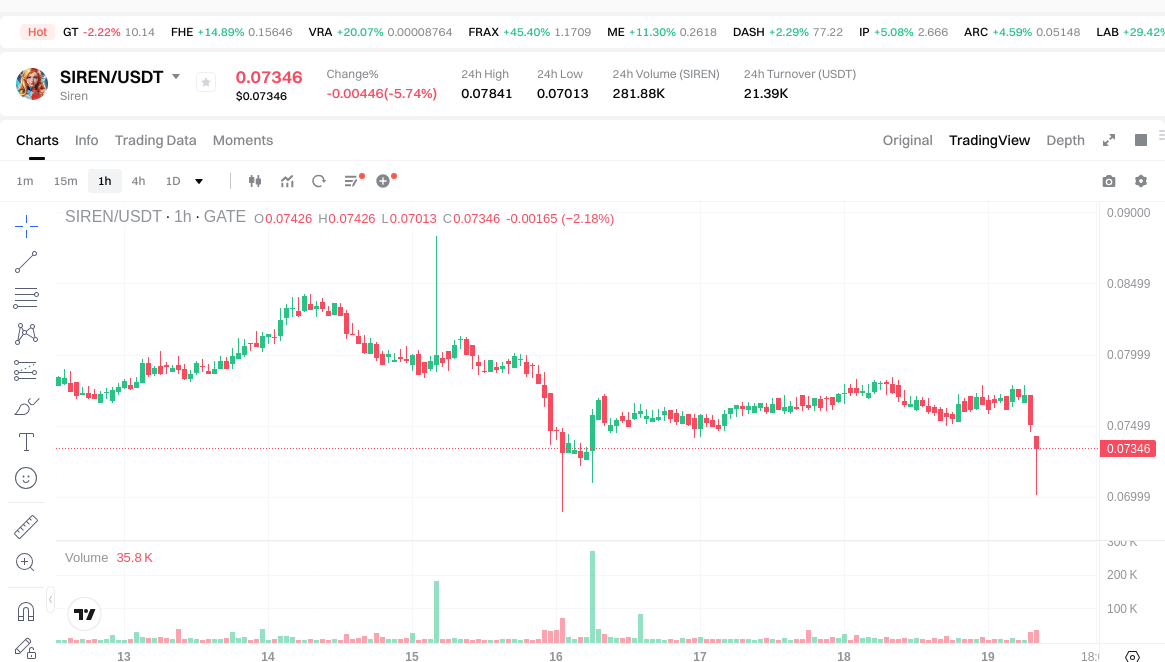
- SIREN current price: $0.0751
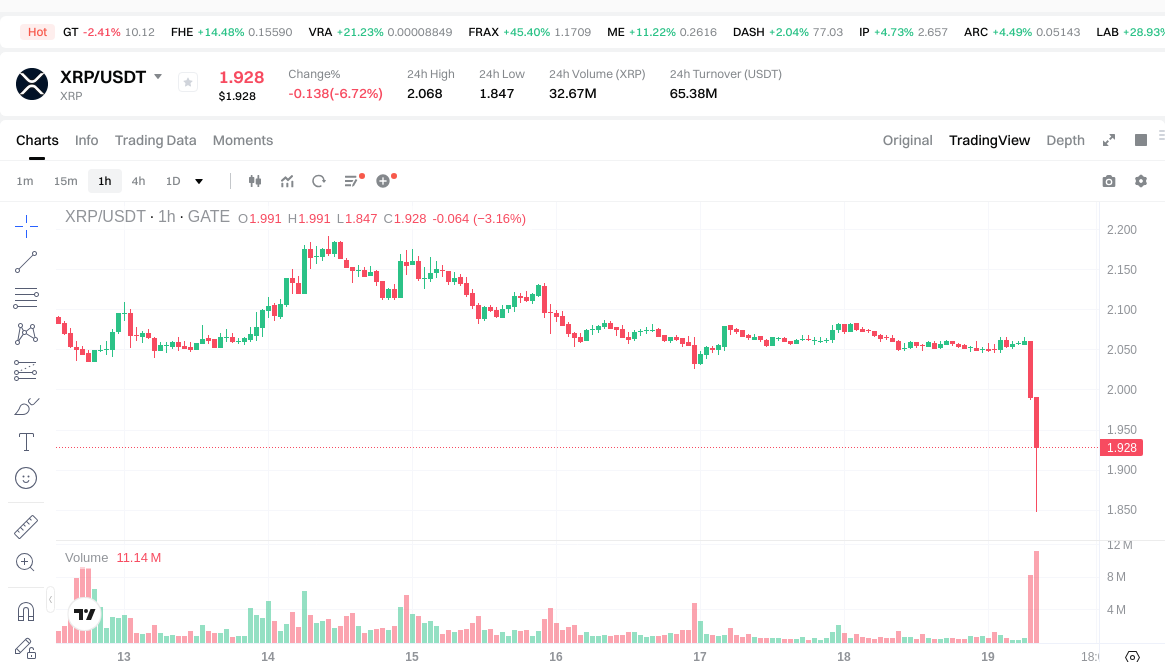
- XRP current price: $1.989
- 24-hour trading volume: SIREN $21,080.20 vs XRP $55,332,071.55
- Market Sentiment Index (Fear & Greed Index): 49 (Neutral)
View real-time prices:
II. Core Factors Influencing SIREN vs XRP Investment Value
Supply Mechanism Comparison (Tokenomics)
-
SIREN: Deployed on BNB Chain as an AI project token, with the Siren AI Agent designed to provide intelligent and personalized crypto service experiences. The specific supply mechanism and token distribution details are not extensively documented in available materials.
-
XRP: Features a pre-mined supply model where the total supply was created at inception, with Ripple Labs holding a significant portion in escrow that releases periodically into circulation.
-
📌 Historical Pattern: Different supply mechanisms can influence price cycles through scarcity dynamics and market circulation changes over time.
Institutional Adoption and Market Application
-
Institutional Holdings: Market materials suggest that XRP has garnered attention from financial institutions due to its applications in cross-border payments and remittance services.
-
Enterprise Adoption: XRP has established use cases in financial sector applications, particularly in payment settlement scenarios. SIREN's adoption remains focused on providing AI-driven services within the BNB Chain ecosystem.
-
Regulatory Environment: XRP's value has been influenced by regulatory developments and compliance frameworks in various jurisdictions. SIREN operates within the emerging AI and crypto service sector with evolving regulatory considerations.
Technology Development and Ecosystem Building
-
SIREN Technology: The project leverages AI agent capabilities to deliver intelligent crypto services on BNB Chain, benefiting from the network's infrastructure and liquidity channels.
-
XRP Technology: Operates on its own ledger system designed for efficient cross-border transactions and payment settlements.
-
Ecosystem Comparison: XRP has established presence in payment and settlement applications, while SIREN focuses on AI-driven service delivery within the DeFi and crypto service landscape. The materials indicate BNB Chain's ecosystem benefits from USD1 stablecoin liquidity and Binance Alpha distribution channels.
Macroeconomic Environment and Market Cycles
-
Inflation Context Performance: Market materials suggest that crypto assets respond differently to macroeconomic conditions, with investors increasingly focusing on protocol revenue and sustainable yield strategies rather than speculative airdrops.
-
Monetary Policy Impact: Interest rates, monetary policy shifts, and dollar index movements can influence demand for digital assets across different use cases and value propositions.
-
Geopolitical Factors: Cross-border transaction demand and international market developments may affect adoption patterns for payment-focused tokens and blockchain-based services.
III. 2026-2031 Price Prediction: SIREN vs XRP
Short-term Forecast (2026)
- SIREN: Conservative $0.058728 - $0.07341 | Optimistic $0.07341 - $0.1093809
- XRP: Conservative $1.11824 - $1.928 | Optimistic $1.928 - $2.3136
Medium-term Forecast (2028-2029)
- SIREN may enter a growth phase, with estimated price range of $0.05275345374 - $0.145462576240575
- XRP may enter a consolidation phase, with estimated price range of $1.630365 - $2.593475951
- Key drivers: institutional capital inflows, ETF developments, ecosystem expansion
Long-term Forecast (2030-2031)
- SIREN: Base scenario $0.103276295278966 - $0.150108963489912 | Optimistic scenario $0.141474377094474 - $0.183916690222817
- XRP: Base scenario $2.132346231675 - $2.985284724345 | Optimistic scenario $2.7469636749225 - $3.928158055139175
View detailed price predictions for SIREN and XRP
Disclaimer
SIREN:
| Year |
Predicted High Price |
Predicted Average Price |
Predicted Low Price |
Price Change |
| 2026 |
0.1093809 |
0.07341 |
0.058728 |
-2 |
| 2027 |
0.111502449 |
0.09139545 |
0.0612349515 |
21 |
| 2028 |
0.138985060815 |
0.1014489495 |
0.05275345374 |
35 |
| 2029 |
0.145462576240575 |
0.1202170051575 |
0.102184454383875 |
60 |
| 2030 |
0.150108963489912 |
0.132839790699037 |
0.128854596978066 |
76 |
| 2031 |
0.183916690222817 |
0.141474377094474 |
0.103276295278966 |
88 |
XRP:
| Year |
Predicted High Price |
Predicted Average Price |
Predicted Low Price |
Price Change |
| 2026 |
2.3136 |
1.928 |
1.11824 |
-3 |
| 2027 |
2.22684 |
2.1208 |
1.993552 |
6 |
| 2028 |
2.6737986 |
2.17382 |
1.630365 |
9 |
| 2029 |
2.593475951 |
2.4238093 |
2.254142649 |
21 |
| 2030 |
2.985284724345 |
2.5086426255 |
2.132346231675 |
26 |
| 2031 |
3.928158055139175 |
2.7469636749225 |
2.444797670681025 |
38 |
IV. Investment Strategy Comparison: SIREN vs XRP
Long-term vs Short-term Investment Strategies
-
SIREN: Suitable for investors focused on emerging AI-driven crypto services and seeking exposure to innovative technology applications within the BNB Chain ecosystem. The token's positioning in the AI agent sector may appeal to those interested in exploring nascent market segments with potential growth trajectories.
-
XRP: Suitable for investors interested in established payment infrastructure and cross-border transaction solutions. The asset's established presence in financial services applications may attract those seeking exposure to digital assets with recognized institutional adoption patterns.
Risk Management and Asset Allocation
- Conservative Investors: SIREN 10-15% vs XRP 85-90%
- Aggressive Investors: SIREN 30-40% vs XRP 60-70%
- Hedging Tools: Stablecoin allocation, options strategies, cross-asset portfolio diversification
V. Potential Risk Comparison
Market Risk
-
SIREN: As an emerging token launched in 2025, SIREN demonstrates considerable price volatility, with historical fluctuations between $0.03273 and $0.20358. The asset's limited trading volume of $21,080.20 suggests lower liquidity levels, which may contribute to increased price sensitivity during market movements.
-
XRP: Despite being an established digital asset since 2011, XRP remains subject to market volatility influenced by broader cryptocurrency market trends, regulatory developments, and institutional adoption patterns. The asset's trading volume of $55,332,071.55 indicates relatively higher market liquidity compared to emerging tokens.
Technical Risk
-
SIREN: The project's reliance on AI agent technology and BNB Chain infrastructure presents considerations regarding network stability, smart contract security, and ecosystem dependencies. The integration of AI capabilities introduces additional technical complexity requiring ongoing development and maintenance.
-
XRP: Operating on its own ledger system, XRP's technical considerations include network consensus mechanisms, transaction processing capacity, and system upgrades. The centralized aspects of its initial distribution model present unique characteristics within the decentralized finance landscape.
Regulatory Risk
- Global regulatory frameworks continue to evolve regarding digital assets, with different jurisdictions implementing varying approaches to cryptocurrency oversight. XRP has experienced regulatory scrutiny in multiple markets, particularly concerning securities classification questions. SIREN, as a newer project in the AI and crypto services sector, operates within an emerging regulatory environment where frameworks for AI-integrated blockchain applications are still developing. Investors should monitor regulatory developments in their respective jurisdictions that may impact both payment-focused tokens and AI-driven crypto service platforms.
VI. Conclusion: Which Is the Better Buy?
📌 Investment Value Summary:
-
SIREN Advantages: Positioning in the emerging AI agent sector within the BNB Chain ecosystem, potential exposure to innovative technology applications in crypto services, benefits from ecosystem infrastructure including USD1 stablecoin liquidity channels.
-
XRP Advantages: Established presence since 2011 with recognized institutional adoption patterns, designed specifically for payment and cross-border transaction solutions with transaction speed and cost efficiency characteristics, higher market liquidity with substantial trading volume.
✅ Investment Recommendations:
-
New Investors: Consider starting with XRP for exposure to an established digital asset with clearer use cases in payment infrastructure, while allocating a smaller portion to SIREN for diversification into emerging AI-driven services. Focus on understanding fundamental differences in technology applications and market positioning.
-
Experienced Investors: Evaluate portfolio allocation based on risk tolerance and investment thesis, considering XRP's position in payment infrastructure versus SIREN's emerging AI service applications. Implement risk management strategies including position sizing, stop-loss mechanisms, and regular portfolio rebalancing.
-
Institutional Investors: Conduct comprehensive due diligence on regulatory compliance, custody solutions, and liquidity considerations for both assets. Consider XRP's established institutional adoption patterns and SIREN's positioning within the evolving AI and blockchain services landscape when developing allocation strategies.
⚠️ Risk Disclosure: Cryptocurrency markets demonstrate significant volatility characteristics. This content does not constitute investment advice. Investors should conduct independent research and consult with qualified financial advisors before making investment decisions.
VII. FAQ
Q1: What is the main difference between SIREN and XRP in terms of use cases?
XRP is designed specifically for payment infrastructure and cross-border transactions, while SIREN focuses on AI-driven crypto services within the BNB Chain ecosystem. XRP has been operational since 2011 with established applications in financial services, featuring transaction speeds of approximately 3 seconds and costs around $0.0002 per transaction. In contrast, SIREN, launched in 2025, leverages AI agent technology to provide intelligent and personalized crypto service experiences, representing a newer approach to blockchain applications centered around artificial intelligence integration.
Q2: Which asset demonstrates higher liquidity and trading volume?
XRP exhibits significantly higher liquidity with a 24-hour trading volume of $55,332,071.55 compared to SIREN's $21,080.20. This substantial difference reflects XRP's established market presence since 2011 and broader institutional adoption, whereas SIREN, as an emerging token launched in 2025, maintains lower trading volumes typical of newer projects. Higher liquidity generally translates to easier entry and exit positions with reduced price slippage, making XRP more accessible for larger transaction volumes.
Q3: What are the primary risks associated with investing in SIREN versus XRP?
SIREN presents higher volatility risk due to its recent launch and limited liquidity, with historical price fluctuations ranging from $0.03273 to $0.20358. Technical risks include dependencies on AI agent technology and BNB Chain infrastructure. XRP faces regulatory risks stemming from ongoing scrutiny regarding securities classification across multiple jurisdictions, despite its established market presence. Both assets remain subject to broader cryptocurrency market volatility, but SIREN's lower liquidity levels may amplify price sensitivity during market movements, while XRP's regulatory considerations create unique compliance-related uncertainties.
Q4: How do the supply mechanisms differ between these two assets?
XRP features a pre-mined supply model where the total supply was created at inception, with Ripple Labs holding a significant portion in escrow that releases periodically into circulation, creating predictable supply dynamics. SIREN operates as a token deployed on BNB Chain with supply mechanisms designed to support its AI-driven service model, though specific distribution details are less extensively documented compared to XRP's transparent escrow system. These different approaches to supply management can influence price dynamics through varying scarcity characteristics and circulation patterns over time.
Q5: What is the recommended portfolio allocation strategy for different investor types?
Conservative investors should consider allocating 85-90% to XRP and 10-15% to SIREN, prioritizing the established asset with clearer institutional adoption patterns. Aggressive investors may increase SIREN allocation to 30-40% while maintaining 60-70% in XRP, accepting higher risk for exposure to emerging AI service applications. New investors should start with XRP for foundational exposure to payment infrastructure use cases, while allocating smaller portions to SIREN for diversification. All strategies should incorporate risk management tools including stablecoin allocations, position sizing guidelines, and regular portfolio rebalancing.
Q6: How do institutional adoption patterns differ between SIREN and XRP?
XRP has established institutional adoption primarily within the financial services sector, particularly for cross-border payment settlements and remittance applications, with recognized enterprise use cases developed over more than a decade. SIREN's institutional adoption remains in earlier stages, focused on demonstrating value within the AI-driven crypto services sector and leveraging BNB Chain's ecosystem infrastructure. The materials indicate that XRP benefits from established relationships with financial institutions, while SIREN's adoption trajectory centers on emerging applications at the intersection of artificial intelligence and blockchain technology.
Q7: What factors should investors monitor when comparing these assets' future performance?
Investors should track regulatory developments affecting both payment-focused tokens like XRP and AI-integrated platforms like SIREN, as evolving frameworks may significantly impact valuations. Market adoption metrics including transaction volumes for XRP's payment applications and user engagement with SIREN's AI services provide important performance indicators. Additionally, monitoring broader market conditions such as institutional capital flows, ETF developments, macroeconomic factors including interest rate policies, and technological advancement in AI and blockchain integration will help assess comparative investment value over different time horizons.
Q8: What are the projected price trajectories for both assets through 2031?
According to conservative estimates, SIREN may trade between $0.058728 - $0.183916 from 2026 to 2031, with optimistic scenarios reaching higher ranges during growth phases. XRP's conservative projections suggest a range of $1.11824 - $3.928158 over the same period, reflecting its established market position. Short-term (2026) forecasts indicate SIREN between $0.058728 - $0.1093809 and XRP between $1.11824 - $2.3136. Long-term (2030-2031) projections show SIREN potentially reaching $0.103276 - $0.183917 and XRP achieving $2.132346 - $3.928158, though these predictions remain subject to significant market variables and should not constitute investment advice.
* The information is not intended to be and does not constitute financial advice or any other recommendation of any sort offered or endorsed by Gate.