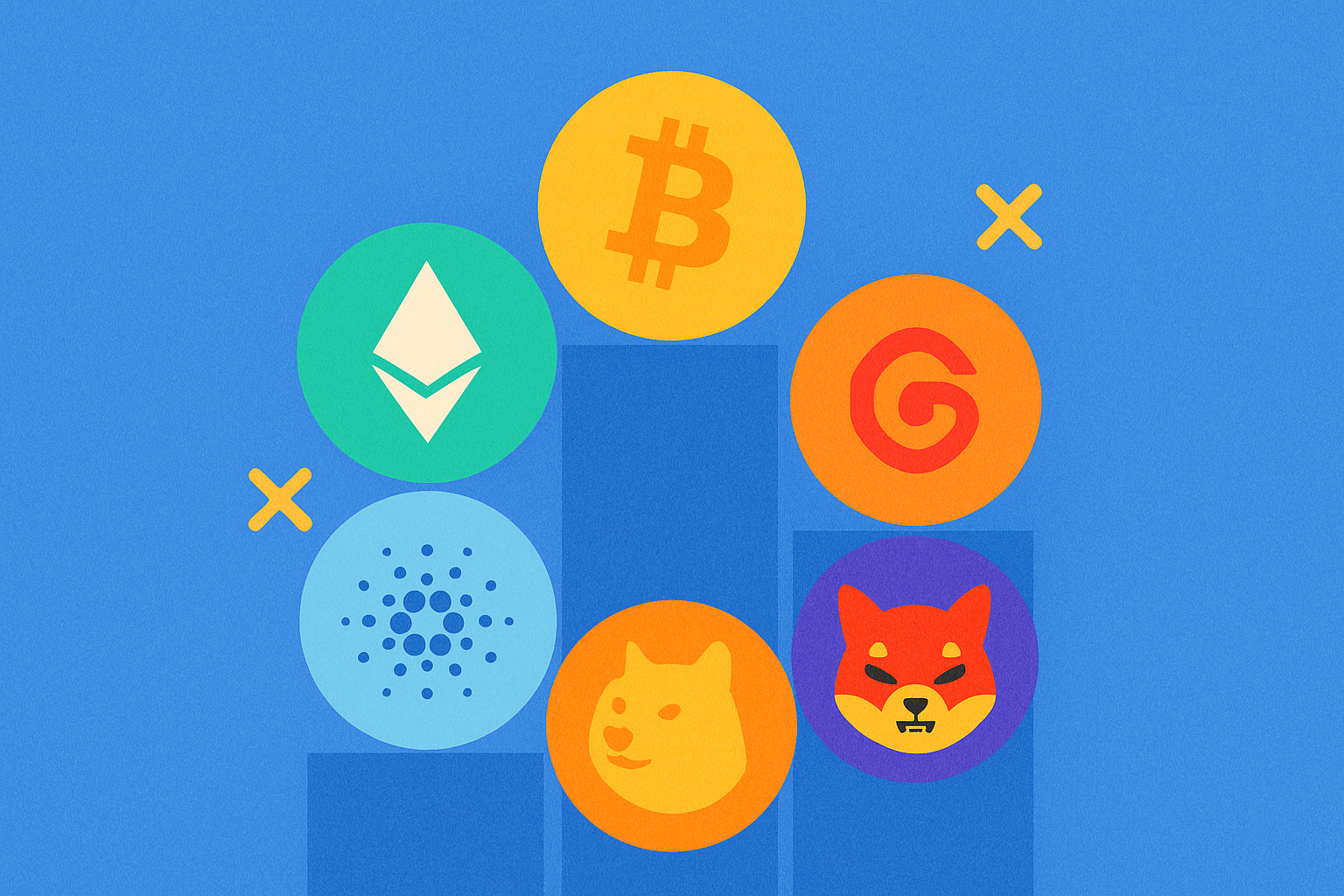
A beginner’s guide to the risks and precautions of cryptocurrency investment. This analysis covers Bitcoin, Ethereum, Gate exchange tokens, and other assets that have experienced 1000x growth, comparing their success factors and failure cases on Gate. Key strategies for risk management and asset selection are also highlighted.
Growth Overview of Six Leading Tokens (Initial Price, All-Time High, Multiples)
Over the past decade, the cryptocurrency market has witnessed extraordinary growth, with many tokens surging hundreds or even thousands of times from their launch prices. Bitcoin stands out, rising by at least 1,000,000x to its peak—and by some counts, tens of millions of times. What other tokens, aside from Bitcoin, have posted returns of 1,000x or more?
This article spotlights six major cryptocurrencies that have achieved more than 1,000x growth between 2009 and recent years, providing detailed analysis for each. The following table summarizes the launch year, initial price (first trade price), all-time high, and growth multiple for each of these six tokens.
| Token (Ticker) |
Launch Year |
Initial Price |
All-Time High (Date) |
Growth Multiple (from Initial) |
| Bitcoin (BTC) |
2009 |
$0.0008 (2010 estimate) |
$109,350 (Jan 20, 2025) |
Approx. 136,687,500x |
| Ethereum (ETH) |
2015 |
$0.31 (2014 ICO) |
$4,878 (Nov 2021) |
Approx. 15,736x |
| Top Exchange Token |
2017 |
$0.15 (2017 ICO) |
$690 (May 2021) |
Approx. 4,600x |
| Cardano (ADA) |
2017 |
$0.0024 (2015–17 ICO) |
$3.10 (Sep 2021) |
Approx. 1,291x |
| Dogecoin (DOGE) |
2013 |
$0.0004 (Dec 2013 launch) |
$0.74 (May 2021) |
Approx. 1,850x |
| Shiba Inu (SHIB) |
2020 |
$0.00000000051 (Aug 2020 launch) |
$0.0000885 (Oct 2021) |
Approx. 173,529x |
Each token has unique factors driving its growth, yet all reflect the rapid expansion of the crypto market and intense investor enthusiasm. Below, we examine the price history and key growth drivers for each token.
Bitcoin (BTC)
Launched in January 2009 by Satoshi Nakamoto, Bitcoin is the world’s first cryptocurrency. It serves as the backbone of the crypto market and is known as “digital gold.” With a capped supply of 21 million BTC and a secure decentralized network, Bitcoin has become a favored long-term store of value.
Bitcoin’s price history is the longest in the crypto space, and its trajectory is emblematic of overall market trends. From a state of virtually no value to tens of millions of times growth, Bitcoin is seen by investors as a “dream asset.”
Price History (Initial Price, All-Time High) and Multiples
Bitcoin had no monetary value at launch in 2009, as there were no exchanges. The first USD exchange rate was set in October 2009 when 5,050 BTC sold for about $5—roughly $0.0009 per BTC. The first exchange launched in July 2010, with prices starting around $0.0008–$0.08.
By late 2010, the price neared $0.5, surpassing $1 for the first time in 2011, then spiking to $29.6 in June amid volatility. Bitcoin’s price has moved in four-year cycles, breaking $1,000 in late 2013 and reaching $19,000 in December 2017. The most recent all-time high was $109,350 on January 20, 2025. From an initial trading price of about $0.0008–$0.08, Bitcoin’s rise is at least 1,000,000x—or tens of millions of times by some estimates.
Such extraordinary growth underscores Bitcoin’s role as a long-term store of value, not merely a speculative asset.
Key Drivers of Bitcoin’s Growth
Market Maturity and Reserve Currency Role
Bitcoin’s status as the original cryptocurrency has made it the market’s anchor. Institutional investors and corporations consistently choose it as their first crypto asset, with Bitcoin representing over half of the market’s total capitalization for years. This reserve currency role supports its price stability and liquidity.
Supply Constraints and Halving Events
Bitcoin’s supply halves roughly every four years—2012, 2016, and 2020—keeping inflation low. The third halving in 2020, coupled with loose monetary policy, led to Bitcoin’s surge as an “inflation hedge.” These supply constraints are central to Bitcoin’s sustained price appreciation.
Macro Trends and Safe Haven Appeal
Post-pandemic fiscal stimulus and quantitative easing drove capital into Bitcoin. In early 2021, Bitcoin was seen as a risk asset alongside stocks and real estate, jumping from $29,000 at the end of 2020 to over $64,000 within months. This sensitivity to macro changes highlights Bitcoin’s acceptance as an investment on par with traditional assets.
Institutional and Corporate Adoption
Major corporations have acquired significant BTC holdings in recent years. A leading EV manufacturer publicly bought $1.5 billion in BTC. Payment services and US banks now offer crypto products, with traditional financial institutions steadily entering the space. Institutional adoption has expanded Bitcoin’s market and stabilized its price.
Legal Tender Status at the National Level
At one point, a Central American country designated Bitcoin as legal tender, distributing wallets to every citizen—a global first. This landmark move transformed Bitcoin from a speculative asset to a viable payment method, significantly raising its credibility.
“Digital Gold” Narrative
The notion of Bitcoin as “digital gold” has become widespread. Its market cap briefly topped $1 trillion, rivaling the gold market’s scale. The supply cap and decentralized nature bolster its appeal for long-term holders. The “digital gold” narrative cements Bitcoin’s role as a store of value.
Sovereign Reserve Initiatives
At one point, a government signaled interest in holding BTC as part of US foreign reserves, aiming to maintain dollar dominance and counter other countries’ digital asset policies. News of this move pushed Bitcoin to new highs, reaffirming the impact of policy on price. Such developments have further enhanced Bitcoin’s investment appeal.
Ethereum (ETH)
Ethereum, launched in July 2015, is a blockchain platform second in scale only to Bitcoin. While Bitcoin is “digital gold,” Ethereum serves as the “decentralized internet protocol,” underpinning smart contracts and DApps.
Ethereum’s flexible architecture places it at the heart of DeFi and NFT trends, with countless projects and tokens built atop its network. Its technical innovations continue to expand the boundaries of the crypto market.
Price History (Initial Price, All-Time High) and Multiples
Ethereum’s 2014 ICO sold ETH at about $0.31, raising $18 million. At mainnet launch in July 2015, ETH traded for several dollars.
The 2017 ICO boom sent demand soaring, with ETH peaking at $1,400 in January 2018 before dropping to the $80 range by year-end. Interest revived after 2020, as DeFi and NFTs fueled a rally to an all-time high of $4,878.26 on November 10, 2021—over 15,000x the ICO price.
Ethereum’s price trajectory mirrors its technical advancement and increasing market demand.
Key Drivers of Ethereum’s Growth
Smart Contract and DApp Innovation
Ethereum’s defining feature is its smart contract capability, enabling anyone to create tokens or apps. Since 2016, countless projects have launched on Ethereum, powering the ICO boom. This innovation has made Ethereum a critical infrastructure for the crypto sector.
Over recent years, DeFi protocols built on Ethereum—including major DEXs and lending platforms—have seen explosive growth. Yield farming locked up ETH, driving prices higher. Ethereum remains the core “financial infrastructure” for DeFi, reinforcing its utility and demand.
NFT Boom and Demand Surge
Recent NFT marketplace growth has accelerated ETH usage for digital art and collectibles, driving new user adoption. Rising gas fees and network activity have pushed ETH prices up. The NFT boom has further strengthened Ethereum’s market presence.
Technical Shifts: Ethereum 2.0 Migration
Recent upgrades—like London’s EIP-1559 and the transition from PoW to PoS via The Merge—have improved energy efficiency and investor confidence. These technical advances are key to Ethereum’s sustainability and future growth.
Enterprise Adoption and Ecosystem Growth
Ethereum is now the second major “investment asset” after Bitcoin. Corporate and institutional involvement—including the Enterprise Ethereum Alliance, ETH futures listings, and expanded custody services—has driven market growth and increased trust in Ethereum.
Top Exchange Token
This native token, issued by one of the world’s largest exchanges, was launched via ICO in July 2017 and began as an ERC-20 token. It later migrated to its own blockchain, serving as a utility token for fee discounts, gas payments, and ecosystem transactions.
The token’s price has climbed alongside the exchange’s expansion, making it a compelling asset for investors.
Price History (Initial Price, All-Time High) and Multiples
Sold at $0.15 per token in the ICO, with 100 million tokens issued, the token initially traded for several dollars. It surged to an all-time high of $690.93, a 4,605x increase from its ICO price.
As the exchange’s ecosystem expanded and regulations eased, a new high of $705 was reached, marking a 7,016x gain. Recently, the token has stabilized in the $500–$700 range.
Key Drivers of Exchange Token Growth
Rapid Exchange Growth and User Expansion
The exchange has maintained the global lead in volume since a pivotal period. Users rely on the token for fee discounts, ensuring steady demand. Scandals at competitors accelerated capital inflows. The exchange’s expansion is a direct driver of token price growth.
Fee Discounts and Expanding Utility
Beyond spot fee discounts, the token is used for IEOs, staking, lending, and more. Holding the token is required for Launchpad IEOs, boosting prices. As users increase, so does the token’s utility, supporting sustained demand.
Proprietary Chain Success
The exchange launched its own chain, making the token its native asset. Recent Ethereum-compatible smart chain releases have spurred DeFi and game app development, thanks to low gas fees. Numerous dApps now run on the chain, positioning it as a leading smart contract platform after Ethereum. Chain success has greatly expanded the token’s utility and demand.
Deflationary Token Burns
The token’s supply is slated for reduction to 100 million. The exchange buys back and burns tokens quarterly, decreasing circulation and building favorable tokenomics for long-term holders. This deflationary effect supports long-term price appreciation.
Brand Strength and Community Loyalty
The founder’s charisma and user-focused marketing have built global loyalty. Airdrops and IEO participation foster long-term holders. Reliable operations, including hack compensation, have established confidence in the token. Strong branding and community have elevated the token’s market presence.
Cardano (ADA)
Cardano, launched in 2017, is a third-generation blockchain platform with ADA as its ticker. It supports smart contracts and DApps, and is led by Ethereum co-founder Charles Hoskinson, with a foundation in academic peer review and formal methods.
Cardano uses the Ouroboros PoS consensus algorithm and has evolved through phases like Byron, Shelley, and Goguen. Its academic approach has set Cardano apart in the crypto market.
Price History (Initial Price, All-Time High) and Multiples
ADA was sold in an ICO for about $0.0024 in January 2017, targeting Japan and Korea. After the mainnet launch in October 2017, ADA surged close to $1 during the altcoin boom.
ADA slumped during the 2018 crypto winter but rebounded in recent years. Major upgrades—staking via Shelley, smart contracts via Alonzo—drove renewed attention, culminating in a $3.1 all-time high. ADA’s ICO-to-peak gain surpassed 1,300x.
Cardano’s price history reflects its technical advances and improved market standing.
Key Drivers of Cardano’s Growth
Upgrades Driving Momentum
Shelley enabled decentralization and staking; Alonzo added smart contracts. Each upgrade sparked price rallies. Most recently, the Hydra upgrade dramatically boosted scalability, enabling thousands of transactions per second and accelerating DeFi and NFT adoption. These upgrades enhance Cardano’s technical competitiveness.
Academic Approach and Trustworthiness
Cardano’s peer-reviewed, theory-driven design has attracted long-term support for its security and stability. This approach remains core, with new cryptographic integrations ongoing. Strong community cohesion and a focus on holding strengthen Cardano’s long-term value. The academic approach underpins Cardano’s reliability and future prospects.
“Ethereum Killer” Expectations
Offering lower fees, greater energy efficiency, and stronger security than ETH, Cardano gained traction as an alternative during high gas fee periods. Hydra’s speed and scalability further reinforce its “Ethereum killer” status. In Japan, “Eda Coin” is widely recognized, and domestic listings provide tailwinds. The “Ethereum killer” narrative elevates Cardano’s market profile.
Real-World Use Cases
Partnerships with an African government have delivered digital IDs and academic records to over 5 million students, expanding to nationwide systems with over 10 million users. Cardano is also being adopted for agricultural traceability in Africa, education certification in Southeast Asia, and notary services in Europe—demonstrating real-world, national-scale utility. These use cases enhance Cardano’s practicality and credibility.
Staking Incentives for Long-Term Holding
ADA holders earn annual yields through PoS staking. As of recent years, about 75% of ADA is staked (up from 70%), reducing liquidity in the market. Staking encourages long-term holding and price stability.
Dogecoin (DOGE)
Dogecoin, launched in 2013 as a meme-based cryptocurrency, was created as a joke by engineers Billy Markus and Jackson Palmer, inspired by the Shiba Inu “Kabosu” meme. It started with no clear purpose or technical breakthrough, intended as an “infinite supply joke currency.”
Its approachable logo and playful culture built a strong community, and Dogecoin has at times ranked in the top five by market cap—evolving from joke to genuine phenomenon. Dogecoin’s growth highlights the market’s diversity.
Price History (Initial Price, All-Time High) and Multiples
DOGE launched at about $0.0004 in December 2013, gaining traction on Reddit and surging over 300% within days. It hit a low of $0.000086 in 2015, then rebounded during the 2017–18 altcoin boom.
Recent years saw celebrity endorsements and retail enthusiasm drive DOGE to $0.74 on May 8—about 1,850x its initial price (+185,000%).
Further developments pushed DOGE to a new all-time high of $1.23, a 3,075x increase. DOGE now trades in the $0.80–$1.00 range.
Key Drivers of Dogecoin’s Growth
Meme Culture and Community Strength
The Shiba Inu logo and lighthearted tone appeal to newcomers. Dogecoin is widely used for tips and donations on Reddit, carving out a “currency for fun” niche. The slogan “No highs, no lows, only Doge” resonates with its community. Meme popularity remains strong, with community unity supporting the price. Meme culture is central to Dogecoin’s identity and appeal.
Celebrity and Influencer Endorsement
A major celebrity, known as the “Dogefather,” and other public figures have publicly backed DOGE, driving price surges through social media and corporate payment adoption. Recent ETF filings by asset managers, accepted by the SEC, have boosted visibility in tandem with celebrity support. Celebrity endorsements are a major factor in Dogecoin’s market momentum.
Retail Investor Movements
The “WallStreetBets” movement rallied individual investors behind DOGE, with the motto “To the Moon” sparking grassroots buying. On “Doge Day,” DOGE briefly reached the fifth spot by market cap. ETF anticipation has reignited retail interest, keeping DOGE in the top ten. Retail investor energy is a key driver of price growth.
Expansion of Trading Platforms
Major apps and exchanges have listed DOGE, making it more accessible—especially to younger traders. Surges in trading have even caused outages. Recent ETF filings and expanded DOGE trading support institutional adoption and liquidity.
Distinctive Brand Built on Hype
Dogecoin’s appeal often rests on the “fun of holding,” regardless of utility or technical progress. Celebrity-driven changes—such as switching a platform’s logo to a Shiba Inu—keep it in the spotlight. Trials of corporate payments and ETF filings continually generate buzz. The idea of Dogecoin as a “currency for Mars” has fueled ongoing speculative interest. Hype is critical for Dogecoin’s enduring presence.
Shiba Inu (SHIB)
Shiba Inu Coin launched in August 2020, created by the anonymous developer “Ryoshi.” It’s a meme token modeled after Dogecoin, branded as the “Dogecoin Killer.” SHIB is an ERC-20 token on Ethereum, notable for its extremely low price and large supply—making it easy for anyone to own millions.
The meme coin boom brought SHIB global fame, producing “crypto millionaires” in short order. Its rapid ascent shows the potential of meme tokens.
Price History (Initial Price, All-Time High) and Multiples
SHIB debuted on a DEX in 2020 at $0.00000000051 (five one-billionths of a dollar). Initially obscure, SHIB soared after listings on major exchanges, hitting an all-time high of $0.00008845 in October 2020—over 500,000x the starting price.
SHIB has since stabilized in the $0.00001–$0.00003 range, still exponentially higher than its initial value.
Key Drivers of SHIB’s Growth
Meme Appeal and “Dogecoin Killer” Marketing
SHIB’s Shiba Inu branding and “next Dogecoin” pitch went viral, with investors chasing the dream of “becoming a millionaire if it reaches 1 yen.” Explosive rallies occurred in spring and fall, and meme activity remains strong, with annual gains of 150% and FOMO fueling speculation. Meme appeal has amplified SHIB’s market attention.
Fervent Community and Viral Buzz
The SHIB Army drives viral growth. Celebrity tweets and massive SHIB burns—such as a 90% burn by an Ethereum founder—have moved prices. Direct and indirect celebrity involvement causes outsized price reactions. Recent burns of 410 trillion tokens have reduced supply and supported the price. Community enthusiasm is essential to SHIB’s price action.
Rapid Major Exchange Listings
Major exchanges rapidly listed SHIB, improving liquidity and elevating it from “micro-cap” to “mainstream.” Over 100 exchanges now list SHIB, supporting further expansion. The listing surge has driven SHIB’s market growth and liquidity.
Low-Cost “Gambling Appeal”
Investors can buy millions of SHIB for a few hundred dollars, fueling dreams of huge returns if the price surges. Social media stories of turning $1,000,000 into tens of millions have accelerated FOMO. At recent prices, $100 buys about 8 million tokens—maintaining SHIB’s speculative draw.
Project Evolution and Expanding Utility
ShibaSwap (DEX) launched, followed by development of layer 2 “Shibarium” and the SHIB: The Metaverse initiative. Expanded utility and burn mechanisms continue to support the price. Project evolution is a key contributor to SHIB’s long-term value.
Conclusion: Future Outlook
Reviewing six major tokens (BTC, ETH, exchange token, ADA, DOGE, SHIB) that have grown over 1,000x since 2009, we find diverse drivers: technical innovation, macro trends, and social media influence.
Bitcoin has established itself as “digital gold,” while Ethereum leads as the foundation for smart contracts, DeFi, and NFTs. The exchange token benefits from ecosystem expansion; Cardano is backed by academic rigor and reliability. Dogecoin and SHIB have achieved remarkable growth powered by meme culture and community strength.
While similar events may occur again, past success does not guarantee future results. The crypto market remains highly volatile, with regulatory changes and technical challenges creating uncertainty. Investors need a disciplined, long-term perspective.
Understanding each token’s growth drivers and practicing strong risk management are crucial for investment success. Careful, strategic decision-making is essential as the market evolves.
FAQ
What distinguishes cryptocurrencies that have grown over 1,000x?
Tokens that have achieved 1,000x growth typically feature breakthrough technology, a strong community, and real market demand. Bitcoin, Ethereum, and Dogecoin rose dramatically from low initial prices, achieving long-term growth through innovation and widespread adoption.
Which cryptocurrencies have grown over 1,000x in the past?
Bitcoin, Ethereum, and Ripple are major examples of tokens that grew by more than 1,000x, driven by technical innovation and robust market demand from their earliest days.
How can you identify high-growth potential tokens in crypto?
Look for innovative technology, expanding market demand, experienced development teams, and a solid track record. Focus especially on emerging sectors like RWA and DePIN, projects poised for adoption growth, and credible analyst reviews.
What are the risks of investing in tokens that have grown 1,000x?
Risks include extreme price volatility, regulatory changes, security threats, limited liquidity, and project failure. Past 1,000x performers do not guarantee future gains.
What should you consider when investing in new cryptocurrencies?
Emerging tokens are highly volatile and selection is challenging. Carefully research the project’s technology, team credentials, and trading volume growth, and maintain strict risk management.
Which indicators should you assess for crypto growth rates?
Check market capitalization, trading volume, and active address count. Market cap reflects size, volume indicates liquidity, and active addresses show network activity. Analyzing these indicators together helps accurately assess growth potential.
* The information is not intended to be and does not constitute financial advice or any other recommendation of any sort offered or endorsed by Gate.