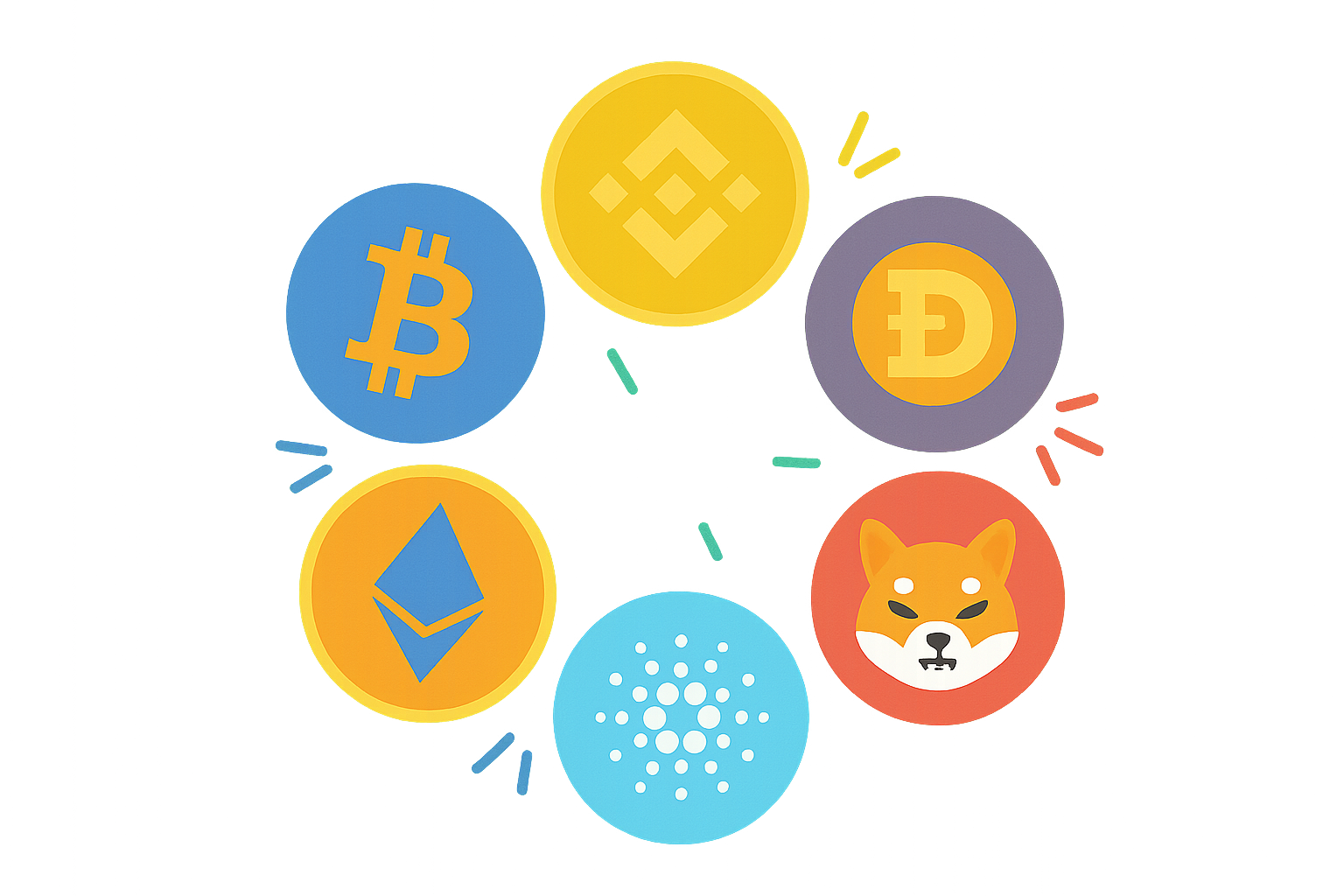
In-depth analysis of the price growth drivers for six major cryptocurrencies—including Bitcoin, Ethereum, and BNB—that have each surged over 1,000 times. This report offers clear explanations of key factors behind digital asset appreciation, such as technological innovation, market maturation, institutional investor involvement, and community building. Designed for beginner and intermediate traders, it delivers comprehensive insights to support investment decisions on exchanges like Gate.
Growth Overview of Six Major Tokens (Initial Price, All-Time High, and Multipliers)
The cryptocurrency market has delivered astonishing growth over the past decade, with many tokens posting increases of hundreds or even thousands of times from their initial prices. Bitcoin alone saw an unprecedented surge—at least 1,000,000x to its peak, and by some measures, tens of millions of times. Beyond Bitcoin, which other tokens have achieved gains of over 1,000x?
This article spotlights six leading cryptocurrencies whose prices have grown more than 1,000x between 2009 and recent years. We provide a detailed analysis of each. First, here’s a summary table of the six tokens, including launch year, initial price (at trading debut), all-time high, and the approximate multiplier from the initial price.
| Token (Ticker) |
Launch Year |
Initial Price |
All-Time High (Year/Month) |
Multiplier (From Initial) |
| Bitcoin (BTC) |
2009 |
$0.0008 (2010 estimated) |
$109,350 (recent January) |
Approx. 136,687,500x |
| Ethereum (ETH) |
2015 |
$0.31 (2014 ICO price) |
$4,878 (Nov 2021) |
Approx. 15,736x |
| Binance Coin (BNB) |
2017 |
$0.15 (2017 ICO price) |
$690 (May 2021) |
Approx. 4,600x |
| Cardano (ADA) |
2017 |
$0.0024 (2015–17 ICO price) |
$3.10 (Sep 2021) |
Approx. 1,291x |
| Dogecoin (DOGE) |
2013 |
$0.0004 (Dec 2013 launch) |
$0.74 (May 2021) |
Approx. 1,850x |
| Shiba Inu (SHIB) |
2020 |
$0.00000000051 (Aug 2020 launch) |
$0.0000885 (Oct 2021) |
Approx. 173,529x |
These tokens have each demonstrated remarkable price appreciation, driven by unique backgrounds and growth drivers. The following sections analyze the growth trajectory and key drivers for each token in detail.
Bitcoin (BTC)
Launched in January 2009 by Satoshi Nakamoto, Bitcoin is the world’s first cryptocurrency. As the foundational asset of the crypto market, it is often dubbed “digital gold.” With a hard supply cap of 21 million BTC, Bitcoin’s scarcity and decentralized network security have made it a standout long-term store of value.
Bitcoin is more than a speculative asset: it is widely recognized by global investors and institutions as a symbol of financial innovation. Its decentralized nature—independent of central banks—and programmatic supply cap are fundamental pillars of its value proposition.
Price Trends (Initial Price, All-Time High) and Multipliers
At launch, Bitcoin was effectively valueless—there were no exchanges in 2009 and it had no monetary price. The first USD exchange rate was established in October 2009 with the sale of 5,050 BTC for about $5, assigning each BTC a value near $0.0009.
Exchange trading began in July 2010, with initial prices ranging from about $0.0008 to $0.08. By the end of 2010, Bitcoin climbed to around $0.5, surpassed $1 in 2011, and then soared to about $29.6 in June before experiencing sharp volatility.
Bitcoin’s price has followed a four-year cycle, breaching $1,000 in late 2013 and reaching approximately $19,000 in December 2017. The most recent peak was $109,350 in January. From the early trading range ($0.0008–$0.08), this marks an increase of at least 1,000,000x, with some estimates reaching tens of millions.
This extraordinary growth marks Bitcoin’s evolution from a speculative asset to a global store of value. Institutional participation and national-level adoption have become major price catalysts.
Major Drivers of Bitcoin’s Growth
■ Market Maturity and Reserve Currency Role
As the world’s first cryptocurrency, Bitcoin has remained the cornerstone of the market. It became the “first choice” for institutions and corporations, long representing over half of the crypto market’s total capitalization.
Bitcoin acts as the sector’s reserve currency, with many altcoin prices tracking its movements. This central role enhances both liquidity and trust across the market.
■ Supply Constraints and Scarcity through Halvings
Bitcoin’s new issuance halves approximately every four years—2012, 2016, and 2020—effectively controlling inflation. The third halving in 2020, combined with monetary easing, accelerated its reputation as an “inflation hedge.”
The halving is a programmed economic mechanism—reduced supply and rising demand drive prices higher. This is analogous to the increasing difficulty of gold mining, further establishing Bitcoin as “digital gold.”
■ Macro Factors and Safe-Haven Reassessment
Massive stimulus and quantitative easing following the COVID-19 shock fueled inflows into Bitcoin. In early 2021, Bitcoin was spotlighted alongside stocks and real estate as a risk asset, soaring from $29,000 to over $64,000 within months.
This trend reflects rising uncertainty in traditional finance and large-scale monetary easing by central banks. Investors increasingly turned to Bitcoin as a hedge against fiat currency devaluation.
■ Institutional and Corporate Adoption
Major companies began accumulating large BTC holdings from 2020 onward. A top EV manufacturer announced a $1.5 billion BTC purchase in 2021. Leading payment providers and U.S. banks launched crypto services, signaling a wave of institutional adoption.
These developments mark Bitcoin’s shift from a speculative asset to an institutional-grade asset class. Public companies holding Bitcoin on their balance sheets sent a strong signal to the market.
■ Legal Tender Adoption at the National Level
In 2021, a Central American nation adopted Bitcoin as legal tender, distributing wallets to all citizens—an unprecedented national-scale initiative. Bitcoin’s potential as a payment method, not just a speculative asset, became a practical reality.
This landmark decision demonstrated Bitcoin’s utility in national policy, especially for lowering remittance costs and promoting financial inclusion.
■ Global Recognition as Digital Gold
Bitcoin’s “digital gold” status is now globally recognized. In 2021, its market cap briefly exceeded $1 trillion, rivaling gold. The hard supply cap and decentralization enhance its appeal as a long-term holding asset.
Like physical gold, Bitcoin’s limited supply and independence from government or central bank policy make it a compelling store of value, especially in inflationary environments.
■ U.S. Government Bitcoin Reserve Considerations
Recently, the U.S. government has signaled the potential inclusion of BTC in foreign reserves, citing “dollar hegemony” and competition with other countries’ digital asset strategies. Bitcoin reached new highs following these reports, underscoring the link between policy and price.
This signals Bitcoin’s emergence as a strategic national asset, particularly as geopolitical tensions and economic competition intensify.
Ethereum (ETH)
Launched in July 2015, Ethereum is a blockchain platform with the second-largest market capitalization after Bitcoin. While Bitcoin is called “digital gold,” Ethereum is viewed as “the protocol for a decentralized internet,” widely used as the foundation for smart contracts and DApps (decentralized applications).
Ethereum’s flexible architecture has placed it at the heart of trends like DeFi and NFTs, with countless projects and tokens launched on its network. More than just a currency, Ethereum has massively broadened blockchain’s application potential as a decentralized platform.
Price Trends (Initial Price, All-Time High) and Multipliers
Ethereum’s 2014 ICO priced ETH at about $0.31, raising roughly $18 million. The mainnet launch in July 2015 saw ETH begin trading at a few dollars.
The 2017 ICO boom drove demand to new heights, with ETH hitting about $1,400 in January 2018 before crashing to the $80s by year-end. Ethereum’s resurgence from 2020, powered by DeFi and NFTs, pushed it to an all-time high of $4,878.26 in November 2021—over 15,000x the ICO price.
Ethereum’s market trajectory demonstrates value increases that track technological advancement and market demand. The mass adoption of DeFi and NFTs has been a primary driver of price appreciation.
Major Drivers of Ethereum’s Growth
■ Innovation in Smart Contracts and DApps
Ethereum’s defining feature is its smart contract capability, allowing anyone to build custom tokens or applications. Since 2016, a vast number of projects have launched on Ethereum, fueling the ICO boom.
Smart contracts are a breakthrough, enabling self-executing agreements across finance, real estate, supply chains, and more. They eliminate intermediaries, enhancing transparency and efficiency.
■ The Rise of DeFi (Decentralized Finance)
From roughly 2020, DeFi protocols built on Ethereum—especially decentralized exchanges—experienced rapid growth. Yield farming locked up large amounts of ETH, driving its price. Ethereum remains the core “financial infrastructure” for DeFi.
DeFi delivers traditional financial services on decentralized blockchains, expanding access to those without bank accounts and advancing financial inclusion.
■ NFT Boom and Surging Demand
The first half of 2021 saw NFT marketplaces surge in popularity, with ETH used for trading digital art and collectibles. Network usage and gas fees climbed, boosting ETH prices.
NFTs prove ownership of digital content, impacting art, music, gaming, and beyond. Their adoption has created new revenue streams for creators and accelerated the digital economy.
■ Technical Progress: Transition to Ethereum 2.0
The London Upgrade in August 2021 introduced EIP-1559, burning part of transaction fees. The Merge in September 2022 shifted Ethereum from PoW to PoS, dramatically improving energy efficiency and long-term investor confidence.
These upgrades have greatly improved Ethereum’s scalability and sustainability, with the PoS transition reducing energy consumption by about 99%—a major competitive factor in today’s environmentally conscious world.
■ Institutional Use and Ecosystem Expansion
Ethereum has established itself as the second leading investment after Bitcoin. The Enterprise Ethereum Alliance (EEA) launched in 2017 with participation from major IT and financial institutions. Since 2020, ETH futures have gone live on major exchanges and custody services have expanded, attracting institutional players.
These trends underscore Ethereum’s growing reputation as a practical enterprise platform, with its technology widely adopted for blockchain solutions.
Binance Coin (BNB)
Binance Coin is the native token of one of the world’s largest crypto exchanges. Issued via ICO in July 2017 at the exchange’s launch, BNB initially operated as an ERC-20 token before migrating to its own blockchain. It has evolved into a utility token used for trading fee discounts, gas fees, and across the entire ecosystem.
BNB’s value is closely tied to the exchange’s growth and services, offering a unique value proposition compared to other cryptocurrencies.
Price Trends (Initial Price, All-Time High) and Multipliers
BNB was sold at $0.15 per token in the ICO, with 100 million tokens distributed. Initially trading for a few dollars, BNB surged in early 2021 to a high of $690.93 on May 10—a 4,605x increase from the ICO price.
More recently, ecosystem expansion and favorable regulatory winds pushed BNB to a new high of $705 on November 15, a 7,016x gain from the ICO price. In recent periods, BNB has traded steadily in the $500–$700 range.
This trajectory demonstrates how BNB’s value is directly linked to exchange growth—user numbers and service expansion drive BNB demand.
Major Drivers of BNB’s Growth
■ Exchange Expansion and User Growth
Since 2018, the exchange has ranked first globally by trading volume. BNB users receive trading fee discounts, ensuring stable demand. Scandals at rival exchanges since 2019 have also fueled capital inflows.
Exchange growth directly lifts BNB’s value, with trading fee discounts incentivizing BNB holding among users.
■ Fee Discounts and Expanding Use Cases
Beyond spot trading discounts, BNB is used for IEOs, staking, lending, and more. Holding BNB is required to participate in Launchpad IEOs, supporting price appreciation. As the user base grows, BNB’s utility expands as well.
These use cases position BNB as a practical utility token, not just a speculative asset. Access to IEOs adds investment appeal and strengthens demand for BNB.
■ Success of the Native Blockchain
The exchange launched its native chain in 2019, making BNB its native token. In 2020, it launched an Ethereum-compatible smart chain, spurring a wave of DeFi and gaming apps thanks to low gas fees. Numerous dApps now run on the chain, establishing it as the leading smart contract platform after Ethereum.
The native chain’s success has dramatically expanded the BNB ecosystem. Fast, low-cost transactions are highly attractive to developers and users, leading to broad project adoption.
■ Regular Token Burns and Deflationary Structure
BNB’s supply will eventually shrink to 100 million. The exchange conducts quarterly buybacks and burns using a portion of profits, building a tokenomics model favorable to long-term holders.
This burn mechanism enhances BNB’s scarcity and supports long-term value—similar to corporate share buybacks in equities.
■ Brand Strength and Community Loyalty
The founder’s charisma and user-centric marketing have won global support. Frequent BNB use for airdrops and IEOs has encouraged long-term holding. Reliable exchange operations, including hack compensation, also bolster confidence in BNB.
Brand power and community engagement are critical to BNB’s value. Prioritizing user trust is foundational for sustained growth.
Cardano (ADA)
Cardano is a third-generation blockchain platform that launched in 2017. Its ticker is ADA, and it supports smart contracts and DApps. Led by a former Ethereum co-founder, Cardano’s development prioritizes academic peer review and formal methods.
Its consensus mechanism is the Proof-of-Stake (PoS) Ouroboros protocol, with a phased roadmap. Cardano’s scientific approach and rigorous development process emphasize reliability and stability over the long term.
Price Trends (Initial Price, All-Time High) and Multipliers
ADA’s ICO in January 2017 focused on Japan and South Korea, selling at about $0.0024. Mainnet launch in October 2017 coincided with an altcoin boom, briefly pushing ADA close to $1.
After a long market winter in 2018, Cardano rebounded in 2020–2021 as staking and smart contracts drew attention. ADA hit its all-time high of $3.1 on September 2, 2021—an increase of over 1,300x from the ICO price.
These trends show Cardano’s value rising with technical progress and market expectations. Notably, smart contract implementation significantly boosted Cardano’s utility and price.
Major Drivers of Cardano’s Growth
■ Catalysts from Major Upgrades
The Shelley upgrade in 2020 enabled decentralization and staking, followed by smart contract support with Alonzo in 2021. Each milestone triggered price rallies.
Recently, the “Hydra” upgrade improved scalability, supporting thousands of transactions per second and accelerating DeFi and NFT adoption.
These upgrades highlight Cardano’s technical edge and lay the foundation for long-term growth. Enhanced scalability enables large-scale applications and ecosystem expansion.
■ Academic Development Approach and Reliability
Cardano’s theory-driven, peer-reviewed design has earned long-term investor trust. The project continues to integrate state-of-the-art cryptographic technologies.
The Cardano community is strong and oriented toward long-term holding, supporting lasting value. The academic approach sets Cardano apart from other projects.
■ “Ethereum Killer” Positioning
Cardano offers lower energy use, lower fees, and higher security than ETH, attracting attention as an alternative in early 2021 amid high Ethereum gas fees. The “Hydra” upgrade’s speed has further strengthened this position as Ethereum scaling remains a challenge.
Known as “Ada Coin” in Japan, Cardano’s listings on domestic exchanges have also helped. Its “Ethereum killer” branding is a major growth driver.
■ Real-World Utility and Adoption
Cardano partnered with African governments to provide digital IDs and academic management for over 5 million students. The project has since expanded to integrate into wider education systems, now serving over 10 million users in Africa.
Other deployments include agricultural traceability, educational certification, and notary services, enhancing Cardano’s prospects for national-scale adoption. These use cases validate Cardano’s utility and support its long-term value.
■ Staking Incentives for Long-Term Holding
ADA holders earn several percent per year via PoS staking, with about 75% of circulating ADA staked, reducing market liquidity.
Staking incentivizes long-term holding and stabilizes the price, supporting Cardano’s ecosystem and investor appeal.
Dogecoin (DOGE)
Dogecoin is a meme-based cryptocurrency launched in 2013. Created by engineers Billy Markus and Jackson Palmer as a playful experiment based on the Shiba Inu “Kabosu” meme, Dogecoin started as a “joke coin” with no clear purpose or technical innovation and unlimited supply.
Its approachable logo and fun culture quickly gained a loyal community, and by 2021 Dogecoin was a top-five asset by market cap—truly evolving from meme to mainstream. Dogecoin is a prime example of the power of community and culture in crypto.
Price Trends (Initial Price, All-Time High) and Multipliers
DOGE launched in December 2013 at around $0.0004. It went viral on Reddit, surging more than 300% in days. In 2015, it reached an all-time low of $0.000086, but rebounded during the 2017–2018 altcoin boom.
In 2021, celebrity endorsements and retail enthusiasm lifted DOGE to $0.74 on May 8—a 1,850x increase from launch.
Recently, major corporate adoption fueled a new high of $1.23 in December, representing a 3,075x gain from the initial price. DOGE now trades in the $0.80–$1.00 range.
These trends show Dogecoin’s transformation from a joke coin to a mainstream asset, driven by influencer impact and community enthusiasm.
Major Drivers of Dogecoin’s Growth
■ Meme Culture and Community Strength
The Shiba Inu logo and lighthearted tone make Dogecoin accessible to newcomers. Used for tips and donations on Reddit, it carved a niche as the “currency for fun.” The meme-friendly culture built a loyal following.
Meme popularity on social media remains strong, and community cohesion continues to underpin DOGE’s price. Meme culture is central to Dogecoin’s market identity.
■ Celebrity and Influencer Support
A prominent entrepreneur’s advocacy—self-styled as the “Dogefather”—as well as corporate adoption, drove major price surges. Other celebrities have voiced support, with social media amplification fueling both the 2021 bubble and the recent $1.23 high.
ETF filings by leading investment firms, amplified by celebrity support, have further increased attention. Celebrity impact remains a powerful price driver.
■ Retail Investor Movement Alignment
The “WallStreetBets” movement in January 2021 drove retail investors to DOGE. The “To the Moon” slogan sparked a grassroots buying campaign, briefly vaulting DOGE into the top five by market cap on “Doge Day.”
ETF anticipation has reignited retail interest, keeping DOGE in the top ten. Retail engagement is a key price support for Dogecoin.
■ Broader Platform Availability
DOGE listings on major trading apps and exchanges have dramatically improved accessibility, especially for younger investors. Surging volumes even caused system outages on some platforms.
ETF filings and expanded DOGE trading have encouraged institutional participation, boosting liquidity and accessibility.
■ Virality as a Brand Asset
Dogecoin’s value is sustained by “fun to own” appeal, regardless of utility or technology. A major entrepreneur’s adoption of a Shiba Inu as a social media logo reignited attention—Dogecoin is always in the spotlight.
Major enterprise payment pilots drove DOGE to $1.23, while ETF approvals added to its buzz. The entrepreneur’s call to “make Dogecoin the currency of Mars” further fueled the speculative frenzy.
Virality is Dogecoin’s unique value driver, distinguishing it from other cryptocurrencies.
Shiba Inu (SHIB)
Shiba Inu launched in August 2020 by the anonymous “Ryoshi” as a meme token inspired by Dogecoin, branding itself as the “Dogecoin Killer.” Issued as an ERC-20 token on Ethereum, it’s characterized by an ultra-low price and massive supply, enabling anyone to own millions of tokens.
The meme coin boom of 2021 brought explosive attention and created countless overnight millionaires—SHIB became globally recognized as a speculative “dream coin.” Shiba Inu combines meme appeal with high-risk, high-reward speculation.
Price Trends (Initial Price, All-Time High) and Multipliers
SHIB began trading on major DEXs in 2020 at a negligible initial price of $0.00000000051. Initially obscure, SHIB soared after listing on major exchanges in May 2021, climbing to an all-time high of $0.00008845 in October—over 500,000x its original price.
After a correction, SHIB has traded in the $0.00001–$0.00003 range, still vastly higher than its launch price.
These moves highlight SHIB’s phenomenal short-term growth, powered by the meme coin boom and major exchange listings.
Major Drivers of SHIB’s Growth
■ Meme Power and “Dogecoin Killer” Branding
SHIB used the Shiba Inu breed to position itself as the “next Dogecoin,” with viral hopes of “if it hits $0.01, you’ll be a millionaire” spreading on social media. Explosive rallies unfolded in spring and fall 2021.
Active memes continue to drive annual gains and FOMO. Meme appeal is key to SHIB’s popularity and investor engagement.
■ Fanatical Community and Viral Hype
The “SHIB Army” spread the word. Celebrity tweets and a massive SHIB burn by Ethereum’s founder drew major attention. Celebrity involvement triggers sharp price moves.
Recent large-scale token burns have helped support the price. Community enthusiasm is a critical price driver for SHIB.
■ Rapid Listings on Major Exchanges
In 2021, a wave of listings on top exchanges boosted SHIB’s liquidity and transformed its image from “meme coin” to “legitimate asset.” Many investors entered SHIB as an accessible meme coin.
Now listed on over 100 exchanges, SHIB’s liquidity and accessibility continue to improve. Major listings have enhanced SHIB’s credibility and reach.
■ Low-Cost, Lottery-Like Appeal
The ability to buy millions of SHIB for just a few dollars is a key psychological driver. Stories of small investments turning into millions spread on social media, fueling FOMO and speculation.
At $0.00001252, $100 buys around 8 million SHIB, sustaining speculative appeal. The low entry price attracts retail investors and boosts SHIB’s popularity.
■ Project Evolution and Expanding Utility
SHIB launched its own DEX in 2021 and has since announced layer-2 development and metaverse plans. As use cases expand, token burns aim to support the price.
Ongoing development could transform SHIB from a pure meme coin into a practical token. Layer-2 and metaverse projects are central to growing the SHIB ecosystem.
Conclusion: Future Outlook
Looking back at the six leading tokens (BTC, ETH, BNB, ADA, DOGE, SHIB) that grew more than 1,000x since 2009, we see that diverse drivers—technology, macro trends, and social media—have fueled their rise.
Bitcoin established itself as “digital gold,” Ethereum as a “decentralized platform.” BNB’s value is tied to its exchange ecosystem, Cardano built credibility through academic rigor, while Dogecoin and Shiba Inu became icons of meme culture and community power.
While similar phenomena could recur, past performance does not guarantee future results. The cryptocurrency market remains highly volatile, with shifting regulations and ongoing technical challenges creating continued uncertainty.
Investors should look beyond short-term price moves and assess each project’s technology, utility, and community strength. A disciplined, long-term perspective and thorough risk management are essential for sound investment decisions.
The crypto market will keep evolving, with new technologies and use cases emerging. Learning from past successes while focusing on future possibilities is the hallmark of a prudent investor.
FAQ
What are cryptocurrencies, and why do some tokens increase over 1,000x?
Cryptocurrencies are digital currencies built on blockchain technology. Tokens with innovative features and strong communities can post massive growth. Expanding demand for new projects and low early market caps are primary drivers of 1,000x gains.
Which cryptocurrencies have achieved over 1,000x growth, and what are their common features?
AXS and MATIC, among others, have surpassed 1,000x growth. Common features include solving real-world problems, strong community support, and rapid adoption and utility expansion.
If I invest in cryptocurrencies that previously soared, can I profit? What are the risks?
Past top performers may still offer gains, but volatility and regulatory uncertainty carry significant risk. Past results do not guarantee future returns. Comprehensive research is essential.
How can I identify and evaluate new cryptocurrencies with growth potential?
Carefully read the whitepaper and verify the team’s credibility. Analyze market cap, trading volume, and circulating supply. Assess the project’s innovation, utility, and community strength.
How do crypto and traditional equity investments compare in advantages and risks?
Cryptocurrencies offer high volatility and potential returns; equities are more stable. Crypto is less regulated; stocks are tightly regulated. Crypto also offers extra earning opportunities like liquidity mining and staking. Choose based on your goals and risk tolerance.
What fundamentals and security measures should I understand before investing in crypto?
Verify official URLs, safeguard your private keys, enable two-factor authentication, and manage high-risk activities in separate wallets. Basic precautions can greatly reduce risk.
How should everyday investors build strategies in highly volatile crypto markets?
Diversify your portfolio, set clear risk limits, and adopt a long-term holding approach. Regular dollar-cost averaging can mitigate volatility’s impact and increase opportunity during post-2026 bull markets.
* The information is not intended to be and does not constitute financial advice or any other recommendation of any sort offered or endorsed by Gate.