This comprehensive analysis compares SMTX and STX, two distinct blockchain solutions serving different market segments. SMTX focuses on real-world asset tokenization and DeFi trading, while STX provides blockchain infrastructure for decentralized applications. The article examines critical investment factors including historical price performance (SMTX declined 97.5% vs STX 92.7% in 2024), trading liquidity disparities ($32,774 vs $1.5M daily volume), and price forecasts through 2031. Current market data shows SMTX at $0.03657 and STX at $0.2824, with extreme fear sentiment (Fear & Greed Index: 16). Designed for investors seeking comparative analysis, the guide addresses market positioning, technological ecosystems, tokenomics, and risk management strategies. Suitable for novice to institutional investors evaluating allocation strategies between emerging RWA platforms and established blockchain infrastructure projects.
Introduction: Investment Comparison Between SMTX and STX
In the cryptocurrency market, the comparison between SMTX and STX has been a recurring topic among investors. Both show notable differences in market cap ranking, application scenarios, and price performance, representing distinct positioning within the crypto asset landscape.
Swarm Markets (SMTX): Launched in August 2021, it has gained market recognition by focusing on tokenization and trading of real-world assets (RWAs), including stocks, bonds, gold, and carbon certificates. Through smart contract-based DeFi applications and AMM pools, Swarm Markets offers users the ability to trade tokenized versions of traditional assets such as APPLE, TESLA, MICROSOFT, and BLACKROCK US Treasury Bond ETFs.
Stacks (STX): Since its launch in October 2019, Stacks has been positioned as a blockchain infrastructure enabling decentralized applications with built-in privacy features. Utilizing its Proof of Transfer (PoX) consensus mechanism and the Clarity programming language, Stacks aims to create a new internet for decentralized applications where users maintain full control over their data.
This article will comprehensively analyze the investment value comparison between SMTX and STX by examining historical price trends, supply mechanisms, institutional adoption, technological ecosystems, and future projections, attempting to address investors' most pressing question:
"Which presents more favorable investment characteristics based on current market dynamics?"
I. Historical Price Comparison and Current Market Status
SMTX (Coin A) vs STX (Coin B) Historical Price Trends
- 2024: SMTX reached an all-time high of $1.489 on March 26, 2024, driven by market momentum. The token subsequently experienced significant volatility, declining to its historical low of $0.0208 on February 2, 2024.
- 2024: STX achieved its all-time high of $3.86 on April 1, 2024, benefiting from ecosystem developments. The token later retreated to its historical low of $0.04559639 on March 13, 2020.
- Comparative analysis: During the 2024 market cycle, SMTX declined from $1.489 to $0.03657, representing a contraction of approximately 97.5%, while STX declined from $3.86 to $0.2824, representing a decline of approximately 92.7%.
Current Market Status (2026-01-30)
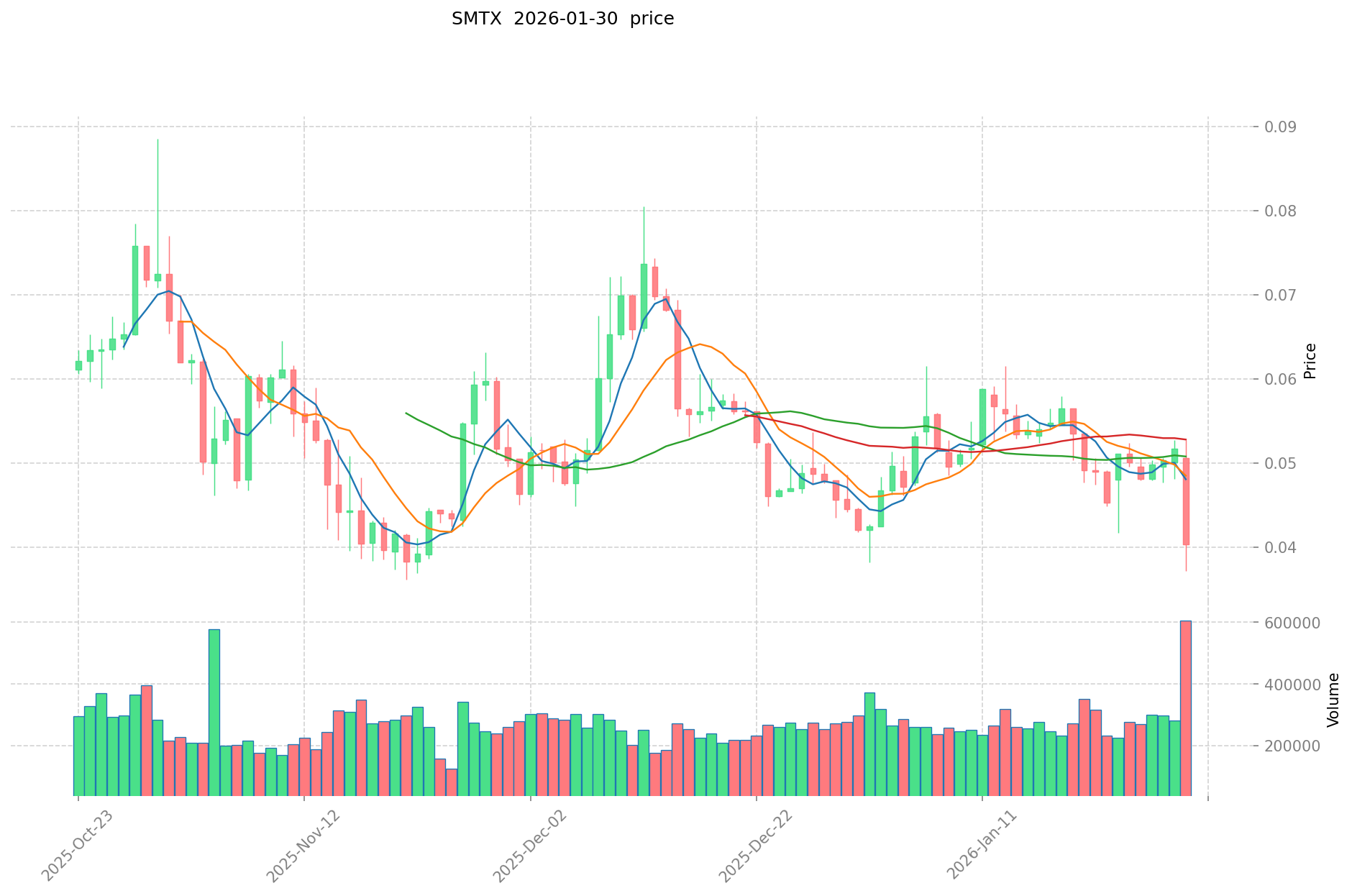
- SMTX current price: $0.03657
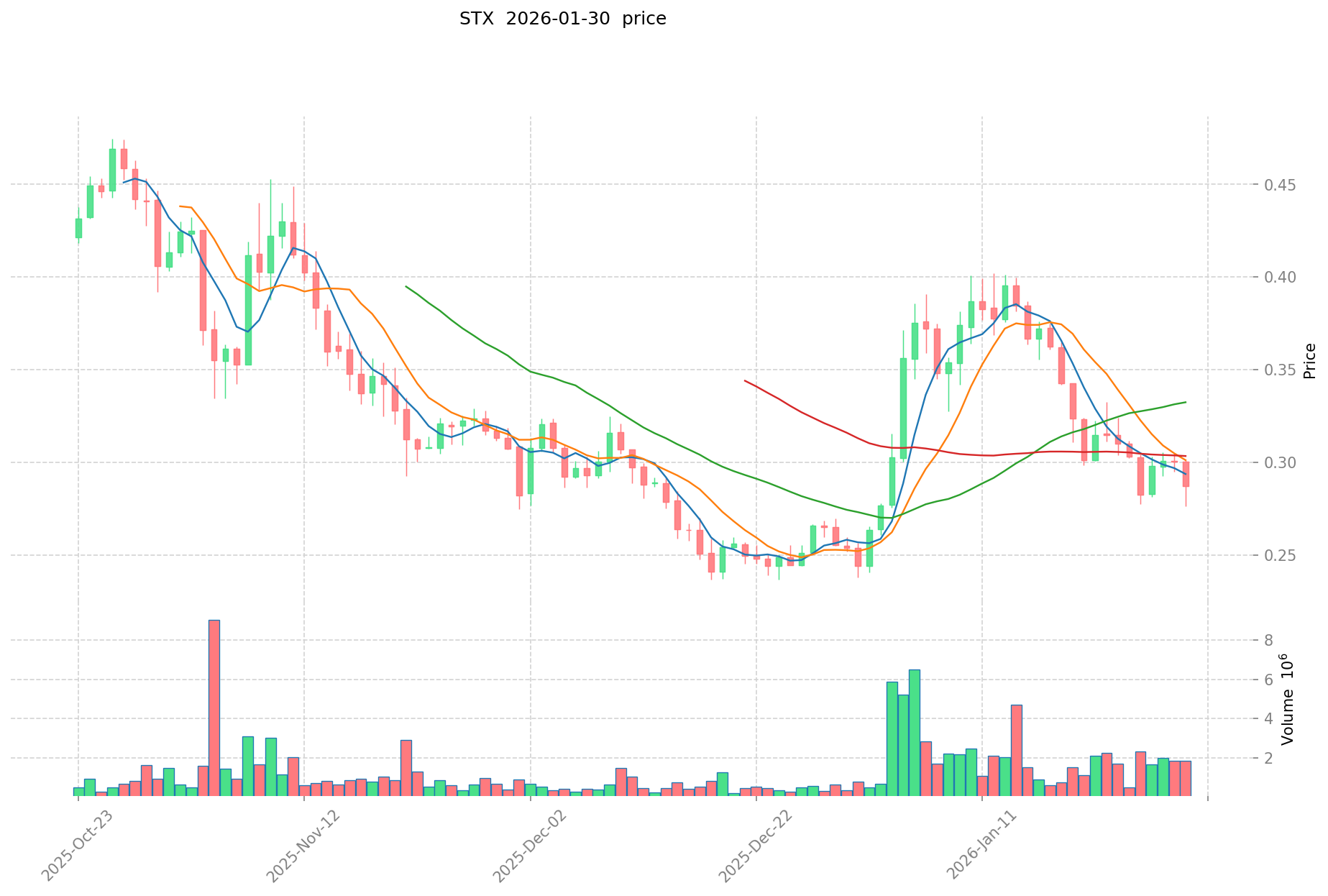
- STX current price: $0.2824
- 24-hour trading volume: SMTX $32,774.27 vs STX $1,507,449.05
- Market sentiment index (Fear & Greed Index): 16 (Extreme Fear)
View real-time prices:
II. Core Factors Influencing SMTX vs STX Investment Value
Supply Mechanism Comparison (Tokenomics)
Due to limited information in the provided materials regarding the specific supply mechanisms of SMTX and STX, a detailed comparison cannot be provided at this time. Token supply structures, including total supply caps, emission schedules, and deflationary or inflationary models, typically play a significant role in long-term value assessment.
Institutional Adoption and Market Application
Market Positioning:
SMTX is associated with SmartX, a company focused on hyper-converged infrastructure software (SMTX OS) for IT infrastructure modernization. The company serves financial institutions and enterprises seeking digital transformation and IT architecture upgrades. SmartX's solutions address infrastructure demands in sectors requiring robust, production-ready software and decoupled architecture.
Enterprise Adoption:
SmartX has demonstrated presence in the IT infrastructure market, particularly among financial institutions undergoing digital and信创 (信息技术应用创新) transformation. The company's hyper-converged and distributed storage solutions are designed to meet dual requirements of digitalization and localized technology adoption.
Regulatory Environment:
No specific policy positions from different jurisdictions regarding SMTX or STX were identified in the available materials.
Technology Development and Ecosystem Building
SMTX Technology:
SmartX's core offering, SMTX OS, features proprietary, decoupled, and production-ready hyper-converged software. The platform includes SMTX OS DRS, which incorporates a novel evaluation system and operations-friendly configuration settings. The technology aims to provide value through infrastructure optimization and operational efficiency improvements.
Ecosystem Comparison:
The provided materials focus primarily on SmartX's enterprise IT infrastructure solutions. Information regarding decentralized finance (DeFi), non-fungible tokens (NFTs), payment systems, or smart contract implementations related to either SMTX or STX was not available in the reference materials.
Macroeconomic and Market Cycle Considerations
The available materials do not contain specific information regarding how SMTX or STX perform under different macroeconomic conditions, including inflation environments, monetary policy shifts, interest rate fluctuations, or US dollar index movements. Similarly, geopolitical factors and their impact on cross-border transaction demand for these assets were not covered in the provided context.
III. 2026-2031 Price Forecast: SMTX vs STX
Short-term Forecast (2026)
- SMTX: Conservative $0.019-$0.037 | Optimistic $0.037-$0.052
- STX: Conservative $0.212-$0.282 | Optimistic $0.282-$0.381
Mid-term Forecast (2028-2029)
- SMTX may enter a consolidation phase, with projected prices ranging from $0.029-$0.067
- STX may enter an expansion phase, with projected prices ranging from $0.288-$0.471
- Key drivers: institutional capital inflows, ETF developments, ecosystem growth
Long-term Forecast (2030-2031)
- SMTX: Baseline scenario $0.047-$0.066 | Optimistic scenario $0.066-$0.071
- STX: Baseline scenario $0.378-$0.511 | Optimistic scenario $0.511-$0.752
View detailed price predictions for SMTX and STX
Disclaimer
SMTX:
| Year |
Predicted High Price |
Predicted Average Price |
Predicted Low Price |
Price Change |
| 2026 |
0.0515637 |
0.03657 |
0.0190164 |
0 |
| 2027 |
0.059930916 |
0.04406685 |
0.0409821705 |
20 |
| 2028 |
0.05667878247 |
0.051998883 |
0.04991892768 |
42 |
| 2029 |
0.0673801525914 |
0.054338832735 |
0.02879958134955 |
48 |
| 2030 |
0.070597011489312 |
0.0608594926632 |
0.046861809350664 |
66 |
| 2031 |
0.070329229721593 |
0.065728252076256 |
0.054554449223292 |
79 |
STX:
| Year |
Predicted High Price |
Predicted Average Price |
Predicted Low Price |
Price Change |
| 2026 |
0.38124 |
0.2824 |
0.2118 |
0 |
| 2027 |
0.4015022 |
0.33182 |
0.3085926 |
18 |
| 2028 |
0.381327544 |
0.3666611 |
0.318995157 |
30 |
| 2029 |
0.47123284572 |
0.373994322 |
0.28797562794 |
32 |
| 2030 |
0.6001112890812 |
0.42261358386 |
0.4057090405056 |
50 |
| 2031 |
0.751702781611782 |
0.5113624364706 |
0.378408202988244 |
81 |
IV. Investment Strategy Comparison: SMTX vs STX
Long-term vs Short-term Investment Strategies
- SMTX: May appeal to investors interested in enterprise IT infrastructure digitalization and real-world asset tokenization applications, particularly those focused on emerging RWA trading platforms
- STX: May appeal to investors seeking exposure to blockchain infrastructure projects with established ecosystem presence and decentralized application development capabilities
Risk Management and Asset Allocation
- Conservative investors: SMTX 20-30% vs STX 70-80%
- Aggressive investors: SMTX 40-50% vs STX 50-60%
- Hedging instruments: stablecoin allocation, options strategies, cross-asset portfolio diversification
V. Potential Risk Comparison
Market Risk
- SMTX: Higher price volatility as reflected in the 97.5% decline from 2024 peak levels; relatively lower liquidity with 24-hour trading volume of $32,774.27 as of current data
- STX: Moderate volatility with 92.7% decline from 2024 peak levels; comparatively higher liquidity with 24-hour trading volume of $1,507,449.05
Technical Risk
- SMTX: Limited information available regarding network scalability, technical infrastructure resilience, and smart contract security audit results
- STX: Considerations related to Proof of Transfer consensus mechanism performance, network stability under varying transaction loads, and potential security vulnerabilities in the Clarity programming language implementation
Regulatory Risk
- Global regulatory developments may affect both assets differently: SMTX's focus on real-world asset tokenization may face securities law scrutiny in multiple jurisdictions, while STX's blockchain infrastructure positioning may encounter varying regulatory treatment across different regions
VI. Conclusion: Which Is the Better Buy?
📌 Investment Value Summary:
- SMTX advantages: Exposure to real-world asset tokenization sector, association with enterprise IT infrastructure modernization services targeting financial institutions
- STX advantages: Established blockchain infrastructure with longer operational history since 2019, higher trading liquidity, comparatively lower volatility metrics
✅ Investment Recommendations:
- Novice investors: Consider STX for relatively higher liquidity and established market presence; exercise caution with position sizing given current extreme fear sentiment (Fear & Greed Index: 16)
- Experienced investors: May explore diversified allocation between both assets based on risk tolerance, with emphasis on technical analysis and ecosystem development monitoring
- Institutional investors: Conduct thorough due diligence on regulatory compliance frameworks, custody solutions, and counterparty risks before establishing positions in either asset
⚠️ Risk Disclaimer: Cryptocurrency markets exhibit high volatility characteristics. This content does not constitute investment advice.
VII. FAQ
Q1: Which cryptocurrency has higher liquidity, SMTX or STX?
STX demonstrates significantly higher liquidity. As of January 30, 2026, STX recorded a 24-hour trading volume of $1,507,449.05, approximately 46 times higher than SMTX's trading volume of $32,774.27. Higher liquidity typically facilitates easier trade execution with minimal price slippage, making STX more accessible for investors seeking to enter or exit positions efficiently.
Q2: What are the primary use cases distinguishing SMTX from STX?
SMTX focuses on real-world asset (RWA) tokenization and trading, offering users exposure to tokenized traditional assets such as stocks, bonds, gold, and carbon certificates through DeFi applications and AMM pools. In contrast, STX positions itself as blockchain infrastructure enabling decentralized applications with built-in privacy features, utilizing its Proof of Transfer (PoX) consensus mechanism and Clarity programming language to support dApp development where users maintain full control over their data.
Q3: How do the historical price volatilities of SMTX and STX compare?
SMTX exhibited higher volatility during the 2024 market cycle, declining approximately 97.5% from its all-time high of $1.489 (March 26, 2024) to $0.03657. STX demonstrated relatively lower volatility with a decline of approximately 92.7% from its peak of $3.86 (April 1, 2024) to $0.2824. These metrics suggest SMTX carries higher price risk compared to STX, which may be attributed to differences in market maturity, trading volume, and ecosystem development.
Q4: What is the recommended asset allocation strategy between SMTX and STX?
For conservative investors, a portfolio allocation of 20-30% SMTX and 70-80% STX may be appropriate, emphasizing STX's established market presence and higher liquidity. Aggressive investors might consider a more balanced allocation of 40-50% SMTX and 50-60% STX to capture potential upside from SMTX's exposure to the emerging RWA tokenization sector while maintaining substantial STX holdings for infrastructure-related growth opportunities. These allocations should be adjusted based on individual risk tolerance and investment objectives.
Q5: Which cryptocurrency has a longer operational history?
STX has a longer operational history, having launched in October 2019, while SMTX entered the market in August 2021. STX's additional two years of market presence may provide advantages in terms of ecosystem maturity, developer community establishment, network effect accumulation, and institutional relationship development. However, operational longevity alone does not guarantee superior investment performance.
Q6: What are the projected price ranges for SMTX and STX by 2030?
According to baseline scenarios, SMTX is projected to trade between $0.047-$0.066 by 2030, with an optimistic scenario extending to $0.066-$0.071. STX shows higher projected price ranges of $0.378-$0.511 in the baseline scenario and $0.511-$0.752 in the optimistic scenario for 2030. These projections reflect STX's stronger historical price foundation and potentially greater market capitalization growth trajectory, though actual outcomes depend on numerous variables including adoption rates, regulatory developments, and macroeconomic conditions.
Q7: What regulatory risks should investors consider for SMTX and STX?
SMTX's focus on real-world asset tokenization may subject it to securities law scrutiny in multiple jurisdictions, as tokenized stocks, bonds, and other traditional financial instruments typically fall under existing securities regulations. STX's positioning as blockchain infrastructure may encounter varying regulatory treatment across different regions depending on how authorities classify smart contract platforms and decentralized application ecosystems. Investors should monitor evolving regulatory frameworks in their respective jurisdictions and assess compliance implications before establishing positions in either asset.
Q8: What is the current market sentiment, and how might it affect investment decisions?
The current Fear & Greed Index stands at 16, indicating "Extreme Fear" conditions in the cryptocurrency market as of January 30, 2026. Historically, extreme fear conditions may present accumulation opportunities for long-term investors, as assets may be trading below intrinsic value due to widespread panic selling. However, such conditions also suggest elevated market uncertainty and potential for further downside volatility. Investors should implement appropriate risk management strategies, including position sizing discipline and staged entry approaches, rather than deploying full capital allocations during periods of extreme market sentiment.
* The information is not intended to be and does not constitute financial advice or any other recommendation of any sort offered or endorsed by Gate.