This comprehensive comparison analyzes SNX and ICP as two distinct blockchain investments within the crypto ecosystem. SNX operates as a decentralized synthetic asset platform launched in 2018, enabling users to create and trade derivatives, while ICP functions as a decentralized cloud blockchain for hosting applications and enterprise systems since 2019. The article examines critical investment factors including historical price performance—SNX declining from $28.53 to $0.46, ICP from $700.65 to $4.38—alongside tokenomics mechanisms, institutional adoption levels, and technology development trajectories. By evaluating supply structures, ecosystem integration, regulatory environments, and macroeconomic impacts, this guide provides investors with actionable insights for portfolio positioning. Whether you're a conservative or aggressive investor, understanding SNX's DeFi derivatives focus versus ICP's infrastructure positioning on Gate enables informed decision-making in cryptocurrency markets. The analysis inc
Introduction: Investment Comparison Between SNX and ICP
In the cryptocurrency market, the comparison between SNX vs ICP continues to be a topic of interest for investors. Both projects show notable differences in market cap ranking, application scenarios, and price performance, representing distinct positions within the crypto asset landscape.
SNX (Synthetix Network Token): Since its launch in 2018, this protocol has gained market recognition for its decentralized synthetic asset platform, enabling users to create and trade various synthetic assets including fiat currencies, precious metals, and cryptocurrencies.
ICP (Internet Computer): Introduced in 2019, this project presents itself as a decentralized cloud blockchain capable of hosting applications, websites, and enterprise systems while supporting trustless multi-chain interactions.
This article will provide a comprehensive analysis of the investment value comparison between SNX vs ICP, examining historical price trends, supply mechanisms, institutional adoption, technical ecosystems, and future projections. We aim to address the key question that concerns investors:
"Which is the better buy right now?"
I. Historical Price Comparison and Current Market Status
Historical Price Trends of SNX (Coin A) and ICP (Coin B)
- 2021: SNX reached its all-time high of $28.53 in February 2021, driven by the growth of decentralized finance (DeFi) protocols and increased adoption of synthetic asset trading platforms.
- 2021: ICP achieved its historical peak of $700.65 in May 2021 following its mainnet launch and initial market enthusiasm for the Internet Computer project.
- Comparative Analysis: During the 2021-2025 market cycle, SNX declined from its peak of $28.53 to a current level around $0.46, representing a significant correction. Meanwhile, ICP experienced a similar downward trajectory, dropping from $700.65 to approximately $4.38, reflecting broader market volatility and changing investor sentiment toward both projects.
Current Market Conditions (2026-01-16)
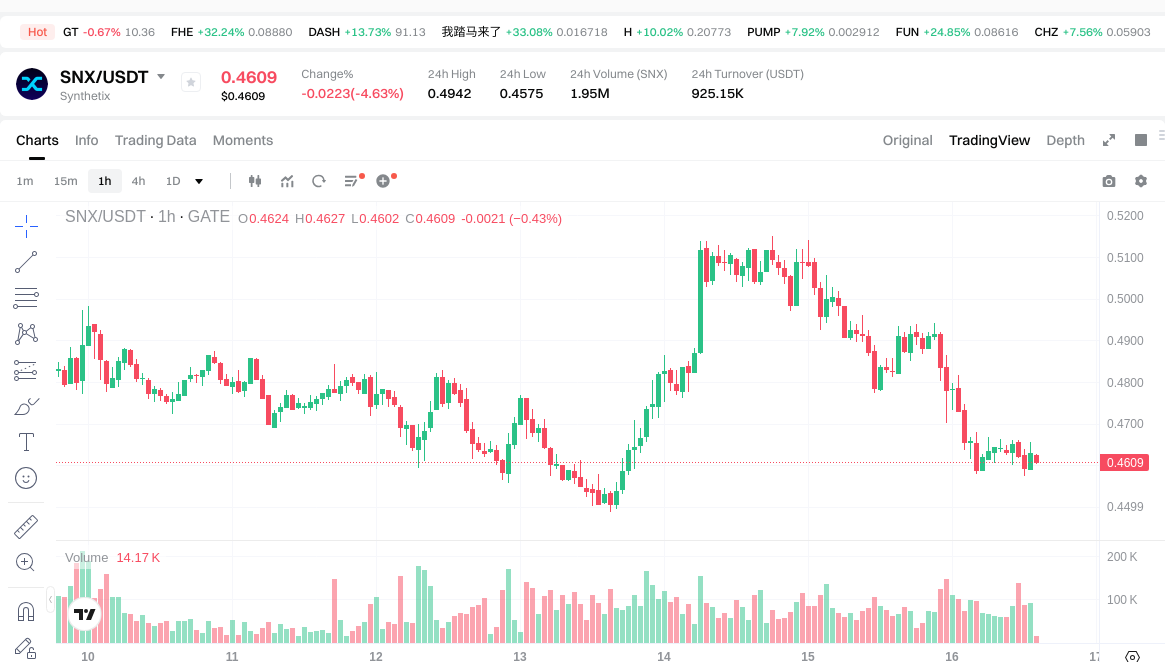
- SNX Current Price: $0.4616
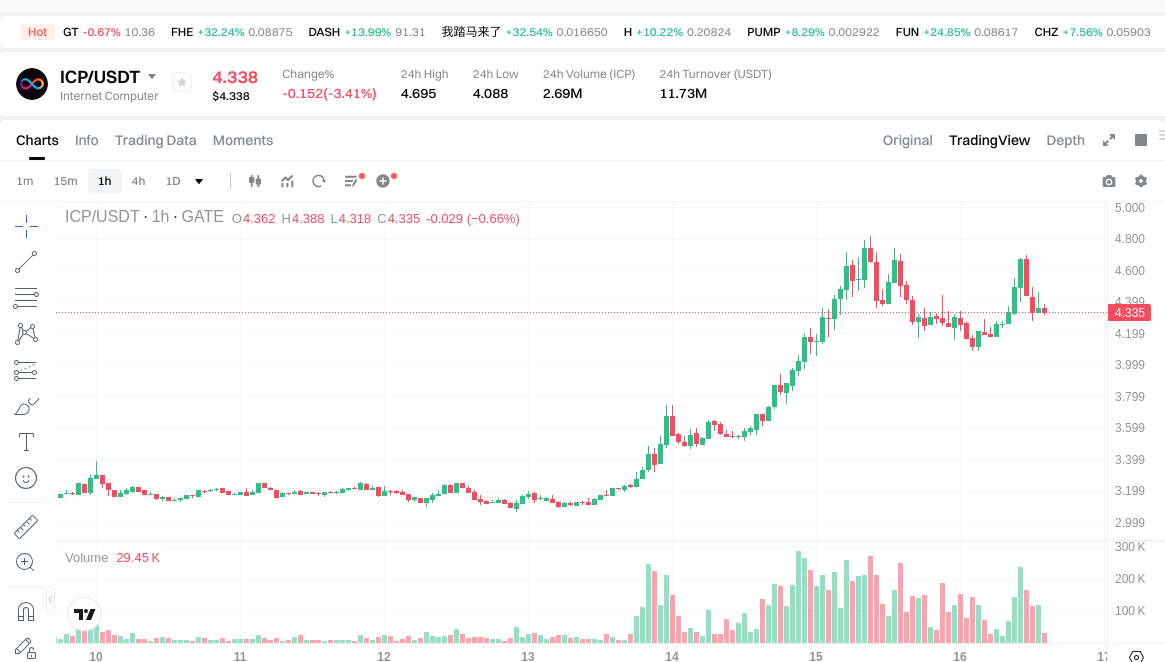
- ICP Current Price: $4.379
- 24-Hour Trading Volume: SNX recorded $925,072.68 compared to ICP's substantially higher $11,849,516.35
- Market Sentiment Index (Fear & Greed Index): 49 (Neutral)
Click to view real-time prices:
II. Core Factors Influencing SNX vs ICP Investment Value
Supply Mechanism Comparison (Tokenomics)
-
SNX: Features an inflationary supply model with token staking mechanisms. Users stake SNX to mint synthetic assets (sUSD), with staking rewards distributed from trading fees. The protocol implements a debt pool system where stakers share collective debt, requiring a collateralization ratio around 160%.
-
ICP: Operates with a complex tokenomics structure involving Network Nervous System (NNS) governance. Tokens can be staked in neurons for governance participation and rewards. Supply dynamics are influenced by network growth and computational resource consumption.
-
📌 Historical Pattern: SNX demonstrated strong performance momentum from mid-2023, with the staking mechanism creating demand pressure during periods of increased synthetic asset trading activity. Supply mechanisms directly correlate with protocol usage cycles and DeFi market conditions.
Institutional Adoption and Market Application
-
Institutional Holdings: Market data suggests institutional interest remains limited for both assets compared to major cryptocurrencies like Bitcoin and Ethereum. SNX has gained some traction within DeFi-focused institutional portfolios.
-
Enterprise Adoption:
- SNX primarily serves DeFi protocols as infrastructure for synthetic asset creation and derivatives trading
- ICP positions itself for enterprise blockchain applications and decentralized internet services
- Neither has achieved significant mainstream payment or settlement adoption
-
Regulatory Environment: Both assets operate in evolving regulatory landscapes. The 2024 MiCA regulations in Europe and varying approaches across Asia-Pacific markets create compliance challenges. U.S. tax policies and classification uncertainties continue to impact institutional participation.
Technology Development and Ecosystem Building
-
SNX Technology Progress: V3 architecture aims to improve capital efficiency by reducing collateralization requirements and introducing ETH as collateral. Integration with Atomic Swaps, Curve, and Perpetual V2 expanded application scenarios across multiple chains.
-
ICP Technology Evolution: Development depends on broader market dynamics and the success of its Internet Computer vision. Progress in decentralized application hosting and computational capabilities continues.
-
Ecosystem Comparison:
- SNX maintains strong positioning within DeFi derivatives and synthetic assets sectors
- Integration with established protocols like Curve and Aave provides network effects
- Cross-chain deployment strategy enhances accessibility
- ICP focuses on decentralized web infrastructure with distinct use cases
Macroeconomic Conditions and Market Cycles
-
Performance Under Inflation: Neither asset has established clear anti-inflation credentials comparable to Bitcoin. Performance correlates more strongly with broader cryptocurrency market sentiment and DeFi sector health.
-
Monetary Policy Impact: Federal Reserve rate decisions and liquidity conditions significantly influence both assets. The 2024 rate cut cycle initially benefited broader crypto markets, though effects on alternative assets like SNX and ICP remained secondary to Bitcoin flows.
-
Geopolitical Factors:
- Regulatory developments across regions (U.S., Europe, Middle East, Asia) create varying opportunity sets
- Cross-border transaction demand primarily benefits established cryptocurrencies
- Policy uncertainty in major markets affects risk appetite for alternative assets
- International institutional adoption remains dependent on regulatory clarity
III. 2026-2031 Price Forecast: SNX vs ICP
Short-term Forecast (2026)
- SNX: Conservative $0.24-$0.46 | Optimistic $0.46-$0.55
- ICP: Conservative $4.08-$5.12 | Optimistic $5.12-$5.90
Mid-term Forecast (2028-2029)
- SNX may enter a consolidation phase with estimated price range of $0.40-$0.83
- ICP may enter an expansion phase with estimated price range of $3.76-$7.07
- Key drivers: institutional capital inflows, ETF developments, ecosystem growth
Long-term Forecast (2030-2031)
- SNX: Baseline scenario $0.46-$0.75 | Optimistic scenario $0.75-$1.02
- ICP: Baseline scenario $4.90-$7.48 | Optimistic scenario $7.48-$11.00
View detailed price predictions for SNX and ICP
Disclaimer
SNX:
| Year |
Predicted High Price |
Predicted Average Price |
Predicted Low Price |
Price Change |
| 2026 |
0.55308 |
0.4609 |
0.244277 |
0 |
| 2027 |
0.7199258 |
0.50699 |
0.4512211 |
9 |
| 2028 |
0.723880322 |
0.6134579 |
0.404882214 |
32 |
| 2029 |
0.82914969764 |
0.668669111 |
0.40788815771 |
44 |
| 2030 |
0.9061803792272 |
0.74890940432 |
0.4643238306784 |
62 |
| 2031 |
1.017880216881528 |
0.8275448917736 |
0.49652693506416 |
79 |
ICP:
| Year |
Predicted High Price |
Predicted Average Price |
Predicted Low Price |
Price Change |
| 2026 |
5.89832 |
4.337 |
4.07678 |
0 |
| 2027 |
5.7829558 |
5.11766 |
4.5547174 |
16 |
| 2028 |
6.54036948 |
5.4503079 |
3.760712451 |
24 |
| 2029 |
7.0744996542 |
5.99533869 |
4.3765972437 |
36 |
| 2030 |
8.430045732009 |
6.5349191721 |
4.901189379075 |
49 |
| 2031 |
10.999249204520115 |
7.4824824520545 |
5.53703701452033 |
70 |
IV. Investment Strategy Comparison: SNX vs ICP
Long-term vs Short-term Investment Strategies
-
SNX: May appeal to investors focused on DeFi derivatives exposure and synthetic asset innovation. The protocol's V3 upgrades and cross-chain deployment strategy suggest potential for ecosystem expansion, though sustainability depends on DeFi sector recovery and protocol adoption rates.
-
ICP: May attract investors interested in decentralized web infrastructure and blockchain-based enterprise applications. The project's positioning in computational services and decentralized hosting represents a distinct technological approach, though market validation remains ongoing.
Risk Management and Asset Allocation
- Conservative Investors: SNX 20-30% vs ICP 20-30% (within alternative asset allocation)
- Aggressive Investors: SNX 40-50% vs ICP 30-40% (within higher-risk portfolio segments)
- Hedging Tools: Stablecoin reserves (USDT, USDC), options strategies for downside protection, cross-asset diversification with established cryptocurrencies
V. Potential Risk Comparison
Market Risks
-
SNX: High correlation with DeFi sector performance creates concentration risk. Protocol usage depends on synthetic asset demand, which experiences cyclical volatility. Trading volume fluctuations directly impact staking rewards and token utility.
-
ICP: Price performance remains closely tied to broader cryptocurrency market sentiment. Limited mainstream adoption creates uncertainty around long-term value proposition. Competition from established cloud infrastructure and blockchain platforms presents ongoing challenges.
Technical Risks
-
SNX: Scalability improvements through V3 architecture require successful implementation. Network stability depends on debt pool management and collateralization ratios. Smart contract complexity creates potential vulnerability surfaces.
-
ICP: Computational resource allocation mechanisms require continued refinement. Network decentralization metrics and validator distribution present ongoing considerations. Technical architecture complexity may affect adoption rates.
Regulatory Risks
- Global regulatory developments affect both assets differently based on their functional characteristics. SNX's synthetic asset creation may face heightened scrutiny under securities regulations in certain jurisdictions. ICP's positioning as decentralized infrastructure may encounter different regulatory frameworks. Policy uncertainty in major markets (U.S., Europe, Asia-Pacific) creates compliance challenges. Tax treatment variations across regions impact investor considerations.
VI. Conclusion: Which Is the Better Buy?
📌 Investment Value Summary:
-
SNX Characteristics: Established position within DeFi derivatives sector, protocol upgrades targeting improved capital efficiency, integration with major DeFi protocols, staking mechanism creating token utility
-
ICP Characteristics: Distinct technological approach to decentralized computing, positioning in web infrastructure space, governance participation through NNS staking, alternative use case focus compared to traditional DeFi
✅ Investment Considerations:
-
New Investors: Consider dollar-cost averaging approaches with smaller position sizes. Focus on understanding protocol mechanics and use cases before committing capital. Maintain significant stablecoin reserves for portfolio stability.
-
Experienced Investors: Evaluate both assets within broader alternative cryptocurrency allocations. Consider DeFi sector exposure through SNX versus infrastructure positioning through ICP. Monitor protocol development metrics and ecosystem growth indicators.
-
Institutional Investors: Assess regulatory compliance frameworks applicable to each asset. Evaluate liquidity conditions and counterparty risks. Consider position sizing relative to established cryptocurrency holdings and overall risk management parameters.
⚠️ Risk Disclosure: Cryptocurrency markets demonstrate significant volatility characteristics. This content does not constitute investment advice. Investors should conduct independent research and consult qualified financial advisors before making investment decisions.
VII. FAQ
Q1: What are the main differences between SNX and ICP in terms of use cases?
SNX focuses on decentralized synthetic asset creation and DeFi derivatives trading, while ICP aims to provide decentralized web infrastructure and blockchain-based computational services. SNX operates primarily within the DeFi ecosystem, enabling users to create and trade synthetic assets representing various real-world and crypto assets through staking mechanisms. In contrast, ICP positions itself as a decentralized cloud platform capable of hosting applications, websites, and enterprise systems, targeting a broader web infrastructure market rather than financial derivatives specifically.
Q2: How do the staking mechanisms differ between SNX and ICP?
SNX requires stakers to maintain a collateralization ratio around 160% to mint synthetic assets (sUSD), with rewards derived from trading fees within the protocol. ICP utilizes a Network Nervous System (NNS) governance model where tokens are staked in "neurons" for governance participation and staking rewards. SNX stakers share collective debt through a debt pool system, directly linking rewards to protocol trading activity, whereas ICP staking primarily serves governance functions while earning rewards based on network participation and computational resource contributions.
Q3: Which asset has experienced greater price volatility since their respective peaks?
Both assets have experienced significant volatility, but ICP shows greater percentage decline from its peak. SNX dropped from $28.53 (February 2021) to approximately $0.46 currently—a decline of roughly 98.4%. ICP fell from $700.65 (May 2021) to around $4.38—representing approximately 99.4% decline. However, in absolute terms, ICP's initial peak was substantially higher, reflecting different launch dynamics and initial market reception. Both declines align with broader cryptocurrency market corrections during 2021-2025.
Q4: What institutional adoption factors should investors consider for SNX vs ICP?
Institutional adoption remains limited for both assets compared to major cryptocurrencies like Bitcoin and Ethereum. SNX has gained some traction within DeFi-focused institutional portfolios due to its established position in synthetic asset infrastructure and integration with protocols like Curve and Aave. ICP's institutional appeal centers on its decentralized web infrastructure positioning, though mainstream enterprise adoption has yet to materialize significantly. Regulatory clarity, particularly regarding synthetic asset classification for SNX and computational service frameworks for ICP, remains crucial for institutional participation in both assets.
Q5: How do macroeconomic conditions affect SNX and ICP differently?
Both assets correlate strongly with broader cryptocurrency market sentiment rather than demonstrating independent macroeconomic hedging characteristics. SNX performance particularly depends on DeFi sector health and synthetic asset trading demand, making it sensitive to liquidity conditions affecting decentralized finance protocols. ICP's performance ties more closely to general blockchain infrastructure adoption trends and enterprise technology spending patterns. Neither has established clear anti-inflation credentials comparable to Bitcoin, with Federal Reserve monetary policy and risk appetite in crypto markets affecting both assets similarly as alternative cryptocurrency investments.
Q6: What are the primary technical risks associated with each project?
SNX faces technical risks related to its V3 architecture implementation, debt pool management complexity, and smart contract security given the synthetic asset creation mechanisms. Successful scalability improvements and maintaining proper collateralization ratios across the protocol remain critical. ICP's technical risks involve computational resource allocation mechanisms, network decentralization metrics, and the complexity of its Internet Computer architecture potentially affecting adoption rates. Both projects require continued development execution and network stability to maintain investor confidence and protocol functionality.
Q7: Which asset is more suitable for conservative versus aggressive investors?
Conservative investors might consider smaller allocations (20-30% within alternative asset portfolios) to either asset, with preference potentially toward SNX given its more established DeFi positioning and clearer use case validation. Aggressive investors might allocate 40-50% to SNX or 30-40% to ICP within higher-risk portfolio segments, depending on thesis alignment—DeFi derivatives exposure (SNX) versus decentralized infrastructure potential (ICP). Both require significant risk tolerance and should represent only portions of broader cryptocurrency allocations. Maintaining stablecoin reserves and cross-asset diversification with established cryptocurrencies remains essential for risk management regardless of investor profile.
Q8: What indicators should investors monitor to assess future performance?
For SNX, monitor DeFi sector trading volumes, synthetic asset creation metrics, staking participation rates, collateralization ratios, and V3 adoption across integrated protocols. Track cross-chain deployment success and partnerships with major DeFi platforms. For ICP, observe decentralized application hosting adoption, computational resource utilization, Network Nervous System governance participation, and enterprise partnership developments. Both assets require monitoring of broader cryptocurrency market sentiment, regulatory developments in key jurisdictions, and technological milestone achievements within their respective ecosystems.
* The information is not intended to be and does not constitute financial advice or any other recommendation of any sort offered or endorsed by Gate.