This comprehensive guide compares SOIL and ATOM, two distinct blockchain assets with contrasting market positions and investment profiles. SOIL, a regulated DeFi protocol launched October 2023, bridges traditional finance through real-world asset backing, currently trading at $0.13755. ATOM, the Cosmos interoperability token since March 2019, enables cross-chain communication at $2.269. The article analyzes historical price trends, supply mechanisms, institutional adoption, and technological ecosystems across both platforms. SOIL demonstrates higher volatility with significant growth potential but lower liquidity ($46,243.19 daily volume), while ATOM offers established infrastructure with superior market stability ($378,924.10 daily volume). Price forecasts through 2031 suggest SOIL may reach $0.326 and ATOM $4.325 under base scenarios. Investment strategies vary by risk tolerance, with beginner investors favoring ATOM's liquidity and experienced traders considering portfolio diversification. Current Extreme
Introduction: Investment Comparison Between SOIL and ATOM
In the cryptocurrency market, the comparison between SOIL vs ATOM has become a topic of interest for investors. The two assets exhibit notable differences in market cap ranking, application scenarios, and price performance, representing distinct positioning within the crypto asset landscape.
SOIL: Launched in October 2023, it positions itself as a fully regulated DeFi protocol backed by real-world assets, bridging traditional finance and the crypto world through debt marketplace solutions.
ATOM: Originating in March 2019, it serves as the native token of Cosmos, a parallel network designed to enable blockchain interoperability, creating an "Internet of blockchains" through its Tendermint consensus mechanism.
This article will comprehensively analyze the investment value comparison between SOIL vs ATOM across multiple dimensions including historical price trends, supply mechanisms, technological ecosystems, and future outlook, attempting to address investors' most pressing question:
"Which is the better buy right now?"
I. Historical Price Comparison and Current Market Status
SOIL (Coin A) and ATOM (Coin B) Historical Price Trends
- 2022-01-17: ATOM reached a peak price of $44.45 during the bull market cycle, benefiting from ecosystem expansion and increased adoption of the Cosmos Hub.
- 2023-10-10: SOIL recorded its lowest price point at $0.04 amid broader market weakness.
- 2024-03-28: SOIL achieved a peak price of $4.00, representing significant growth from its previous lows.
- 2020-03-13: ATOM experienced its historical low at $1.16 during the global market downturn.
- Comparative Analysis: During the 2022-2024 market cycle, SOIL moved from a high of $4.00 to its current level of approximately $0.14, representing a substantial correction. In contrast, ATOM declined from its peak of $44.45 to $2.27, showing a similar downward trajectory but with different volatility patterns.
Current Market Status (2026-01-26)
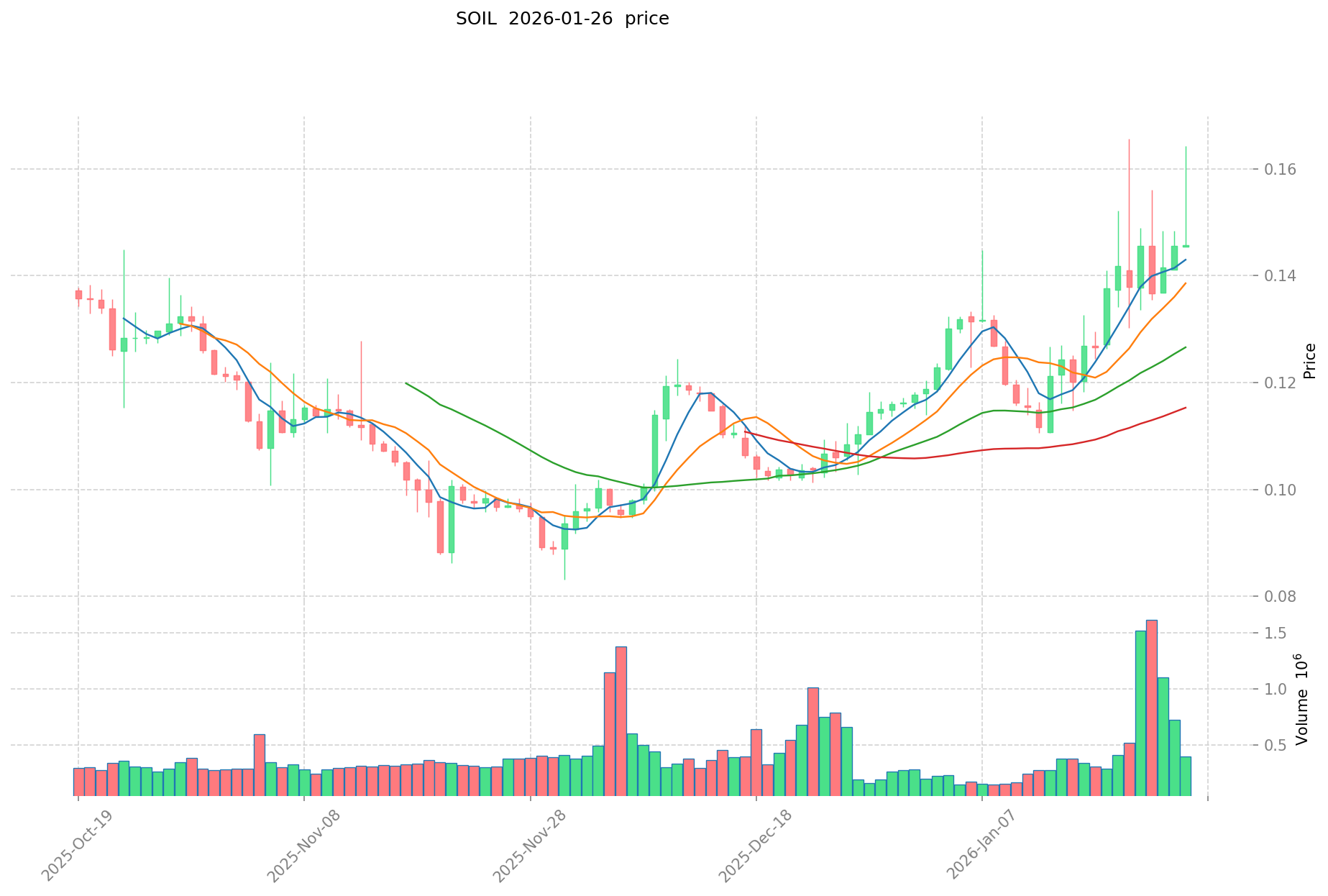
- SOIL Current Price: $0.13755
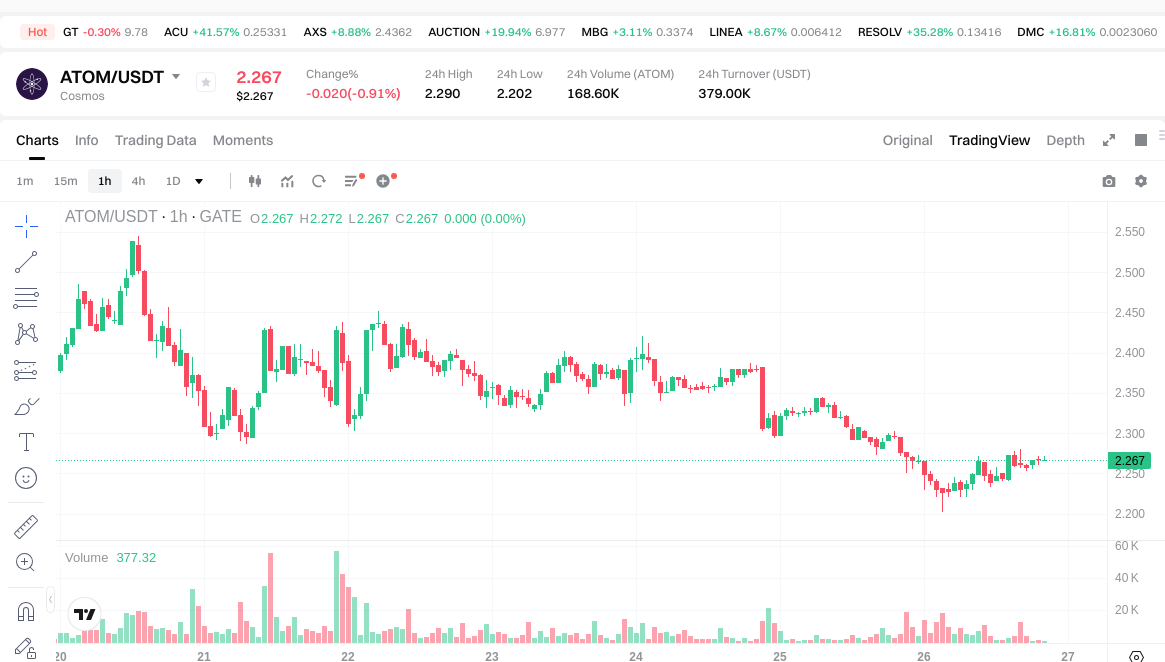
- ATOM Current Price: $2.269
- 24-Hour Trading Volume: SOIL recorded $46,243.19 while ATOM registered $378,924.10
- Market Sentiment Index (Fear & Greed Index): 20 (Extreme Fear)
View real-time prices:
II. Core Factors Affecting SOIL vs ATOM Investment Value
Supply Mechanism Comparison (Tokenomics)
Due to insufficient reference materials and lack of verifiable data in the knowledge base regarding the specific supply mechanisms of SOIL and ATOM, this section cannot be completed with accurate information.
Institutional Adoption and Market Application
Without adequate reference materials detailing institutional holdings, enterprise adoption patterns, or regulatory positions across different jurisdictions for SOIL and ATOM, a comparative analysis cannot be reliably established at this time.
Technology Development and Ecosystem Construction
The reference materials provided do not contain sufficient information regarding technical upgrades, development roadmaps, or ecosystem implementations (including DeFi, NFT, payment systems, or smart contract deployments) for either SOIL or ATOM to support a meaningful comparison.
Macroeconomic Factors and Market Cycles
Given the absence of relevant data in the reference materials concerning the performance characteristics of SOIL and ATOM under various macroeconomic conditions—including inflationary environments, monetary policy impacts, interest rate sensitivities, or geopolitical factors—this comparative analysis cannot be substantiated with reliable information.
III. 2026-2031 Price Forecast: SOIL vs ATOM
Short-term Forecast (2026)
- SOIL: Conservative $0.0817 - $0.1384 | Optimistic $0.1384 - $0.1495
- ATOM: Conservative $2.041 - $2.268 | Optimistic $2.268 - $2.926
Mid-term Forecast (2028-2029)
- SOIL may enter a consolidation phase, with projected price range of $0.1430 - $0.2677
- ATOM may enter a growth phase, with projected price range of $1.791 - $4.022
- Key drivers: institutional capital inflows, ETF developments, ecosystem expansion
Long-term Forecast (2030-2031)
- SOIL: Base scenario $0.1875 - $0.2790 | Optimistic scenario $0.2510 - $0.3264
- ATOM: Base scenario $2.683 - $4.005 | Optimistic scenario $2.943 - $4.325
View detailed price predictions for SOIL and ATOM
Disclaimer
SOIL:
| Year |
Predicted High Price |
Predicted Average Price |
Predicted Low Price |
Price Change |
| 2026 |
0.1494936 |
0.13842 |
0.0816678 |
0 |
| 2027 |
0.188583408 |
0.1439568 |
0.09357192 |
4 |
| 2028 |
0.2244646404 |
0.166270104 |
0.14299228944 |
20 |
| 2029 |
0.267653299914 |
0.1953673722 |
0.160201245204 |
42 |
| 2030 |
0.32642957384037 |
0.231510336057 |
0.18752337220617 |
68 |
| 2031 |
0.292918452696119 |
0.278969954948685 |
0.251072959453816 |
102 |
ATOM:
| Year |
Predicted High Price |
Predicted Average Price |
Predicted Low Price |
Price Change |
| 2026 |
2.92572 |
2.268 |
2.0412 |
0 |
| 2027 |
3.6875412 |
2.59686 |
1.9995822 |
14 |
| 2028 |
4.022016768 |
3.1422006 |
1.791054342 |
38 |
| 2029 |
3.86867737872 |
3.582108684 |
2.3283706446 |
57 |
| 2030 |
4.284201986064 |
3.72539303136 |
2.9430604947744 |
64 |
| 2031 |
4.32518130940896 |
4.004797508712 |
2.68321433083704 |
76 |
IV. Investment Strategy Comparison: SOIL vs ATOM
Long-term vs Short-term Investment Strategies
- SOIL: May appeal to investors focused on regulated DeFi protocols and real-world asset integration, particularly those seeking exposure to emerging debt marketplace solutions with higher risk tolerance for smaller market cap assets
- ATOM: May suit investors interested in blockchain interoperability infrastructure and established ecosystem participation, with focus on cross-chain communication technology
Risk Management and Asset Allocation
- Conservative Investors: SOIL 20% vs ATOM 80% - emphasizing the more established protocol with broader adoption
- Aggressive Investors: SOIL 40% vs ATOM 60% - incorporating higher exposure to emerging protocols while maintaining core infrastructure positions
- Hedging Tools: Stablecoin allocation, options strategies, cross-asset portfolio diversification
V. Potential Risk Comparison
Market Risk
- SOIL: Higher volatility exposure due to lower market capitalization and trading volume ($46,243.19 24-hour volume), with price movements from $0.04 to $4.00 demonstrating significant fluctuation potential
- ATOM: Moderate volatility with established market presence, 24-hour trading volume of $378,924.10 indicating more liquid market conditions, historical range from $1.16 to $44.45 showing substantial but relatively more stable patterns
Technical Risk
- SOIL: Scalability considerations and network stability factors associated with newer protocol launches since October 2023
- ATOM: Network coordination challenges across multiple interconnected blockchains, consensus mechanism dependencies
Regulatory Risk
- Global regulatory frameworks may impact both assets differently, with SOIL's positioning as a regulated DeFi protocol potentially facing specific compliance requirements, while ATOM's infrastructure role may encounter varying jurisdictional approaches to blockchain interoperability standards
VI. Conclusion: Which Is the Better Buy?
📌 Investment Value Summary:
- SOIL Characteristics: Positioning in regulated DeFi space with real-world asset backing, earlier stage protocol with growth potential, higher volatility profile
- ATOM Characteristics: Established blockchain interoperability infrastructure, broader ecosystem adoption, relatively more stable market presence with higher liquidity
✅ Investment Considerations:
- Beginner Investors: Consider starting with more established protocols having higher liquidity and market presence, focusing on understanding fundamental technology differences before allocation
- Experienced Investors: Evaluate portfolio diversification between infrastructure protocols and emerging DeFi solutions, considering risk-adjusted return profiles and correlation patterns
- Institutional Investors: Assess regulatory compliance frameworks, liquidity requirements, and strategic positioning within blockchain interoperability versus regulated DeFi sectors
⚠️ Risk Disclosure: Cryptocurrency markets exhibit extreme volatility. This content does not constitute investment advice. Current market sentiment index stands at 20 (Extreme Fear) as of 2026-01-26. Conduct thorough research and consider individual risk tolerance before making investment decisions.
VII. FAQ
Q1: What are the fundamental differences between SOIL and ATOM that investors should understand?
SOIL is a regulated DeFi protocol launched in October 2023, focusing on real-world asset backing and debt marketplace solutions, while ATOM is an established blockchain interoperability token from March 2019 that powers the Cosmos ecosystem. The key distinction lies in their core purposes: SOIL bridges traditional finance with crypto through compliance-focused DeFi, whereas ATOM enables cross-chain communication and serves as infrastructure for the "Internet of blockchains." Their market positioning differs significantly—SOIL operates in the emerging regulated DeFi sector with higher volatility ($0.04-$4.00 historical range), while ATOM maintains established infrastructure status with broader ecosystem adoption and higher liquidity ($378,924.10 vs $46,243.19 in 24-hour trading volume).
Q2: How do the current price levels of SOIL and ATOM compare to their historical performance?
As of January 26, 2026, SOIL trades at $0.13755, significantly below its March 2024 peak of $4.00, representing a substantial correction from previous highs. ATOM currently trades at $2.269, down from its January 2022 peak of $44.45, showing a similar downward trajectory but with different volatility characteristics. Both assets have experienced considerable declines from their respective peaks, with SOIL demonstrating approximately 96% retracement and ATOM showing roughly 95% decline. The current market sentiment index stands at 20 (Extreme Fear), suggesting both assets are trading in a bearish environment with potential accumulation opportunities for risk-tolerant investors.
Q3: What are the price predictions for SOIL and ATOM through 2031?
For 2026, SOIL's conservative forecast ranges from $0.0817-$0.1384, with optimistic scenarios reaching $0.1495, while ATOM projects conservatively between $2.041-$2.268 and optimistically up to $2.926. By 2031, SOIL's base scenario forecasts $0.1875-$0.2790 with optimistic potential of $0.3264, representing projected growth ranging from 102% to 137% from current levels. ATOM's 2031 projections show base scenarios of $2.683-$4.005 and optimistic scenarios reaching $4.325, suggesting potential increases of 76% to 91% from current prices. These predictions indicate both assets may experience growth through the cycle, with SOIL showing higher percentage potential but from a lower base, while ATOM demonstrates more moderate but potentially stable appreciation patterns.
Q4: Which asset is more suitable for different investor profiles?
For beginner investors, ATOM may be more appropriate due to its established market presence, higher liquidity ($378,924.10 daily volume), and infrastructure positioning within the blockchain ecosystem, offering relatively more stable exposure to cryptocurrency technology adoption. Experienced investors might consider diversification between both assets, potentially allocating 60% ATOM and 40% SOIL for aggressive strategies, or 80% ATOM and 20% SOIL for conservative approaches. Institutional investors should evaluate SOIL's regulatory compliance framework against ATOM's infrastructure role, considering factors such as liquidity requirements, strategic sector positioning, and risk-adjusted return profiles. Conservative portfolios might emphasize ATOM's established ecosystem participation, while growth-oriented strategies could incorporate SOIL's emerging regulated DeFi positioning.
Q5: What are the primary risks associated with investing in SOIL versus ATOM?
SOIL carries higher market risk due to its lower market capitalization and significantly lower trading volume ($46,243.19 daily), resulting in greater price volatility as evidenced by its historical range from $0.04 to $4.00. Technical risks include scalability considerations and network stability factors associated with its October 2023 launch. ATOM presents moderate volatility with more liquid market conditions but faces technical challenges related to coordinating multiple interconnected blockchains and consensus mechanism dependencies. Both assets face regulatory risk, though differently: SOIL's positioning as a regulated DeFi protocol may encounter specific compliance requirements across jurisdictions, while ATOM's infrastructure role could face varying regulatory approaches to blockchain interoperability standards. The current market sentiment of Extreme Fear (index: 20) amplifies downside risks for both assets.
Q6: How does trading volume impact the investment decision between SOIL and ATOM?
Trading volume represents a critical differentiator between these assets, with ATOM's 24-hour volume of $378,924.10 substantially exceeding SOIL's $46,243.19—approximately 8 times higher. This disparity directly impacts liquidity, meaning ATOM investors can enter and exit positions more easily without significantly affecting price, while SOIL traders face higher slippage risk and potentially wider bid-ask spreads. Higher trading volume in ATOM also suggests greater market confidence, broader institutional participation, and more efficient price discovery mechanisms. For investors requiring quick portfolio adjustments or managing larger positions, ATOM's superior liquidity provides significant advantages. Conversely, SOIL's lower volume may present opportunities for patient investors willing to accept liquidity constraints in exchange for exposure to emerging regulated DeFi protocols with potential growth trajectories.
Q7: What role does the current market sentiment play in evaluating SOIL vs ATOM investment opportunities?
The current Fear & Greed Index reading of 20 (Extreme Fear) as of January 26, 2026, indicates heightened market pessimism that affects both assets but with different implications. Historically, extreme fear conditions often present accumulation opportunities for long-term investors, as assets may trade below intrinsic value due to emotional selling. For SOIL, extreme fear conditions amplify volatility risks given its lower liquidity and market cap, potentially creating deeper temporary drawdowns but also stronger recovery potential for risk-tolerant investors. ATOM's established market position may provide relative stability during extreme fear periods, with its higher liquidity enabling more efficient price recovery when sentiment improves. Investors should consider that both assets have declined substantially from peaks (SOIL from $4.00, ATOM from $44.45), and extreme fear readings might signal approaching cyclical bottoms, though timing market sentiment reversals carries inherent uncertainty.
Q8: What factors should investors monitor when deciding between SOIL and ATOM for portfolio allocation?
Key monitoring factors include ecosystem development progress, with SOIL requiring attention to regulatory compliance milestones, real-world asset integration achievements, and debt marketplace adoption metrics, while ATOM demands tracking of cross-chain interoperability implementations, validator network growth, and ecosystem expansion across connected blockchains. Market liquidity metrics remain crucial—observe whether SOIL's trading volume increases toward ATOM's levels, indicating growing market confidence. Macroeconomic conditions including regulatory developments in DeFi sectors and infrastructure blockchain frameworks will differentially impact each asset. Technical development milestones, partnership announcements, and institutional adoption patterns provide forward-looking indicators. Additionally, monitor relative price performance during market recovery phases—ATOM's established status may lead recoveries, while SOIL's smaller cap could demonstrate amplified gains during risk-on environments, informing dynamic rebalancing decisions within diversified cryptocurrency portfolios.
* The information is not intended to be and does not constitute financial advice or any other recommendation of any sort offered or endorsed by Gate.