This comprehensive technical analysis examines Solana's death cross formation between its 50-day and 200-day moving averages, a bearish indicator historically signaling extended downtrends. Currently trading near $130, SOL faces critical support at the $121–$123 zone while confined within a descending channel since September. The article evaluates key bearish pressures including lower highs and weakening volume, alongside emerging bullish divergence signals from the RSI at 33. Traders will discover specific price levels ($144–$146 resistance, $95–$107 support zones) and three actionable scenarios: bullish (hold above $121 targeting $172), neutral (range-bound $121–$144), and bearish (breakdown accelerating toward $95). The analysis combines technical patterns with risk management strategies, providing traders guidance on position sizing, stop-loss placement, and confirmation signals before entry decisions across Gate and other platforms.
Solana has been trading near the $130 level recently, showing signs of stabilization after experiencing a highly volatile period marked by significant sell-offs and the formation of a looming death cross between its 50-day and 200-day moving averages. This technical crossover, historically associated with extended bearish cycles, has captured the attention of traders and analysts as they evaluate whether the critical $121–$123 support zone can withstand the mounting selling pressure.
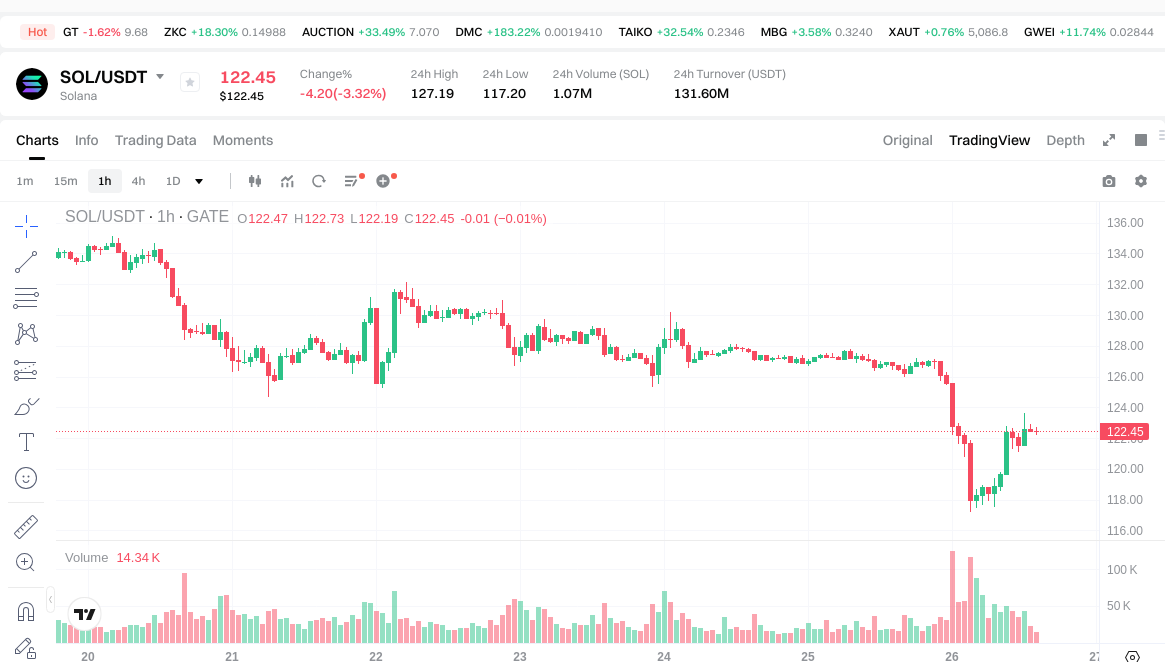
With SOL remaining confined within a multi-month descending channel pattern, market participants are closely monitoring whether this key support level will hold firm or eventually give way to a deeper correction. The current price action represents a crucial juncture for Solana, as the outcome of this technical battle could determine the trajectory for the coming weeks and potentially months.
Trend Weakens as Death Cross Approaches
SOL's technical structure continues to exhibit broadly bearish characteristics, primarily defined by a steep falling channel that has governed every major price swing since mid-September. The pattern of lower highs has consistently reinforced the prevailing downtrend, with each recovery attempt encountering resistance and stalling beneath the channel's midpoint. This repetitive failure to break above key resistance levels has gradually eroded bullish confidence.
The near-term period carries particular significance as the death cross is forming for the first time since early 2023. This technical development signals a potential transition toward a more prolonged consolidation phase if buyers fail to regain momentum and reverse the current trajectory. The death cross occurs when the shorter-term 50-day moving average crosses below the longer-term 200-day moving average, and it is widely regarded as a bearish signal that often precedes extended periods of price weakness.
The $121–$123 region, which has been tested repeatedly in recent trading sessions, stands as the last major line of defense before a potential slide toward the $107 level and subsequently the $95 zone. A breakdown below this support area could trigger accelerated selling as stop-loss orders are activated and momentum traders add to short positions.
Key bearish pressures currently affecting Solana include:
- A persistent sequence of lower highs established since September, creating a clear downtrend pattern
- The channel midline consistently rejecting every bullish breakout attempt, demonstrating strong overhead resistance
- An imminent crossover between the 50-day and 200-day exponential moving averages, which could attract additional selling pressure from technical traders
- Weakening volume during rally attempts, suggesting diminishing buyer conviction
- Broader market uncertainty affecting risk assets across the cryptocurrency sector
Support Holds, but Momentum Remains Fragile
Despite the predominantly bearish technical setup, buyers have demonstrated notable resilience at the lower boundary of the descending channel. Recent candlestick formations have featured long lower wicks combined with relatively smaller bodies, providing clear evidence of aggressive dip buying activity concentrated around the $121 level. This price behavior suggests that a substantial cohort of market participants views this zone as an attractive entry point and is willing to defend it.
The Relative Strength Index (RSI) currently sits at 33, having bounced from oversold territory below 30. This recovery in the RSI has formed a mild bullish divergence, as momentum indicators show signs of steadying even while price continues to test support levels. Bullish divergence occurs when price makes lower lows but the RSI makes higher lows, potentially signaling that selling pressure is beginning to exhaust itself.
However, it's important to note that momentum remains fragile, and the sustainability of this support depends heavily on broader market conditions and the ability of buyers to absorb ongoing selling pressure. The current consolidation near support could represent either a temporary pause before further decline or the early stages of a base-building process that precedes a reversal.
Reclaiming the $144–$146 zone represents the first meaningful test of renewed strength for Solana bulls. This area previously served as support and has now flipped to resistance, making it a critical hurdle to overcome. A decisive break above $172, which marks the channel's upper boundary, would signal a more significant trend shift and potentially invalidate the bearish channel structure that has dominated price action for months.
For bulls to regain control, they would need to achieve several key milestones: first, establish a higher low above the current support zone; second, break above the descending channel midline with conviction; and third, reclaim the 50-day moving average as support rather than resistance.
Solana Technical Outlook: Price Stabilizes Inside a Falling Channel as Bulls Defend Support
The Solana price prediction remains tilted to the downside as the technical structure continues to favor sellers. Traders seeking safer entry points may prefer to wait for a confirmed bullish reversal candle formation within the $121–$123 region before initiating long positions. Such confirmation could take the form of a bullish engulfing pattern, hammer candlestick, or morning star formation that demonstrates buyer strength.
A daily close above the $144 level would provide early validation of emerging strength and open a potential path toward the $146 resistance level, followed by the more significant $172 channel top. If broader market sentiment improves and risk appetite returns to the cryptocurrency sector, Solana could extend gains toward the $205 region, which represents a major resistance zone from previous price action.
However, failure to successfully defend the $121 support level would activate the death cross narrative more aggressively and likely trigger a cascade of stop-loss orders. Such a breakdown would expose Solana to deeper downside risk, with the next major support zones located at $107 and $95. These lower levels could attract value buyers, but reaching them would require enduring significant additional losses from current prices.
From a risk management perspective, traders should consider the following scenarios:
- Bullish scenario: A hold above $121 followed by a break above $144 could target $172, offering a favorable risk-reward ratio for long positions
- Neutral scenario: Continued range-bound trading between $121 and $144 as bulls and bears battle for control
- Bearish scenario: A breakdown below $121 could accelerate selling toward $107 and potentially $95
If macroeconomic conditions stabilize and risk appetite returns to financial markets, SOL could potentially transition from its current decline phase into an accumulation phase. This would create new entry opportunities for longer-term investors seeking exposure to the Solana ecosystem at more attractive valuations. However, such a transition would require confirmation through improved price action and technical indicators before committing significant capital.
FAQ
What is Death Cross (死亡交叉)? What does it mean for Solana's price?
Death Cross occurs when a short-term moving average crosses below a long-term one, signaling bearish momentum. For Solana, this technical pattern suggests potential downward pressure, potentially driving prices lower toward support levels like $123.
Solana价格跌破$123的可能性有多大?
Based on current technical indicators showing a death cross pattern, Solana faces meaningful downside risk. The probability of testing below $123 is moderately high, estimated at 55-65% in the near term. Key support levels and market momentum will determine if this level breaks convincingly.
How accurate is the Death Cross technical indicator? Can it be used as the sole basis for investment decisions?
Death Cross accuracy varies around 60-70% historically. While useful for identifying potential downtrends, it should not be your sole investment criterion. Combine it with volume analysis, support levels, and market sentiment for comprehensive decision-making.
What are Solana's advantages and risks compared to Ethereum and other Layer 1 blockchains?
Solana offers faster transaction speeds and lower fees through its Proof of History consensus mechanism. It handles high transaction volume efficiently. Risks include network stability concerns, validator centralization, and ecosystem maturity compared to Ethereum's established infrastructure and developer base.
If Solana price drops, how should I manage investment risk?
Set stop-loss orders to limit downside exposure. Diversify your portfolio across multiple assets. Consider dollar-cost averaging to reduce timing risk. Maintain adequate liquidity reserves. Monitor technical levels—support at $123 is critical. Take profits during rallies and rebalance regularly to align with your risk tolerance and investment timeline.
What are the main factors affecting Solana's price trend? What else should be monitored beyond technical indicators?
Solana's price is influenced by network activity, developer ecosystem growth, macroeconomic conditions, regulatory developments, institutional adoption, and competing blockchain innovations. Monitor on-chain metrics, transaction volume, validator participation, ecosystem partnerships, and market sentiment alongside technical indicators for comprehensive analysis.
* The information is not intended to be and does not constitute financial advice or any other recommendation of any sort offered or endorsed by Gate.