This comprehensive guide compares SOPH and SNX, two leading decentralized finance protocols with distinct market positioning. SOPH, launched in May 2025, focuses on monetizing user-generated data through consumer applications to attract mainstream users. SNX, established in 2018, is a proven DeFi synthetic asset protocol supporting diverse financial instruments. The article analyzes historical price trends, supply mechanisms, institutional adoption, technical ecosystems, and risk factors across both platforms. It provides 2026-2031 price forecasts, investment strategies for different investor profiles, and detailed risk assessments. Real-time market data available on Gate shows current prices, trading volumes, and extreme market fear sentiment. Whether you seek emerging opportunities or established infrastructure exposure, this guide helps you determine which protocol aligns with your investment objectives and risk tolerance.
Introduction: Investment Comparison Between SOPH and SNX
In the cryptocurrency market, the comparison between SOPH vs SNX has always been a topic that investors cannot bypass. The two not only have obvious differences in market cap ranking, application scenarios, and price performance, but also represent different crypto asset positioning.
SOPH (Sophon): Launched in 2025, it has gained market recognition by focusing on monetizing user-generated data through everyday consumer products. The platform aims to onboard the next generation of crypto users by powering real applications without traditional crypto friction.
SNX (Synthetix): Since its launch in 2018, it has been recognized for its decentralized synthetic assets protocol, supporting various comprehensive assets including fiat currencies pegged to the US dollar, precious metals, indices, and even other cryptocurrencies. It is one of the established players in the DeFi ecosystem.
This article will comprehensively analyze the investment value comparison of SOPH vs SNX around historical price trends, supply mechanisms, institutional adoption, technical ecosystems, and future predictions, and attempt to answer the question that investors are most concerned about:
"Which is the better buy right now?"
I. Historical Price Comparison and Current Market Status
SOPH and SNX Historical Price Trends
- 2025: SOPH launched in late May 2025, reaching its historical high of $0.0799 on May 28, 2025, shortly after its market debut.
- 2021: SNX experienced significant growth during the DeFi summer period, achieving its all-time high of $28.53 on February 14, 2021.
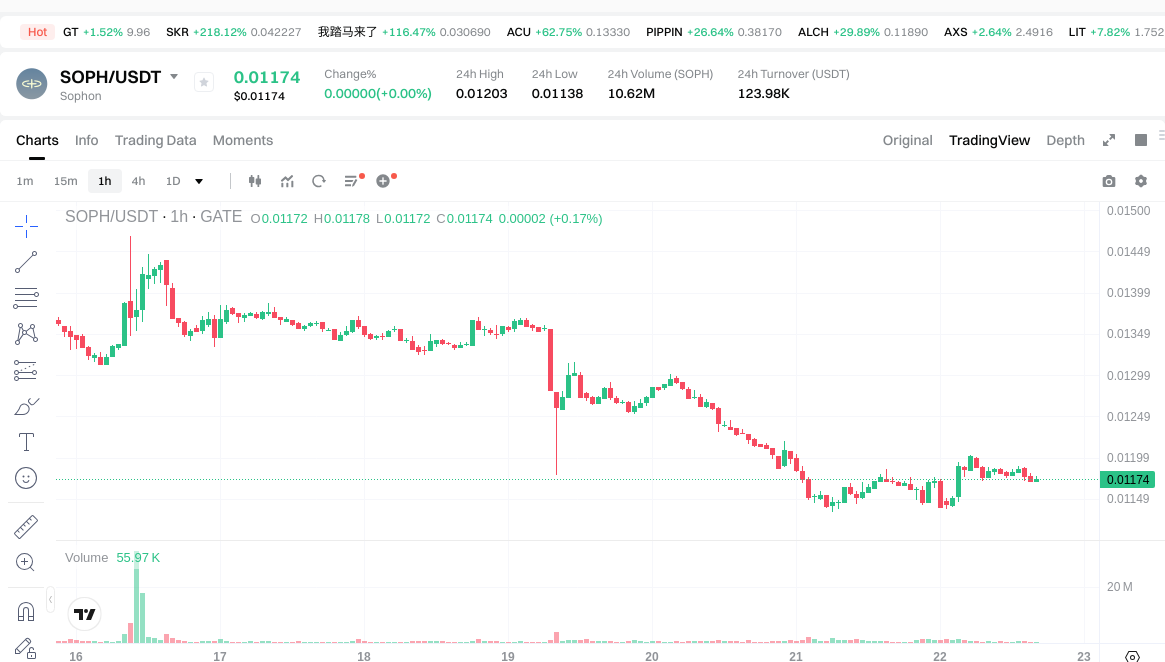
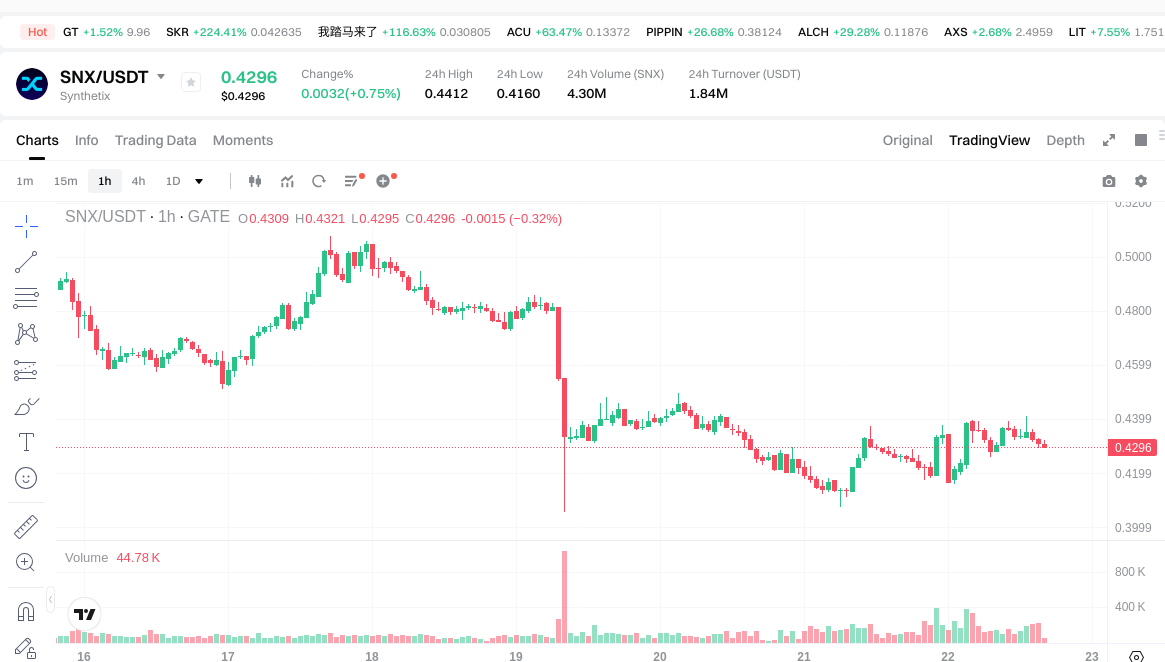
- Comparative Analysis: During different market cycles, SOPH declined from its peak of $0.0799 to a low of $0.01123 in December 2025, representing an 85.95% decrease. In contrast, SNX has experienced a more prolonged downtrend from its 2021 peak of $28.53 to current levels around $0.43, marking a decline of approximately 98.5% from its historical high.
Current Market Status (January 22, 2026)
- SOPH Current Price: $0.01173
- SNX Current Price: $0.4312
- 24-Hour Trading Volume: SOPH recorded $123,616.94 vs SNX recorded $1,833,455.50
- Market Sentiment Index (Fear & Greed Index): 20 (Extreme Fear)
View real-time prices:
- Check SOPH current price Market Price
- Check SNX current price Market Price
II. Core Factors Affecting SOPH vs SNX Investment Value
Supply Mechanism Comparison (Tokenomics)
Due to limited available data on the specific supply mechanisms of SOPH and SNX, a detailed comparison cannot be provided at this time. Generally, token supply mechanisms including total supply caps, emission schedules, and deflationary features can influence long-term price dynamics through supply-demand economics.
Institutional Adoption and Market Application
Institutional Holdings: Current data does not provide specific information regarding institutional preference between SOPH and SNX.
Enterprise Adoption: Information on cross-border payment integration, settlement systems, or investment portfolio inclusion for either token is not available in the provided materials.
National Policy: Regulatory stances toward SOPH and SNX across different jurisdictions have not been documented in the available resources.
Technical Development and Ecosystem Building
SOPH Technical Upgrades: Specific technical roadmap updates and their potential market impact are not detailed in current materials.
SNX Technical Development: Information regarding recent protocol improvements or development milestones is not available.
Ecosystem Comparison: Comparative data on DeFi integration, NFT ecosystem participation, payment infrastructure, and smart contract deployment for both tokens is insufficient for analysis.
Macroeconomic Conditions and Market Cycles
Performance During Inflation: Analysis of which asset demonstrates stronger inflation-hedging characteristics requires historical performance data that is not currently available.
Macroeconomic Monetary Policy: The specific impact of interest rate changes and US dollar index movements on SOPH and SNX cannot be assessed without relevant correlation data.
Geopolitical Factors: The role of cross-border transaction demand and international developments in driving adoption of either token remains unclear from available information.
III. 2026-2031 Price Forecast: SOPH vs SNX
Short-term Forecast (2026)
- SOPH: Conservative $0.0103-$0.0117 | Optimistic $0.0117-$0.0144
- SNX: Conservative $0.322-$0.430 | Optimistic $0.430-$0.593
Mid-term Forecast (2028-2029)
- SOPH may enter a consolidation phase, with projected price range of $0.0096-$0.0177
- SNX may enter an expansion phase, with projected price range of $0.338-$0.924
- Key drivers: institutional capital inflows, ETF developments, ecosystem growth
Long-term Forecast (2030-2031)
- SOPH: Baseline scenario $0.0098-$0.0183 | Optimistic scenario $0.0172-$0.0247
- SNX: Baseline scenario $0.524-$0.813 | Optimistic scenario $0.610-$0.912
View detailed price predictions for SOPH and SNX
Disclaimer
SOPH:
| Year |
Predicted High Price |
Predicted Average Price |
Predicted Low Price |
Price Change |
| 2026 |
0.0144156 |
0.01172 |
0.0103136 |
0 |
| 2027 |
0.01372119 |
0.0130678 |
0.008102036 |
11 |
| 2028 |
0.01379632985 |
0.013394495 |
0.0096440364 |
14 |
| 2029 |
0.0176740361525 |
0.013595412425 |
0.0127796876795 |
15 |
| 2030 |
0.020950530546925 |
0.01563472428875 |
0.009849876301912 |
33 |
| 2031 |
0.02469504701408 |
0.018292627417837 |
0.017195069772767 |
55 |
SNX:
| Year |
Predicted High Price |
Predicted Average Price |
Predicted Low Price |
Price Change |
| 2026 |
0.592986 |
0.4297 |
0.322275 |
0 |
| 2027 |
0.63406532 |
0.511343 |
0.36816696 |
18 |
| 2028 |
0.7101531584 |
0.57270416 |
0.3378954544 |
32 |
| 2029 |
0.923657269248 |
0.6414286592 |
0.538800073728 |
48 |
| 2030 |
0.84514640136192 |
0.782542964224 |
0.52430378603008 |
81 |
| 2031 |
0.911506044728115 |
0.81384468279296 |
0.61038351209472 |
88 |
IV. Investment Strategy Comparison: SOPH vs SNX
Long-term vs Short-term Investment Strategies
- SOPH: May be suitable for investors focused on emerging ecosystem opportunities and consumer-oriented applications, particularly those interested in data monetization platforms targeting mainstream adoption.
- SNX: May appeal to investors seeking exposure to established DeFi protocols with synthetic asset capabilities, particularly those interested in decentralized financial infrastructure.
Risk Management and Asset Allocation
- Conservative Investors: SOPH 20-30% vs SNX 70-80% allocation may reflect a preference for more established market presence
- Aggressive Investors: SOPH 50-60% vs SNX 40-50% allocation could target higher growth potential in newer platforms
- Hedging Tools: Stablecoin reserves, options strategies, cross-asset portfolio diversification
V. Potential Risk Comparison
Market Risks
- SOPH: Limited price history since May 2025 launch creates uncertainty in trend analysis; experienced 85.95% decline from initial peak, indicating high volatility potential
- SNX: Extended bear market showing approximately 98.5% decline from 2021 peak; longer operational history provides more data but reflects sustained downward pressure
Technical Risks
- SOPH: As a newer platform focused on consumer applications, scalability during user adoption phases and network stability under increased usage remain areas requiring monitoring
- SNX: Decentralized synthetic asset protocols face ongoing challenges related to oracle dependencies, smart contract complexity, and maintaining collateralization ratios during market volatility
Regulatory Risks
- Global regulatory frameworks continue evolving for both consumer-focused data platforms and DeFi synthetic asset protocols, with potential impacts varying by jurisdiction and specific use cases
VI. Conclusion: Which Is the Better Buy?
📌 Investment Value Summary:
- SOPH Characteristics: Represents newer market entry with focus on mainstream user onboarding through consumer applications; shorter operational history with limited long-term performance data
- SNX Characteristics: Established DeFi protocol with operational history since 2018; proven infrastructure in synthetic asset space but facing extended price decline from historical levels
✅ Investment Considerations:
- New Investors: Consider starting with smaller position sizes in either asset given extreme fear market sentiment (Index: 20); prioritize understanding fundamental use cases before allocation
- Experienced Investors: May evaluate risk-adjusted opportunities based on individual portfolio objectives, considering SOPH's emerging platform narrative versus SNX's established protocol position
- Institutional Investors: Assess alignment with specific mandates regarding maturity stage, liquidity requirements, and regulatory considerations for each asset class
⚠️ Risk Disclaimer: The cryptocurrency market exhibits extreme volatility. This analysis does not constitute investment advice. Both assets have experienced significant price declines from peak levels. Investors should conduct independent research and consider their risk tolerance before making allocation decisions.
VII. FAQ
Q1: What are the main differences between SOPH and SNX?
SOPH is a newer platform launched in May 2025 that focuses on monetizing user-generated data through consumer applications, aiming to onboard mainstream users without traditional crypto friction. SNX, launched in 2018, is an established DeFi protocol specializing in decentralized synthetic assets including fiat currencies, precious metals, and cryptocurrencies. The key distinction lies in their market positioning: SOPH targets consumer adoption through everyday applications, while SNX serves the DeFi ecosystem with financial infrastructure for synthetic asset trading.
Q2: Which token has experienced greater price volatility?
SNX has experienced more extreme long-term volatility, declining approximately 98.5% from its February 2021 all-time high of $28.53 to current levels around $0.43. While SOPH has shown significant short-term volatility with an 85.95% decline from its May 2025 peak of $0.0799 to $0.01123 in December 2025, its limited operational history makes long-term volatility assessment incomplete. Both assets demonstrate high-risk characteristics, with SNX's extended bear market providing more historical data on price behavior during different market cycles.
Q3: What is the current market sentiment for both tokens?
As of January 22, 2026, the overall cryptocurrency market exhibits extreme fear with a Fear & Greed Index reading of 20. This sentiment affects both SOPH (trading at $0.01173) and SNX (trading at $0.4312). The trading volume shows SNX with significantly higher liquidity at $1,833,455.50 compared to SOPH's $123,616.94 in 24-hour volume, suggesting SNX maintains stronger market participation despite bearish conditions. This extreme fear environment historically presents both heightened risk and potential opportunity for long-term investors.
Q4: What are the price predictions for 2026-2031?
For 2026, SOPH is projected to trade between $0.0103-$0.0144 (optimistic scenario), while SNX ranges from $0.430-$0.593 (optimistic scenario). By 2031, SOPH's baseline forecast shows $0.0098-$0.0183 with optimistic scenarios reaching $0.0172-$0.0247, while SNX baseline forecasts indicate $0.524-$0.813 with optimistic scenarios of $0.610-$0.912. These projections suggest SNX maintains higher absolute price levels but both assets face uncertain growth trajectories. Key drivers include institutional adoption, ecosystem development, and broader market cycle dynamics affecting the entire cryptocurrency sector.
Q5: Which token is more suitable for conservative investors?
For conservative investors, a suggested allocation might be 70-80% SNX versus 20-30% SOPH. SNX's longer operational history since 2018 provides more historical data for analysis, established protocol infrastructure, and greater trading liquidity. However, both assets carry substantial risk given their significant declines from peak levels. Conservative investors should prioritize understanding each platform's fundamental use cases, maintain diversified portfolios including stablecoin reserves for risk management, and only allocate capital they can afford to lose given the extreme volatility inherent in both assets.
Q6: What are the primary risks associated with investing in SOPH vs SNX?
SOPH's primary risks include limited operational history creating uncertainty in trend analysis, high short-term volatility evidenced by its 85.95% decline from launch peak, and unproven scalability during potential user adoption phases. SNX faces risks from its extended bear market showing 98.5% decline from all-time highs, technical complexities related to oracle dependencies and collateralization requirements in synthetic asset protocols, and ongoing regulatory uncertainty affecting DeFi platforms. Both tokens are subject to evolving global regulatory frameworks, macroeconomic conditions, and broader cryptocurrency market cycles that can dramatically impact valuations.
Q7: How do institutional adoption prospects differ between the two?
Current data does not provide specific information regarding institutional holdings or adoption patterns for either SOPH or SNX. Generally, SNX's established presence in the DeFi ecosystem since 2018 may offer more visibility to institutional investors familiar with decentralized financial infrastructure. SOPH's consumer-focused approach targeting mainstream user onboarding represents a different institutional narrative centered on data monetization and application-layer adoption. Institutional investors should assess alignment with specific investment mandates, considering factors such as operational maturity, liquidity requirements, regulatory clarity, and strategic positioning within their broader cryptocurrency portfolio allocations.
Q8: What market conditions would favor SOPH versus SNX?
SOPH may outperform during market conditions favoring consumer adoption narratives, increased focus on user data monetization, and when investors seek exposure to newer platforms with potential for rapid ecosystem growth. SNX could benefit from renewed DeFi activity, increased demand for synthetic asset trading, recognition of established protocol value, and market cycles rewarding infrastructure platforms with proven operational history. Both tokens would likely benefit from overall cryptocurrency market recovery, positive regulatory developments, and increased institutional participation. However, their different market positioning means they may respond differently to specific sector trends within the broader digital asset ecosystem.
* The information is not intended to be and does not constitute financial advice or any other recommendation of any sort offered or endorsed by Gate.