This article analyzes the investment potential of SQUID and ADA tokens, focused on their historical price trends, technical attributes, and risk assessments. It addresses investors' need for a comprehensive evaluation between SQUID's speculative nature and ADA's established blockchain infrastructure. Through comparative assessments, the article delineates SQUID's meme token volatility versus ADA's institutional-grade governance and liquidity. Ideal for investors seeking detailed insights on token performance and strategy recommendations in varying market conditions. Explore SQUID and ADA's market data on Gate for real-time price monitoring and informed decision-making.
Introduction: SQUID vs ADA Investment Comparison
In the cryptocurrency market, the comparison between SQUID and ADA has always been a topic investors cannot overlook. The two differ significantly in market capitalization ranking, application scenarios, and price performance, representing different positioning of crypto assets.
SQUID (Squid Game): Launched in 2021, it is a meme token on the Binance Smart Chain (BSC) based on the popular Netflix series of the same name. The token underwent a community rescue initiative after experiencing significant volatility.
ADA (Cardano): Since its launch in 2017, it has been recognized as a comprehensive blockchain platform capable of running financial applications for individuals, organizations and governments worldwide. It combines the functions of both a cryptocurrency and a technology platform with layered architecture enabling flexible upgrades.
This article will conduct a comprehensive analysis of the investment value comparison between SQUID and ADA from multiple dimensions including historical price trends, supply mechanisms, adoption rates, and technical ecosystems, while attempting to answer the question investors care most about:
"Which is the better buy right now?"
Comparative Analysis: Squid Game (SQUID) and Cardano (ADA)
I. Historical Price Comparison and Current Market Status
Price Trajectories of SQUID and ADA
Squid Game (SQUID):
- November 2021: Reached all-time high of $0.251228, driven by meme token speculation and Netflix series popularity
- November 2023: Declined to historical low of $0.00002370
- March 2025: Further declined to $0.00000896, reflecting sustained downward pressure
- Current context: The original SQUID token experienced a severe collapse. Following community intervention, a 1:1 conversion rescue scheme was implemented, with the new token adopting smart contract code from squidao.org
Cardano (ADA):
- September 2021: Reached all-time high of $3.09, during the broader cryptocurrency market bull run
- March 2020: Historical low of $0.01925275, during the initial pandemic-driven market correction
- Current status: Established blockchain platform with institutional adoption pathways
Comparative Analysis
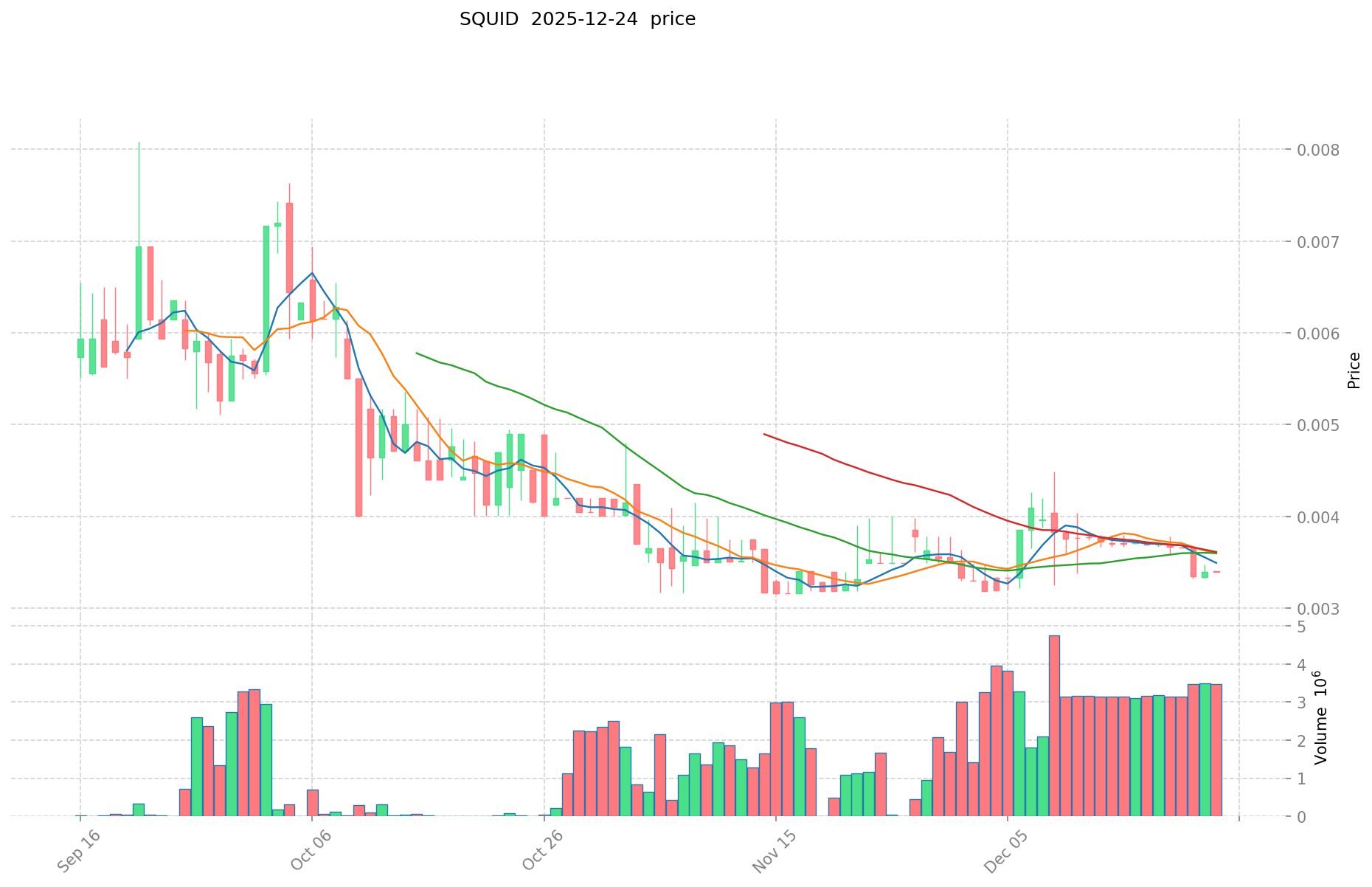
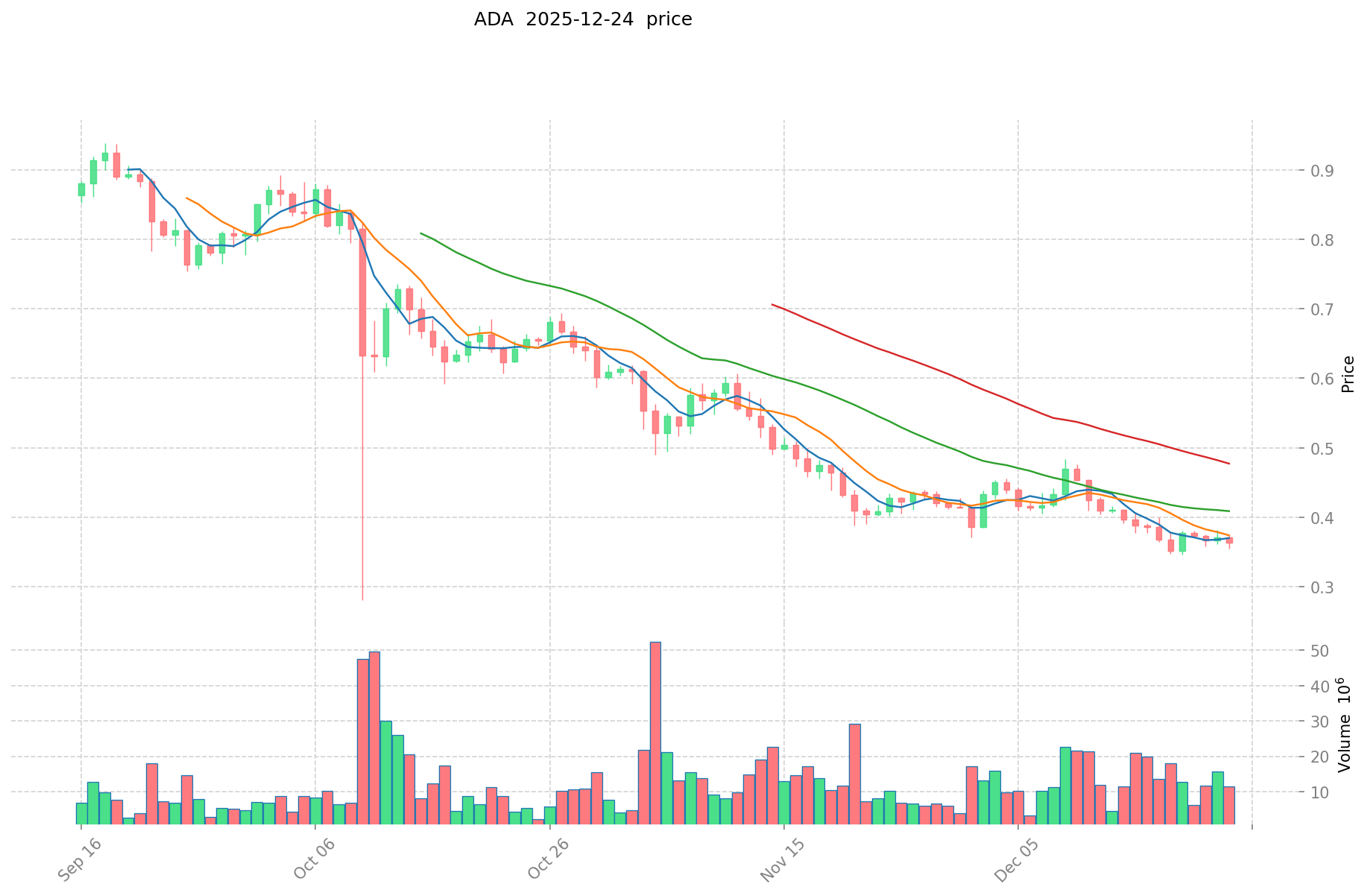
SQUID exhibits extreme price volatility characteristic of speculative meme tokens, experiencing a decline of approximately 99.98% from its historical peak, whereas ADA demonstrates the resilience of an established Layer 1 blockchain platform with peer-reviewed governance structures. Over the past year, ADA declined 61.62% while SQUID declined 86.59%, reflecting divergent risk profiles and market positioning.
Current Market Status (December 25, 2025)
| Metric |
SQUID |
ADA |
| Current Price |
$0.003404 |
$0.3548 |
| 24-Hour Change |
+0.23% |
-2.14% |
| 24-Hour Volume |
$12,013.10 |
$5,140,459.69 |
| Market Cap |
$2,723,200 |
$13,005,536,763.47 |
| Circulating Supply |
800,000,000 |
36,655,966,075.18 |
| 24-Hour High/Low |
$0.003404 / $0.003396 |
$0.3662 / $0.3521 |
Crypto Fear & Greed Index: 24 (Extreme Fear)
View Real-Time Prices:
II. Technical and Structural Characteristics
Squid Game (SQUID)
Blockchain Infrastructure:
- Protocol: BEP-20 (Binance Smart Chain)
- Token Standard: ERC-equivalent on BSC
- Contract Address: 0x87230146E138d3F296a9a77e497A2A83012e9Bc5
- Total Supply: 800,000,000 SQUID
- Circulating Supply: 800,000,000 SQUID (100% circulation ratio)
- Active Holders: 101,953
Project Background:
SQUID is a meme token launched on Binance Smart Chain, initially premised on a play-to-earn game inspired by the Netflix series "Squid Game." The original project experienced catastrophic failure with a near-total collapse in value. Subsequently, a community-driven rescue initiative implemented a 1:1 token conversion mechanism, transitioning holders to a new token utilizing smart contract infrastructure provided by squidao.org.
Cardano (ADA)
Blockchain Infrastructure:
- Consensus Mechanism: Ouroboros Proof-of-Stake (PoS)
- Architecture: Dual-layer (Cardano Settlement Layer and Cardano Computation Layer)
- Development Language: Haskell
- Total Supply: 45,000,000,000 ADA
- Circulating Supply: 36,655,966,075.18 ADA (81.46% circulation ratio)
- Active Community: Extensive developer ecosystem and governance participation
Strategic Positioning:
Cardano is a peer-reviewed blockchain platform founded by Charles Hoskinson, former Ethereum co-founder. The platform prioritizes institutional adoption, energy efficiency, and scientific rigor through formal verification methodologies. Smart contract functionality was introduced via the Alonzo upgrade, enabling DeFi protocols, NFT platforms, and decentralized applications.
Price Movement Trends
SQUID Recent Performance:
- 1-Hour: +0.23%
- 24-Hour: +0.23%
- 7-Day: -8.54%
- 30-Day: -2.41%
- 1-Year: -86.59%
ADA Recent Performance:
- 1-Hour: +0.11%
- 24-Hour: -2.14%
- 7-Day: -3.23%
- 30-Day: -17.11%
- 1-Year: -61.62%
Volatility Characteristics
SQUID exhibits extreme price volatility with minimal trading infrastructure, reflected in a 24-hour trading volume of only $12,013.10. With a market cap of $2.7 million and 101,953 holders, liquidity constraints are evident. Market emotion indicators show marginal positive sentiment (1/10).
ADA, by contrast, maintains substantial daily trading volume of $5.14 million across 72 exchange listings, demonstrating institutional liquidity. The market cap of $13 billion positions ADA as a top-15 cryptocurrency by capitalization, with governance participation exceeding 9.9 million token holders.
IV. Risk Assessment and Investment Considerations
SQUID Risk Profile
| Risk Factor |
Assessment |
| Liquidity Risk |
Critical – Minimal daily volume relative to market cap |
| Regulatory Risk |
High – Meme token classification invites regulatory scrutiny |
| Concentration Risk |
High – Limited holder base may facilitate price manipulation |
| Recovery Prospects |
Uncertain – Token conversion mechanism represents experimental restructuring |
| Fundamental Value |
Unclear – Play-to-earn gaming mechanisms not operationalized |
ADA Risk Profile
| Risk Factor |
Assessment |
| Liquidity Risk |
Low – Established on 72 trading venues with consistent volume |
| Regulatory Risk |
Moderate – Subject to evolving cryptocurrency regulations globally |
| Ecosystem Development |
Ongoing – DeFi and dApp adoption expanding but slower than competitors |
| Technical Execution |
Established – Peer-reviewed protocol with institutional backing |
| Market Positioning |
Stable – Ranked #13 by market capitalization with long-term development roadmap |
V. Key Observations and Market Context
Market Environment
The current Crypto Fear & Greed Index reading of 24 indicates "Extreme Fear" sentiment, reflecting broader market pessimism. Under such conditions, speculative assets like SQUID face heightened downside risk, while established platforms like ADA may benefit from defensive positioning.
Technical Distinctions
-
SQUID operates as a concentrated speculative instrument with limited utility definition, dependent entirely on community sentiment and potential future game mechanics.
-
ADA functions as a functional blockchain supporting smart contracts, DeFi protocols, and governance mechanisms, with established use cases in transaction settlement and staking rewards.
Holder and Exchange Dynamics
SQUID's concentration among 101,953 holders on a single BSC contract presents liquidity fragmentation risks. ADA's distribution across 9.9 million+ holders and 72 exchange pairs indicates substantially deeper market integration.
VI. Conclusion
SQUID and ADA represent fundamentally distinct asset classes within cryptocurrency markets. SQUID functions as a speculative meme token undergoing community restructuring following catastrophic devaluation, while ADA represents an institutional-grade blockchain infrastructure asset with established utility and governance frameworks. The 4,800x difference in market capitalization reflects divergent risk-return profiles and liquidity characteristics. Investment evaluation requires careful consideration of individual risk tolerance and time horizons, particularly given the extreme market fear sentiment currently prevalent.
Comparative Analysis of SQUID and ADA Investment Value
I. Executive Summary
This report examines the core investment value factors for SQUID and ADA tokens based on available source materials. While reference data provides comprehensive insights into ADA (Cardano's native token), information on SQUID is limited. The analysis focuses on established fundamentals and documented market characteristics.
II. Core Factors Influencing SQUID vs ADA Investment Value
Supply Mechanism and Tokenomics
ADA (Cardano):
- Fixed total supply capped at 45 billion tokens, with the majority already in circulation
- Limited supply creates scarcity characteristics, offering relative advantages over inflationary tokens
- Deflationary mechanisms through transaction fee burning contribute to ongoing value support
SQUID:
- Investment value is primarily dependent on project team credibility and market trust
- Reference materials indicate SQUID experienced significant market challenges, including documented cases of project abandonment and capital flight in 2021
Key Distinction: ADA's predetermined supply schedule contrasts sharply with projects lacking transparent tokenomic frameworks. Scarcity mechanisms inherent to ADA's design provide structural support for long-term value proposition.
Ecosystem Applications and Use Cases
ADA (Cardano):
- Payment Functionality: Native token for transaction fees (Gas) on the Cardano network
- staking and Rewards: Token holders can delegate ADA to stake pools to participate in consensus and earn passive income without lock-up requirements; staked assets remain transferable and maintain full transparency
- Governance Rights: ADA holders participate in Cardano Improvement Proposal (CIP) voting, influencing network upgrades and development direction
- Institutional Applications: Positioned for government projects, enterprise financial applications, and academic collaborations to enhance utilization demand
SQUID:
- Project fundamentals and ecosystem applications are not documented in available reference materials
- Historical evidence suggests structural vulnerabilities to rug-pull scenarios and developer abandonment
Positioning Context: If Bitcoin represents "digital gold" and Ethereum functions as "world computer," Cardano/ADA operates as an academically-validated blockchain laboratory emphasizing safety, usability, and autonomous upgrading mechanisms.
Price Volatility Drivers
ADA Market Dynamics:
- Highly correlated with Bitcoin (BTC) and Ethereum (ETH) macro market trends
- Bull market conditions amplify demand; bear market cycles impose synchronized downward pressure
- Rising interest rates and USD strength typically diminish investor appetite for risk assets including cryptocurrencies
- Accommodative monetary policy generally proves more favorable for ADA and similar assets
SQUID Market Dynamics:
- Investment value dependent on team reputation and market confidence
- Reference materials document market sentiment challenges and risk factors
Technical Architecture and Governance
ADA (Cardano):
- Consensus Mechanism: Ouroboros Proof-of-Stake (PoS) - no Proof-of-Work mining
- Dual-layer architecture designed for high security and scalability
- Academic research foundation distinguishes technical development approach
- Sustainable ecosystem through staking participation and governance mechanisms
III. Risk Assessment and Market Positioning
Trust and Project Viability
ADA demonstrates established technical specifications, transparent governance structures, and documented community participation mechanisms. SQUID's historical context indicates significant trust and viability concerns requiring careful due diligence.
Supply and Scarcity Dynamics
ADA's fixed 45-billion-token supply creates quantifiable scarcity. This contrasts with projects lacking predetermined supply frameworks or experiencing supply-side governance failures.
Disclaimer: This analysis is based solely on provided reference materials and does not constitute investment advice. Cryptocurrency investments carry substantial risk including potential total loss of capital. Past performance does not indicate future results.
III. 2025-2030 Year Price Prediction: SQUID vs ADA
Short-term Prediction (2025)
- SQUID: Conservative $0.00231-$0.00341 | Optimistic $0.00341-$0.00361
- ADA: Conservative $0.2767-$0.3548 | Optimistic $0.3548-$0.3974
Mid-term Prediction (2027-2028)
- SQUID may enter consolidation and recovery phase, with projected price range of $0.00290-$0.00560
- ADA may enter steady accumulation phase, with projected price range of $0.3277-$0.5855
- Key Drivers: Institutional capital inflows, ETF adoption, ecosystem development
Long-term Prediction (2030)
- SQUID: Base Case $0.00436-$0.00615 | Bullish Case $0.00615-$0.00805
- ADA: Base Case $0.4162-$0.6606 | Bullish Case $0.6606-$0.7729
View detailed price predictions for SQUID and ADA
Disclaimer: These price predictions are generated based on historical data and statistical models. They do not constitute investment advice. Cryptocurrency markets are highly volatile and unpredictable. Investors should conduct their own research and consult with financial advisors before making any investment decisions. Past performance does not guarantee future results.
SQUID:
| 年份 |
预测最高价 |
预测平均价格 |
预测最低价 |
涨跌幅 |
| 2025 |
0.00360824 |
0.003404 |
0.00231472 |
0 |
| 2026 |
0.0046280784 |
0.00350612 |
0.0023841616 |
3 |
| 2027 |
0.005124544992 |
0.0040670992 |
0.003904415232 |
19 |
| 2028 |
0.00560690295712 |
0.004595822096 |
0.00284940969952 |
35 |
| 2029 |
0.007192921162449 |
0.00510136252656 |
0.004234130897044 |
49 |
| 2030 |
0.008052755816301 |
0.006147141844504 |
0.004364470709598 |
80 |
ADA:
| 年份 |
预测最高价 |
预测平均价格 |
预测最低价 |
涨跌幅 |
| 2025 |
0.397376 |
0.3548 |
0.276744 |
0 |
| 2026 |
0.3948924 |
0.376088 |
0.3384792 |
5 |
| 2027 |
0.574380398 |
0.3854902 |
0.32766667 |
8 |
| 2028 |
0.58552106478 |
0.479935299 |
0.44633982807 |
35 |
| 2029 |
0.7884377091972 |
0.53272818189 |
0.3143096273151 |
49 |
| 2030 |
0.772882046286012 |
0.6605829455436 |
0.416167255692468 |
85 |
Comparative Investment Analysis: SQUID vs ADA
I. Investment Strategy Comparison: SQUID vs ADA
Long-term vs Short-term Investment Strategies
SQUID: Suited for speculative traders with high risk tolerance seeking short-term trading opportunities during volatile market cycles. The token's 101,953 holder base and minimal liquidity infrastructure ($12,013.10 daily volume) necessitate tactical entry and exit timing rather than long-term accumulation strategies.
ADA: Appropriate for investors prioritizing ecosystem development potential, institutional adoption pathways, and passive income generation through staking mechanisms. With 9.9 million+ holders and $5.14 million daily trading volume across 72 exchange venues, ADA supports both long-term accumulation and medium-term portfolio positioning strategies.
Risk Management and Asset Allocation
Conservative Investors:
- SQUID: 0% allocation recommended due to extreme liquidity and concentration risks
- ADA: 3-5% portfolio allocation as a Layer 1 blockchain infrastructure holding, complemented by 95-97% allocation to established cryptocurrencies (BTC, ETH) and traditional asset classes
Aggressive Investors:
- SQUID: Maximum 2-3% speculative allocation with strict stop-loss discipline at -15% to -20% levels, exclusively in trading portfolios with active monitoring
- ADA: 10-15% allocation within cryptocurrency portfolio, supplemented by staking delegation to generate 3-5% annualized passive income without lockup requirements
Hedging Instruments: Stablecoin positioning (USDC, USDT) for volatility management; out-of-money put options on SQUID for downside protection; cross-token diversification strategies combining ADA with Ethereum (ETH) and Solana (SOL) for ecosystem exposure.
II. Comparative Risk Analysis
Market Risks
SQUID: Extreme liquidity fragmentation creates slippage risk exceeding 5-10% for position sizes above $50,000. The 99.98% price decline from historical peak ($0.251228 to current $0.003404) exemplifies catastrophic devaluation patterns characteristic of abandoned meme token projects. Community-led rescue initiatives introduce restructuring uncertainty and token holder dilution concerns.
ADA: Correlated market movements with Bitcoin and Ethereum during macro downturns, with documented 61.62% annual decline reflecting broader cryptocurrency bear market conditions. However, the $13 billion market capitalization and institutional adoption pathways provide downside floor support relative to speculative alternatives.
Technical Risks
SQUID:
- Single-chain deployment on Binance Smart Chain creates network concentration risk
- Reliance on squidao.org smart contract infrastructure introduces third-party dependency risks
- Limited technical governance mechanisms for protocol upgrades or emergency circuit breakers
- Play-to-earn gaming mechanics remain non-operationalized, creating utility realization uncertainty
ADA:
- Dual-layer architecture (Settlement Layer and Computation Layer) provides built-in redundancy and security compartmentalization
- Ouroboros Proof-of-Stake consensus mechanism eliminates mining-related energy consumption risks present in Bitcoin-equivalent protocols
- Peer-reviewed development process reduces but does not eliminate smart contract vulnerabilities; Alonzo upgrade introduced DeFi functionality with rigorous audit requirements
Regulatory Risks
Global Impact: Cryptocurrency regulations remain fragmented across jurisdictions, with meme token classification potentially inviting enhanced scrutiny in EU (MiCA framework) and North American regulatory environments.
SQUID-Specific Exposure: Meme token designation combined with documented project rescues may trigger regulatory review for investor protection concerns, particularly in jurisdictions implementing consumer safeguard provisions.
ADA-Specific Exposure: Established blockchain infrastructure classification positions ADA favorably relative to speculative asset categories, though regulatory uncertainty regarding staking rewards treatment persists in certain tax jurisdictions.
III. Conclusion: Which Is the Better Buy?
Investment Value Summary
SQUID Advantages:
- Extreme undervaluation from historical peak presents theoretical recovery optionality
- Community rescue initiative demonstrates token holder advocacy potential
- Minimal correlation with mainstream cryptocurrency market cycles
SQUID Disadvantages:
- 99.98% historical decline signals fundamental project viability challenges
- Liquidity constraints ($12,013.10 daily volume) create execution risk for meaningful position sizing
- Unclear fundamental value proposition and operationalized gaming mechanics
- Concentration among 101,953 holders elevates price manipulation susceptibility
ADA Advantages:
- Institutional-grade blockchain infrastructure with peer-reviewed governance structures
- Established use cases: transaction settlement, smart contracts, DeFi protocols, NFT platforms
- Staking participation generates 3-5% annualized passive income without asset lockup
- 72 exchange listings and $5.14 million daily volume provide deep liquidity infrastructure
- Top-15 market capitalization ranking ($13 billion) reflects institutional adoption pathways
ADA Disadvantages:
- 61.62% annual price decline reflects broader cryptocurrency market volatility
- DeFi ecosystem adoption progresses slower than competitive Layer 1 platforms (Ethereum, Solana)
- Regulatory uncertainty regarding staking rewards classification in certain jurisdictions
Investment Recommendations
Beginner Investors: Allocate 100% to ADA within cryptocurrency portfolio, with staking delegation to stake pools earning passive income. Avoid SQUID entirely due to complexity, liquidity constraints, and extreme volatility unsuitable for portfolio foundation building. Implement 3-5% cryptocurrency allocation within broader diversified portfolio (stocks, bonds, real estate).
Experienced Investors: Construct ADA core holding (10-15% of cryptocurrency allocation) supplemented by staking rewards; allocate maximum 2-3% speculative allocation to SQUID exclusively within dedicated trading portfolios with automated stop-loss orders at -15% levels and daily position monitoring. Implement cross-token hedging strategies combining ADA with Ethereum and Solana exposure.
Institutional Investors: ADA qualifies for custody-enabled holdings through established institutional service providers (Fidelity, Kraken Prime), enabling foundation and endowment allocations within ESG-compliant cryptocurrency exposure mandates. Staking participation provides sustainable yield generation (3-5% annualized) complementing fixed-income portfolios during low-rate environments. SQUID remains unsuitable for institutional mandates due to liquidity constraints, concentration risks, and regulatory classification concerns.
⚠️ Risk Disclaimer: Cryptocurrency markets exhibit extreme volatility with potential for total capital loss. SQUID demonstrates 99.98% historical decline reflecting project viability risks; ADA exhibits 61.62% annual volatility correlated with broader market cycles. This analysis does not constitute investment advice. Investors must conduct independent research, assess individual risk tolerance, and consult qualified financial advisors before portfolio allocation decisions. Past performance does not guarantee future results. Current market conditions reflect "Extreme Fear" sentiment (Fear & Greed Index: 24), amplifying downside risks for speculative assets.
None
FAQ: SQUID vs ADA Investment Comparison
I. What are the fundamental differences between SQUID and ADA tokens?
Answer: SQUID is a meme token launched on Binance Smart Chain (BSC) in 2021, inspired by the Netflix series "Squid Game," with a total supply of 800 million tokens. It experienced a catastrophic 99.98% price decline from its $0.251228 peak and underwent a community rescue involving token conversion. Conversely, ADA is the native token of Cardano, a peer-reviewed Layer 1 blockchain platform launched in 2017, with a fixed supply cap of 45 billion tokens and established utility in transaction settlement, smart contracts, DeFi protocols, and staking rewards. ADA ranks #13 by market capitalization ($13 billion), while SQUID's market cap stands at only $2.7 million.
II. Which token offers better liquidity and trading infrastructure?
Answer: ADA demonstrates substantially superior liquidity with $5.14 million in 24-hour trading volume across 72 exchange listings and 9.9 million+ token holders. SQUID exhibits critical liquidity constraints with only $12,013.10 in daily volume, 101,953 holders, and single-venue concentration on BSC, creating slippage risks exceeding 5-10% for positions above $50,000. ADA's deep market integration enables institutional participation and predictable execution; SQUID's fragmentation creates execution challenges unsuitable for meaningful position sizing.
III. What are the risk profiles for each token?
Answer: SQUID presents extreme risk with critical liquidity risk, high regulatory scrutiny due to meme token classification, concentration risk among limited holders, and unclear fundamental value proposition following project abandonment. ADA carries moderate risk including cryptocurrency market correlation (61.62% annual decline), regulatory uncertainty regarding staking rewards taxation, and slower DeFi ecosystem adoption versus competitors. However, ADA's peer-reviewed governance, institutional backing, and established use cases provide substantially greater downside protection than SQUID's experimental restructuring mechanisms.
IV. Can investors generate passive income from either token?
Answer: ADA token holders participate in staking mechanisms generating 3-5% annualized rewards without mandatory lockup periods, with staked assets remaining transferable and maintaining full transparency. This passive income stream derives from Ouroboros Proof-of-Stake consensus participation through delegation to stake pools. SQUID lacks documented staking mechanisms or passive income generation infrastructure, positioning it exclusively as a speculative trading vehicle rather than income-generating asset. ADA's staking framework provides sustainable yield complementing long-term holding strategies.
V. What price targets should investors anticipate through 2030?
Answer: For 2025, SQUID's conservative range targets $0.00231-$0.00341, while ADA projects $0.2767-$0.3548. By 2030, SQUID base case estimates $0.00436-$0.00615, while ADA projects $0.4162-$0.6606. These forecasts reflect historical volatility patterns and ecosystem development trajectories. However, cryptocurrency markets remain highly unpredictable; these predictions do not constitute investment advice and carry substantial uncertainty regarding macroeconomic conditions, regulatory developments, and technology adoption rates. Investors should conduct independent analysis and consult qualified financial advisors.
VI. Which token suits conservative versus aggressive investors?
Answer: Conservative investors should avoid SQUID entirely and allocate 3-5% to ADA within broader cryptocurrency portfolios (3-5% of total assets), leveraging staking rewards for passive income. Experienced investors may allocate 10-15% to ADA core holdings while restricting SQUID to maximum 2-3% speculative positions with automated stop-loss orders at -15% levels. Institutional investors can utilize ADA through custody-enabled providers for ESG-compliant cryptocurrency exposure; SQUID remains unsuitable for institutional mandates due to liquidity and regulatory constraints. Risk tolerance and investment time horizon should guide allocation decisions.
Answer: ADA demonstrates high correlation with Bitcoin and Ethereum, amplified during bull market cycles and compressed during bear markets. Rising interest rates and USD strength typically diminish cryptocurrency investor appetite; accommodative monetary policy generally favors risk asset demand. SQUID exhibits independent price dynamics dependent primarily on community sentiment, team credibility perceptions, and speculative trading cycles rather than macro variables. The current Crypto Fear & Greed Index reading of 24 (Extreme Fear) creates heightened downside risk for speculative assets like SQUID while supporting defensive positioning in established infrastructure assets like ADA.
VIII. What are the governance and decision-making structures for each token?
Answer: ADA holders participate in Cardano Improvement Proposal (CIP) voting, directly influencing network upgrades and development direction through transparent governance mechanisms. Cardano's peer-reviewed development process emphasizes academic rigor and formal verification methodologies. SQUID governance structures remain unclear following community rescue initiatives; the token conversion mechanism utilized squidao.org smart contract infrastructure, introducing third-party dependency and governance opacity relative to Cardano's decentralized framework. ADA's established governance participation mechanisms provide token holders meaningful protocol influence; SQUID's governance architecture remains experimental and underdocumented.
⚠️ Disclaimer: This analysis does not constitute investment advice. Cryptocurrency investments carry substantial risk including potential total capital loss. Past performance does not guarantee future results. Investors must conduct independent research and consult qualified financial advisors before making investment decisions.
* The information is not intended to be and does not constitute financial advice or any other recommendation of any sort offered or endorsed by Gate.