This comprehensive analysis compares SSV Network and Litecoin across multiple investment dimensions as of January 2026. SSV, a distributed Ethereum staking protocol, operates at $4.186 with $61.53M market cap, while LTC trades at $75.06 with $5.76B market cap—reflecting vastly different market positions. The article examines historical price performance (SSV declined 93% from 2024 peak; LTC declined 81% from 2021 peak), tokenomics, institutional adoption, technological ecosystems, and regulatory environments. Through 2031 price forecasts and strategic allocation frameworks, the analysis helps investors determine appropriate positioning: conservative portfolios favoring LTC's established liquidity, aggressive strategies seeking SSV's staking infrastructure growth potential. Risk assessment addresses market volatility, liquidity constraints, technical dependencies, and regulatory uncertainties specific to each asset on Gate platform.
Introduction: Investment Comparison Between SSV and LTC
In the cryptocurrency market, the comparison between SSV vs LTC has been a topic that investors cannot avoid. The two not only differ significantly in market cap ranking, application scenarios, and price performance, but also represent different positioning in crypto assets.
SSV Network (SSV): Since its launch in 2021, it has gained market recognition through its distributed validator technology for Ethereum staking infrastructure.
Litecoin (LTC): Since 2011, it has been regarded as digital silver and is one of the cryptocurrencies with the highest global trading volume and market capitalization.
This article will comprehensively analyze the investment value comparison between SSV vs LTC around historical price trends, supply mechanisms, institutional adoption, technological ecosystems, and future predictions, and attempt to answer the question that investors are most concerned about:
"Which is the better buy right now?"
I. Historical Price Comparison and Current Market Status
SSV Network (SSV) and Litecoin (LTC) Historical Price Trends
-
2024: SSV Network reached a notable price level of $65.82 on March 25, 2024, representing a significant peak in its trading history. During this period, the asset experienced substantial price appreciation from earlier levels.
-
2021: Litecoin achieved its peak price of $410.26 on May 10, 2021, coinciding with a broader cryptocurrency market rally. This represented a multi-year high for the asset.
-
2025: SSV Network experienced a substantial decline, with prices dropping to $2.65 on October 11, 2025, marking its historical low point. This represented a significant correction from previous highs.
-
2015: Litecoin recorded its historical low of $1.15 on January 14, 2015, during an extended period of reduced market activity across digital assets.
-
Comparative Analysis: During the market cycle from March 2024 to January 2026, SSV Network declined from $65.82 to approximately $4.19, representing a decrease of over 93%. Meanwhile, Litecoin declined from $410.26 (May 2021 peak) to approximately $75.06, showing a decline of over 81% from its peak, though measured over a longer timeframe.
Current Market Status (January 19, 2026)
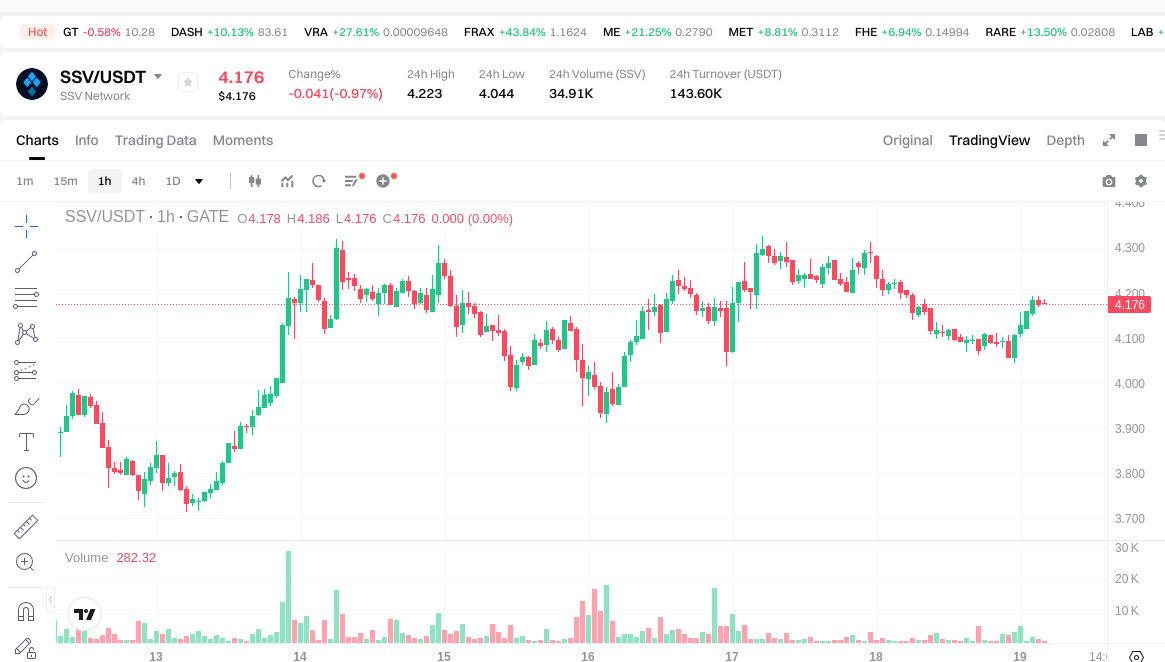
- SSV Network Current Price: $4.186
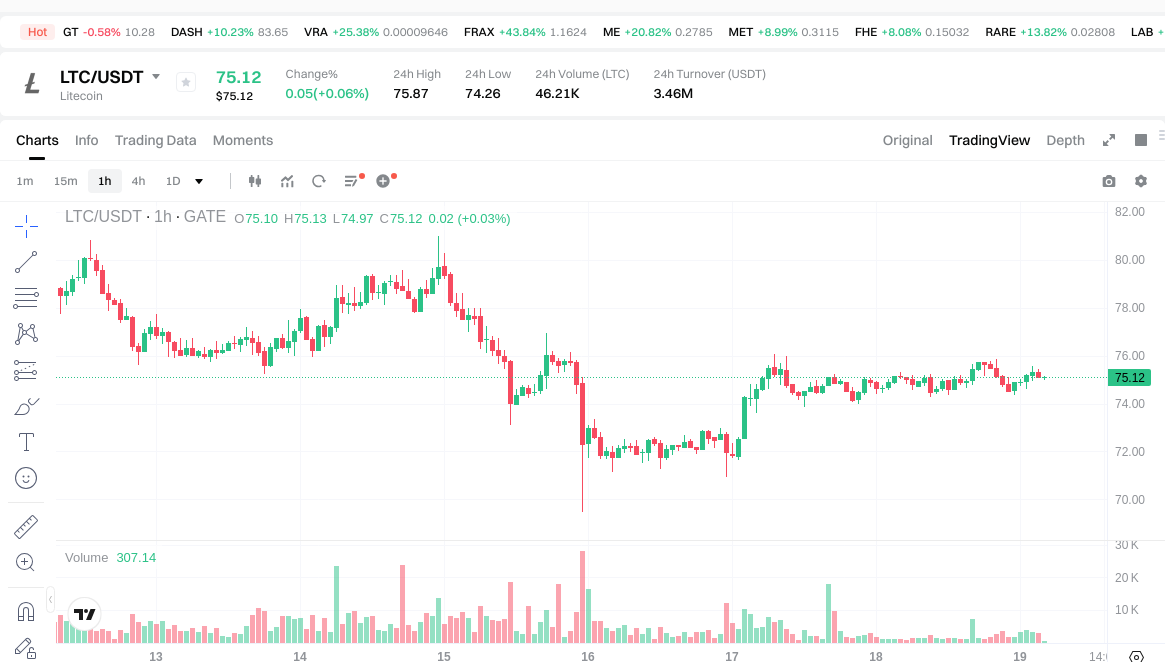
- Litecoin Current Price: $75.06
- 24-Hour Trading Volume: SSV Network recorded $142,847.42 compared to Litecoin's $3,447,434.73
- Market Capitalization: SSV Network at $61.53 million versus Litecoin at $5.76 billion
- 24-Hour Price Change: SSV Network declined 0.94%, while Litecoin declined 0.03%
- Market Sentiment Index (Fear & Greed Index): 49 (Neutral)
View real-time prices:
II. Core Factors Influencing SSV vs LTC Investment Value
Supply Mechanism Comparison (Tokenomics)
-
SSV: The reference materials indicate that SSV operates as a decentralized staking infrastructure protocol with token distribution tied to network participation and governance. The protocol has raised $10 million in cumulative financing, suggesting institutional backing for its tokenomics design.
-
LTC: While the provided materials mention LTC in the context of stable coin utility, specific details about Litecoin's halving mechanism or fixed supply characteristics are not present in the reference sources.
-
📌 Historical Pattern: Supply mechanisms tend to influence price cycles through scarcity dynamics and network participation incentives, though specific historical data for these tokens is not available in the provided materials.
Institutional Adoption and Market Application
-
Institutional Holdings: The reference materials show that SSV.Network received investment from prominent institutions including Amber Group, which has backing from Temasek, Sequoia China, Pantera Capital, and Tiger Global Management. This indicates notable institutional interest in the staking infrastructure sector.
-
Enterprise Adoption: SSV's application focuses on decentralized Ethereum staking infrastructure, making staking accessible and scalable. The materials suggest that institutional investors view liquid staking protocols as having investment value, particularly in the context of Ethereum's transition to Proof of Stake.
-
Regulatory Landscape: The reference materials mention Hong Kong's regulatory framework for virtual assets, where the Securities and Futures Commission (SFC) and Hong Kong Monetary Authority (HKMA) provide oversight. However, specific policy stances toward SSV or LTC are not detailed in the provided sources.
Technology Development and Ecosystem Building
-
SSV Technology Advancement: The core innovation allows users to distribute validator keys across multiple operators, enhancing decentralization and security in Ethereum staking. This represents a novel approach to addressing centralization risks in staking infrastructure.
-
LTC Technology Development: Specific technical upgrades or developments for Litecoin are not covered in the reference materials provided.
-
Ecosystem Comparison: The materials indicate that liquid staking protocols like SSV offer users multiple advantages: simplified participation without requiring 32 ETH, flexible staking and withdrawal options, liquidity through staking certificates for DeFi participation, and potential governance rewards. The ecosystem integration with other DApps and yield products appears to be a key development focus.
Macroeconomic Environment and Market Cycles
-
Performance Under Inflation: The reference materials suggest that certain crypto assets may serve different roles during various economic conditions, though specific comparative performance data between SSV and LTC under inflationary environments is not provided.
-
Macroeconomic Monetary Policy: The materials reference broader market dynamics including interest rates and liquidity conditions in traditional markets, but do not provide specific analysis of how these factors differentially impact SSV versus LTC.
-
Geopolitical Factors: The reference materials discuss Hong Kong's position as a crypto hub and its regulatory approach, suggesting that regional developments may influence market dynamics. However, specific impacts on cross-border transaction demand for either SSV or LTC are not detailed in the provided sources.
III. 2026-2031 Price Forecast: SSV vs LTC
Short-term Forecast (2026)
- SSV: Conservative $3.26-$4.18 | Optimistic $4.18-$5.05
- LTC: Conservative $48.79-$75.06 | Optimistic $75.06-$87.07
Mid-term Forecast (2028-2029)
- SSV may enter a growth phase, with estimated prices ranging from $3.16 to $9.71
- LTC may enter an expansion stage, with estimated prices ranging from $68.95 to $170.55
- Key drivers: institutional capital inflows, ETF developments, ecosystem expansion
Long-term Forecast (2030-2031)
- SSV: Baseline scenario $4.15-$8.14 | Optimistic scenario $8.66-$11.96
- LTC: Baseline scenario $75.73-$159.47 | Optimistic scenario $177.19-$211.48
View detailed price predictions for SSV and LTC
Disclaimer
SSV:
| Year |
Predicted High Price |
Predicted Average Price |
Predicted Low Price |
Price Change |
| 2026 |
5.05296 |
4.176 |
3.25728 |
0 |
| 2027 |
6.2756928 |
4.61448 |
4.4760456 |
10 |
| 2028 |
7.677571824 |
5.4450864 |
3.158150112 |
30 |
| 2029 |
9.71076708576 |
6.561329112 |
4.39609050504 |
56 |
| 2030 |
9.1937343517344 |
8.13604809888 |
4.1493845304288 |
94 |
| 2031 |
11.957549890923936 |
8.6648912253072 |
8.144997751788768 |
106 |
LTC:
| Year |
Predicted High Price |
Predicted Average Price |
Predicted Low Price |
Price Change |
| 2026 |
87.0696 |
75.06 |
48.789 |
0 |
| 2027 |
115.922664 |
81.0648 |
51.070824 |
8 |
| 2028 |
131.98160088 |
98.493732 |
68.9456124 |
31 |
| 2029 |
170.5517463312 |
115.23766644 |
87.5806264944 |
53 |
| 2030 |
211.484165450688 |
142.8947063856 |
75.734194384368 |
90 |
| 2031 |
207.31164002422848 |
177.189435918144 |
159.4704923263296 |
136 |
IV. Investment Strategy Comparison: SSV vs LTC
Long-term vs Short-term Investment Strategies
-
SSV: May be suitable for investors interested in Ethereum staking infrastructure development and decentralized validation technology. The protocol's focus on distributed validator technology positions it within the evolving Ethereum ecosystem, potentially appealing to those with longer investment horizons who anticipate growth in liquid staking adoption.
-
LTC: May be suitable for investors seeking exposure to established digital assets with broader market recognition and liquidity. With presence since 2011 and substantial trading volumes, it may appeal to investors prioritizing market depth and transaction utility across various platforms.
Risk Management and Asset Allocation
-
Conservative Investors: A potential allocation could consider 20-30% SSV and 70-80% LTC, reflecting LTC's larger market capitalization ($5.76 billion vs $61.53 million) and established market presence. This approach emphasizes stability while maintaining some exposure to emerging staking infrastructure.
-
Aggressive Investors: A potential allocation could explore 40-50% SSV and 50-60% LTC, increasing exposure to SSV's growth potential within the staking sector while maintaining substantial position in LTC's established market presence.
-
Hedging Tools: Portfolio diversification may include stablecoin allocations for liquidity management, options contracts where available for downside protection, and cross-asset combinations to balance sector-specific risks between staking infrastructure and established payment-oriented assets.
V. Potential Risk Comparison
Market Risks
-
SSV: The asset experienced a decline exceeding 93% from its March 2024 peak of $65.82 to approximately $4.19 by January 2026, indicating substantial price volatility. With a market capitalization of $61.53 million and 24-hour trading volume of $142,847.42, liquidity constraints may present challenges during market stress periods.
-
LTC: While showing an over 81% decline from its May 2021 peak of $410.26 to approximately $75.06, the asset maintains significantly higher liquidity with $3,447,434.73 in 24-hour trading volume and $5.76 billion market capitalization. However, correlation with broader cryptocurrency market cycles remains a consideration.
Technical Risks
-
SSV: As a protocol focused on distributed validator technology, network adoption and validator participation rates represent key dependencies. The technology's reliance on multiple operators for key distribution introduces coordination complexity, though this design aims to enhance decentralization.
-
LTC: Specific technical risk factors for Litecoin's current infrastructure are not detailed in the reference materials. However, as an established protocol operating since 2011, considerations may include network security maintenance and technological competitiveness relative to newer protocols.
Regulatory Risks
- The regulatory landscape varies across jurisdictions, with frameworks like Hong Kong's Securities and Futures Commission (SFC) and Hong Kong Monetary Authority (HKMA) providing oversight for virtual assets. Regulatory developments regarding staking services, classification of utility tokens versus securities, and cross-border transaction requirements may impact both assets differently based on their respective use cases and market positioning.
VI. Conclusion: Which Is the Better Buy?
📌 Investment Value Summary
-
SSV Characteristics: Positioned within Ethereum staking infrastructure with distributed validator technology; institutional backing from entities including Amber Group; focus on decentralization and scalability in staking services; smaller market capitalization of $61.53 million offering potential for growth correlation with Ethereum ecosystem development.
-
LTC Characteristics: Established market presence since 2011 with substantial market capitalization of $5.76 billion; higher liquidity with 24-hour trading volume of $3,447,434.73; broader recognition and integration across cryptocurrency exchanges and payment platforms; longer operating history providing track record of network stability.
✅ Investment Considerations
-
New Investors: May consider prioritizing assets with established liquidity and market infrastructure while developing understanding of cryptocurrency market dynamics. Gradual exposure to emerging sectors like staking infrastructure could follow initial foundation building.
-
Experienced Investors: May evaluate allocation strategies balancing exposure between established digital assets and emerging protocol infrastructure based on individual risk tolerance, investment timeline, and sector outlook assessments. Diversification across market capitalizations and use cases may support portfolio resilience.
-
Institutional Investors: May assess opportunities within both established payment-oriented assets and emerging staking infrastructure based on investment mandates, liquidity requirements, and sector specialization strategies. Institutional participation in liquid staking protocols has been noted in the reference materials, suggesting sector interest.
⚠️ Risk Disclosure: Cryptocurrency markets exhibit substantial volatility, and historical performance does not indicate future results. This analysis does not constitute investment advice, and individuals should conduct independent research and consult qualified financial advisors before making investment decisions.
VII. FAQ
Q1: What is the current price difference between SSV and LTC, and how does their market capitalization compare?
As of January 19, 2026, SSV is priced at $4.186 with a market capitalization of $61.53 million, while LTC is priced at $75.06 with a market capitalization of $5.76 billion. This represents a substantial difference in market positioning, with LTC having approximately 94 times the market capitalization of SSV. The 24-hour trading volume also reflects this disparity, with LTC recording $3,447,434.73 compared to SSV's $142,847.42, indicating significantly higher liquidity for Litecoin.
Q2: How have SSV and LTC performed since their respective price peaks?
SSV experienced a decline exceeding 93% from its peak of $65.82 on March 25, 2024, to approximately $4.19 by January 2026. LTC declined over 81% from its all-time high of $410.26 on May 10, 2021, to approximately $75.06. While both assets have experienced substantial corrections, SSV's decline has been more severe in percentage terms, though measured over a shorter timeframe. These movements reflect broader cryptocurrency market cycles and sector-specific dynamics affecting staking infrastructure and established payment-oriented assets differently.
Q3: What are the key technological differences between SSV and LTC?
SSV Network focuses on distributed validator technology for Ethereum staking infrastructure, allowing users to distribute validator keys across multiple operators to enhance decentralization and security. This innovation addresses centralization risks in staking and enables participation without requiring the full 32 ETH minimum while providing liquidity through staking certificates for DeFi participation. Litecoin, operating since 2011, has established itself as a payment-oriented cryptocurrency with broad market recognition and integration across exchanges and payment platforms, though specific recent technical developments are not detailed in available materials.
Q4: Which asset is more suitable for conservative versus aggressive investors?
Conservative investors might consider an allocation favoring LTC (70-80%) with smaller SSV exposure (20-30%), reflecting LTC's larger market capitalization, established presence, and higher liquidity. This approach emphasizes stability while maintaining some exposure to emerging staking infrastructure. Aggressive investors might explore increased SSV allocation (40-50%) balanced with LTC (50-60%), gaining greater exposure to potential growth in the staking sector while maintaining substantial position in an established asset. Individual risk tolerance, investment timeline, and sector outlook should guide these allocation decisions.
Q5: What institutional backing does SSV have compared to LTC?
SSV Network has received investment from prominent institutions including Amber Group, which has backing from Temasek, Sequoia China, Pantera Capital, and Tiger Global Management. The protocol has raised $10 million in cumulative financing, indicating notable institutional interest in staking infrastructure. The reference materials suggest institutional investors view liquid staking protocols as having investment value, particularly following Ethereum's transition to Proof of Stake. Specific institutional backing details for LTC are not provided in the available materials.
Q6: What are the projected price ranges for SSV and LTC through 2031?
For 2026, SSV projections range from $3.26-$5.05, while LTC ranges from $48.79-$87.07. By 2030-2031, baseline scenarios suggest SSV could reach $4.15-$11.96 and LTC could reach $75.73-$211.48. Mid-term forecasts for 2028-2029 estimate SSV between $3.16-$9.71 and LTC between $68.95-$170.55. These projections consider factors including institutional capital inflows, ecosystem expansion, and broader market cycles, though actual performance may vary substantially from predictions.
Q7: What are the primary risks associated with investing in SSV versus LTC?
SSV faces higher volatility risk given its 93% decline from peak and lower liquidity with $61.53 million market capitalization. Technical risks include dependency on network adoption rates and validator participation, while the distributed key technology introduces coordination complexity. LTC, while more established with higher liquidity, remains correlated with broader cryptocurrency market cycles. Both assets face regulatory risks that vary by jurisdiction, with potential impacts from evolving frameworks regarding staking services classification, utility token versus securities determinations, and cross-border transaction requirements.
Q8: How do macroeconomic factors and market cycles affect SSV and LTC differently?
Both assets are influenced by broader cryptocurrency market cycles, interest rates, and liquidity conditions in traditional markets, though their specific responses may differ based on use case positioning. SSV's performance is closely tied to Ethereum ecosystem development and adoption of liquid staking solutions, making it sensitive to Ethereum-specific developments and institutional interest in staking infrastructure. LTC's broader recognition as an established payment-oriented asset may result in different sensitivity to macroeconomic factors, transaction demand patterns, and correlation with major cryptocurrencies like Bitcoin. The current market sentiment index stands at 49 (Neutral), reflecting balanced positioning across the cryptocurrency sector.
* The information is not intended to be and does not constitute financial advice or any other recommendation of any sort offered or endorsed by Gate.