In-depth analysis and price projection for STABLE from 2025 to 2030. Review technical analysis, key growth factors, risk assessment, and actionable guidance for crypto investors and Web3 traders.
Key Highlights
The STABLE token introduces an innovative Layer-1 payment solution for stablecoins, leveraging USDT as its native gas token. Since launch, STABLE has shown marked volatility, reaching a historical peak before undergoing a correction. Neutral technical indicators point to consolidation near critical support zones.
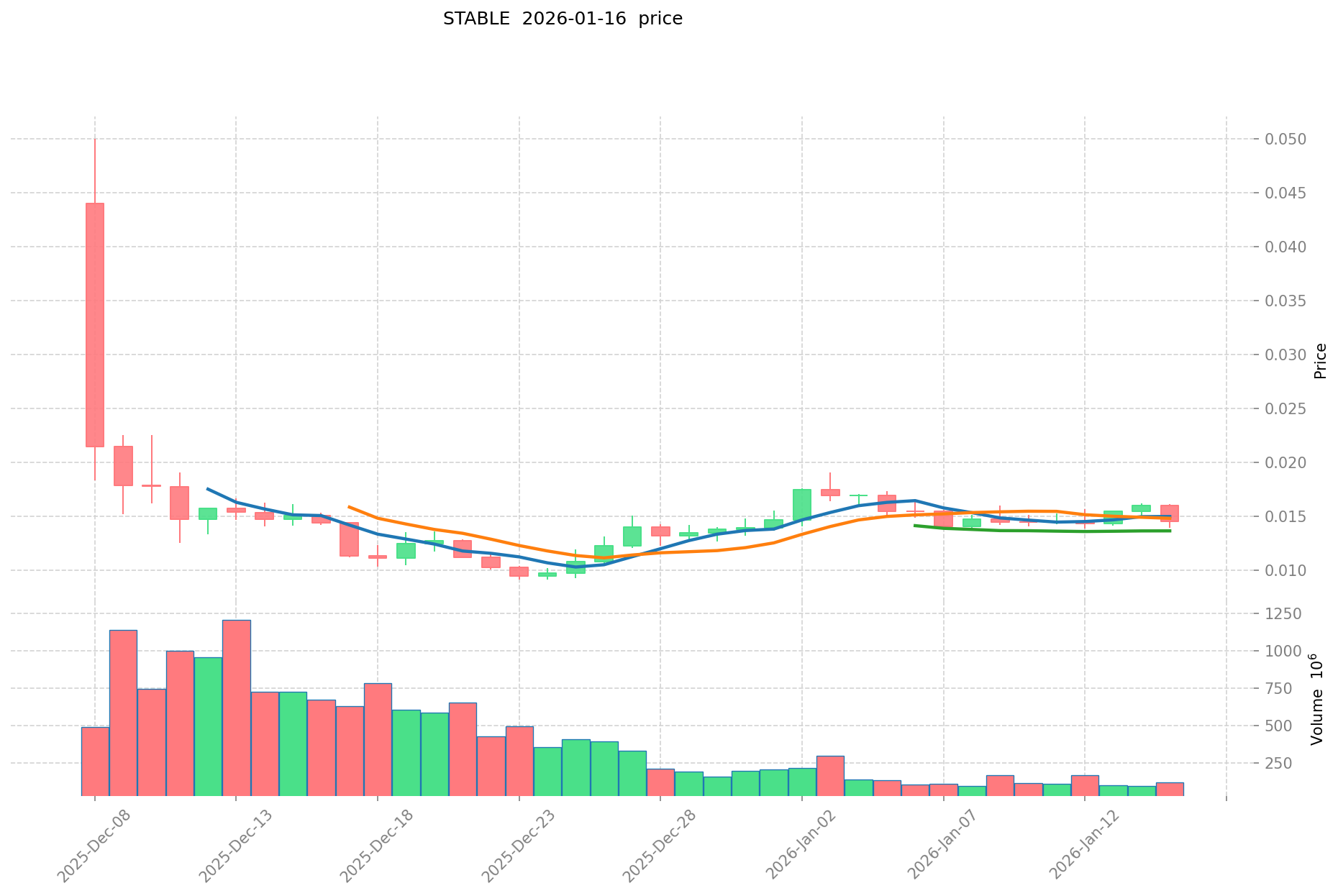 If validator participation increases and the target TVL of $500 million is reached, STABLE could see significant short-term upside. Long-term projections call for substantial price growth as commercial adoption and ecosystem expansion accelerate.
Introduction: A New Growth Catalyst for Stable
Stable’s mainnet launch delivers a unique Layer-1 blockchain, using USDT as the native gas token to ensure predictable fees and rapid transaction settlements. The project experienced initial volatility within the stablecoin infrastructure market, a typical pattern for emerging blockchain platforms.
This 2025–2030 Stable price outlook offers a comprehensive market analysis, drawing on industry trends, on-chain metrics, crypto community sentiment, and technical indicators. The assessment explores potential development paths for the STABLE token and factors likely to influence its value in both the short and long term.
The review highlights Stable’s technological innovations, competitive strengths within the stablecoin infrastructure segment, and key risks and challenges the ecosystem may face as it evolves.
Summary: Stable Overview
| Parameter |
Value |
| Ticker |
STABLE |
| Current Price |
$0.01572 |
| Network |
Stable (Layer-1, USDT-native) |
| Market Cap |
$276.72M |
| Circulating / Max Supply |
17.6B / 100B |
| All-Time High / Low |
$0.04565 / $0.01547 |
Why Stable Is Important
Stable is a specialized Layer-1 blockchain engineered for USDT-native transactions, offering a distinct solution within the stablecoin ecosystem.
Core Project Features:
- Category: Layer-1 blockchain, stablecoin infrastructure
- Main Function: USDT serves as the gas token to provide fixed, predictable transaction fees. The platform achieves over 1,000 transactions per second via the advanced StableBFT consensus algorithm.
- Problem Solved: Removes technical and economic barriers to stablecoin use in decentralized finance (DeFi).
- STABLE Token Role: Enables staking, protocol governance, and ecosystem incentives. Notably, 40% of the total supply is dedicated to community development and developer support.
The project secured $28 million in seed funding from leading venture firms—including Hack VC—and strategic partners Bitfinex and USDT0, underscoring strong institutional confidence in STABLE’s long-term prospects.
Current Price and Market Data
| Metric |
Value |
24h Change |
| Price |
$0.01572 |
-58.93% |
| Market Cap |
$276.72M |
Stable |
| Rank |
#211 |
Stable |
| 24h Trading Volume |
$236.28M |
Stable |
Stable’s Evolution: Key Milestones
The Stable mainnet launch marked a turning point for stablecoin infrastructure, introducing USDT-native settlements with fixed fees.
Key Ecosystem Development Tracks:
-
Decentralized Application Ecosystem: Rollout of initial payment apps, tools for commercial partners, and DeFi protocol integration. Includes user-centric interfaces for merchants accepting stablecoin payments.
-
Cross-Chain Integration: Bridges to major blockchains Ethereum and Solana via LayerZero protocol deliver seamless asset transfers and expand STABLE’s utility.
-
Infrastructure Solutions: StableBFT consensus provides high throughput and security; integration of Tether-compatible oracles ensures reliable external data feeds.
-
Staking & Incentive System: Validator reward mechanisms and grant programs encourage developers to build on Stable.
-
Development Roadmap: Cross-chain bridges are scheduled for Q1 2026, alongside validator elections driven by STABLE token holder voting.
Price History: Key Events
| Date/Period |
Event |
Impact on Price |
| Mainnet Launch |
Trading Begins |
Initial price $0.03909 |
| First Trading Day |
All-Time High Achieved |
ATH $0.04565 |
| Subsequent Period |
Market Correction |
Down 58.93% to $0.01572 |
Technical Analysis: Detailed Review
Support & Resistance Levels
| Level |
Type |
Rationale |
| $0.045 |
Resistance |
Recent all-time high, psychological barrier |
| $0.039 |
Support |
50-day exponential moving average |
| $0.035 |
Support |
0.618 Fibonacci retracement from all-time low |
| $0.033 |
Support |
High trading volume zone |
| $0.032 |
Support |
Psychological round number |
Key Technical Indicators
| Indicator |
Value |
Interpretation |
| RSI (Relative Strength Index) |
50 |
Neutral zone; balance between buyers and sellers |
| MACD (Moving Average Convergence Divergence) |
0 |
Momentum stabilization; no clear trend |
| Trading Volume |
Stable |
Supports current consolidation phase |
An RSI reading of 50 signals market equilibrium—typical for consolidation periods. Neutral MACD further confirms early consolidation after sharp price movement.
Additional technical analysis highlights volume concentration in the $0.032–$0.035 band, forming strong support. A breakout above $0.045 could pave the way for higher targets.
Short-Term Forecast (2025–2026)
| Scenario |
2025 Target Range |
2026 Target Range |
Key Factors |
| Optimistic |
$0.045 – $0.055 |
$0.06 – $0.08 |
Validator growth, broad USDT payment integration, major strategic partnerships |
| Base |
$0.038 – $0.042 |
$0.045 – $0.05 |
Organic ecosystem growth, steady USDT transaction usage |
| Pessimistic |
$0.032 – $0.035 |
$0.03 – $0.04 |
Prolonged crypto market weakness, regulatory hurdles, token unlock pressure |
Growth Drivers
-
Technological innovation: The unique USDT-native architecture and high-throughput StableBFT consensus deliver clear competitive advantages.
-
Strategic partnerships: Alliances with Bitfinex, Tether, and other major players grant access to broad user bases and technical expertise.
-
Liquidity expansion: More exchange listings and perpetual futures contracts enable greater trading opportunities.
-
Macroeconomic trends: Rising demand for robust stablecoin infrastructure as the digital economy expands.
Potential Risks
-
Post-launch volatility: A 58.93% drop from ATH highlights sensitivity to market sentiment.
-
Adoption challenges: Difficulty attracting institutional users or increased regulatory scrutiny pose ongoing risks.
-
Market conditions: Bearish crypto trends threaten younger Layer-1 projects.
-
Tokenomics: With 82.4% of supply still locked, future unlocks could produce significant selling pressure.
Long-Term Forecast (2027–2030)
| Year |
Optimistic Scenario |
Base Scenario |
Pessimistic Scenario |
| 2027 |
$0.06 – $0.08 |
$0.045 – $0.055 |
$0.03 – $0.04 |
| 2028 |
$0.07 – $0.09 |
$0.05 – $0.06 |
$0.035 – $0.045 |
| 2029 |
$0.08 – $0.10 |
$0.055 – $0.065 |
$0.04 – $0.05 |
| 2030 |
$0.09 – $0.11 |
$0.06 – $0.07 |
$0.045 – $0.055 |
Fundamental Growth Drivers
-
USDT-native gas token — Delivers fixed, predictable fees for all stablecoin transactions, crucial for commercial adoption.
-
StableBFT consensus — A scalable, reliable protocol powering the payment-focused Layer-1 platform.
-
Institutional investor support — $28 million from top funds (Hack VC) and strategic partners (Bitfinex, USDT0) signals market confidence.
-
Ecosystem grants and incentives — 40% of supply is earmarked for developer and liquidity support, fostering ecosystem growth.
-
Controlled issuance — Maximum supply of 100B tokens, with 82.4% vesting, ensures long-term tokenomics transparency.
Key Risks
| Risk Category |
Details |
Potential Impact |
| Launch Volatility |
58.93% drop from ATH in early trading |
Price swings of 10–20% |
| Regulatory Pressure |
Compliance and oversight concerns around stablecoins |
Slower adoption and ecosystem growth |
| Competition |
Competing solutions: USDC chains, other USDT platforms, Layer-2 networks |
Possible loss of market share |
| Liquidity |
Low initial trading volume ($236.28M) |
Risk of flash crashes and sharp moves |
| Tokenomics |
82.4% of supply locked |
Future unlocks could drive sell pressure |
Analyst Views & Community Sentiment
Sentiment toward Stable is currently cautiously optimistic. The USDT-native gas token and predictable fee model have generated strong interest among analysts and market participants.
However, the 59% drawdown from peak and heavy reliance on the Tether ecosystem mean both professionals and retail users remain guarded in their assessments.
Experts see short-term upside to $0.045–0.055 if validator growth and ecosystem expansion persist. Long-term projections are more bullish, with $0.09–0.11 by 2030 considered achievable if commercial adoption and DeFi integration succeed.
Project execution quality and the team’s ability to deliver on its roadmap are key sentiment drivers. Strong institutional partnerships are regarded as positive for long-term prospects.
Should You Invest in Stable?
Project Strengths
-
USDT as native gas token eliminates fee volatility in the $150B stablecoin payment sector, creating a decisive competitive edge.
-
$28M raised from respected institutional backers (Hack VC, Bitfinex, and others) signals market trust.
-
Allocating 40% of total supply for ecosystem growth and liquidity supports long-term value creation.
Risks and Drawbacks
-
The 59% early decline underscores high initial volatility, requiring careful investment consideration.
-
Strong dependence on the Tether ecosystem increases regulatory and counterparty risks, which may hinder development.
-
With 82.4% of tokens still locked, future unlocks could trigger substantial selling pressure and price declines.
FAQ
What is STABLE coin and how does it differ from other stablecoins like USDT and USDC?
STABLE is a US dollar-pegged stablecoin designed to minimize volatility. USDT is operated by Tether Limited; USDC is more transparent and regulated. USDC tends to be more trusted, but USDT enjoys wider adoption in the crypto market.
What factors drive the price forecast for STABLE between 2025 and 2030?
Key factors include USDFI ecosystem adoption and TVL growth, broader crypto market cycles, Bitcoin price performance, sentiment shifts, and the protocol’s perpetual buyback mechanism.
How can beginners buy and store STABLE?
Purchase STABLE by swapping USDT using a Web3 wallet. Store your coins securely with two-factor authentication and a backup seed phrase for optimal security.
What are the main risks and benefits of investing in STABLE?
Benefits: Lower volatility versus Bitcoin, straightforward payments and transfers. Risks: Credit risk, reserve dependency, regulatory uncertainty. STABLE offers stability in the volatile crypto landscape.
How is STABLE’s value maintained? What is its peg mechanism?
STABLE maintains value using collateralized positions and arbitrage. The peg is achieved via linkage to fiat or other assets, supporting price stability.
How has STABLE’s price fluctuated historically?
STABLE has exhibited notable volatility, reaching a record high above $0.3360 in July 2023. Since then, it has seen price swings and periodic deviations from its peg.
Is STABLE better for long-term investment or short-term trading?
STABLE is best suited for long-term investment. As a stablecoin, its price is pegged to fiat and remains relatively stable, making it ideal for portfolio allocation. Short-term trading can also be profitable due to market fluctuations.
How can the prospects and market potential for STABLE be evaluated for 2025–2030?
Stablecoins are expected to grow on institutional demand and regulatory clarity. Key factors: reserve transparency, compliance, and diversification. By 2030, the market could surpass $1 trillion in transaction volume.
* The information is not intended to be and does not constitute financial advice or any other recommendation of any sort offered or endorsed by Gate.