This comprehensive guide compares STBL and HBAR, two distinct blockchain tokens with contrasting market positions. STBL, launched in 2025, is a decentralized stablecoin platform featuring yield generation and real-world asset backing, currently priced at $0.04456 with a market cap of $22.28 million. HBAR, the native token of the Hedera public network since 2020, operates at $0.10866 with a market cap exceeding $4.65 billion, demonstrating significantly higher trading liquidity. The article examines historical price trends, current market status, tokenomics, institutional adoption, technological ecosystems, and risk factors to address investor portfolio allocation decisions. Price analysis reveals STBL gained 256.10% over the past year while HBAR declined 67.9%, reflecting different market trajectories. Investment strategies vary by risk profile: conservative investors may favor 70-80% HBAR allocation, while aggressive investors consider 40-50% STBL exposure. The comparison provides actionable insights for inv
Introduction: Investment Comparison Between STBL and HBAR
In the cryptocurrency market, the comparison between STBL vs HBAR has become a topic of interest for investors. These two assets differ notably in market cap ranking, application scenarios, and price performance, representing distinct positioning within the crypto asset landscape.
STBL: Launched in 2025, this decentralized platform has gained market attention through its approach to stablecoin utility, combining yield generation, transparency, and real-world asset (RWA) backing. The platform offers a mechanism for minting stablecoins (USST and YLD) with features including yield without staking and no lockup periods.
HBAR: Operating since 2020, Hedera represents a public ledger network utilizing hashgraph consensus, known for its transaction processing capabilities and security features. HBAR serves as the native cryptocurrency of the Hedera public network, supporting decentralized applications and payment models.
This article will provide a comprehensive analysis of STBL vs HBAR investment value comparison, examining historical price trends, supply mechanisms, institutional adoption, technological ecosystems, and future outlook, attempting to address investors' key question:
"Which represents a more suitable consideration for portfolio allocation at this time?"
I. Historical Price Comparison and Current Market Status
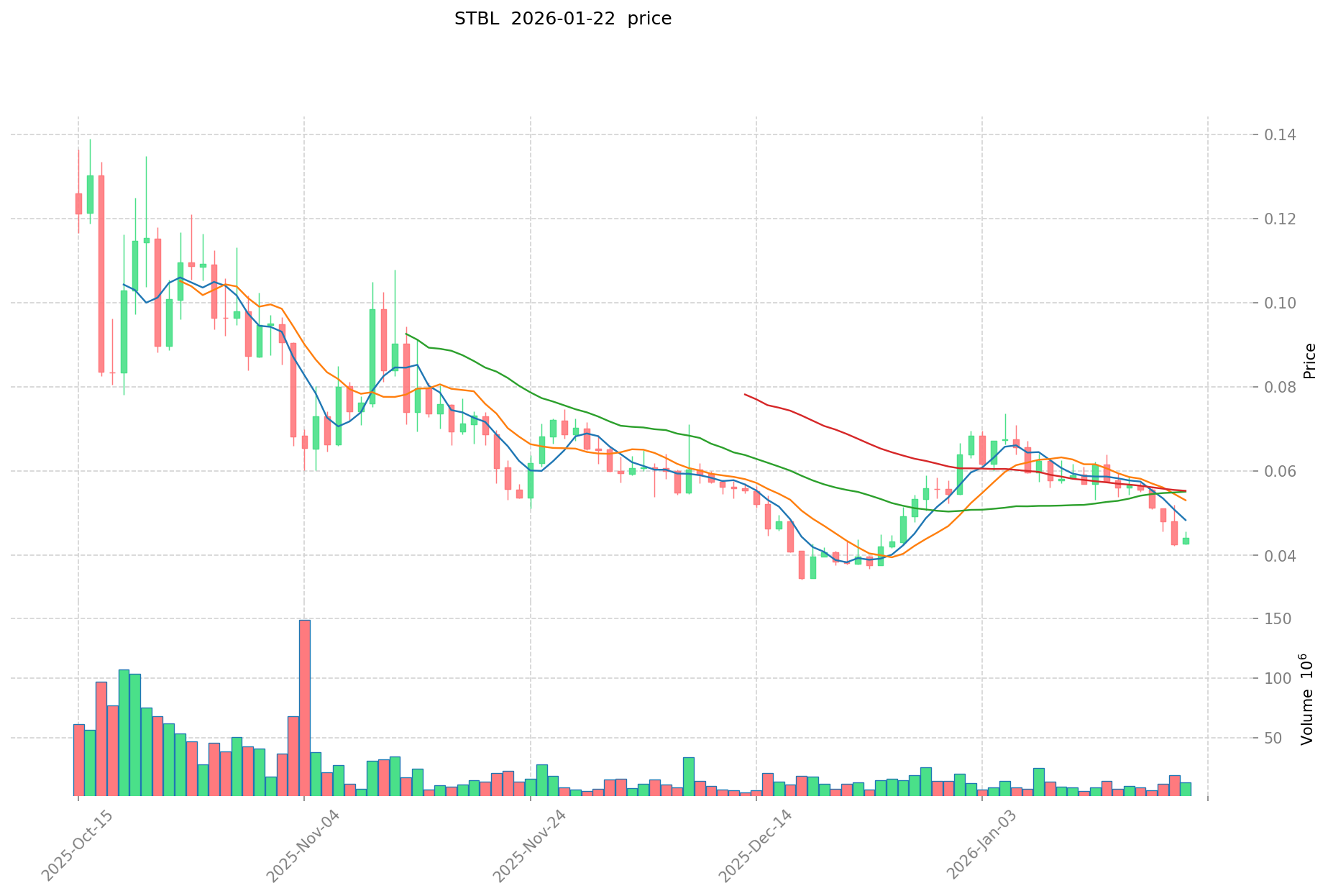
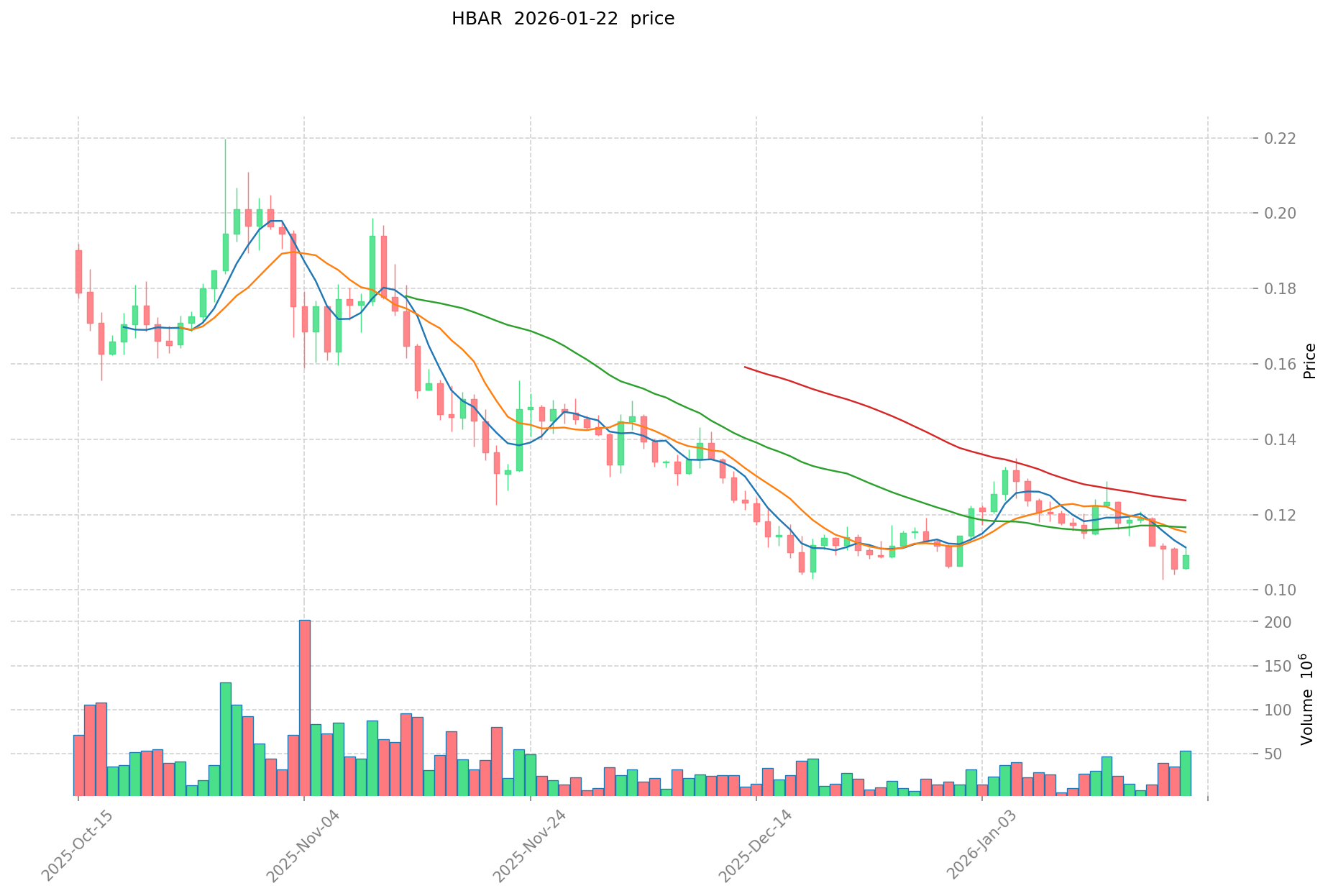
Historical Price Trends of STBL (Coin A) and HBAR (Coin B)
- 2025: STBL reached a historical high of $0.55 on September 26, 2025, followed by a decline to $0.03424 on December 18, 2025, representing a significant price fluctuation period.
- 2021: HBAR achieved its all-time high of $0.569229 on September 15, 2021, during a period of broader cryptocurrency market momentum.
- 2020: HBAR recorded its historical low of $0.00986111 on January 3, 2020, during early market development phases.
- Comparative Analysis: STBL demonstrated a price increase of 256.10% over the past year, recovering from its December 2025 low, while HBAR experienced a decline of 67.9% over the same period, reflecting different market trajectories.
Current Market Status (January 22, 2026)
- STBL Current Price: $0.04456
- HBAR Current Price: $0.10866
- 24-Hour Trading Volume: STBL $453,879.77 vs HBAR $4,598,405.05
- 24-Hour Price Change: STBL -0.13% vs HBAR +0.14%
- Market Capitalization: STBL $22,280,000 vs HBAR $4,650,036,661.78
- Market Sentiment Index (Fear & Greed Index): 20 (Extreme Fear)
View real-time prices:
- Check STBL current price Market Price
- Check HBAR current price Market Price
II. Core Factors Affecting STBL vs HBAR Investment Value
Supply Mechanism Comparison (Tokenomics)
Due to insufficient data in the provided materials regarding the specific supply mechanisms of STBL and HBAR, this section cannot be elaborated upon at this time.
Institutional Adoption and Market Application
Without available information on institutional holdings, enterprise adoption cases, or regulatory policies specific to STBL and HBAR in the reference materials, a comparative analysis cannot be conducted in this segment.
Technology Development and Ecosystem Construction
The provided materials do not contain details about technical upgrades, ecosystem development, or application scenarios (such as DeFi, NFT, payment systems, or smart contract implementations) for either STBL or HBAR, preventing a meaningful comparison.
Macroeconomic Factors and Market Cycles
In the absence of data regarding the performance of STBL and HBAR under different macroeconomic conditions, including inflation environments, monetary policy impacts, interest rate fluctuations, USD index correlations, or geopolitical influences, this analysis cannot be completed based on the current reference materials.
III. 2026-2031 Price Prediction: STBL vs HBAR
Short-term Prediction (2026)
- STBL: Conservative $0.0406 - $0.0446 | Optimistic $0.0446 - $0.0513
- HBAR: Conservative $0.0890 - $0.1086 | Optimistic $0.1086 - $0.1541
Mid-term Prediction (2028-2029)
- STBL may enter a moderate growth phase, with estimated price ranging from $0.0405 to $0.0626 by 2028, potentially experiencing volatility in 2029 with prices between $0.0313 and $0.0621
- HBAR may enter an expansion phase, with estimated price ranging from $0.1043 to $0.1839 by 2028, and further growth anticipated in 2029 with prices between $0.1461 and $0.1959
- Key drivers: institutional capital inflows, ETF developments, ecosystem expansion
Long-term Prediction (2030-2031)
- STBL: Base scenario $0.0339 - $0.0595 (2030), $0.0472 - $0.0738 (2031) | Optimistic scenario $0.0595 - $0.0881 (2030), $0.0738 - $0.0768 (2031)
- HBAR: Base scenario $0.1034 - $0.1783 (2030), $0.1681 - $0.2184 (2031) | Optimistic scenario $0.1783 - $0.2585 (2030), $0.2184 - $0.3188 (2031)
View detailed price predictions for STBL and HBAR
Disclaimer
STBL:
| Year |
Predicted High Price |
Predicted Average Price |
Predicted Low Price |
Price Change |
| 2026 |
0.0513015 |
0.04461 |
0.0405951 |
0 |
| 2027 |
0.054669555 |
0.04795575 |
0.039323715 |
7 |
| 2028 |
0.06260143605 |
0.0513126525 |
0.040536995475 |
15 |
| 2029 |
0.06208317825975 |
0.056957044275 |
0.03132637435125 |
27 |
| 2030 |
0.088089764675715 |
0.059520111267375 |
0.033926463422403 |
33 |
| 2031 |
0.076757135490406 |
0.073804937971545 |
0.047235160301788 |
65 |
HBAR:
| Year |
Predicted High Price |
Predicted Average Price |
Predicted Low Price |
Price Change |
| 2026 |
0.154141 |
0.10855 |
0.089011 |
0 |
| 2027 |
0.143166595 |
0.1313455 |
0.11558404 |
20 |
| 2028 |
0.18392310365 |
0.1372560475 |
0.1043145961 |
26 |
| 2029 |
0.1959192822015 |
0.160589575575 |
0.14613651377325 |
47 |
| 2030 |
0.258468921887962 |
0.17825442888825 |
0.103387568755185 |
64 |
| 2031 |
0.318808046066635 |
0.218361675388106 |
0.168138490048841 |
100 |
IV. Investment Strategy Comparison: STBL vs HBAR
Long-term vs Short-term Investment Strategies
- STBL: May be considered by investors interested in emerging stablecoin utility platforms and yield generation mechanisms, noting the project's recent launch timeline and early-stage market positioning
- HBAR: May be considered by investors focusing on established distributed ledger technology and network infrastructure with longer operational history
Risk Management and Asset Allocation
- Conservative Investors: STBL 20-30% vs HBAR 70-80%
- Aggressive Investors: STBL 40-50% vs HBAR 50-60%
- Hedging Tools: Stablecoin allocation, options strategies, cross-asset portfolio diversification
V. Potential Risk Comparison
Market Risk
- STBL: Price volatility observed in recent months, with fluctuations from $0.55 to $0.03424 during 2025, indicating potential for significant price movements; relatively lower trading volume of $453,879.77 may present liquidity considerations
- HBAR: Historical price decline of 67.9% over the past year suggests exposure to market downturns; current market sentiment index at 20 (Extreme Fear) indicates challenging market conditions
Technical Risk
- STBL: Network scalability and operational stability considerations for a platform launched in 2025
- HBAR: Network performance characteristics related to hashgraph consensus mechanism
Regulatory Risk
- Global regulatory developments may impact both assets differently based on their respective classifications and operational frameworks
VI. Conclusion: Which Is the Better Buy?
📌 Investment Value Summary:
- STBL Characteristics: 256.10% price increase over the past year from December 2025 lows; stablecoin utility platform with yield generation features; market capitalization of $22,280,000
- HBAR Characteristics: Established public network operational since 2020; market capitalization of $4,650,036,661.78; trading volume of $4,598,405.05 indicating market activity
✅ Investment Considerations:
- Novice Investors: Consider starting with smaller position sizes across both assets, with emphasis on understanding fundamental differences between stablecoin platforms and distributed ledger networks
- Experienced Investors: May evaluate portfolio allocation based on risk tolerance, market cycle positioning, and technical understanding of respective platforms
- Institutional Investors: Assess alignment with investment mandates, liquidity requirements, and regulatory compliance frameworks
⚠️ Risk Disclosure: The cryptocurrency market exhibits significant volatility. This content does not constitute investment advice. Investors should conduct independent research and consult with financial professionals before making investment decisions.
VII. FAQ
Q1: What are the key differences in market positioning between STBL and HBAR?
STBL represents a decentralized stablecoin utility platform launched in 2025 with a market capitalization of $22,280,000, while HBAR operates as the native cryptocurrency of the Hedera public network established in 2020 with a market capitalization of $4,650,036,661.78. The fundamental distinction lies in their operational frameworks: STBL focuses on stablecoin minting (USST and YLD) with yield generation features and real-world asset backing, whereas HBAR serves as the utility token for a distributed ledger network utilizing hashgraph consensus technology for transaction processing and decentralized application support.
Q2: How have STBL and HBAR performed in terms of price movement over the past year?
STBL demonstrated a price increase of 256.10% over the past year, recovering from its December 2025 low of $0.03424 to reach a current price of $0.04456 as of January 22, 2026. In contrast, HBAR experienced a decline of 67.9% over the same period, with its current price standing at $0.10866. These divergent trajectories reflect different market dynamics: STBL's recovery from early volatility versus HBAR's broader market correction from historical peaks.
Q3: What are the projected price ranges for STBL and HBAR through 2031?
For 2026, STBL's conservative projection ranges from $0.0406 to $0.0446, with optimistic scenarios reaching $0.0513, while HBAR's conservative range spans $0.0890 to $0.1086, with optimistic projections up to $0.1541. Long-term forecasts for 2031 suggest STBL may range between $0.0472 and $0.0738 in base scenarios, potentially reaching $0.0768 in optimistic conditions. HBAR's 2031 projections indicate a base scenario range of $0.1681 to $0.2184, with optimistic scenarios potentially reaching $0.3188.
Q4: What trading volume and liquidity considerations exist between these two assets?
As of January 22, 2026, HBAR demonstrates significantly higher trading volume at $4,598,405.05 compared to STBL's $453,879.77 over a 24-hour period. This substantial difference in trading activity—approximately 10 times higher for HBAR—indicates greater market liquidity and potentially easier entry and exit positions for HBAR. The lower trading volume for STBL may present liquidity considerations for investors, particularly those planning larger position sizes or requiring quick execution.
Q5: How should different investor types approach allocation between STBL and HBAR?
Conservative investors might consider a portfolio weighting of 20-30% STBL and 70-80% HBAR, emphasizing the established operational history and larger market capitalization of HBAR. Aggressive investors could explore a more balanced allocation of 40-50% STBL and 50-60% HBAR, potentially capturing STBL's emerging platform growth while maintaining exposure to HBAR's network infrastructure. Novice investors should begin with smaller position sizes across both assets, focusing on understanding the fundamental differences between stablecoin utility platforms and distributed ledger technologies before scaling allocations.
Q6: What are the primary risk factors associated with investing in STBL versus HBAR?
STBL faces market risk related to significant price volatility, demonstrated by fluctuations from $0.55 to $0.03424 during 2025, alongside liquidity considerations due to lower trading volumes. Technical risks include network scalability and operational stability factors for a platform operational since 2025. HBAR encounters market risk evidenced by a 67.9% price decline over the past year and current extreme fear market sentiment (index at 20). Both assets face regulatory risk, though potentially in different contexts: STBL as a stablecoin platform and HBAR as a distributed ledger network, each subject to evolving global regulatory frameworks affecting their respective operational categories.
Q7: What time horizons are most suitable for investing in STBL versus HBAR?
STBL may be considered by investors with higher risk tolerance interested in early-stage platform development and willing to navigate near-term volatility, potentially suitable for medium to long-term horizons (2-5 years) as the platform establishes operational track record. HBAR, with its longer operational history since 2020 and established network infrastructure, may accommodate both medium-term (1-3 years) investors seeking to participate in distributed ledger technology adoption and long-term holders (3-7 years) focused on network infrastructure growth. Current market conditions (extreme fear sentiment) suggest both assets may require patience for recovery and growth trajectories to materialize.
* The information is not intended to be and does not constitute financial advice or any other recommendation of any sort offered or endorsed by Gate.