This comprehensive analysis compares STOC and AVAX, two distinct blockchain assets targeting different market segments. STOC focuses on regulated asset tokenization and Real-World Assets (RWAs) for institutional compliance infrastructure, while AVAX operates as an established Layer-1 platform for DeFi and NFT ecosystems with three-chain architecture enabling horizontal scaling. Current market metrics show STOC at $0.18315 with $29,658 daily volume versus AVAX at $14.47 with $3,006,490 volume, reflecting maturity differences. AVAX demonstrates institutional adoption through ETF filings and $230 million ecosystem funding, employing deflationary tokenomics via fee-burning mechanisms. The article evaluates historical price performance, supply mechanisms, ecosystem development, and 2026-2031 price forecasts to guide investment decisions across conservative, aggressive, and institutional investor profiles, while addressing critical risk factors including liquidity constraints, regulatory uncertainty, and competitiv
Introduction: Investment Comparison Between STOC and AVAX
In the cryptocurrency market, the comparison between STOC vs AVAX has consistently been a topic investors cannot overlook. The two differ markedly in market cap ranking, application scenarios, and price performance, representing distinct positioning within the crypto asset landscape.
STO Chain (STOC): Since its launch, it has garnered market recognition through its positioning as a blockchain designed specifically for regulated assets, enabling seamless issuance, trading, and settlement of security tokens and Real-World Assets (RWAs).
Avalanche (AVAX): Launched in 2020, it has been recognized as a high-performance platform for decentralized applications and interoperable blockchains, ranking among the top cryptocurrencies globally by trading volume and market capitalization.
This article will provide a comprehensive analysis of the investment value comparison between STOC vs AVAX, focusing on historical price trends, supply mechanisms, institutional adoption, technical ecosystems, and future projections, while attempting to answer the question investors care about most:
"Which is the better buy right now?"
I. Historical Price Comparison and Current Market Status
STOC and AVAX Historical Price Trends
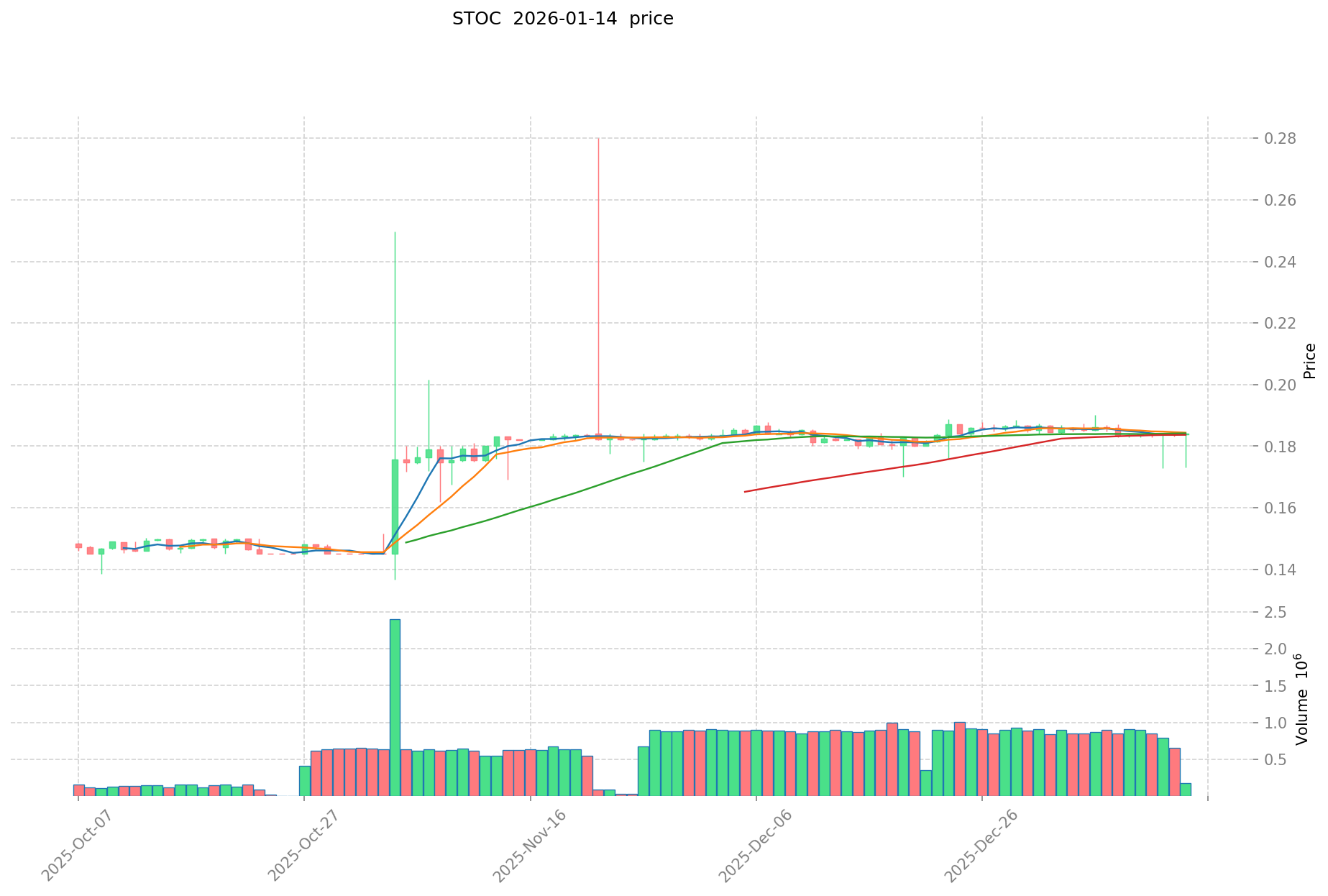
- 2025: STOC reached a notable price point of $2.40 on July 11, 2025, before experiencing a decline to $0.027 by August 1, 2025.
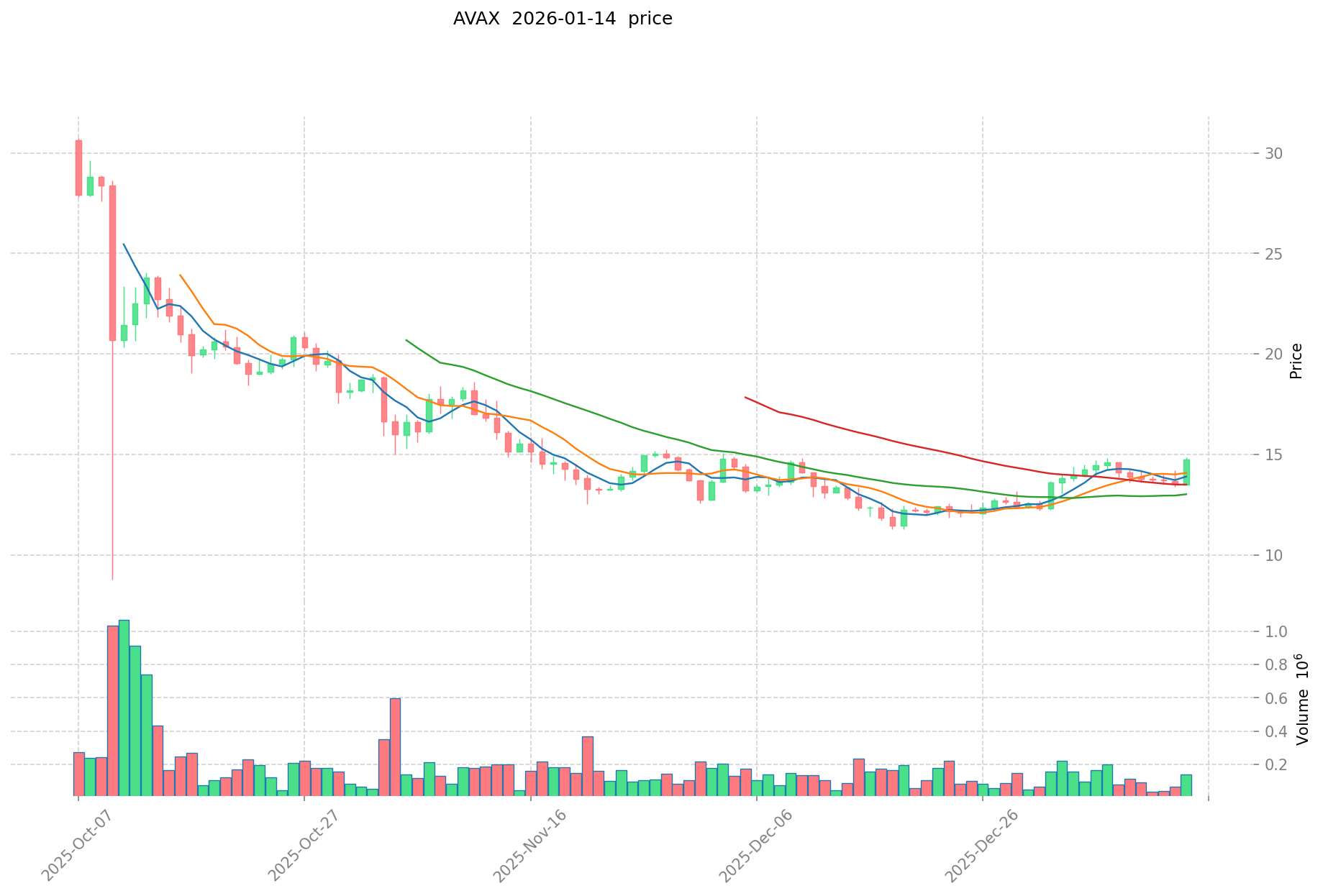
- 2021: AVAX achieved a significant milestone when its price reached $144.96 on November 21, 2021, followed by a substantial correction to $2.80 by December 31, 2020.
- Comparative Analysis: During recent market cycles, STOC demonstrated volatility with movements from its peak of $2.40 to a low of $0.027, while AVAX experienced a broader range, declining from $144.96 to $2.80, reflecting different market dynamics and maturity levels.
Current Market Status (January 14, 2026)
- STOC Current Price: $0.18315
- AVAX Current Price: $14.47
- 24-Hour Trading Volume: STOC $29,658 vs AVAX $3,006,490
- Market Sentiment Index (Fear & Greed Index): 48 (Neutral)
View Real-Time Prices:
- Check STOC Current Price Market Price
- Check AVAX Current Price Market Price
II. Core Factors Influencing STOC vs AVAX Investment Value
Supply Mechanism Comparison (Tokenomics)
-
AVAX: Avalanche employs a capped supply model with a maximum of 720 million tokens. The network utilizes a fee-burning mechanism where transaction fees are permanently removed from circulation, creating deflationary pressure over time. AVAX tokens are distributed through staking rewards to validators and delegators who participate in network consensus.
-
STOC: Information regarding STOC's supply mechanism is not available in the provided materials.
-
📌 Historical Pattern: Supply mechanisms influence price cycles through scarcity dynamics. AVAX's deflationary model through fee burning may support long-term value appreciation as network usage increases, while token emissions through staking rewards provide ongoing liquidity.
Institutional Adoption and Market Application
-
Institutional Holdings: AVAX has demonstrated growing institutional interest, with financial entities filing for AVAX-based exchange-traded products. According to regulatory filings, funds may stake up to 70% of their AVAX holdings to generate yield, with Coinbase Crypto Services listed as the initial staking provider.
-
Enterprise Adoption: AVAX has established applications across DeFi, NFT marketplaces, and enterprise blockchain solutions. The Avalanche ecosystem attracted significant institutional capital in 2021, including a $230 million investment led by Polychain and Three Arrows Capital, which partially funded the $180 million Avalanche Rush liquidity mining program and over $200 million Blizzard ecosystem development fund.
-
National Policy: Regulatory clarity has improved for digital assets in 2025, particularly in the United States. Policy developments include the GENIUS Act for stablecoins, clarification on liquid staking services, and the introduction of universal listing standards for crypto ETPs. These regulatory advances may benefit blockchain platforms like Avalanche that support compliant financial infrastructure.
Technology Development and Ecosystem Construction
-
AVAX Technology Upgrades: Avalanche operates a three-chain architecture (X-Chain, C-Chain, P-Chain) utilizing the Avalanche consensus protocol. The P-Chain enables subnet creation, allowing horizontal scaling where each subnet can maintain independent validators and customized rules. This architecture addresses scalability bottlenecks common in traditional blockchains during high-concurrency scenarios.
-
STOC Technology Development: Information regarding STOC's technical development is not available in the provided materials.
-
Ecosystem Comparison: Avalanche demonstrates substantial activity across DeFi and NFT sectors. In DeFi, the platform supports various protocols with competitive transaction speeds and low fees. For NFTs, major platforms including OpenSea have launched marketplaces on Avalanche, while native platforms like Joepegs and Kalao provide specialized services. The ecosystem benefits from sub-second transaction finality and reduced transaction costs compared to alternative networks.
Macroeconomic Environment and Market Cycles
-
Performance in Inflationary Environment: Digital assets with fixed or deflationary supply characteristics may serve as alternative stores of value during periods of fiat currency depreciation. AVAX's fee-burning mechanism and capped supply align with this potential use case, though market performance depends on multiple factors including adoption rates and competitive positioning.
-
Macroeconomic Monetary Policy: Interest rates and US dollar strength influence capital flows into digital assets. The broader crypto market has experienced structural shifts from retail-driven cycles toward institutional capital allocation, with price movements increasingly driven by compliance channels and sustainable fundamentals rather than sentiment-driven rallies.
-
Geopolitical Factors: Cross-border transaction demand and international regulatory developments affect blockchain platform adoption. Layer-1 assets experienced notable corrections in 2025, with market redistribution favoring protocols with demonstrated revenue generation. According to industry reports, Solana declined 35.9% while Avalanche declined over 67% during this period, reflecting broader sector reallocation trends.
III. 2026-2031 Price Forecast: STOC vs AVAX
Short-term Forecast (2026)
- STOC: Conservative $0.164889 - $0.18321 | Optimistic $0.18321 - $0.2601582
- AVAX: Conservative $12.905 - $14.5 | Optimistic $14.5 - $18.995
Medium-term Forecast (2028-2029)
- STOC may enter a consolidation phase, with projected price range of $0.2100221862354 - $0.28252984576905
- AVAX may enter an expansion phase, with projected price range of $15.338331855 - $23.95301139
- Key drivers: institutional capital inflows, ETF developments, ecosystem growth
Long-term Forecast (2031)
- STOC: Baseline scenario $0.234750798506145 - $0.308882629613349 | Optimistic scenario $0.308882629613349 - $0.389192113312819
- AVAX: Baseline scenario $22.653077259582 - $25.742133249525 | Optimistic scenario $25.742133249525 - $27.02923991200125
View detailed price predictions for STOC and AVAX
Disclaimer
STOC:
| Year |
Predicted High Price |
Predicted Average Price |
Predicted Low Price |
Price Change |
| 2026 |
0.2601582 |
0.18321 |
0.164889 |
0 |
| 2027 |
0.263804079 |
0.2216841 |
0.164046234 |
21 |
| 2028 |
0.25730873487 |
0.2427440895 |
0.230606885025 |
32 |
| 2029 |
0.28252984576905 |
0.250026412185 |
0.2100221862354 |
36 |
| 2030 |
0.351487130249673 |
0.266278128977025 |
0.178406346414606 |
45 |
| 2031 |
0.389192113312819 |
0.308882629613349 |
0.234750798506145 |
68 |
AVAX:
| Year |
Predicted High Price |
Predicted Average Price |
Predicted Low Price |
Price Change |
| 2026 |
18.995 |
14.5 |
12.905 |
0 |
| 2027 |
24.45135 |
16.7475 |
13.565475 |
16 |
| 2028 |
21.423402 |
20.599425 |
12.15366075 |
42 |
| 2029 |
23.95301139 |
21.0114135 |
15.338331855 |
45 |
| 2030 |
29.00205405405 |
22.482212445 |
19.3347027027 |
55 |
| 2031 |
27.02923991200125 |
25.742133249525 |
22.653077259582 |
78 |
IV. Investment Strategy Comparison: STOC vs AVAX
Long-term vs Short-term Investment Strategies
-
STOC: May suit investors focused on regulated asset tokenization and security token adoption, with a longer-term perspective on RWA infrastructure development. The current volatility patterns suggest suitability for those comfortable with emerging market dynamics and willing to accept higher risk-reward ratios.
-
AVAX: May suit investors seeking exposure to established Layer-1 infrastructure with demonstrated ecosystem activity across DeFi and NFT sectors. The platform's institutional adoption trajectory and deflationary tokenomics may appeal to those balancing growth potential with relative market maturity.
Risk Management and Asset Allocation
-
Conservative Investors: STOC 20-30% vs AVAX 70-80% - Given AVAX's established market position, institutional recognition, and broader ecosystem adoption, a conservative approach may favor higher allocation to AVAX while maintaining limited exposure to STOC's potential upside.
-
Aggressive Investors: STOC 40-50% vs AVAX 50-60% - Risk-tolerant investors may increase STOC allocation based on potential growth in regulated asset tokenization, while maintaining substantial AVAX holdings for ecosystem participation and staking yield generation.
-
Hedging Tools: Stablecoin allocation for market volatility management, options strategies for downside protection, cross-asset diversification across different blockchain infrastructure categories to reduce correlated risk exposure.
V. Potential Risk Comparison
Market Risks
-
STOC: Faces liquidity constraints evidenced by lower trading volumes ($29,658 in 24-hour volume as of January 14, 2026), which may amplify price volatility during market stress. The token's historical price movement from $2.40 to $0.027 demonstrates susceptibility to sharp corrections.
-
AVAX: Experienced significant drawdowns during sector-wide reallocations, with reported declines exceeding 67% in 2025. While higher liquidity ($3,006,490 in 24-hour volume) provides better price discovery, the asset remains exposed to broader Layer-1 competitive pressures and capital rotation patterns.
Technical Risks
-
STOC: Technical development information and network performance metrics are not available in current materials, limiting comprehensive assessment of scalability constraints or infrastructure vulnerabilities.
-
AVAX: Operates complex three-chain architecture (X-Chain, C-Chain, P-Chain) requiring coordination across multiple consensus mechanisms. While subnet architecture enables horizontal scaling, network complexity introduces potential integration challenges. The platform's consensus model differs from traditional proof-of-work, requiring validator network stability and adequate participation rates.
Regulatory Risks
- Regulatory developments in 2025, including the GENIUS Act and stablecoin framework clarifications, may differentially impact both assets. AVAX's positioning as infrastructure for compliant financial applications may benefit from regulatory clarity, while uncertainty around security token classifications could affect STOC's regulated asset focus. Both assets face ongoing policy evolution across multiple jurisdictions, with enforcement actions and compliance requirements potentially affecting market access and institutional adoption rates.
VI. Conclusion: Which Is the Better Buy?
📌 Investment Value Summary:
-
STOC Advantages: Specialized positioning in regulated asset tokenization and RWA infrastructure may capture growth in securities digitization. Potential upside exists if security token adoption accelerates and regulatory frameworks crystallize around compliant issuance platforms.
-
AVAX Advantages: Established ecosystem with demonstrated activity across DeFi and NFT sectors, institutional recognition through ETF filings and staking infrastructure, deflationary tokenomics through fee-burning mechanism, scalable subnet architecture addressing throughput limitations, and broader liquidity supporting more efficient price discovery.
✅ Investment Recommendations:
-
Novice Investors: May consider starting with AVAX given its larger market presence, established infrastructure, and available educational resources around ecosystem participation. Dollar-cost averaging strategies may help navigate volatility while building foundational understanding of Layer-1 blockchain economics.
-
Experienced Investors: Could implement diversified allocation across both assets based on risk tolerance and thesis alignment. AVAX positions may focus on staking yield generation and ecosystem participation, while selective STOC allocation addresses potential regulated asset infrastructure growth with appropriate position sizing relative to liquidity constraints.
-
Institutional Investors: May prioritize AVAX for custody infrastructure availability, regulatory clarity around staking operations (as demonstrated by ETF filings with 70% staking provisions), and established compliance frameworks. STOC consideration would require thorough due diligence on regulatory positioning and security token market development timelines.
⚠️ Risk Disclosure: Cryptocurrency markets demonstrate extreme volatility with potential for substantial capital loss. This analysis does not constitute investment advice. Investors should conduct independent research, assess personal risk tolerance, and consult qualified financial advisors before making investment decisions.
VII. FAQ
Q1: What are the main differences between STOC and AVAX in terms of market positioning?
STOC focuses on regulated asset tokenization and Real-World Assets (RWAs), while AVAX serves as a high-performance platform for decentralized applications and interoperable blockchains. STOC positions itself specifically for security token issuance, trading, and settlement within regulatory frameworks, targeting institutional adoption in compliant financial infrastructure. AVAX, launched in 2020, has established broader market presence across DeFi and NFT ecosystems, ranking among top cryptocurrencies globally by trading volume and market capitalization with a three-chain architecture (X-Chain, C-Chain, P-Chain) enabling horizontal scaling through customizable subnets.
Q2: How do the supply mechanisms of STOC and AVAX affect their long-term value proposition?
AVAX employs a deflationary model with a capped supply of 720 million tokens and a fee-burning mechanism that permanently removes transaction fees from circulation, creating scarcity dynamics as network usage increases. This tokenomics structure supports potential long-term value appreciation while providing staking rewards to validators and delegators for network consensus participation. STOC's supply mechanism information is not available in current materials, limiting comprehensive comparison of inflation rates, distribution schedules, and potential deflationary pressures that could influence price trajectories over multi-year periods.
Q3: What institutional adoption evidence exists for AVAX compared to STOC?
AVAX demonstrates substantial institutional recognition through financial entities filing for AVAX-based exchange-traded products, with funds authorized to stake up to 70% of holdings via Coinbase Crypto Services as the initial staking provider. The platform attracted $230 million institutional investment in 2021 led by Polychain and Three Arrows Capital, funding the $180 million Avalanche Rush liquidity mining program and over $200 million Blizzard ecosystem development fund. STOC's institutional adoption metrics are not documented in available materials, though its regulated asset focus suggests potential appeal to compliance-oriented institutional participants as security token frameworks mature.
Q4: How do the 2031 price forecasts compare between STOC and AVAX?
By 2031, STOC's baseline scenario projects $0.234750798506145 - $0.308882629613349 with an optimistic range of $0.308882629613349 - $0.389192113312819, representing a 68% price change from 2026 levels. AVAX's baseline scenario forecasts $22.653077259582 - $25.742133249525 with an optimistic range of $25.742133249525 - $27.02923991200125, reflecting a 78% price change from 2026. These projections assume continued ecosystem growth, institutional capital inflows, ETF developments, and favorable regulatory environments, though actual outcomes may vary significantly based on competitive dynamics, technological developments, and macroeconomic conditions.
Q5: What are the primary risks investors should consider when comparing STOC vs AVAX?
STOC faces liquidity constraints with $29,658 in 24-hour trading volume as of January 14, 2026, potentially amplifying price volatility during market stress, evidenced by historical movements from $2.40 to $0.027. AVAX experienced sector-wide corrections exceeding 67% in 2025 despite higher liquidity of $3,006,490 in 24-hour volume, demonstrating exposure to Layer-1 competitive pressures. Both assets face regulatory uncertainty around security token classifications and evolving compliance frameworks across multiple jurisdictions. Technical risks include AVAX's complex three-chain architecture requiring validator network stability, while STOC's technical infrastructure lacks comprehensive public documentation for thorough assessment.
Q6: Which asset is more suitable for staking and yield generation strategies?
AVAX provides established staking infrastructure where tokens are distributed to validators and delegators participating in network consensus, with institutional precedent demonstrated through ETF filings authorizing 70% staking provisions via Coinbase Crypto Services. This creates dual value proposition combining potential price appreciation with ongoing yield generation from network security participation. STOC's staking capabilities and yield mechanisms are not documented in available materials, limiting assessment of passive income opportunities or network participation rewards that could enhance total return profiles for long-term holders seeking income alongside capital appreciation.
Q7: How should portfolio allocation differ between conservative and aggressive investors when comparing these assets?
Conservative investors may consider 70-80% AVAX allocation versus 20-30% STOC, prioritizing AVAX's established market position, institutional recognition, broader ecosystem adoption, and demonstrated liquidity for more efficient entry and exit execution. Aggressive investors could increase STOC allocation to 40-50% versus 50-60% AVAX, accepting higher volatility and liquidity constraints for potential upside in regulated asset tokenization growth. Both strategies should incorporate stablecoin reserves for volatility management, options strategies for downside protection, and cross-asset diversification across different blockchain infrastructure categories to reduce correlated risk exposure during sector-wide corrections.
Q8: What macroeconomic factors most significantly impact the relative performance of STOC vs AVAX?
Interest rate policies and US dollar strength influence capital flows into digital assets, with the crypto market shifting from retail-driven cycles toward institutional capital allocation through compliance channels. AVAX's deflationary supply and fixed cap may provide alternative store of value characteristics during fiat currency depreciation periods, though adoption rates and competitive positioning determine actual performance. Geopolitical factors affecting cross-border transaction demand and international regulatory developments impact blockchain platform adoption, with Layer-1 assets experiencing market redistribution favoring protocols with demonstrated revenue generation. Regulatory clarity improvements in 2025, including the GENIUS Act and universal listing standards for crypto ETPs, may differentially benefit platforms supporting compliant financial infrastructure like AVAX's established ecosystem.
* The information is not intended to be and does not constitute financial advice or any other recommendation of any sort offered or endorsed by Gate.