This comprehensive guide compares SUKU and GMX, two distinct DeFi protocols serving different market needs. SUKU focuses on supply chain transparency and supplier financing tools, currently trading at $0.010075, while GMX operates as a decentralized perpetual exchange accruing 30% of platform fees, priced at $7.634. The article analyzes historical price trends, tokenomics, institutional adoption, technical ecosystems, and 2026-2031 price forecasts to help investors determine optimal allocation strategies. GMX demonstrates better liquidity and established market presence, making it suitable for conservative investors, while SUKU's lower entry point appeals to aggressive portfolio builders. Both tokens present distinct risk-reward profiles requiring careful due diligence on regulatory frameworks, market depth, and sector-specific adoption drivers on Gate.
Introduction: SUKU vs GMX Investment Comparison
In the cryptocurrency market, the comparison between SUKU vs GMX has consistently been a topic that investors cannot bypass. The two differ notably in market cap ranking, application scenarios, and price performance, representing distinct positioning within the crypto asset landscape.
SUKU: Emerged as a project leveraging decentralized finance (DeFi) protocols to enhance supply chain transparency and provide financial tools for vulnerable suppliers. Its network enables brands to trace, verify, and validate each step in product supply chains.
GMX: Positioned as a decentralized perpetual exchange since its launch, the GMX token serves as both a utility and governance token while accruing 30% of platform-generated fees.
This article will comprehensively analyze the investment value comparison between SUKU vs GMX across historical price trends, supply mechanisms, institutional adoption, technical ecosystems, and future projections, attempting to address the question investors care about most:
"Which is the better buy right now?"
I. Historical Price Comparison and Current Market Status
SUKU and GMX Historical Price Trends
- 2021: SUKU reached a notable price level of $1.51 in November 2021, reflecting heightened market activity during that period.
- 2023: GMX experienced significant price movement, with its price reaching $91.07 in April 2023, marking a period of strong market performance.
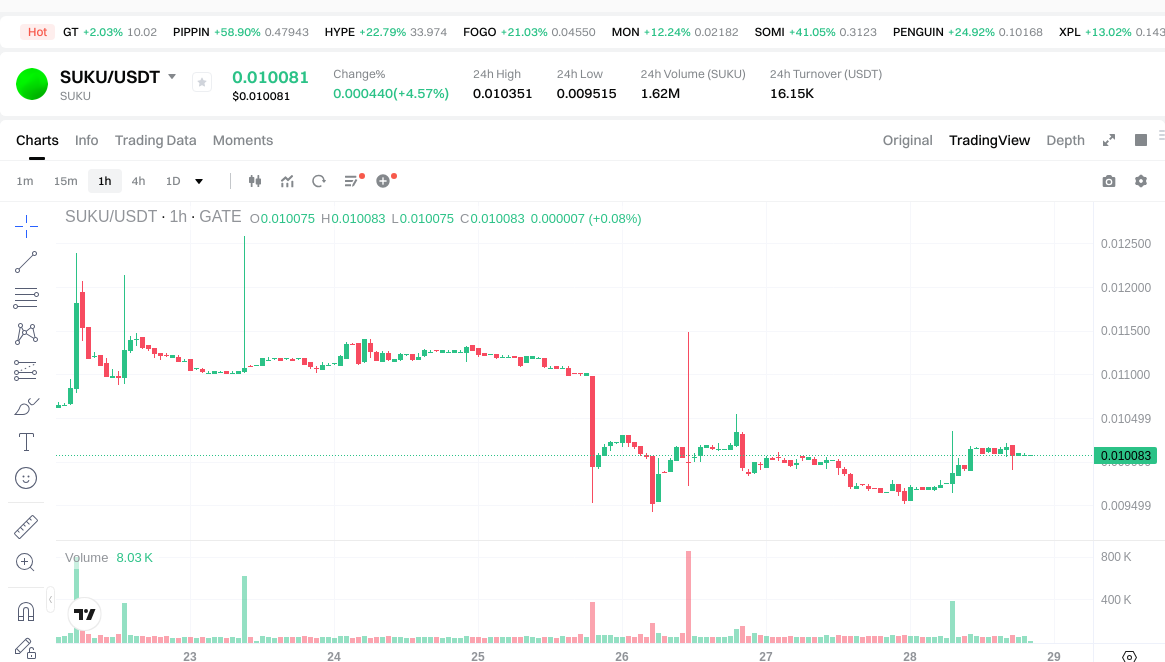
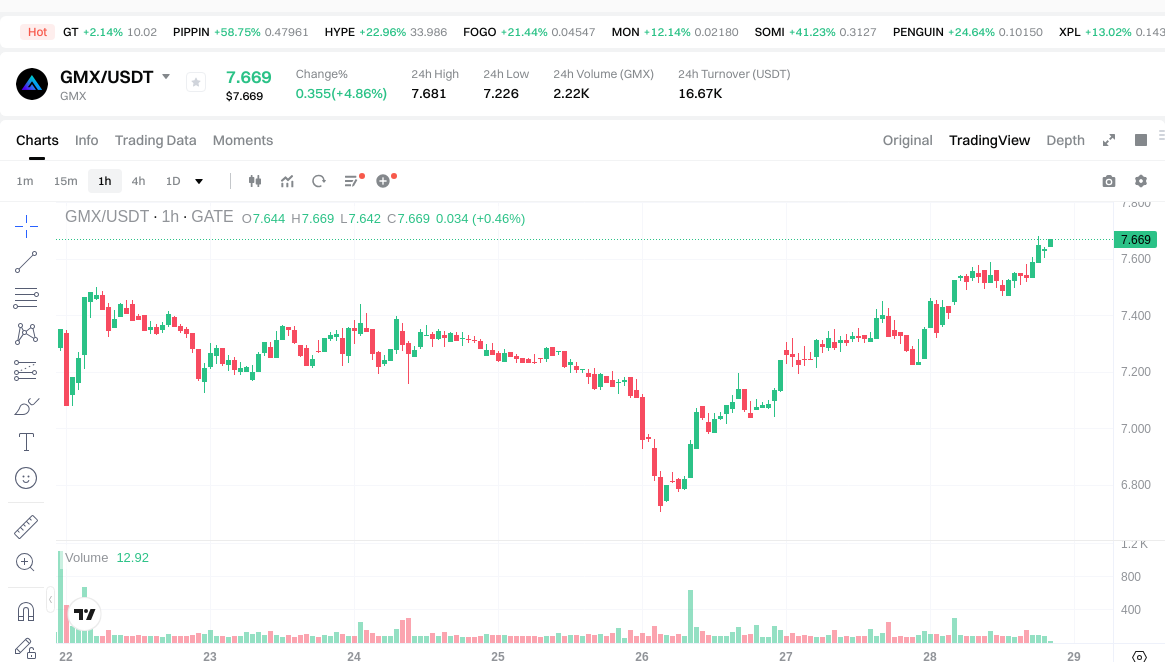
- Comparative Analysis: During recent market cycles, SUKU declined from its peak of $1.51 to a lower level of $0.00948152 recorded on January 26, 2026, while GMX moved from its high of $91.07 down to $6.74, also on January 26, 2026.
Current Market Status (January 28, 2026)
- SUKU Current Price: $0.010075
- GMX Current Price: $7.634
- 24-Hour Trading Volume: SUKU recorded $16,171.11 compared to GMX's $16,691.96
- Market Sentiment Index (Fear & Greed Index): 29 (Fear)
Check real-time prices:
II. Core Factors Influencing SUKU vs GMX Investment Value
Supply Mechanism Comparison (Tokenomics)
- SUKU: The supply mechanism details are not extensively documented in available materials, though market demand and partnership developments appear to influence token utility and circulation patterns.
- GMX: Trading volume and platform activity may affect token economics, with fee structures and reward mechanisms potentially impacting supply dynamics.
- 📌 Historical patterns: Supply mechanisms can influence price cycles through changes in circulating supply, token burns, and staking incentives, though specific historical data for these tokens requires further documentation.
Institutional Adoption and Market Applications
- Institutional holdings: Limited information exists regarding comparative institutional preference between SUKU and GMX.
- Enterprise adoption: Both tokens show varying degrees of integration within their respective ecosystems, with SUKU focusing on supply chain solutions and GMX on decentralized trading infrastructure.
- Regulatory stance: Different jurisdictions maintain evolving regulatory frameworks that may affect both tokens' adoption trajectories.
Technical Development and Ecosystem Building
- SUKU technical upgrades: Partnership-driven developments appear to be a focus area, though specific technical roadmap details are limited in available materials.
- GMX technical development: Platform reputation and trading infrastructure development play roles in ecosystem growth.
- Ecosystem comparison: Both projects operate in distinct sectors - SUKU in supply chain verification and GMX in decentralized exchange services - making direct DeFi, NFT, payment, and smart contract comparisons challenging without additional data.
Macroeconomic Environment and Market Cycles
- Performance during inflation: Both tokens' correlation with broader crypto market trends and macroeconomic conditions requires ongoing monitoring.
- Macroeconomic monetary policy: Interest rates, dollar index movements, and liquidity conditions may affect both tokens through their impact on overall crypto market sentiment.
- Geopolitical factors: Cross-border transaction demand and international developments may influence adoption patterns differently based on each token's use case and geographic focus.
III. 2026-2031 Price Forecast: SUKU vs GMX
Short-term Forecast (2026)
- SUKU: Conservative $0.00555 - $0.01008 | Optimistic $0.01008 - $0.01119
- GMX: Conservative $6.365 - $7.669 | Optimistic $7.669 - $8.283
Mid-term Forecast (2028-2029)
- SUKU may enter a consolidation phase, with projected price range of $0.00629 - $0.01864
- GMX may enter a growth phase, with projected price range of $6.653 - $12.613
- Key drivers: institutional capital inflows, ETF developments, ecosystem expansion
Long-term Forecast (2030-2031)
- SUKU: Baseline scenario $0.00875 - $0.01563 | Optimistic scenario $0.01563 - $0.02103
- GMX: Baseline scenario $10.451 - $13.563 | Optimistic scenario $13.563 - $15.383
View detailed price predictions for SUKU and GMX
Disclaimer
SUKU:
| Year |
Predicted High Price |
Predicted Average Price |
Predicted Low Price |
Price Change |
| 2026 |
0.01119213 |
0.010083 |
0.00554565 |
0 |
| 2027 |
0.01223319975 |
0.010637565 |
0.0087228033 |
5 |
| 2028 |
0.01429422796875 |
0.011435382375 |
0.00628946030625 |
13 |
| 2029 |
0.018396671395781 |
0.012864805171875 |
0.010549140240937 |
27 |
| 2030 |
0.016724889963696 |
0.015630738283828 |
0.008753213438943 |
55 |
| 2031 |
0.02103115836089 |
0.016177814123762 |
0.015368923417573 |
60 |
GMX:
| Year |
Predicted High Price |
Predicted Average Price |
Predicted Low Price |
Price Change |
| 2026 |
8.28252 |
7.669 |
6.36527 |
0 |
| 2027 |
11.8838824 |
7.97576 |
5.3437592 |
4 |
| 2028 |
11.816487228 |
9.9298212 |
6.652980204 |
29 |
| 2029 |
12.61285888824 |
10.873154214 |
8.1548656605 |
42 |
| 2030 |
15.3833385819672 |
11.74300655112 |
10.4512758304968 |
53 |
| 2031 |
14.105699469205344 |
13.5631725665436 |
11.799960132892932 |
77 |
IV. Investment Strategy Comparison: SUKU vs GMX
Long-term vs Short-term Investment Strategies
- SUKU: May appeal to investors interested in supply chain innovation and niche enterprise adoption scenarios, though limited liquidity and market depth considerations apply for both short and long-term positions.
- GMX: May suit investors seeking exposure to decentralized exchange infrastructure and trading fee revenue models, with consideration for platform activity levels affecting token value.
Risk Management and Asset Allocation
- Conservative Investors: A balanced approach might consider SUKU 30-40% vs GMX 60-70%, reflecting GMX's relatively higher liquidity and established platform presence.
- Aggressive Investors: Higher risk tolerance portfolios might allocate SUKU 50-60% vs GMX 40-50%, accounting for SUKU's lower price point and potential growth scenarios.
- Hedging Tools: Stablecoin reserves for market downturns, options strategies where available, and cross-asset diversification across different crypto sectors.
V. Potential Risk Comparison
Market Risks
- SUKU: Lower trading volumes ($16,171.11 recorded on January 26, 2026) may result in reduced liquidity and higher price volatility during market stress periods.
- GMX: Platform competition from other decentralized exchanges and shifts in trading activity patterns could affect token demand and fee generation.
Technical Risks
- SUKU: Network scalability considerations and dependency on partnership developments for utility expansion.
- GMX: Platform infrastructure stability requirements and potential smart contract vulnerabilities inherent in DeFi protocols.
Regulatory Risks
- Evolving global regulatory frameworks may impact both tokens differently based on their classification - SUKU as a supply chain utility token versus GMX as a DeFi trading platform token - with varying compliance requirements across jurisdictions.
VI. Conclusion: Which Is the Better Buy?
📌 Investment Value Summary:
- SUKU Advantages: Lower entry price point at $0.010075, positioning in supply chain transparency sector, potential for partnership-driven growth.
- GMX Advantages: Established decentralized exchange platform, fee revenue model generating consistent token utility, higher trading volume indicating better liquidity.
✅ Investment Recommendations:
- Novice Investors: Consider starting with GMX due to relatively higher liquidity and more transparent platform metrics, while allocating smaller positions to understand market dynamics before diversifying.
- Experienced Investors: May evaluate portfolio diversification between both tokens based on risk tolerance, with attention to sector exposure (supply chain vs DeFi) and market cycle positioning.
- Institutional Investors: Conduct thorough due diligence on regulatory compliance status, liquidity depth for large position management, and alignment with institutional investment mandates before allocation decisions.
⚠️ Risk Disclaimer: Cryptocurrency markets exhibit high volatility. This content does not constitute investment advice.
VII. FAQ
Q1: What are the main differences between SUKU and GMX tokens?
SUKU is a supply chain-focused token enabling transparency and verification in product supply chains, while GMX is a decentralized perpetual exchange token that accrues 30% of platform-generated trading fees. SUKU serves enterprise supply chain solutions with a current price of $0.010075, whereas GMX functions as both a utility and governance token for decentralized trading infrastructure, priced at $7.634. The fundamental difference lies in their use cases: SUKU targets supply chain transparency and supplier financial tools, while GMX provides decentralized derivatives trading services with direct fee revenue mechanisms.
Q2: Which token shows better liquidity based on current market data?
GMX demonstrates marginally better liquidity characteristics with a 24-hour trading volume of $16,691.96 compared to SUKU's $16,171.11 as of January 26, 2026. However, both tokens exhibit relatively low trading volumes, suggesting limited market depth. GMX's higher price point ($7.634 vs $0.010075) and established platform presence may provide slightly better execution for larger trades, though both tokens require careful consideration of slippage and market impact when entering or exiting positions.
Q3: What are the projected price ranges for SUKU and GMX by 2031?
Based on available forecasts, SUKU's 2031 projected range spans from a low of $0.01537 to a high of $0.02103 under optimistic scenarios, representing a potential 60% increase from 2026 levels. GMX's 2031 projections range from $11.80 to $15.38 in optimistic scenarios, indicating a potential 77% increase. These forecasts assume baseline adoption trends, ecosystem development, and favorable market cycles. However, actual performance depends on numerous unpredictable factors including regulatory developments, technological advancement, competitive dynamics, and broader cryptocurrency market conditions.
Q4: How do supply mechanisms affect each token's investment potential?
GMX's tokenomics incorporate a direct fee revenue model where 30% of platform-generated fees accrue to token holders, creating a clear utility-driven demand mechanism. SUKU's supply mechanism details remain less documented, with token utility primarily driven by partnership developments and supply chain adoption. GMX's transparent fee-sharing structure provides more predictable token demand correlation with platform activity, while SUKU's value proposition depends more heavily on enterprise adoption rates and partnership expansion, making its supply-demand dynamics less quantifiable for investors.
Q5: What risk factors should investors consider when choosing between SUKU and GMX?
Key risk considerations include: (I) Liquidity risk - both tokens show limited trading volumes, potentially causing execution challenges; (II) Sector-specific risk - SUKU faces enterprise adoption hurdles and supply chain market penetration challenges, while GMX confronts intense competition from other decentralized exchanges; (III) Regulatory uncertainty - evolving frameworks may classify these tokens differently, with varying compliance requirements; (IV) Technical risks - SUKU depends on partnership-driven development, whereas GMX faces smart contract vulnerabilities inherent in DeFi protocols; (V) Market volatility - both tokens experienced significant price declines from historical peaks, reflecting broader cryptocurrency market cyclicality.
Q6: Which token is more suitable for conservative versus aggressive investment strategies?
Conservative investors may favor GMX allocation (60-70% of crypto portfolio allocation) due to its established platform presence, transparent fee revenue model, and relatively higher liquidity profile. GMX's operational track record and quantifiable platform metrics provide more predictable risk assessment parameters. Aggressive investors might consider higher SUKU exposure (50-60%) given its lower price point ($0.010075), potential for partnership-driven growth, and positioning in the emerging supply chain transparency sector. However, SUKU's higher speculative risk stems from limited liquidity, less transparent utility mechanisms, and dependency on enterprise adoption rates that remain difficult to forecast.
Q7: How do macroeconomic conditions affect SUKU vs GMX differently?
Both tokens correlate with broader cryptocurrency market sentiment, currently reflected in the Fear & Greed Index reading of 29 (Fear). However, their sensitivity to macroeconomic factors differs: GMX's performance links more directly to trading activity levels, which tend to increase during both bull markets (speculation-driven) and volatile periods (hedging demand). SUKU's value proposition depends on enterprise capital allocation decisions, which may be more sensitive to traditional economic cycles, interest rates, and corporate spending patterns. During inflationary periods, GMX may benefit from increased trading volatility, while SUKU's adoption could slow if enterprises reduce technology infrastructure investments.
Q8: What institutional considerations apply when evaluating SUKU vs GMX investments?
Institutional investors should assess several factors: (I) Regulatory compliance status - verify each token's classification under relevant jurisdictions and securities law implications; (II) Custodial solutions - confirm availability of qualified custody services for both tokens; (III) Liquidity depth - current volumes ($16,171.11 for SUKU, $16,691.96 for GMX) may be insufficient for institutional-sized positions without significant market impact; (IV) Due diligence requirements - GMX offers more transparent platform metrics and revenue data, while SUKU requires deeper analysis of partnership agreements and enterprise adoption pipelines; (V) Portfolio mandate alignment - determine whether supply chain technology (SUKU) or DeFi infrastructure (GMX) fits institutional investment thesis and sector exposure targets.
* The information is not intended to be and does not constitute financial advice or any other recommendation of any sort offered or endorsed by Gate.