This comprehensive analysis compares SUPRA and ETH blockchain platforms across performance, scalability, and investment value for DeFi applications. The article addresses critical questions for investors evaluating both assets: examining historical price trends showing SUPRA's volatility from $0.0798 to $0.0006735 versus ETH's market stability at $3,019.46, analyzing tokenomics mechanisms and institutional adoption patterns, and evaluating technical ecosystems where SUPRA focuses on oracle infrastructure with 500,000 TPS throughput while ETH maintains broader smart contract platform dominance. Investment strategy comparisons cover risk management approaches for conservative versus aggressive portfolios, macroeconomic influences on both platforms, and long-term scalability solutions including Layer 2 developments for ETH. Detailed risk assessments evaluate market volatility, technical maturity differences between emerging SUPRA and established ETH infrastructure, and evolving regulatory frameworks. Price forec
Introduction: SUPRA vs ETH Investment Comparison
In the cryptocurrency market, the comparison between SUPRA and ETH has been a topic that investors cannot avoid. The two not only show significant differences in market cap ranking, application scenarios, and price performance, but also represent different positioning in the crypto asset landscape.
SUPRA (SUPRA): Launched in November 2024, it has gained market recognition with its positioning as a MultiVM Layer 1 blockchain starting with MoveVM, achieving 500,000 TPS throughput with sub-second consensus latency across 300 globally distributed nodes.
ETH (ETH): Since its launch in July 2014, it has been regarded as a decentralized smart contract platform and is one of the cryptocurrencies with the highest trading volume and market capitalization globally.
This article will comprehensively analyze the investment value comparison between SUPRA and ETH around historical price trends, supply mechanisms, institutional adoption, technical ecosystems, and future predictions, attempting to answer the question that investors care about most:
"Which is the better buy right now?"
I. Historical Price Comparison and Current Market Status
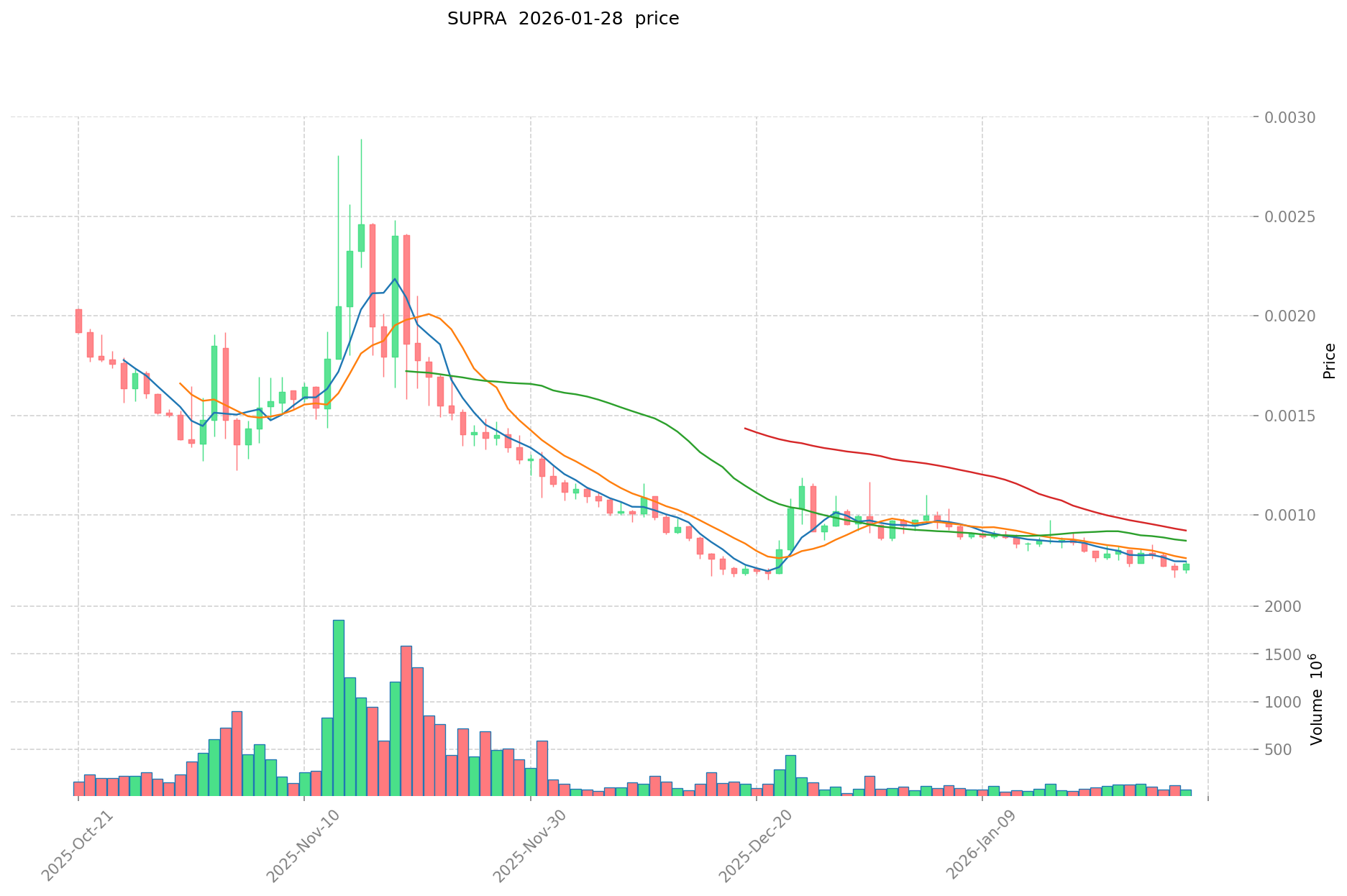
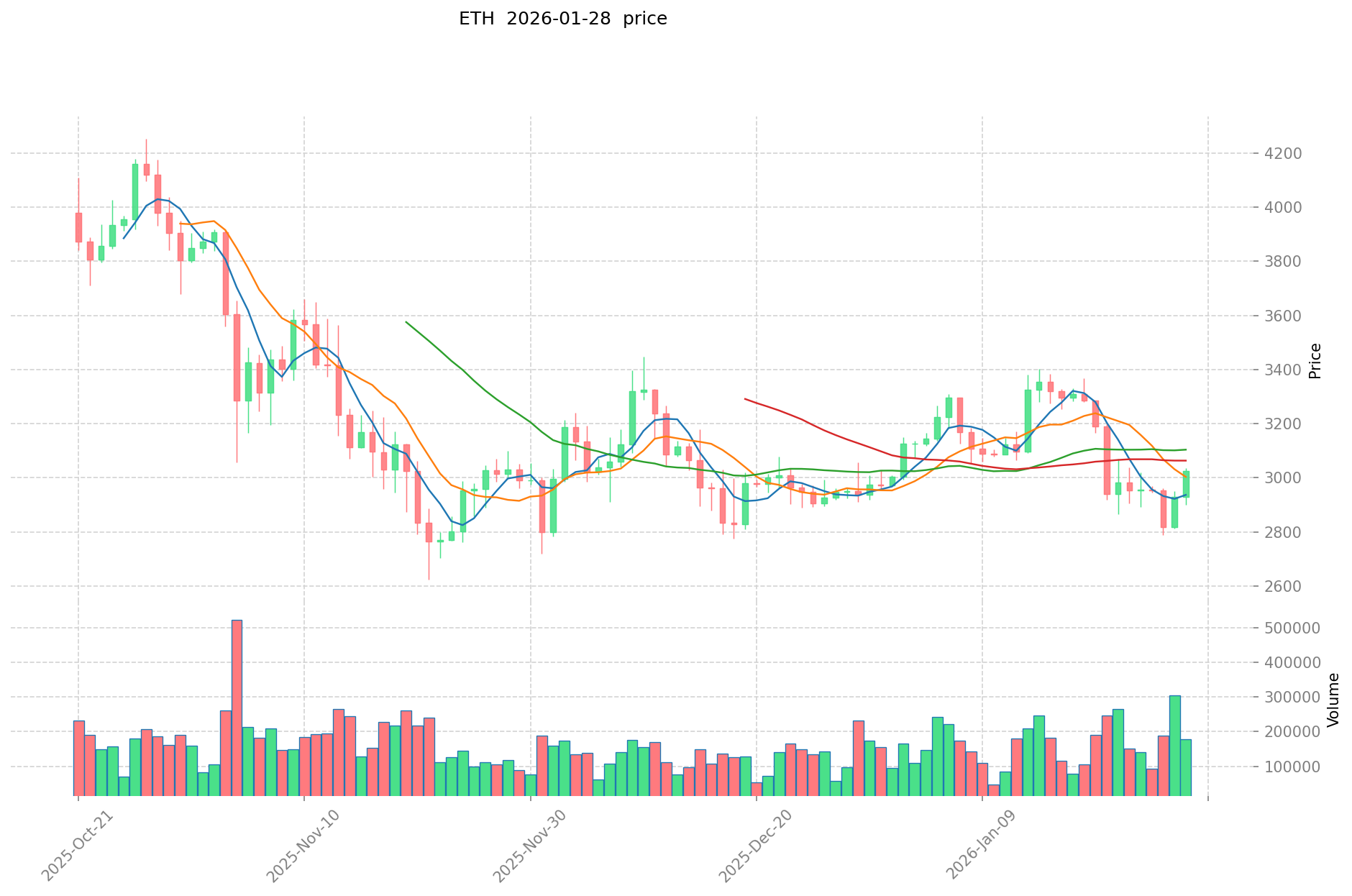
SUPRA and ETH Historical Price Trends
-
2024: SUPRA reached an all-time high of $0.0798 on December 8, 2024, following its listing on major exchanges. The token experienced significant volatility during its initial trading period.
-
2025: ETH demonstrated resilience throughout the year, with prices fluctuating between support levels around $2,978.92 and resistance near $4,946.05 recorded on August 25, 2025. The network continued its technological evolution through planned upgrades.
-
2025 (December): SUPRA experienced a sharp decline, falling to its all-time low of $0.0006735 on December 21, 2025, representing a substantial correction from its peak price levels.
-
Comparative Analysis: During the market cycle from late 2024 through 2025, SUPRA declined from its high of $0.0798 to $0.0006735, while ETH maintained relatively stronger price stability, trading within a range that preserved much of its market capitalization.
Current Market Status (January 29, 2026)
- SUPRA Current Price: $0.0007726
- ETH Current Price: $3,019.46
- 24-Hour Trading Volume: SUPRA $80,880.59 vs ETH $503,835,939.86
- Market Capitalization: SUPRA $5.29M vs ETH $364.43B
- 24-Hour Price Change: SUPRA +7.03% vs ETH +1.35%
- Market Sentiment Index (Fear & Greed Index): 29 (Fear)
View real-time prices:
II. Core Factors Influencing SUPRA vs ETH Investment Value
Supply Mechanism Comparison (Tokenomics)
-
SUPRA: Features a total supply of 100 billion tokens, with supply distribution mechanisms designed to balance ecosystem incentives and token circulation. The tokenomics model includes allocations for team, investors, and community participants, which may influence long-term price dynamics through vesting schedules and release patterns.
-
ETH: Operates under a dynamic supply model that transitioned to a deflationary mechanism following the implementation of EIP-1559 and The Merge upgrade. The burning mechanism reduces circulating supply during periods of high network activity, potentially creating deflationary pressure.
-
📌 Historical Pattern: Supply mechanism changes have historically driven significant price cycle variations in cryptocurrency markets. Token supply dynamics, including release schedules and burning mechanisms, tend to correlate with market sentiment shifts and liquidity conditions.
Institutional Adoption and Market Application
-
Institutional Holdings: Ethereum has demonstrated stronger institutional appeal, with established infrastructure for custody, derivatives trading, and regulatory compliance frameworks. SUPRA's institutional adoption remains in earlier development stages.
-
Enterprise Adoption: ETH maintains broader enterprise integration across DeFi protocols, payment systems, and settlement infrastructure. SUPRA is positioning itself within the oracle and data infrastructure space, with applications in cross-chain data transmission and real-world asset (RWA) integration, though adoption metrics remain limited compared to established platforms.
-
Regulatory Environment: Different jurisdictions maintain varying regulatory stances toward blockchain platforms. Ethereum's longer operational history has resulted in more defined regulatory treatment in major markets, while newer platforms like SUPRA continue to navigate evolving compliance frameworks.
Technology Development and Ecosystem Construction
-
SUPRA Technology: Focuses on oracle infrastructure and cross-chain data solutions, with technical architecture designed to address MEV (Maximum Extractable Value) mitigation and censorship resistance. The platform emphasizes end-to-end transaction processing capabilities within its blockchain stack.
-
ETH Technology Development: Continues development through scheduled network upgrades, including scalability improvements via Layer 2 solutions and future sharding implementation. The transition to Proof-of-Stake consensus has altered network economics and energy consumption profiles.
-
Ecosystem Comparison: Ethereum maintains substantial advantages in DeFi protocol deployment, NFT marketplace infrastructure, and smart contract development activity. SUPRA's ecosystem development concentrates on oracle services and data infrastructure, positioning within a more specialized segment of the blockchain technology stack.
Macroeconomic Environment and Market Cycles
-
Performance in Inflationary Conditions: Cryptocurrency assets have shown varied responses to inflationary environments, with performance dependent on multiple factors including liquidity conditions, risk appetite, and correlation with traditional financial markets. Neither asset demonstrates conclusive evidence of consistent anti-inflation characteristics across all economic conditions.
-
Monetary Policy Impact: Interest rate adjustments and U.S. dollar strength influence cryptocurrency market dynamics through effects on risk asset valuations and capital flows. Both SUPRA and ETH operate within broader market cycles affected by these macroeconomic variables.
-
Geopolitical Considerations: Cross-border transaction demand and international regulatory developments continue to influence blockchain platform adoption patterns. Established platforms with greater liquidity and infrastructure development may demonstrate different sensitivity to geopolitical factors compared to emerging platforms.
III. 2026-2031 Price Forecast: SUPRA vs ETH
Short-term Forecast (2026)
- SUPRA: Conservative $0.000720 - $0.000774 | Optimistic $0.000774 - $0.000797
- ETH: Conservative $2,236 - $3,022 | Optimistic $3,022 - $3,808
Mid-term Forecast (2028-2029)
- SUPRA may enter a gradual growth phase, with projected prices ranging from $0.000802 to $0.001515
- ETH may enter a consolidation and expansion phase, with projected prices ranging from $3,525 to $4,890
- Key drivers: institutional capital inflows, ETF developments, ecosystem expansion
Long-term Forecast (2030-2031)
- SUPRA: Baseline scenario $0.000836 - $0.001306 | Optimistic scenario $0.001306 - $0.001912
- ETH: Baseline scenario $2,684 - $4,557 | Optimistic scenario $4,557 - $6,527
View detailed price predictions for SUPRA and ETH
Disclaimer
The price forecasts presented are based on historical data analysis and market trends. Cryptocurrency markets are highly volatile and subject to numerous unpredictable factors. These projections should not be considered as financial advice or guarantees of future performance. Investors should conduct their own research and consult with qualified financial advisors before making investment decisions.
SUPRA:
| Year |
Predicted High Price |
Predicted Average Price |
Predicted Low Price |
Price Change |
| 2026 |
0.000797117 |
0.0007739 |
0.000719727 |
0 |
| 2027 |
0.001123277155 |
0.0007855085 |
0.0006284068 |
1 |
| 2028 |
0.00124071067575 |
0.0009543928275 |
0.0008016899751 |
23 |
| 2029 |
0.001514621417242 |
0.001097551751625 |
0.000987796576462 |
42 |
| 2030 |
0.001854642949895 |
0.001306086584433 |
0.000835895414037 |
69 |
| 2031 |
0.001912241368269 |
0.001580364767164 |
0.001406524642776 |
104 |
ETH:
| Year |
Predicted High Price |
Predicted Average Price |
Predicted Low Price |
Price Change |
| 2026 |
3807.7704 |
3022.04 |
2236.3096 |
0 |
| 2027 |
4166.184344 |
3414.9052 |
2766.073212 |
13 |
| 2028 |
4889.80275588 |
3790.544772 |
3525.20663796 |
25 |
| 2029 |
4774.191140334 |
4340.17376394 |
4209.9685510218 |
43 |
| 2030 |
5969.90901229947 |
4557.182452137 |
2734.3094712822 |
50 |
| 2031 |
6526.7967079506114 |
5263.545732218235 |
2684.40832343129985 |
74 |
IV. Investment Strategy Comparison: SUPRA vs ETH
Long-term vs Short-term Investment Strategies
-
SUPRA: May appeal to investors with higher risk tolerance who are interested in emerging oracle infrastructure and cross-chain data solutions. The platform's positioning in specialized blockchain services suggests potential for early-stage technology adoption scenarios, though with corresponding volatility considerations.
-
ETH: May suit investors seeking exposure to established smart contract infrastructure with broader ecosystem development. The platform's longer operational history and institutional integration present different risk-return characteristics compared to emerging platforms.
Risk Management and Asset Allocation
-
Conservative Investors: A conservative approach might consider minimal exposure to emerging platforms like SUPRA (0-5%) while allocating larger portions to established networks like ETH (10-20%) within a diversified portfolio that includes traditional assets and stablecoins.
-
Aggressive Investors: Higher risk tolerance portfolios might allocate increased exposure to both platforms (SUPRA 5-15%, ETH 20-40%), though concentration risk considerations remain important across all allocation strategies.
-
Hedging Instruments: Portfolio risk management tools include stablecoin allocations for liquidity management, options contracts for directional positioning, and cross-asset diversification strategies across multiple blockchain platforms and traditional financial instruments.
V. Potential Risk Comparison
Market Risk
-
SUPRA: Faces elevated volatility risk characteristic of lower market capitalization assets, with limited trading volume ($80,880.59 daily) potentially affecting liquidity during market stress periods. Price movements from $0.0798 to $0.0006735 demonstrate substantial downside volatility potential.
-
ETH: Experiences market cycle volatility correlated with broader cryptocurrency market trends, though with greater liquidity depth ($503.8M daily volume) and established price discovery mechanisms. Historical price ranges indicate ongoing volatility despite larger market capitalization.
Technical Risk
-
SUPRA: Platform maturity considerations include limited operational history since November 2024 launch, with ecosystem development still in early stages. Infrastructure dependencies and integration testing across oracle services present ongoing technical considerations.
-
ETH: Faces scalability challenges being addressed through Layer 2 solutions and planned network upgrades. Network congestion during high-activity periods can result in elevated transaction fees, while ongoing protocol development introduces implementation risks.
Regulatory Risk
- Global regulatory frameworks continue evolving across jurisdictions, with potential differential impacts on established platforms versus emerging networks. Ethereum's classification and regulatory treatment varies by jurisdiction, while newer platforms like SUPRA operate with less regulatory precedent. Compliance requirements, securities law considerations, and cross-border operational frameworks remain subject to change across major markets.
VI. Conclusion: Which Is the Better Buy?
📌 Investment Value Summary
-
SUPRA Characteristics: Positioned within oracle infrastructure and cross-chain data services, with technical features addressing MEV mitigation. Limited operational history and lower market capitalization present higher risk-return profiles characteristic of emerging platforms.
-
ETH Characteristics: Maintains established position in smart contract infrastructure with broader ecosystem adoption across DeFi, NFT, and enterprise applications. Longer operational track record and institutional integration provide different risk characteristics compared to emerging platforms.
✅ Investment Considerations
-
New Investors: May consider starting with established platforms that offer greater liquidity, educational resources, and infrastructure maturity. Understanding fundamental concepts of blockchain technology, wallet security, and risk management principles remains essential before allocating capital to any cryptocurrency asset.
-
Experienced Investors: Might evaluate portfolio allocation across multiple blockchain platforms based on individual risk tolerance, investment timeframes, and thesis regarding specific protocol developments. Diversification across market capitalizations and use cases can address concentration risk considerations.
-
Institutional Investors: Should assess custody solutions, regulatory compliance frameworks, and integration with existing portfolio management systems. Due diligence processes for emerging platforms require evaluation of technical architecture, team credentials, and long-term sustainability considerations beyond established networks.
⚠️ Risk Disclosure: Cryptocurrency markets demonstrate extreme volatility and involve substantial risk of capital loss. This analysis does not constitute financial advice, investment recommendations, or guarantees of future performance. Investors should conduct independent research and consult qualified financial advisors before making investment decisions.
VII. FAQ
Q1: What is the main difference between SUPRA and ETH in terms of technology focus?
SUPRA is an oracle infrastructure and cross-chain data solution platform, while ETH is an established smart contract platform with broader ecosystem applications. SUPRA focuses on addressing data transmission challenges, MEV mitigation, and cross-chain interoperability with its MultiVM Layer 1 blockchain architecture achieving 500,000 TPS. In contrast, Ethereum serves as the foundational layer for DeFi protocols, NFT marketplaces, and decentralized applications, with ongoing development focused on scalability through Layer 2 solutions and the transition to Proof-of-Stake consensus following The Merge upgrade.
Q2: Which asset has greater market liquidity?
ETH demonstrates significantly greater market liquidity compared to SUPRA. As of January 29, 2026, ETH records $503,835,939.86 in 24-hour trading volume with a market capitalization of $364.43B, while SUPRA shows $80,880.59 in daily volume with a $5.29M market cap. This substantial difference in liquidity affects price stability, trade execution efficiency, and the ability to enter or exit positions, particularly during market stress periods. Higher liquidity typically results in tighter bid-ask spreads and reduced slippage for larger transaction sizes.
Q3: How do the supply mechanisms of SUPRA and ETH differ?
SUPRA operates with a fixed total supply of 100 billion tokens, featuring distribution mechanisms that include allocations for team, investors, and community participants with predetermined vesting schedules. ETH utilizes a dynamic supply model that became deflationary following the implementation of EIP-1559 and The Merge upgrade, where network transaction fees are burned, potentially reducing circulating supply during high activity periods. This fundamental difference means SUPRA's supply follows a programmed release schedule, while ETH's supply responds to network usage patterns, creating distinct inflationary or deflationary pressures under different market conditions.
Q4: What are the primary risks associated with investing in SUPRA versus ETH?
SUPRA faces elevated volatility risk due to its lower market capitalization, limited trading volume, and shorter operational history since November 2024, demonstrated by its dramatic price movement from $0.0798 to $0.0006735. Additional considerations include emerging ecosystem development, limited institutional integration, and less established regulatory precedent. ETH encounters different risk factors including scalability challenges resulting in periodic network congestion and elevated transaction fees, protocol upgrade implementation risks, and ongoing regulatory uncertainty across multiple jurisdictions. Both assets experience correlation with broader cryptocurrency market cycles, though ETH's established infrastructure and liquidity provide different risk characteristics compared to emerging platforms.
Q5: Which asset is more suitable for conservative investors?
ETH may align better with conservative investment approaches within the cryptocurrency space. The platform's longer operational history since July 2014, established institutional custody solutions, broader ecosystem adoption, and significantly higher liquidity ($503.8M daily volume versus $80,880.59 for SUPRA) provide characteristics typically preferred by risk-averse investors. Conservative allocation strategies might consider minimal or zero exposure to emerging platforms like SUPRA while potentially including modest ETH positions (10-20%) within diversified portfolios containing traditional assets and stablecoins. However, all cryptocurrency investments carry substantial risk, and conservative investors should carefully evaluate whether any digital asset exposure aligns with their risk tolerance and investment objectives.
Q6: How does institutional adoption compare between SUPRA and ETH?
ETH demonstrates substantially greater institutional adoption, with established infrastructure for custody services, derivatives trading, regulatory compliance frameworks, and enterprise integration across payment systems and settlement infrastructure. Major financial institutions, publicly traded companies, and investment funds have implemented Ethereum-based solutions and maintain ETH treasury holdings. SUPRA's institutional adoption remains in early development stages, with limited established partnerships and infrastructure compared to Ethereum's ecosystem. This difference in institutional integration affects market depth, price discovery mechanisms, and the availability of professional-grade tools and services for larger market participants.
Q7: What factors should investors consider when choosing between SUPRA and ETH for portfolio allocation?
Investors should evaluate multiple factors including risk tolerance, investment timeframe, portfolio diversification objectives, and thesis regarding specific protocol developments. Key considerations include liquidity needs (ETH provides significantly higher trading volume), technological differentiation (SUPRA's oracle infrastructure versus ETH's smart contract platform), market maturity levels (ETH's established ecosystem versus SUPRA's emerging position), and correlation with broader cryptocurrency market cycles. Additionally, investors should assess custody and security solutions available for each asset, tax implications in their jurisdiction, and how each investment aligns with overall portfolio risk-return objectives. Understanding fundamental blockchain concepts, conducting independent research, and consulting qualified financial advisors remain essential steps before allocating capital to either asset.
Q8: What are the projected price trajectories for SUPRA and ETH through 2031?
Based on historical data analysis and market trend projections, SUPRA shows baseline forecasts ranging from $0.000720-$0.000797 in 2026, potentially reaching $0.001306-$0.001912 by 2031 under optimistic scenarios, representing approximately 104% growth from 2026 baseline predictions. ETH demonstrates projected ranges of $2,236-$3,808 for 2026, with long-term forecasts suggesting $4,557-$6,527 by 2031 under optimistic conditions, representing approximately 74% growth from 2026 baseline predictions. However, these projections carry significant uncertainty given cryptocurrency market volatility, unpredictable regulatory developments, technological advancement trajectories, and macroeconomic factors. These forecasts should not be interpreted as guarantees or investment recommendations, as actual outcomes may vary substantially from any predictive model.
* The information is not intended to be and does not constitute financial advice or any other recommendation of any sort offered or endorsed by Gate.