This article titled "SUSHI vs FIL: Battle of the DeFi Tokens - Comparing Yield Potential and Ecosystem Growth" offers a comprehensive analysis of two notable DeFi tokens, SUSHI and FIL, examining investment value through historical price trends, supply mechanisms, and institutional adoption. Readers will gain insights into factors influencing investment choices, such as market applications, technical developments, and risk assessments. Suitable for both new and experienced crypto investors, the article addresses critical questions regarding market position and growth potential. Structured in logical sequence from price comparisons to strategic investment advice, it caters to informed decision-making with real-time pricing links from Gate.
Introduction: SUSHI vs FIL Investment Comparison
In the cryptocurrency market, SUSHI vs FIL comparison has always been an unavoidable topic for investors. The two not only have significant differences in market cap ranking, application scenarios, and price performance, but also represent different cryptocurrency asset positions.
Sushiswap (SUSHI): Since its launch in 2020, it has gained market recognition for its decentralized exchange and liquidity mining capabilities.
Filecoin(IPFS) (FIL): Since its inception in 2020, it has been hailed as a decentralized storage network, and is one of the cryptocurrencies with high global trading volume and market capitalization.
This article will comprehensively analyze the investment value comparison between SUSHI and FIL, focusing on historical price trends, supply mechanisms, institutional adoption, technological ecosystems, and future predictions, and attempt to answer the question investors care most about:
"Which is the better buy right now?"
I. Price History Comparison and Current Market Status
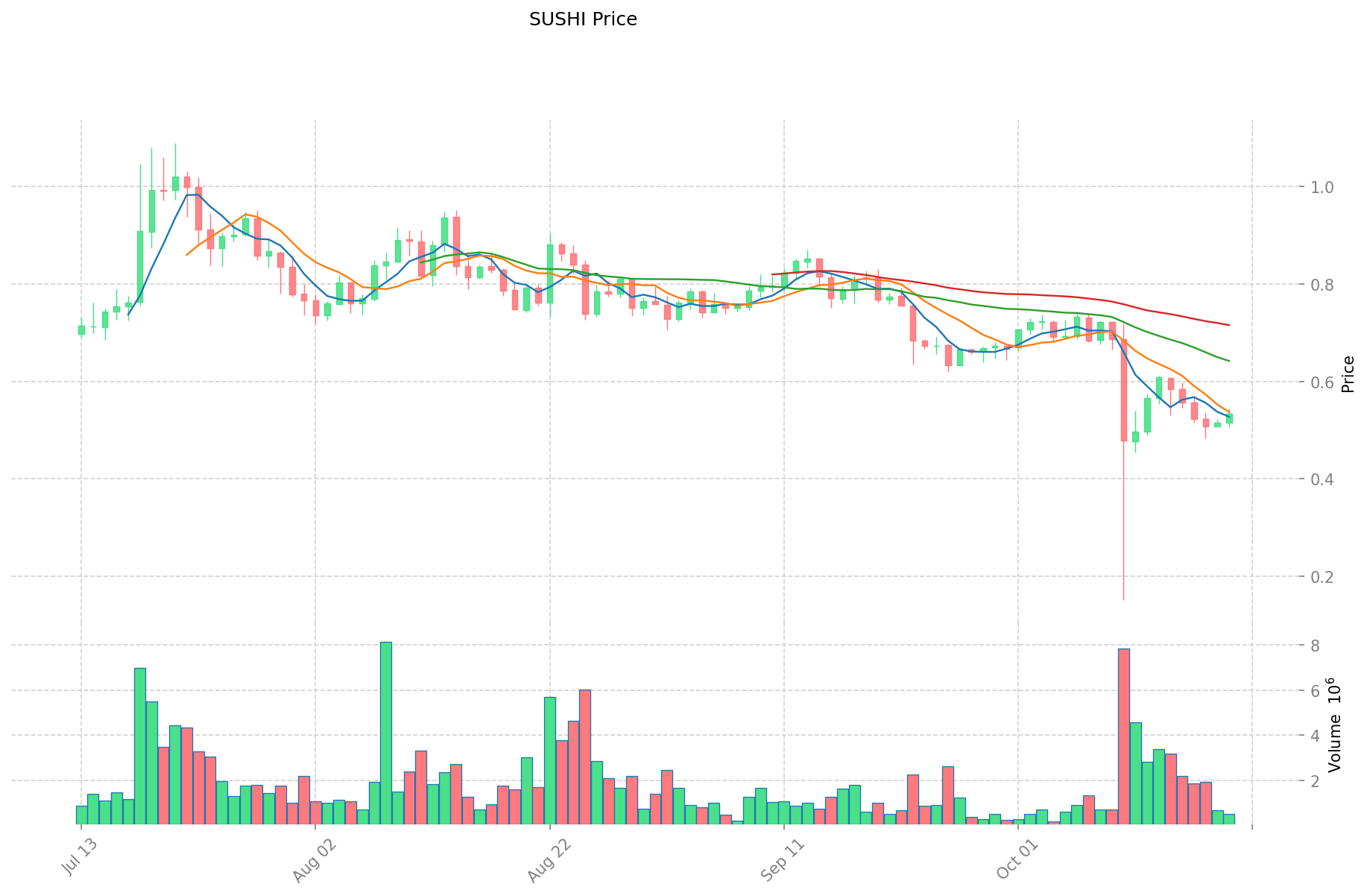
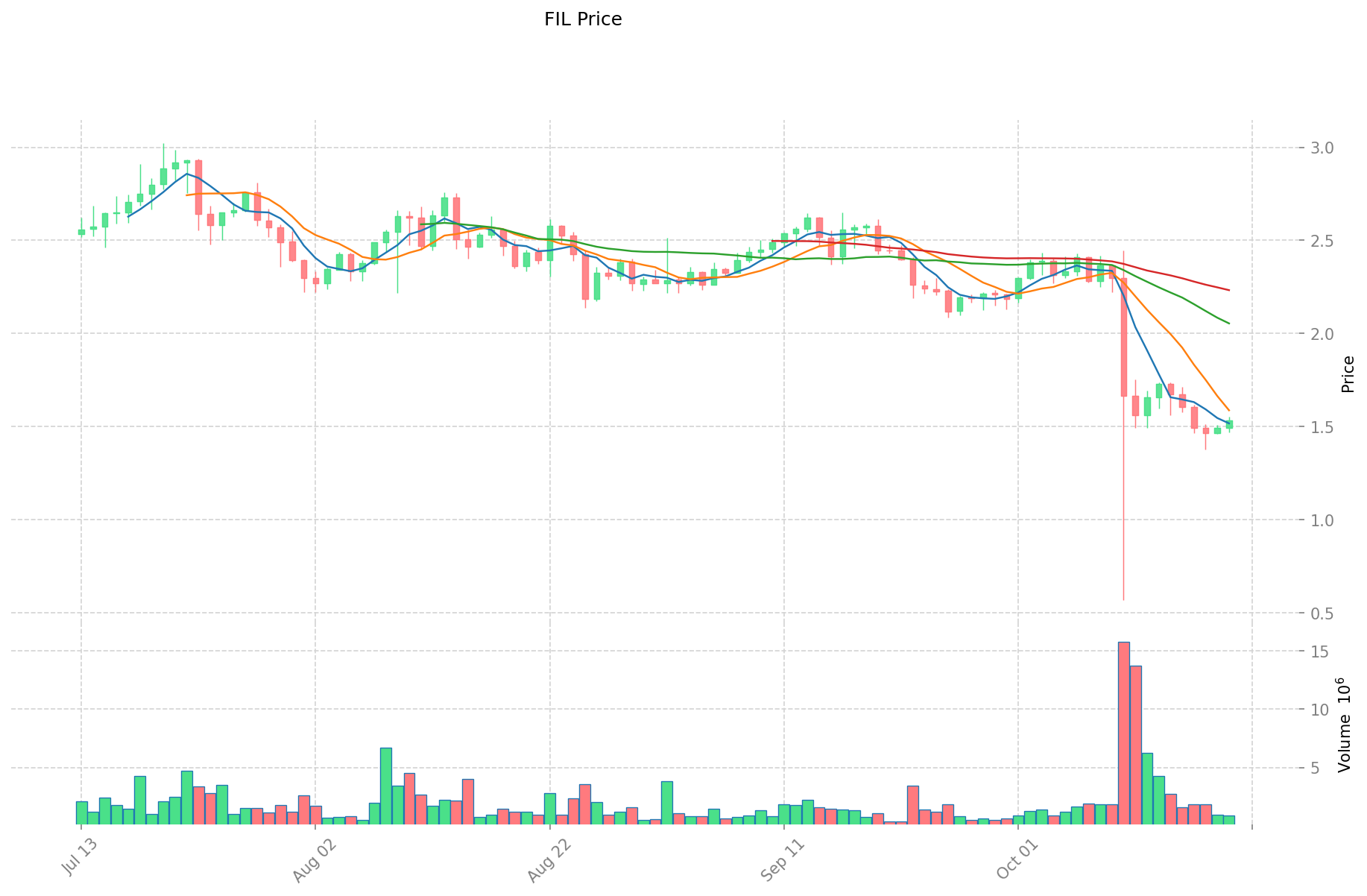
SUSHI and FIL Historical Price Trends
- 2021: SUSHI reached its all-time high of $23.38 on March 14, 2021, during the bull market.
- 2021: FIL hit its all-time high of $236.84 on April 1, 2021, amid the overall crypto market surge.
- Comparative analysis: In the current market cycle, SUSHI has fallen from its all-time high of $23.38 to a low of $0.254831, while FIL has dropped from its peak of $236.84 to a low of $0.848008.
Current Market Situation (2025-10-20)
- SUSHI current price: $0.5262
- FIL current price: $1.506
- 24-hour trading volume: SUSHI $441,732.69 vs FIL $1,359,384.80
- Market Sentiment Index (Fear & Greed Index): 29 (Fear)
Click to view real-time prices:
- Check SUSHI current price Market Price
- Check FIL current price Market Price
II. Core Factors Affecting Investment Value of SUSHI vs FIL
Supply Mechanism Comparison (Tokenomics)
-
SUSHI: Inflationary model with continuous emission, where new tokens are minted as rewards for liquidity providers and stakers in the SushiSwap ecosystem
-
FIL: Capped supply of 2 billion tokens with a deflationary mechanism where tokens are burned during storage operations
-
📌 Historical Pattern: Deflationary models like FIL's tend to create upward price pressure in bull markets, while SUSHI's continuous emission can dilute value unless offset by strong protocol usage.
Institutional Adoption and Market Applications
- Institutional Holdings: FIL has gained more institutional traction, with Grayscale offering a Filecoin Trust product, whereas SUSHI has less institutional-grade investment vehicles
- Enterprise Adoption: FIL has more enterprise applications in decentralized storage solutions, while SUSHI primarily serves DeFi users and liquidity providers
- Regulatory Attitudes: Both tokens face regulatory scrutiny as DeFi protocols, though FIL's utility-focused approach as infrastructure may provide some regulatory advantages compared to SUSHI's pure financial application
Technical Development and Ecosystem Building
- SUSHI Technical Upgrades: Recent development of Sushi 2.0 with improved tokenomics and enhanced yield strategies to compete with other DEXs
- FIL Technical Development: Network upgrades focused on improving storage efficiency, retrieval speeds, and integration with other blockchain ecosystems
- Ecosystem Comparison: SUSHI excels in DeFi applications (DEX, lending, yield) while FIL dominates in decentralized storage infrastructure and has growing Web3 data applications
Macroeconomic Factors and Market Cycles
- Performance in Inflationary Environments: FIL potentially offers better inflation resistance due to its hard cap and utility in digital infrastructure
- Macroeconomic Monetary Policy: Both tokens show sensitivity to risk-off periods during Fed tightening, with SUSHI generally showing higher correlation to overall crypto market movements
- Geopolitical Factors: FIL's decentralized storage utility provides potential value in regions with data sovereignty concerns or censorship risks
III. Price Prediction 2025-2030: SUSHI vs FIL
Short-term Prediction (2025)
- SUSHI: Conservative $0.3255 - $0.525 | Optimistic $0.525 - $0.60375
- FIL: Conservative $1.26504 - $1.506 | Optimistic $1.506 - $2.19876
Mid-term Prediction (2027)
- SUSHI may enter a growth phase, with an expected price range of $0.43863225 - $0.733236
- FIL may enter a consolidation phase, with an expected price range of $1.214049852 - $2.365304022
- Key drivers: Institutional capital inflow, ETF, ecosystem development
Long-term Prediction (2030)
- SUSHI: Base scenario $0.8765525409375 - $1.20964250649375 | Optimistic scenario $1.20964250649375+
- FIL: Base scenario $2.6122312959498 - $3.39590068473474 | Optimistic scenario $3.39590068473474+
View detailed price predictions for SUSHI and FIL
Disclaimer: The above predictions are based on historical data and market analysis. Cryptocurrency markets are highly volatile and subject to change. This information should not be considered as financial advice. Always conduct your own research before making investment decisions.
SUSHI:
| 年份 |
预测最高价 |
预测平均价格 |
预测最低价 |
涨跌幅 |
| 2025 |
0.60375 |
0.525 |
0.3255 |
0 |
| 2026 |
0.744975 |
0.564375 |
0.4176375 |
7 |
| 2027 |
0.733236 |
0.654675 |
0.43863225 |
24 |
| 2028 |
0.798048825 |
0.6939555 |
0.37473597 |
31 |
| 2029 |
1.007102919375 |
0.7460021625 |
0.455061319125 |
41 |
| 2030 |
1.20964250649375 |
0.8765525409375 |
0.64864888029375 |
66 |
FIL:
| 年份 |
预测最高价 |
预测平均价格 |
预测最低价 |
涨跌幅 |
| 2025 |
2.19876 |
1.506 |
1.26504 |
0 |
| 2026 |
2.3339988 |
1.85238 |
1.5004278 |
23 |
| 2027 |
2.365304022 |
2.0931894 |
1.214049852 |
38 |
| 2028 |
2.58592618476 |
2.229246711 |
1.91715217146 |
48 |
| 2029 |
2.8168761440196 |
2.40758644788 |
2.1427519386132 |
59 |
| 2030 |
3.39590068473474 |
2.6122312959498 |
2.22039660155733 |
73 |
IV. Investment Strategy Comparison: SUSHI vs FIL
Long-term vs Short-term Investment Strategies
- SUSHI: Suitable for investors focused on DeFi ecosystem potential and yield farming opportunities
- FIL: Suitable for investors looking for utility-driven tokens with potential for enterprise adoption
Risk Management and Asset Allocation
- Conservative investors: SUSHI: 30% vs FIL: 70%
- Aggressive investors: SUSHI: 60% vs FIL: 40%
- Hedging tools: Stablecoin allocation, options, cross-token portfolio diversification
V. Potential Risk Comparison
Market Risks
- SUSHI: Higher volatility due to DeFi market fluctuations and competitive pressures
- FIL: Susceptible to changes in demand for decentralized storage solutions
Technical Risks
- SUSHI: Scalability issues, smart contract vulnerabilities
- FIL: Network stability, storage provider concentration
Regulatory Risks
- Global regulatory policies may have differing impacts on DeFi protocols (SUSHI) versus utility tokens (FIL)
VI. Conclusion: Which Is the Better Buy?
📌 Investment Value Summary:
- SUSHI advantages: Strong position in DeFi, potential for high yields, active ecosystem development
- FIL advantages: Utility-driven token, enterprise adoption potential, deflationary mechanism
✅ Investment Advice:
- New investors: Consider a higher allocation to FIL due to its utility-driven nature and potential for enterprise adoption
- Experienced investors: Balanced approach with exposure to both SUSHI and FIL, leveraging DeFi yields and storage utility
- Institutional investors: Focus on FIL for its infrastructure play and potential regulatory advantages
⚠️ Risk Warning: Cryptocurrency markets are highly volatile. This article does not constitute investment advice.
None
VII. FAQ
Q1: What are the main differences between SUSHI and FIL?
A: SUSHI is a DeFi token focused on decentralized exchange and liquidity mining, while FIL is a utility token for decentralized storage. SUSHI has an inflationary supply model, whereas FIL has a capped supply with a deflationary mechanism.
Q2: Which token has shown better price performance historically?
A: Both tokens reached their all-time highs in early 2021. FIL hit a higher peak at $236.84, compared to SUSHI's $23.38. However, both have seen significant drops since then, with SUSHI currently at $0.5262 and FIL at $1.506 as of 2025-10-20.
Q3: How do institutional adoption and market applications differ for SUSHI and FIL?
A: FIL has gained more institutional traction, with products like Grayscale's Filecoin Trust. It also has more enterprise applications in decentralized storage. SUSHI primarily serves DeFi users and lacks institutional-grade investment vehicles.
Q4: What are the key technical developments for each token?
A: SUSHI has recently developed Sushi 2.0 with improved tokenomics and yield strategies. FIL focuses on upgrading its network for better storage efficiency, retrieval speeds, and blockchain ecosystem integration.
Q5: How do the long-term price predictions for SUSHI and FIL compare?
A: By 2030, the base scenario for SUSHI predicts a range of $0.8765525409375 - $1.20964250649375, while FIL's base scenario is $2.6122312959498 - $3.39590068473474. FIL is projected to have a higher price and percentage increase.
Q6: What are the main investment risks for each token?
A: SUSHI faces higher volatility due to DeFi market fluctuations and competitive pressures, as well as potential smart contract vulnerabilities. FIL is susceptible to changes in demand for decentralized storage and risks related to network stability and storage provider concentration.
Q7: Which token might be better for different types of investors?
A: New investors might consider a higher allocation to FIL due to its utility-driven nature and enterprise adoption potential. Experienced investors could take a balanced approach with both tokens. Institutional investors may focus more on FIL for its infrastructure play and potential regulatory advantages.
* The information is not intended to be and does not constitute financial advice or any other recommendation of any sort offered or endorsed by Gate.













