This comprehensive comparison analyzes SUSHI and LTC as distinct cryptocurrency investment assets within the digital market landscape. SUSHI operates as a decentralized exchange governance token tied to DeFi platform activity, while LTC functions as a payment-focused cryptocurrency with fixed 84-million-coin supply and halving mechanisms. The article addresses key investment questions by examining historical price trends, market capitalization differences ($98.24M vs $5.73B), trading volume variations, tokenomics structures, institutional adoption patterns, and technical ecosystems. Both assets face distinct regulatory environments and risk profiles—SUSHI experiences higher volatility due to smaller market cap and DeFi sector concentration, while LTC demonstrates established payment infrastructure recognition. The analysis includes 2026-2031 price forecasts, investment strategy considerations for different investor types, and detailed risk comparisons. Readers gain clarity on which asset aligns with their inv
Introduction: SUSHI vs LTC Investment Comparison
In the cryptocurrency market, the comparison between SUSHI and LTC has consistently been a topic that investors cannot overlook. The two differ notably in market capitalization ranking, application scenarios, and price performance, representing distinct positions within the crypto asset landscape.
SUSHI (SUSHI): Since its launch in 2020, it has gained market recognition through its positioning in decentralized exchange governance and liquidity mining mechanisms.
LTC (LTC): Since its introduction in 2011, it has been regarded as a peer-to-peer payment cryptocurrency, being among the cryptocurrencies with substantial global trading volume and market capitalization.
This article will provide a comprehensive analysis of the investment value comparison between SUSHI and LTC, focusing on historical price trends, supply mechanisms, institutional adoption, technological ecosystems, and future forecasts, attempting to address the question that concerns investors most:
"Which is the better buy right now?"
I. Price History Comparison and Current Market Status
Historical Price Trends of SUSHI (Coin A) and LTC (Coin B)
- 2021: SUSHI reached a price peak of $23.38 in March 2021, coinciding with the broader crypto market rally during that period.
- 2011-2021: LTC, launched in 2011 by Charlie Lee, experienced significant growth over the years, reaching its all-time high of $410.26 in May 2021 during the same market cycle.
- 2025: SUSHI recorded its historical low of $0.254831 in October 2025, reflecting substantial price decline.
- 2015: LTC hit its historical low of $1.15 in January 2015, before the subsequent multi-year bull market.
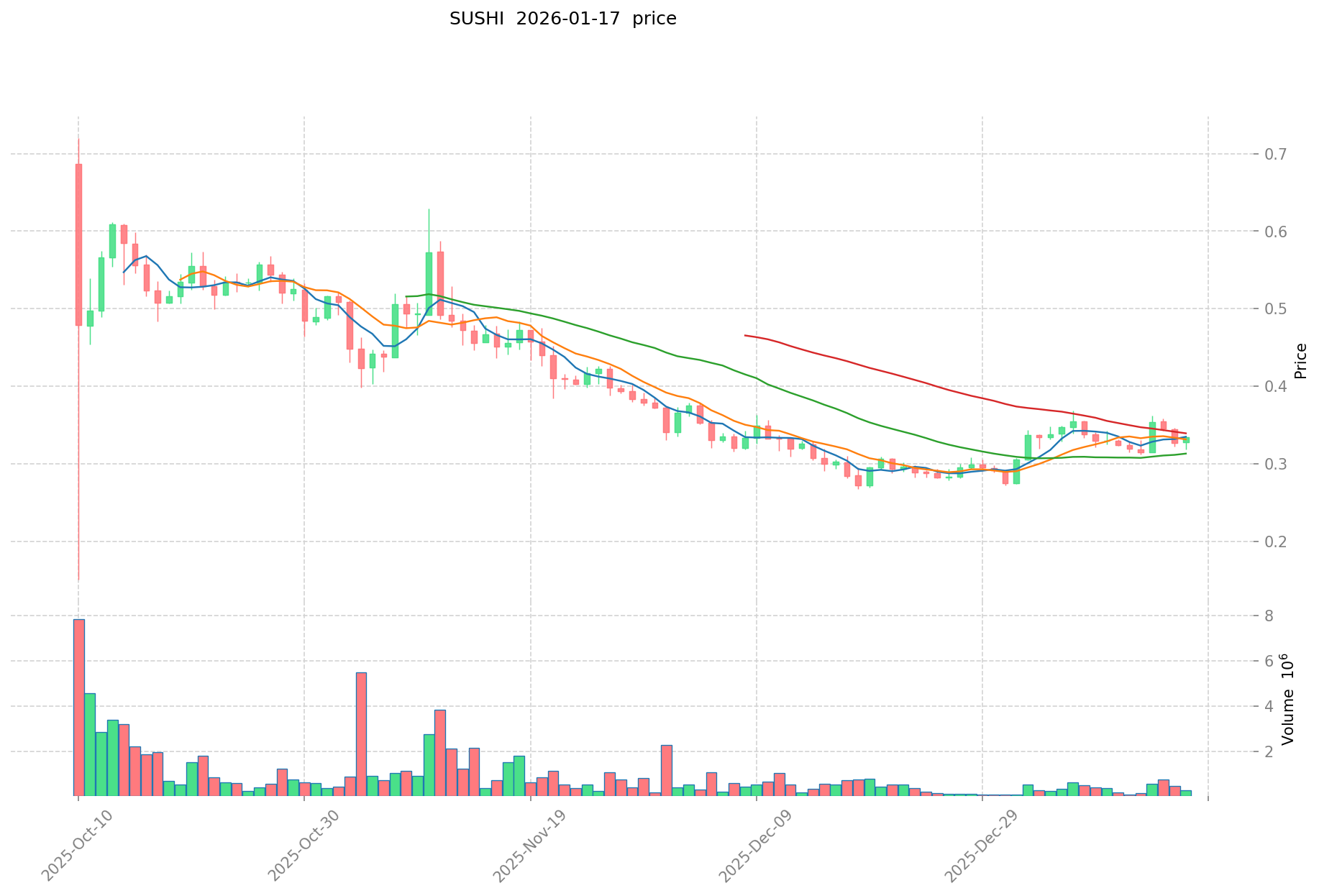
- Comparative Analysis: During the 2021-2025 market cycle, SUSHI declined from its peak of $23.38 to approximately $0.34, representing a significant retracement. In contrast, LTC decreased from $410.26 to around $74.65, showing a more moderate decline in percentage terms.
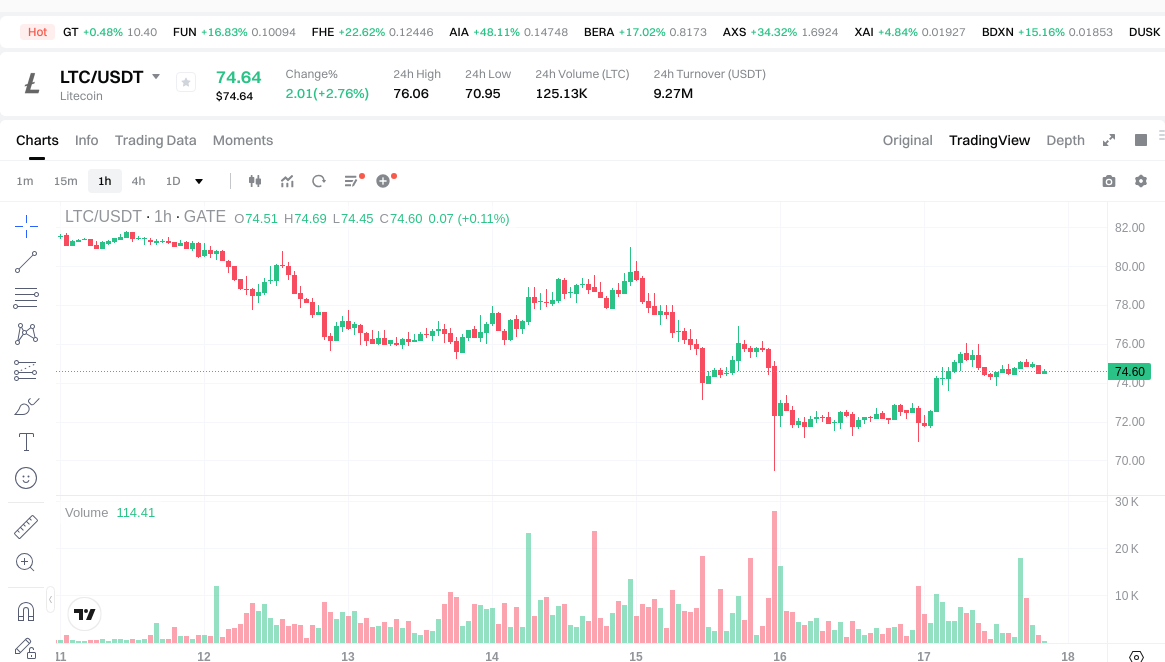
Current Market Situation (2026-01-17)
- SUSHI Current Price: $0.3415
- LTC Current Price: $74.65
- 24-Hour Trading Volume: SUSHI shows $134,026.971055 compared to LTC's $9,284,697.88074
- Market Sentiment Index (Fear & Greed Index): 50 (Neutral)
- Short-term Performance: SUSHI demonstrated a 24-hour price change of +3.36%, while LTC showed +2.37%
- Market Capitalization: SUSHI holds $98,241,478.76 in total market cap versus LTC's $5,729,073,651.50
- Circulating Supply: SUSHI has 273,012,266.13 tokens in circulation, while LTC has 76,744,158.23 coins circulating
View real-time prices:
II. Core Factors Influencing SUSHI vs LTC Investment Value
Tokenomics Comparison
-
SUSHI: SushiSwap operates with a token model tied to its decentralized exchange platform. The value proposition centers on trading volume and liquidity pool participation, where token holders can earn rewards through staking and liquidity provision.
-
LTC: Litecoin features a capped supply of 84 million coins with a halving mechanism that reduces mining rewards periodically. This deflationary model mirrors Bitcoin's scarcity principle, positioning LTC as a faster alternative for transactions.
-
📌 Historical Pattern: Supply mechanisms influence price cycles differently—SUSHI's value correlates with platform activity and DeFi adoption, while LTC's halvings historically precede potential price appreciation periods.
Institutional Adoption and Market Applications
-
Institutional Holdings: Litecoin has demonstrated relatively stronger institutional recognition as a payment-focused cryptocurrency, benefiting from its longer establishment since 2011. SUSHI remains primarily within the DeFi ecosystem without significant institutional treasury adoption.
-
Enterprise Adoption: LTC has seen integration in payment systems and cross-border settlement solutions due to faster transaction speeds compared to Bitcoin. SUSHI's application remains concentrated in decentralized trading and liquidity provision within the DeFi space.
-
Regulatory Environment: Different jurisdictions have varied approaches—Litecoin's payment utility has received clearer regulatory treatment in several markets, while DeFi protocols like SushiSwap face evolving regulatory frameworks regarding decentralized exchange operations.
Technical Development and Ecosystem Building
-
SUSHI Technical Evolution: The platform continues developing its automated market maker (AMM) system and expanding cross-chain capabilities. Long-term value depends on sustained trading volume growth and DeFi sector adoption.
-
LTC Technical Progress: Litecoin maintains focus on transaction efficiency and network security upgrades. Its technical development emphasizes payment functionality and compatibility improvements.
-
Ecosystem Comparison: SUSHI operates within the DeFi ecosystem with liquidity pools and yield farming mechanisms. LTC positions itself in payment infrastructure and value transfer applications, with limited smart contract functionality compared to DeFi-native protocols.
Macroeconomic Environment and Market Cycles
-
Inflationary Context Performance: Litecoin's fixed supply structure may provide potential inflation hedge characteristics similar to other capped-supply cryptocurrencies. SUSHI's value remains more closely tied to DeFi sector growth rather than macroeconomic hedging narratives.
-
Monetary Policy Impact: Interest rate changes and dollar index movements affect broader crypto market sentiment. Both assets exhibit sensitivity to liquidity conditions, though LTC may show correlation patterns more aligned with established cryptocurrencies.
-
Geopolitical Factors: Cross-border payment demand and international regulatory developments impact both assets differently—LTC benefits from payment use case recognition, while SUSHI's exposure relates to global DeFi regulatory evolution and decentralized trading demand.
III. 2026-2031 Price Prediction: SUSHI vs LTC
Short-term Forecast (2026)
- SUSHI: Conservative $0.28044-$0.342 | Optimistic $0.342-$0.48906
- LTC: Conservative $44.014-$74.6 | Optimistic $74.6-$96.234
Medium-term Forecast (2028-2029)
- SUSHI may enter a growth phase, with projected price range of $0.317-$0.639
- LTC may enter an expansion phase, with projected price range of $64.47-$160.94
- Key drivers: institutional capital inflows, ETF developments, ecosystem expansion
Long-term Forecast (2030-2031)
- SUSHI: Base scenario $0.299-$0.684 | Optimistic scenario $0.622-$0.882
- LTC: Base scenario $80.29-$140.86 | Optimistic scenario $83.27-$197.20
View detailed price predictions for SUSHI and LTC
Disclaimer
SUSHI:
| Year |
Predicted High Price |
Predicted Average Price |
Predicted Low Price |
Price Change |
| 2026 |
0.48906 |
0.342 |
0.28044 |
0 |
| 2027 |
0.4653936 |
0.41553 |
0.2991816 |
21 |
| 2028 |
0.581409576 |
0.4404618 |
0.317132496 |
28 |
| 2029 |
0.63866961 |
0.510935688 |
0.4087485504 |
49 |
| 2030 |
0.79322765562 |
0.574802649 |
0.29889737748 |
68 |
| 2031 |
0.8823795464799 |
0.68401515231 |
0.6224537886021 |
100 |
LTC:
| Year |
Predicted High Price |
Predicted Average Price |
Predicted Low Price |
Price Change |
| 2026 |
96.234 |
74.6 |
44.014 |
0 |
| 2027 |
104.20874 |
85.417 |
52.10437 |
14 |
| 2028 |
138.4267902 |
94.81287 |
64.4727516 |
27 |
| 2029 |
160.935365538 |
116.6198301 |
83.966277672 |
56 |
| 2030 |
142.94092575357 |
138.777597819 |
83.2665586914 |
85 |
| 2031 |
197.202966500799 |
140.859261786285 |
80.28977921818245 |
88 |
IV. Investment Strategy Comparison: SUSHI vs LTC
Long-term vs Short-term Investment Strategies
-
SUSHI: May appeal to investors focused on DeFi ecosystem participation and decentralized exchange platform development. The asset's value proposition ties closely to trading volume growth and liquidity provision mechanisms within the decentralized finance sector.
-
LTC: May suit investors interested in payment infrastructure applications and assets with established market presence. The token's longer operational history since 2011 and fixed supply mechanism position it differently in portfolio considerations.
Risk Management and Asset Allocation
-
Conservative Investors: Consider portfolio weighting that accounts for market capitalization differences—SUSHI represents a smaller market cap position ($98.24M) compared to LTC ($5.73B), suggesting different risk-return profiles.
-
Aggressive Investors: May evaluate higher allocation to smaller market cap assets like SUSHI for potential growth exposure, while maintaining LTC positions for established cryptocurrency market participation.
-
Hedging Tools: Portfolio diversification strategies may include stablecoin allocations, derivatives instruments where available, and cross-asset positioning to manage volatility exposure across different crypto sectors.
V. Potential Risk Comparison
Market Risks
-
SUSHI: Experiences significant price volatility, with historical decline from $23.38 (March 2021) to $0.254831 (October 2025). Trading volume of $134,026.97 indicates relatively lower liquidity compared to established cryptocurrencies. Value correlation with DeFi sector performance creates concentrated exposure to decentralized exchange adoption trends.
-
LTC: Demonstrates price fluctuations with decline from $410.26 (May 2021) to current levels around $74.65. Trading volume of $9.28M provides relatively higher liquidity. Market performance shows correlation with broader cryptocurrency market cycles and payment-focused digital asset sentiment.
Technical Risks
-
SUSHI: Platform development depends on sustained DeFi sector growth and automated market maker technology evolution. Cross-chain expansion progress and smart contract security considerations impact long-term functionality.
-
LTC: Network security relies on mining infrastructure distribution and consensus mechanism stability. Transaction processing efficiency and protocol upgrade implementation represent ongoing technical considerations.
Regulatory Risks
- Different jurisdictions maintain evolving frameworks regarding decentralized finance protocols and payment-focused cryptocurrencies. SUSHI faces regulatory developments specific to decentralized exchange operations and DeFi protocol governance. LTC encounters regulatory considerations related to payment applications and cryptocurrency classification across various markets. Both assets remain subject to changing compliance requirements and jurisdictional policy variations.
VI. Conclusion: Which Is the Better Buy?
📌 Investment Value Summary
-
SUSHI Characteristics: Participation in decentralized finance ecosystem with automated market maker functionality. Lower market capitalization ($98.24M) suggests different risk-return profile. Current price positioning at $0.3415 with 24-hour change of +3.36%. Projected price ranges show potential variability from $0.28-$0.88 across forecast periods through 2031.
-
LTC Characteristics: Established market presence since 2011 with payment infrastructure focus. Larger market capitalization ($5.73B) indicates different positioning within crypto asset landscape. Current price at $74.65 with 24-hour change of +2.37%. Fixed supply mechanism with halving events influences supply dynamics. Projected price ranges span $44-$197 across forecast periods through 2031.
✅ Investment Considerations
-
New Market Participants: May consider starting with established cryptocurrencies that have longer operational histories and higher liquidity profiles. Understanding fundamental differences between DeFi protocol tokens and payment-focused cryptocurrencies aids informed decision-making.
-
Experienced Market Participants: Portfolio allocation decisions should account for risk tolerance, investment timeframes, and sector exposure preferences. Diversification across different cryptocurrency categories and market capitalizations represents a common approach to managing concentration risks.
-
Institutional Participants: Due diligence processes typically evaluate factors including regulatory clarity, custody solutions availability, liquidity depth, and alignment with institutional investment mandates. Different cryptocurrencies present varying degrees of institutional infrastructure development.
⚠️ Risk Disclosure: Cryptocurrency markets exhibit substantial price volatility and regulatory uncertainty. This analysis does not constitute investment advice, financial recommendations, or predictions of future performance. Market participants should conduct independent research and consult qualified professionals before making investment decisions. Past performance does not indicate future results. Investment losses may occur.
VII. FAQ
Q1: What are the fundamental differences between SUSHI and LTC as investment assets?
SUSHI operates as a DeFi governance token for decentralized exchange operations, while LTC functions as a payment-focused cryptocurrency with a fixed supply cap. SUSHI's value correlates with decentralized trading volume and liquidity provision mechanisms within the DeFi ecosystem, whereas LTC positions itself as a faster payment alternative with transaction efficiency as its primary utility. The market capitalization gap is substantial—LTC at $5.73B versus SUSHI at $98.24M—reflecting their different maturity levels and market adoption stages. LTC benefits from 15 years of operational history since 2011, while SUSHI emerged in 2020 during the DeFi expansion period.
Q2: How do the supply mechanisms of SUSHI and LTC affect their investment characteristics?
LTC features a deflationary model with an 84 million coin cap and periodic halving events that reduce mining rewards, creating scarcity dynamics similar to Bitcoin's tokenomics. SUSHI operates without a fixed supply cap, with value generation tied to platform trading activity and liquidity rewards distribution. LTC's halving mechanism historically precedes potential appreciation periods as reduced supply issuance meets sustained demand. SUSHI's token economics depend on decentralized exchange adoption rates and DeFi sector growth rather than programmatic supply restrictions. These structural differences create distinct risk-return profiles across market cycles.
Q3: Which asset shows higher volatility and liquidity considerations?
SUSHI demonstrates significantly higher percentage volatility, declining approximately 98.5% from its $23.38 peak (March 2021) to $0.254831 low (October 2025), compared to LTC's decline of approximately 81.8% from $410.26 to current levels around $74.65 during similar periods. Trading volume analysis shows LTC at $9.28M versus SUSHI at $134,026.97 in 24-hour volume, indicating LTC provides approximately 69 times higher liquidity. Market depth differences impact execution costs and slippage potential during position changes. SUSHI's smaller market capitalization creates greater susceptibility to concentrated trading activity effects.
Q4: What regulatory environments affect SUSHI versus LTC differently?
LTC benefits from clearer regulatory treatment in several jurisdictions due to its payment utility classification and longer operational history. Payment-focused cryptocurrencies generally receive more established regulatory frameworks compared to DeFi protocol tokens. SUSHI faces evolving compliance considerations specific to decentralized exchange operations, automated market maker functionality, and protocol governance mechanisms. Different regulatory approaches to DeFi versus payment cryptocurrencies create varying compliance requirements across jurisdictions. Both assets remain subject to changing policy frameworks, though LTC's payment infrastructure positioning provides relatively more regulatory precedent.
Q5: How do institutional adoption patterns differ between these assets?
LTC demonstrates relatively stronger institutional recognition with integration in payment systems and cross-border settlement solutions, benefiting from its established market presence and payment utility focus. SUSHI remains primarily within the DeFi ecosystem without significant institutional treasury adoption, as decentralized exchange governance tokens generally receive limited corporate balance sheet allocation. Institutional infrastructure availability—including custody solutions, regulatory clarity, and trading venue depth—favors LTC's payment-focused positioning over SUSHI's DeFi protocol orientation. These adoption pattern differences reflect institutional investment mandate alignment and risk management framework compatibility.
Q6: What factors should determine allocation decisions between SUSHI and LTC?
Portfolio allocation should consider risk tolerance levels, investment timeframes, sector exposure preferences, and market capitalization diversification strategies. Conservative approaches may favor higher LTC weighting given its larger market cap ($5.73B) and established operational history, while allocating smaller positions to SUSHI's DeFi ecosystem exposure. Aggressive strategies might increase SUSHI allocation for potential growth exposure within decentralized trading development, maintaining LTC positions for broader cryptocurrency market participation. Correlation analysis shows SUSHI's performance ties closely to DeFi sector trends, whereas LTC correlates more with established cryptocurrency market cycles and payment adoption developments.
Q7: What are the projected price trajectories and key uncertainties for 2026-2031?
SUSHI projections range from conservative $0.28-$0.68 to optimistic $0.62-$0.88 across the 2026-2031 forecast period, reflecting high uncertainty around DeFi sector growth trajectories and decentralized exchange adoption rates. LTC forecasts span conservative $44-$140 to optimistic $83-$197 during the same timeframe, influenced by halving event cycles and payment infrastructure development. Key uncertainties include regulatory framework evolution, macroeconomic conditions affecting crypto market liquidity, technological development progress, and institutional adoption pace. Both assets face substantial forecast variability, with SUSHI showing relatively higher percentage range due to smaller market capitalization and sector-specific dependencies.
Q8: What risk management approaches apply to positions in these assets?
Risk management strategies should incorporate position sizing relative to total portfolio value, with smaller market cap assets like SUSHI warranting reduced allocation percentages compared to established cryptocurrencies. Diversification across different crypto sectors—DeFi protocols versus payment infrastructure—provides exposure balance and reduces concentration risk. Implementing stop-loss mechanisms, rebalancing schedules, and regular portfolio reviews helps manage volatility exposure. Hedging tools may include stablecoin allocations for liquidity reserves and derivatives instruments where available. Understanding correlation patterns with broader cryptocurrency markets and specific sector developments enables informed risk adjustment decisions across changing market conditions.
* The information is not intended to be and does not constitute financial advice or any other recommendation of any sort offered or endorsed by Gate.