This comprehensive guide compares SWASH and XLM, two distinct cryptocurrency tokens operating in different market segments. SWASH, launched in 2021, focuses on data economy ecosystems enabling data monetization, currently trading at $0.001952 with limited liquidity. XLM (Stellar), established since 2014, serves as a cross-border payment infrastructure at $0.1807 with significantly higher trading volume. The article examines historical price trends, market sentiment, technological innovations, and adoption dynamics. Long-term predictions through 2031 suggest moderate growth for both assets, with XLM maintaining higher liquidity and stability. Investment recommendations vary by investor profile: conservative investors favor XLM (85-90% allocation), while experienced investors consider balanced approaches. Understanding risk factors—including market volatility, regulatory environment, and adoption challenges—is essential for making informed decisions through Gate trading platforms.
Introduction: Investment Comparison Between SWASH and XLM
In the cryptocurrency market, the comparison between SWASH vs XLM has consistently been a topic that investors cannot overlook. The two not only show distinct differences in market cap ranking, application scenarios, and price performance, but also represent different positioning within the crypto asset landscape.
SWASH: Launched in 2021, it has gained market recognition through its positioning as a data economy ecosystem that enables individuals, businesses, and developers to unlock data value through aggregation, secure sharing, and monetization.
XLM (Stellar): Since its launch in 2014, it has been recognized for its cross-border payment efficiency, establishing a decentralized gateway for transmission between digital and fiat currencies, becoming one of the cryptocurrencies with significant global trading volume and market presence.
This article will comprehensively analyze the investment value comparison between SWASH vs XLM around historical price trends, supply mechanisms, institutional adoption, technical ecosystems, and future predictions, attempting to answer the question that investors care about most:
"Which is the better buy right now?"
I. Price History Comparison and Current Market Status
- 2021: SWASH experienced significant volatility following its initial launch, with prices reaching a peak of $0.95025 in October 2021, driven by early market enthusiasm and initial adoption of its data monetization platform.
- 2018: XLM saw notable price movements during this period, with the token reaching its all-time high of $0.875563 in January 2018, reflecting strong market interest in cross-border payment solutions and blockchain-based financial infrastructure.
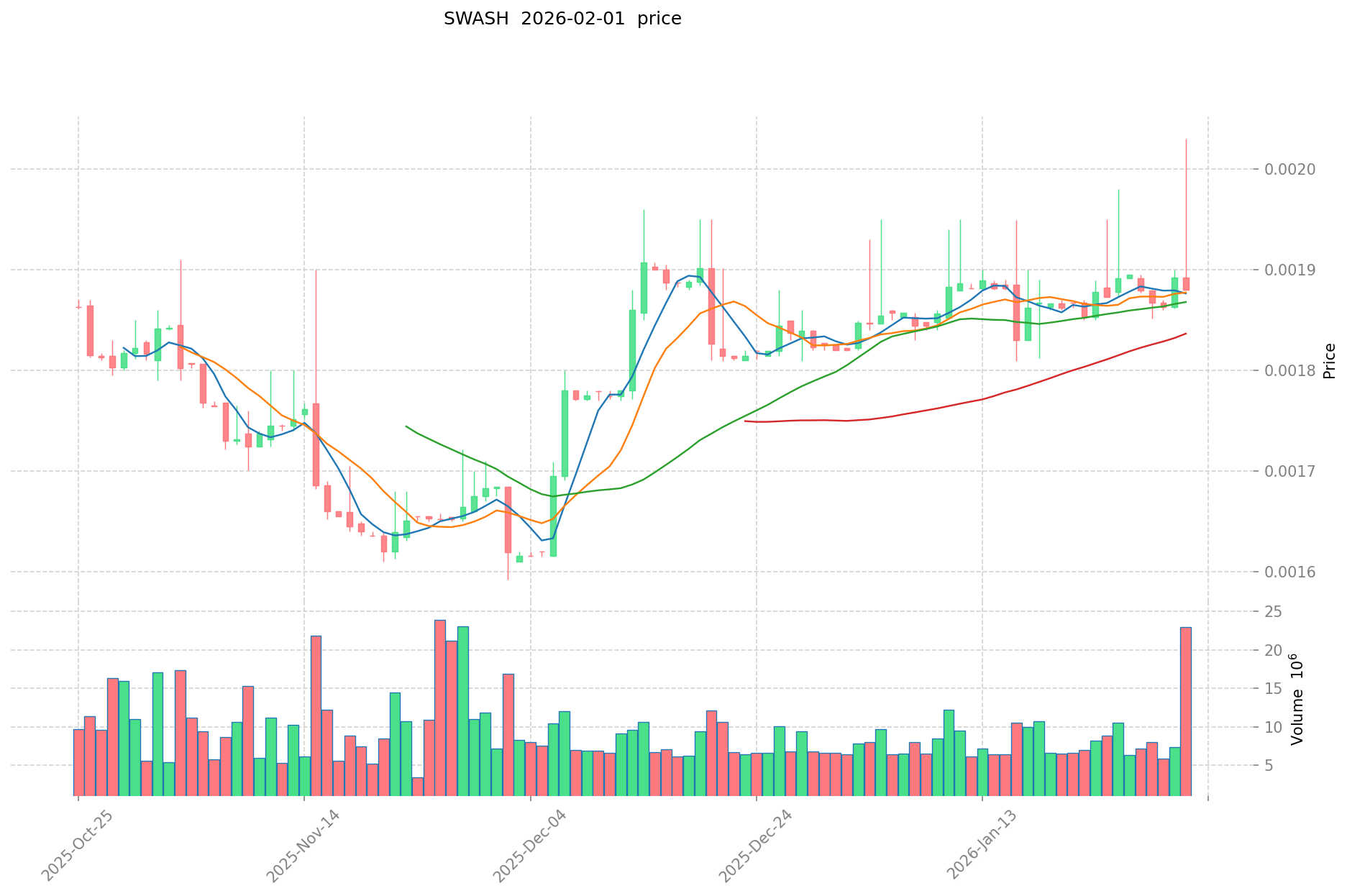
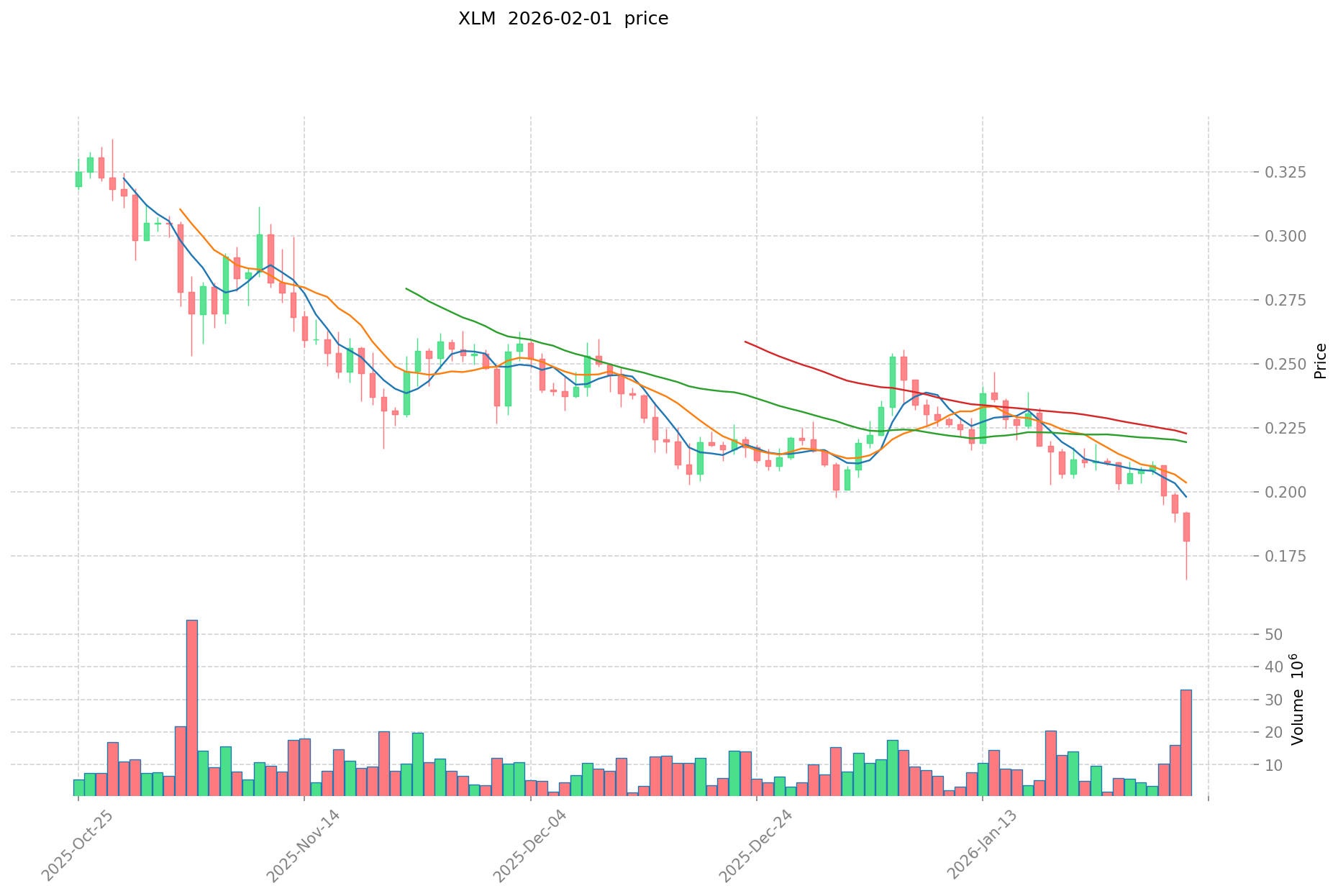
- Comparative Analysis: During the broader market correction cycle, SWASH declined from its peak of $0.95025 to its historical low of $0.00159234 recorded in December 2025, while XLM experienced a more moderate downturn from its high of $0.875563 to a low of $0.00047612 recorded in March 2015.
Current Market Status (2026-02-01)
- SWASH Current Price: $0.001952
- XLM Current Price: $0.1807
- 24-Hour Trading Volume: SWASH $16,601.82 vs XLM $5,979,317.74
- Market Sentiment Index (Fear & Greed Index): 14 (Extreme Fear)
View real-time prices:
II. Core Factors Influencing SWASH vs XLM Investment Value
Market Sentiment and Regulatory Environment
-
Market Sentiment: Investor sentiment and confidence have a direct impact on the price movements of both SWASH and XLM. Changes in market perception can lead to significant volatility in their respective valuations.
-
Regulatory Environment: Government policies and regulatory frameworks toward cryptocurrencies directly affect market acceptance and accessibility. Different jurisdictions' approaches to crypto regulation influence the relative value of these assets against traditional fiat currencies.
-
Macroeconomic Trends: Broader economic trends, including inflation rates, monetary policy decisions, and global economic conditions, play a crucial role in shaping the investment landscape for both SWASH and XLM.
Technology Innovation and Development
-
Technology innovation represents a key driver for both assets' long-term value proposition. Advancements in underlying blockchain infrastructure, protocol upgrades, and technical improvements can significantly impact their market positions and adoption rates.
-
The pace of technological development and the ability to address scalability, security, and interoperability challenges influence investor confidence and market valuation.
Market Acceptance and Adoption Dynamics
-
The level of market acceptance directly correlates with trading volumes, liquidity, and price stability. Both SWASH and XLM face distinct challenges and opportunities in terms of ecosystem development and real-world adoption.
-
Network effects and community engagement contribute to the overall market perception and investment appeal of each asset.
Price Volatility Characteristics
-
Cryptocurrency markets are characterized by frequent price fluctuations. Both SWASH and XLM exhibit volatility patterns influenced by the aforementioned factors, including market sentiment, regulatory developments, and technological progress.
-
Understanding the interplay between these various factors is essential for assessing the relative investment value of SWASH and XLM in different market conditions.
III. 2026-2031 Price Prediction: SWASH vs XLM
Short-term Prediction (2026)
- SWASH: Conservative $0.0013664 - $0.001952 | Optimistic $0.001952 - $0.00259616
- XLM: Conservative $0.1759483 - $0.18139 | Optimistic $0.18139 - $0.2612016
Mid-term Prediction (2028-2029)
- SWASH may enter a gradual growth phase, with estimated price range of $0.001684865872 - $0.0033914719488
- XLM may enter a moderate expansion phase, with estimated price range of $0.18752606092 - $0.33804039929
- Key drivers: institutional capital inflows, ETF developments, ecosystem expansion
Long-term Prediction (2031)
- SWASH: Baseline scenario $0.0026893100752 - $0.003404189968608 | Optimistic scenario $0.003404189968608 - $0.004153111761701
- XLM: Baseline scenario $0.195865694301459 - $0.384050380983253 | Optimistic scenario $0.384050380983253 - $0.449338945750407
View detailed price predictions for SWASH and XLM
Disclaimer
SWASH:
| Year |
Predicted High Price |
Predicted Average Price |
Predicted Low Price |
Price Change |
| 2026 |
0.00259616 |
0.001952 |
0.0013664 |
0 |
| 2027 |
0.0031609712 |
0.00227408 |
0.001478152 |
16 |
| 2028 |
0.002934927648 |
0.0027175256 |
0.001684865872 |
39 |
| 2029 |
0.0033914719488 |
0.002826226624 |
0.00186530957184 |
44 |
| 2030 |
0.003699530650816 |
0.0031088492864 |
0.002766875864896 |
59 |
| 2031 |
0.004153111761701 |
0.003404189968608 |
0.0026893100752 |
74 |
XLM:
| Year |
Predicted High Price |
Predicted Average Price |
Predicted Low Price |
Price Change |
| 2026 |
0.2612016 |
0.18139 |
0.1759483 |
0 |
| 2027 |
0.272193834 |
0.2212958 |
0.139416354 |
22 |
| 2028 |
0.33804039929 |
0.246744817 |
0.18752606092 |
36 |
| 2029 |
0.32455579504095 |
0.292392608145 |
0.21344660394585 |
61 |
| 2030 |
0.459626560373532 |
0.308474201592975 |
0.157321842812417 |
70 |
| 2031 |
0.449338945750407 |
0.384050380983253 |
0.195865694301459 |
112 |
IV. Investment Strategy Comparison: SWASH vs XLM
Long-term vs Short-term Investment Strategies
- SWASH: Suitable for investors focused on data economy innovation and early-stage ecosystem development opportunities, particularly those with higher risk tolerance and interest in emerging data monetization platforms.
- XLM: Suitable for investors seeking exposure to established cross-border payment infrastructure and those interested in decentralized financial gateways with proven market presence.
Risk Management and Asset Allocation
- Conservative Investors: SWASH 10-15% vs XLM 85-90%
- Aggressive Investors: SWASH 30-40% vs XLM 60-70%
- Hedging Tools: Stablecoin allocation, options strategies, cross-asset portfolio diversification
V. Potential Risk Comparison
Market Risk
- SWASH: Subject to higher volatility due to lower market capitalization and trading volume ($16,601.82 daily), with price movements potentially influenced by limited liquidity conditions.
- XLM: Experiences market fluctuations driven by broader cryptocurrency sentiment, regulatory developments, and macroeconomic trends, with relatively higher liquidity ($5,979,317.74 daily trading volume).
Technical Risk
- SWASH: Scalability considerations and network stability as the data economy platform continues development.
- XLM: Network infrastructure dependencies and ongoing technical evolution requirements.
Regulatory Risk
- Global regulatory policies toward cryptocurrencies affect both assets differently, with cross-border payment solutions like XLM potentially facing heightened scrutiny from financial authorities, while data-focused platforms like SWASH navigate evolving data privacy and digital asset regulations across jurisdictions.
VI. Conclusion: Which Is the Better Buy?
📌 Investment Value Summary:
- SWASH Strengths: Early-stage positioning in the data economy sector with potential for growth as data monetization adoption expands, offering exposure to an emerging market segment.
- XLM Strengths: Established market presence since 2014 with proven cross-border payment infrastructure, higher liquidity levels, and broader institutional recognition in the decentralized financial gateway space.
✅ Investment Recommendations:
- Novice Investors: Consider starting with XLM due to its established market position, higher liquidity, and more accessible entry point, while allocating a smaller portion to SWASH for diversification if comfortable with elevated risk levels.
- Experienced Investors: Evaluate a balanced approach with heavier XLM allocation for stability, supplemented by strategic SWASH positions to capture potential upside from data economy developments, adjusting ratios based on individual risk profiles.
- Institutional Investors: Focus on XLM for core holdings given its established infrastructure and higher trading volumes, while selectively incorporating SWASH for portfolio diversification and exposure to emerging data monetization trends.
⚠️ Risk Warning: The cryptocurrency market exhibits extreme volatility. This article does not constitute investment advice.
VII. FAQ
Q1: What is the main difference between SWASH and XLM in terms of their core functionality?
SWASH is a data economy ecosystem focused on data aggregation, secure sharing, and monetization for individuals and businesses, while XLM (Stellar) is a cross-border payment infrastructure serving as a decentralized gateway between digital and fiat currencies. SWASH launched in 2021 targeting the emerging data monetization market, whereas XLM has been operational since 2014 with established financial infrastructure for global payments. The fundamental distinction lies in their market positioning: SWASH addresses data value unlocking, while XLM facilitates efficient cross-border transactions and digital-to-fiat currency transmission.
Q2: Which cryptocurrency currently has better liquidity: SWASH or XLM?
XLM demonstrates significantly superior liquidity compared to SWASH. As of February 1, 2026, XLM's 24-hour trading volume stands at $5,979,317.74, whereas SWASH records only $16,601.82 in daily trading volume—representing approximately 360 times higher liquidity for XLM. This substantial difference impacts price stability, entry/exit flexibility, and overall trading execution. Higher liquidity typically translates to tighter bid-ask spreads and reduced slippage for investors, making XLM considerably more accessible for both retail and institutional market participants.
Q3: What are the projected price ranges for SWASH and XLM by 2031?
According to long-term predictions for 2031, SWASH is projected to reach a baseline scenario range of $0.0026893100752 - $0.003404189968608, with an optimistic scenario extending to $0.003404189968608 - $0.004153111761701. XLM's 2031 predictions indicate a baseline range of $0.195865694301459 - $0.384050380983253, with optimistic projections reaching $0.384050380983253 - $0.449338945750407. These forecasts suggest XLM maintaining substantially higher absolute price levels, while both assets show potential for gradual appreciation driven by factors including institutional capital inflows, ecosystem expansion, and broader market adoption.
Q4: What level of risk should investors expect when comparing SWASH and XLM?
SWASH carries higher investment risk due to its lower market capitalization, limited trading volume ($16,601.82 daily), and early-stage ecosystem development, making it more susceptible to price volatility and liquidity constraints. XLM presents moderate risk with established market presence since 2014, significantly higher liquidity ($5,979,317.74 daily volume), and proven infrastructure, though it remains subject to broader cryptocurrency market fluctuations and regulatory developments. Conservative investors typically favor 85-90% XLM allocation versus 10-15% SWASH, while aggressive investors might consider 60-70% XLM and 30-40% SWASH positions depending on individual risk tolerance and portfolio diversification strategies.
Q5: How do market sentiment and regulatory factors affect SWASH and XLM differently?
Market sentiment impacts both assets through investor confidence and perception shifts, though SWASH's lower liquidity amplifies volatility during sentiment swings, while XLM's established position provides relative stability. Regulatory developments affect them distinctly: XLM faces heightened scrutiny as a cross-border payment solution from financial authorities monitoring international money transmission, whereas SWASH navigates evolving data privacy regulations and digital asset frameworks governing data monetization platforms. The current Fear & Greed Index of 14 (Extreme Fear) influences both assets, but XLM's institutional recognition and regulatory clarity in certain jurisdictions provide comparatively more predictable compliance pathways than SWASH's emerging data economy sector.
Q6: What allocation strategy should different investor types consider for SWASH vs XLM?
Novice investors should consider starting with XLM due to its established market position, higher liquidity, and accessibility, potentially allocating 85-95% to XLM with 5-15% to SWASH for diversification if comfortable with elevated risk. Experienced investors might evaluate a balanced 60-80% XLM allocation for stability, supplemented by 20-40% SWASH positions to capture data economy upside, adjusting based on individual risk profiles. Institutional investors typically focus on XLM for core holdings given proven infrastructure and higher trading volumes ($5,979,317.74 daily), while selectively incorporating 10-25% SWASH for portfolio diversification and exposure to emerging data monetization trends, always maintaining risk management protocols and hedging strategies.
Q7: What are the key technological factors distinguishing SWASH from XLM?
SWASH's technology centers on data economy infrastructure enabling secure data aggregation, sharing, and monetization mechanisms for participants in the data marketplace, focusing on scalability and network stability as the platform continues development. XLM's technology emphasizes cross-border payment efficiency through its decentralized consensus protocol, featuring fast transaction settlement, low fees, and interoperability between digital and fiat currencies via anchor institutions. The technological distinction reflects their divergent purposes: SWASH addresses data value unlocking through blockchain-based data exchange protocols, while XLM prioritizes financial infrastructure for global payment transmission, each facing unique technical evolution requirements aligned with their respective market segments.
Q8: Based on historical performance, how have SWASH and XLM responded to market cycles?
SWASH experienced significant volatility following its 2021 launch, peaking at $0.95025 in October 2021 before declining to a historical low of $0.00159234 in December 2025—representing approximately 99.8% correction from its all-time high. XLM demonstrated more moderate cyclical behavior, reaching $0.875563 in January 2018 during the previous bull market, with its historical low of $0.00047612 recorded in March 2015, showing approximately 99.9% correction but recovering over longer timeframes. These patterns suggest SWASH exhibits higher volatility characteristic of newer assets with limited liquidity, while XLM displays established cyclical behavior with historical precedent for recovery following market downturns, informing investor expectations for future market cycles.
* The information is not intended to be and does not constitute financial advice or any other recommendation of any sort offered or endorsed by Gate.