This comprehensive analysis compares TBK and XRP investment potential in 2024-2031, examining two distinctly positioned cryptocurrency assets. TBK, launched in 2025 as an energy-leasing and staking platform within the TRON ecosystem, currently trades at $0.40285, while XRP, established since 2011 for cross-border payments, trades at $1.965. The article evaluates historical price trends, tokenomics, technical ecosystems, and institutional adoption patterns. XRP demonstrates superior liquidity ($86.02M vs $119.5K daily volume) and longer market history, while TBK offers emerging utility within TRON infrastructure. Long-term forecasts through 2031 project XRP reaching $3.38-$5.69 versus TBK's $0.67-$1.01. Investment strategies differentiate by risk tolerance: conservative investors favor XRP (70-80% allocation), while aggressive investors consider balanced exposure. Both assets face distinct risks—TBK experiences higher volatility and liquidity constraints, while XRP faces regulatory and market sentiment challen
Introduction: TBK vs XRP Investment Comparison
In the cryptocurrency market, the comparison between TBK and XRP has been a topic of interest for investors. The two differ significantly in market cap ranking, application scenarios, and price performance, representing distinct crypto asset positioning.
TBK (TBK): Launched in 2025, this energy leasing and TRX staking financial platform within the TRON ecosystem aims to help users reduce transaction costs on the TRON blockchain while enabling earnings through staking idle TRX.
XRP (XRP): Since its launch in 2011, XRP has gained market recognition as a digital asset built on the XRP Ledger, designed specifically for payments with fast transaction speeds (approximately 3 seconds per transaction), low costs ($0.0002 per transaction), and scalability (1,500+ tps).
This article will provide a comprehensive analysis of the TBK vs XRP investment value comparison, focusing on historical price trends, supply mechanisms, institutional adoption, technological ecosystems, and future predictions, attempting to answer the question that concerns investors most:
"Which is the better buy right now?"
I. Historical Price Comparison and Current Market Status
TBK and XRP Historical Price Trends
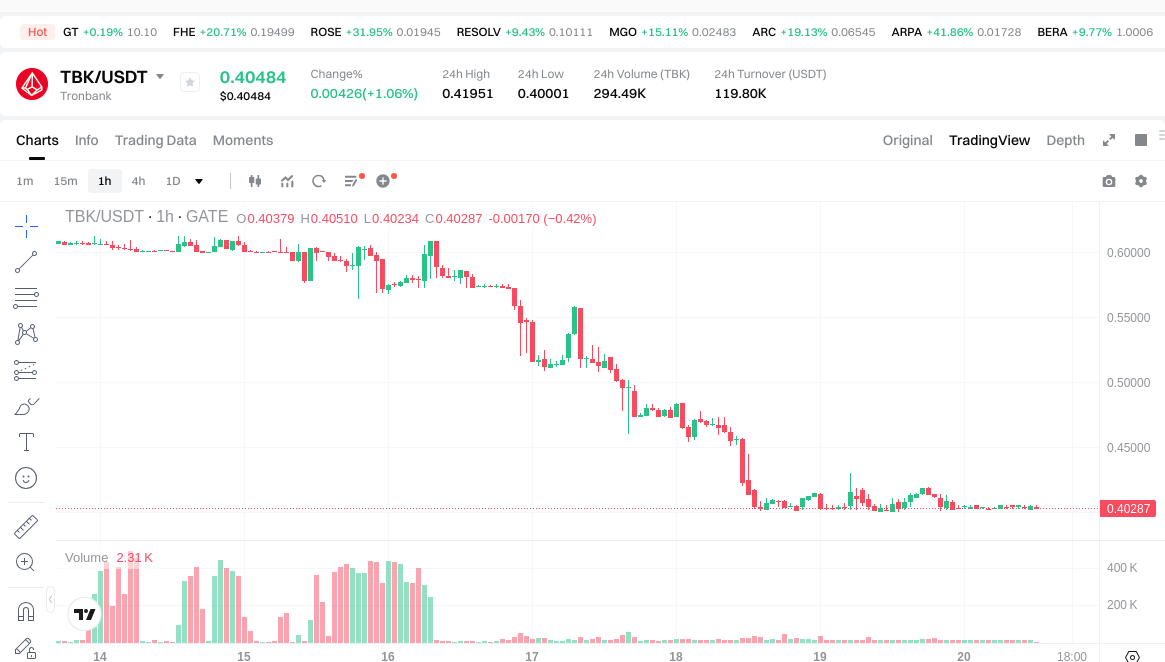
- 2026: TBK experienced significant price volatility, with the price declining from its peak of $2.98998 on January 4, 2026, to a lower level of $0.40285 by January 20, 2026.
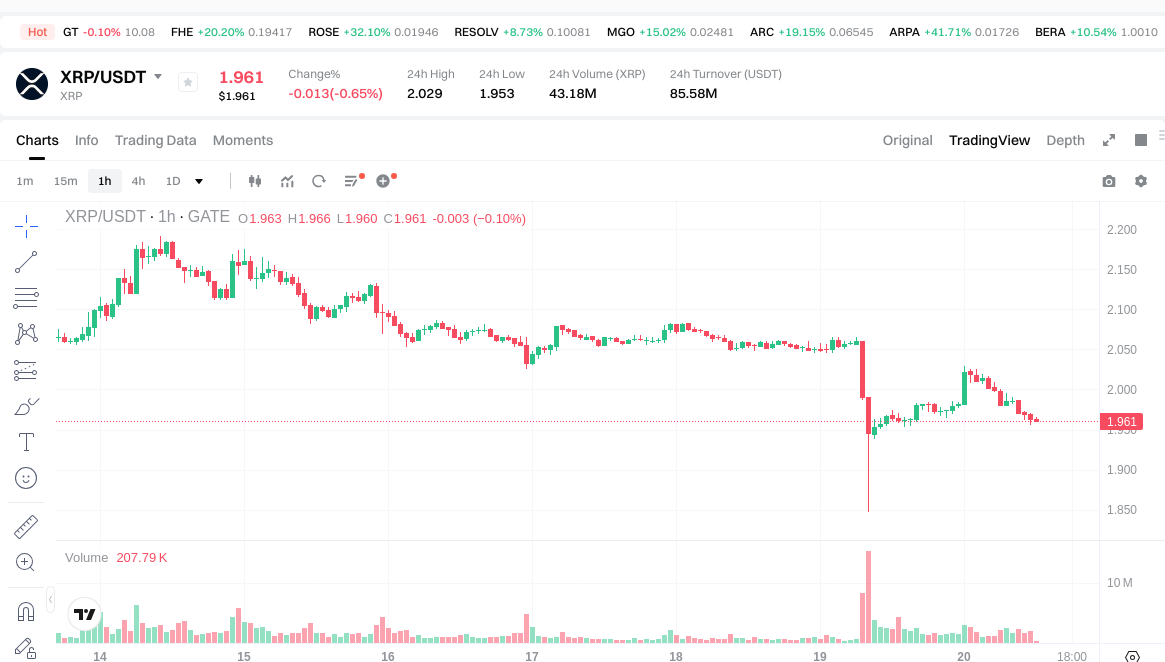
- 2025: XRP showed notable price movements, reaching $3.65 in July 2025 before adjusting to $1.965 by January 20, 2026.
- Comparative Analysis: During the recent market cycle, TBK declined from $2.98998 to $0.40285, representing a significant correction, while XRP adjusted from $3.65 to $1.965, showing a relatively moderate decline.
Current Market Status (2026-01-20)
- TBK Current Price: $0.40285
- XRP Current Price: $1.965
- 24-Hour Trading Volume: TBK $119,581.03 vs XRP $86,021,448.31
- Fear & Greed Index: 32 (Fear)
View real-time prices:
II. Core Factors Affecting TBK vs XRP Investment Value
Due to the absence of provided reference materials regarding TBK and XRP, a comprehensive comparative analysis cannot be conducted at this time. The evaluation of investment value typically requires detailed information on supply mechanisms, institutional adoption patterns, technological development roadmaps, and macroeconomic correlations.
Supply Mechanism Comparison (Tokenomics)
Without access to specific tokenomics data for both assets, supply mechanism characteristics cannot be accurately documented.
Institutional Adoption and Market Application
Information regarding institutional holdings, enterprise-level implementation in cross-border payments or settlement systems, and regulatory positioning across different jurisdictions is not available in the current dataset.
Technical Development and Ecosystem Construction
Details concerning technical upgrades, protocol improvements, and ecosystem expansion in areas such as DeFi integration, smart contract functionality, or payment infrastructure are not present in the reference materials.
Macroeconomic Environment and Market Cycles
Analysis of performance characteristics during inflationary periods, sensitivity to monetary policy adjustments, interest rate fluctuations, or geopolitical developments requires specific historical data that is not currently accessible.
III. 2026-2031 Price Forecast: TBK vs XRP
Short-term Forecast (2026)
- TBK: Conservative $0.23-$0.40 | Optimistic $0.40-$0.53
- XRP: Conservative $1.02-$1.96 | Optimistic $1.96-$2.90
Mid-term Forecast (2028-2029)
- TBK may enter a consolidation phase, with projected price range of $0.40-$0.75
- XRP may enter an expansion phase, with projected price range of $2.23-$3.90
- Key drivers: institutional capital inflows, ETF developments, ecosystem growth
Long-term Forecast (2030-2031)
- TBK: Baseline scenario $0.34-$0.67 | Optimistic scenario $0.67-$1.01
- XRP: Baseline scenario $2.02-$3.38 | Optimistic scenario $3.38-$5.69
View detailed price predictions for TBK and XRP
Disclaimer
TBK:
| Year |
Predicted High Price |
Predicted Average Price |
Predicted Low Price |
Price Change |
| 2026 |
0.5277597 |
0.40287 |
0.2336646 |
0 |
| 2027 |
0.5723372655 |
0.46531485 |
0.2745357615 |
15 |
| 2028 |
0.6692856144975 |
0.51882605775 |
0.49807301544 |
28 |
| 2029 |
0.748510353515925 |
0.59405583612375 |
0.40395796856415 |
47 |
| 2030 |
0.785401220939209 |
0.671283094819837 |
0.342354378358117 |
66 |
| 2031 |
1.012395599452537 |
0.728342157879523 |
0.502556088936871 |
80 |
XRP:
| Year |
Predicted High Price |
Predicted Average Price |
Predicted Low Price |
Price Change |
| 2026 |
2.90376 |
1.962 |
1.02024 |
0 |
| 2027 |
2.9437848 |
2.43288 |
1.3624128 |
23 |
| 2028 |
3.010932288 |
2.6883324 |
2.231315892 |
36 |
| 2029 |
3.90399631128 |
2.849632344 |
2.30820219864 |
45 |
| 2030 |
4.2547860528264 |
3.37681432764 |
3.1742054679816 |
71 |
| 2031 |
5.685542283447468 |
3.8158001902332 |
2.022374100823596 |
94 |
IV. Investment Strategy Comparison: TBK vs XRP
Long-term vs Short-term Investment Strategies
- TBK: May be suitable for investors focused on TRON ecosystem development and energy-leasing utility scenarios, particularly those interested in staking mechanisms and cost-reduction applications within blockchain transactions.
- XRP: May appeal to investors interested in payment infrastructure development, cross-border transaction efficiency, and established market positioning with historical trading activity.
Risk Management and Asset Allocation
- Conservative Investors: TBK 20-30% vs XRP 70-80%
- Aggressive Investors: TBK 40-50% vs XRP 50-60%
- Hedging Tools: Stablecoin allocation, options strategies, cross-asset portfolio diversification
V. Potential Risk Comparison
Market Risk
- TBK: The asset experienced considerable price volatility, declining from $2.98998 to $0.40285 between January 4 and January 20, 2026. Limited trading volume ($119,581.03 on January 20, 2026) may contribute to liquidity challenges and price fluctuation sensitivity.
- XRP: While showing relatively moderate correction from $3.65 to $1.965, the asset maintains substantially higher trading volume ($86,021,448.31 on January 20, 2026), though still subject to broader cryptocurrency market sentiment fluctuations, as indicated by the Fear & Greed Index at 32 (Fear).
Technical Risk
- TBK: Scalability considerations, network stability factors, and dependency on TRON blockchain infrastructure performance.
- XRP: Network capacity management, transaction processing consistency, and technical architecture maintenance requirements.
Regulatory Risk
- Divergent regulatory frameworks across jurisdictions may impact both assets differently, with potential variations in classification, compliance requirements, and operational restrictions depending on regional policy developments.
VI. Conclusion: Which Is the Better Buy?
📌 Investment Value Summary:
- TBK Characteristics: Focus on TRON ecosystem utility, energy-leasing functionality, and staking-based earning mechanisms; launched in 2025 with developing market presence.
- XRP Characteristics: Established payment-focused infrastructure since 2011, transaction efficiency (approximately 3 seconds, $0.0002 cost), processing capacity (1,500+ tps), and higher market liquidity.
✅ Investment Considerations:
- Novice Investors: Consider prioritizing assets with established trading history, higher liquidity levels, and documented market behavior patterns before exploring newer market entrants.
- Experienced Investors: May evaluate portfolio diversification strategies incorporating both established payment-focused assets and emerging ecosystem-specific utilities based on individual risk tolerance and market assessment.
- Institutional Investors: Assessment should incorporate liquidity requirements, regulatory positioning, technical infrastructure maturity, and alignment with institutional investment mandates.
⚠️ Risk Disclosure: Cryptocurrency markets exhibit substantial volatility characteristics. This content does not constitute investment advice. Market participants should conduct independent research and consult qualified financial advisors before making investment decisions.
VII. FAQ
Q1: What is the current price difference between TBK and XRP as of January 2026?
As of January 20, 2026, TBK is trading at $0.40285 while XRP is priced at $1.965, representing a significant price differential. TBK has experienced substantial volatility, declining from its peak of $2.98998 on January 4, 2026, to its current level, while XRP adjusted from $3.65 in July 2025 to its present price. The 24-hour trading volume also shows a considerable gap, with TBK at $119,581.03 compared to XRP's $86,021,448.31, indicating XRP maintains substantially higher market liquidity and trading activity.
Q2: Which asset shows better long-term price potential through 2031?
Based on forecasting models, XRP demonstrates stronger long-term price projections compared to TBK. By 2031, XRP's optimistic scenario forecasts a range of $3.38-$5.69, with a predicted high of $5.685 and an average of $3.816, representing a 94% increase. In contrast, TBK's 2031 projections indicate an optimistic range of $0.67-$1.01, with a predicted high of $1.012 and an average of $0.728, representing an 80% increase. XRP's established market position since 2011, higher trading volumes, and payment infrastructure focus contribute to potentially more robust long-term growth scenarios compared to TBK's newer market presence launched in 2025.
Q3: What are the primary use cases that differentiate TBK from XRP?
TBK and XRP serve fundamentally different purposes within the cryptocurrency ecosystem. TBK, launched in 2025, functions as an energy leasing and TRX staking financial platform within the TRON ecosystem, designed to help users reduce transaction costs on the TRON blockchain while enabling earnings through staking idle TRX. XRP, established in 2011, operates as a payment-focused digital asset on the XRP Ledger, specifically designed for cross-border transactions with fast settlement speeds (approximately 3 seconds per transaction), minimal costs ($0.0002 per transaction), and high processing capacity (1,500+ transactions per second). This fundamental difference positions TBK as an ecosystem-specific utility token while XRP functions as payment infrastructure.
Q4: What risk factors should investors consider when choosing between TBK and XRP?
Investors should evaluate several distinct risk categories for each asset. TBK presents considerable price volatility risk, having declined approximately 86.5% from its January 2026 peak, along with limited trading volume that may contribute to liquidity challenges. Additionally, TBK carries dependency risk on TRON blockchain infrastructure performance and scalability considerations. XRP, while showing more moderate corrections, faces different risk profiles including regulatory uncertainty across various jurisdictions, network capacity management requirements, and sensitivity to broader cryptocurrency market sentiment. The current Fear & Greed Index at 32 (Fear) indicates prevailing market caution. Both assets require careful assessment of technical infrastructure maturity, regulatory positioning, and individual risk tolerance levels.
Q5: How do the recommended allocation strategies differ between conservative and aggressive investors?
Conservative investors may consider a portfolio weighting of 20-30% TBK versus 70-80% XRP, emphasizing the more established asset with higher liquidity and documented trading history. This approach prioritizes capital preservation while maintaining exposure to TRON ecosystem developments. Aggressive investors might adopt a more balanced allocation of 40-50% TBK versus 50-60% XRP, accepting higher volatility in exchange for potential upside from TBK's emerging utility within the TRON ecosystem. Both strategies should incorporate risk management tools including stablecoin allocation, options strategies, and cross-asset portfolio diversification to mitigate cryptocurrency market volatility.
Q6: What market conditions favor TBK investment over XRP?
TBK investment may become more favorable under specific market conditions including significant growth in TRON blockchain adoption, increased demand for energy-leasing mechanisms to reduce transaction costs, and expanding DeFi integration within the TRON ecosystem. Investors focused on emerging ecosystem-specific utilities and staking-based earning mechanisms may find TBK aligned with their investment thesis. Additionally, market participants with higher risk tolerance seeking exposure to newer projects launched in 2025 with potential for substantial percentage gains might consider TBK positioning. However, such scenarios require careful monitoring of TRON network development, technical infrastructure improvements, and actual utility adoption metrics.
Q7: How does liquidity differ between TBK and XRP, and why does it matter?
Liquidity represents a critical differentiating factor between these assets. XRP demonstrates substantially higher liquidity with 24-hour trading volume of $86,021,448.31 compared to TBK's $119,581.03 as of January 20, 2026—a difference of approximately 719 times. Higher liquidity provides several advantages: reduced price slippage during transactions, easier position entry and exit, more stable price discovery mechanisms, and lower vulnerability to market manipulation. For institutional investors and larger portfolio allocations, XRP's superior liquidity enables more efficient capital deployment and risk management. TBK's limited liquidity may result in wider bid-ask spreads, increased transaction costs, and heightened price volatility, particularly during periods of market stress or rapid sentiment shifts.
Q8: What role does institutional adoption play in the TBK vs XRP comparison?
Institutional adoption represents a significant distinguishing factor between these assets, though specific institutional holdings data requires further documentation. XRP's establishment since 2011 and focus on payment infrastructure positions it for potential enterprise-level implementation in cross-border payments and settlement systems, areas where institutional interest traditionally concentrates. The asset's transaction efficiency characteristics—3-second settlement times, $0.0002 transaction costs, and 1,500+ transactions per second processing capacity—align with institutional requirements for scalable payment solutions. TBK, as a newer entrant launched in 2025 within the TRON ecosystem, requires time to develop comparable institutional recognition and adoption patterns. Institutional capital inflows and ETF developments identified as key drivers for mid-term forecasts (2028-2029) may disproportionately benefit assets with established regulatory positioning and market infrastructure.
* The information is not intended to be and does not constitute financial advice or any other recommendation of any sort offered or endorsed by Gate.