TEN vs UNI: Comprehensive Comparison of Token Economics and Universal Protocols in Blockchain Infrastructure
2025-12-27 22:12:15
Altcoins
DeFi
Layer 2
Zero-Knowledge Proof
Article Rating : 4.5
66 ratings
# Article Overview: TEN vs UNI Token Comparison
This comprehensive guide compares TEN Protocol and Uniswap (UNI) across token economics, market performance, and blockchain infrastructure positioning. The analysis addresses critical investment questions by examining historical price trends, tokenomics, institutional adoption, technology ecosystems, and risk factors through 2030. Designed for investors ranging from beginners to institutions, the article provides actionable investment strategies, price forecasts via Gate, and clear recommendations based on risk tolerance. Structured through market analysis, financial projections, and strategic allocation models, this resource helps readers identify which token aligns with their investment objectives in the evolving DeFi landscape.

Introduction: TEN vs UNI Investment Comparison
In the cryptocurrency market, the comparison between TEN and UNI has become an unavoidable topic for investors. The two not only show significant differences in market capitalization ranking, application scenarios, and price performance, but also represent different positioning within the crypto asset landscape.
TEN (TEN): Launched as Ethereum's privacy Layer 2 solution, it leverages Trusted Execution Environments (TEEs) technology to enable encrypted applications with programmable privacy across gaming, DeFi, AI, and institutional finance sectors.
UNI (UNI): Since its inception, it has been recognized as the first automatic market making protocol on the Ethereum blockchain, establishing itself as one of the most significant decentralized exchange infrastructure tokens globally.
This article will conduct a comprehensive analysis of TEN vs UNI's investment value comparison across historical price trends, supply mechanisms, institutional adoption, and technical ecosystems, while attempting to address the question investors care most about:
"Which is the better buy right now?"
TEN Protocol (TEN) vs Uniswap (UNI) Market Analysis
I. Historical Price Comparison and Current Market Status
TEN Protocol and Uniswap Historical Price Trends
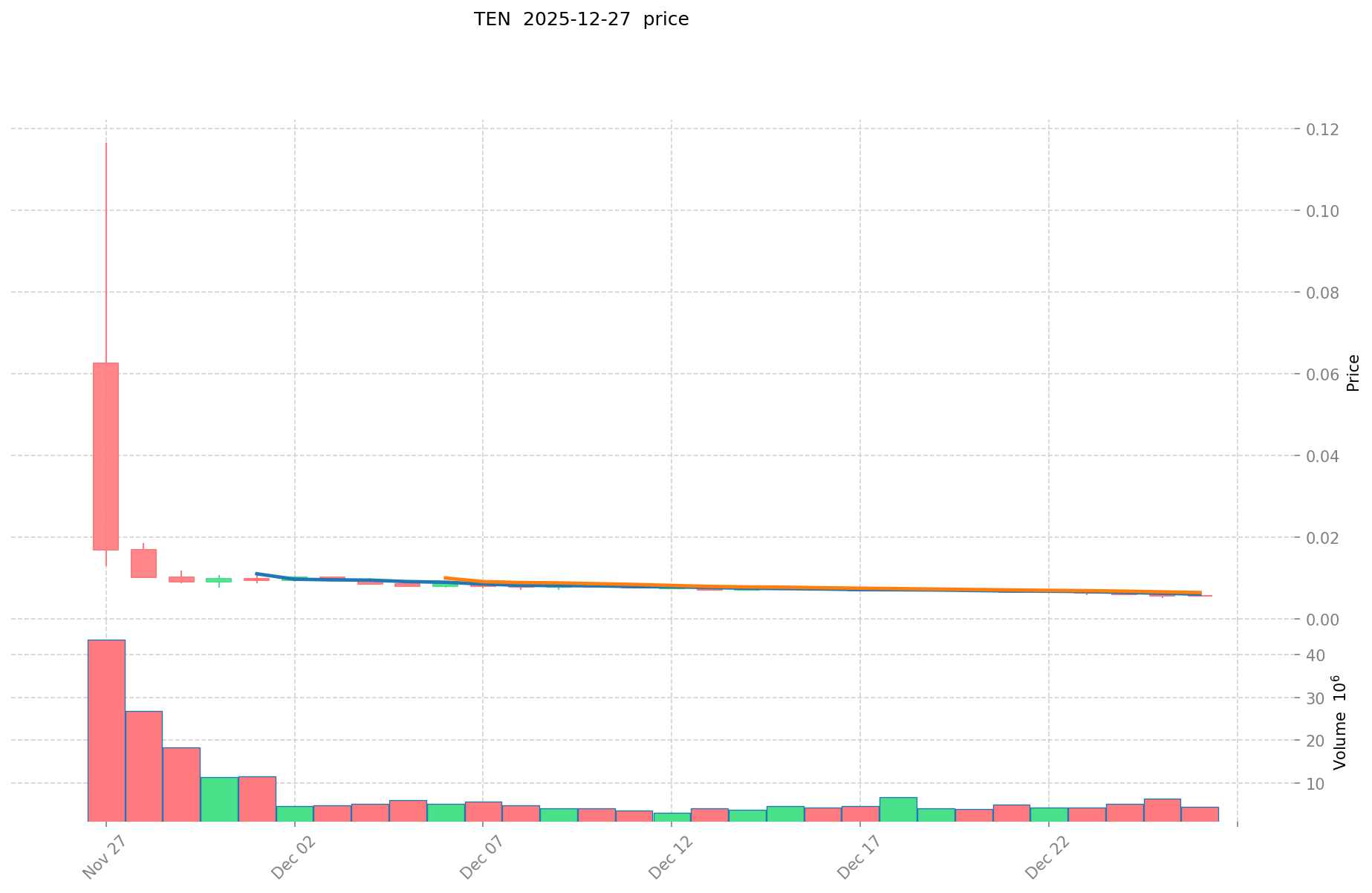
- November 27, 2025: TEN reached its all-time high of $0.11662, representing significant early project momentum.
- December 25, 2025: TEN recorded its all-time low of $0.005094, marking a substantial decline from peak levels.
- Comparison Analysis: Within its trading period, TEN has experienced a dramatic price movement from $0.11662 at its peak to $0.005094 at its low, representing approximately a 95.6% decline from the all-time high, while Uniswap has maintained relatively higher price stability across its longer market history.
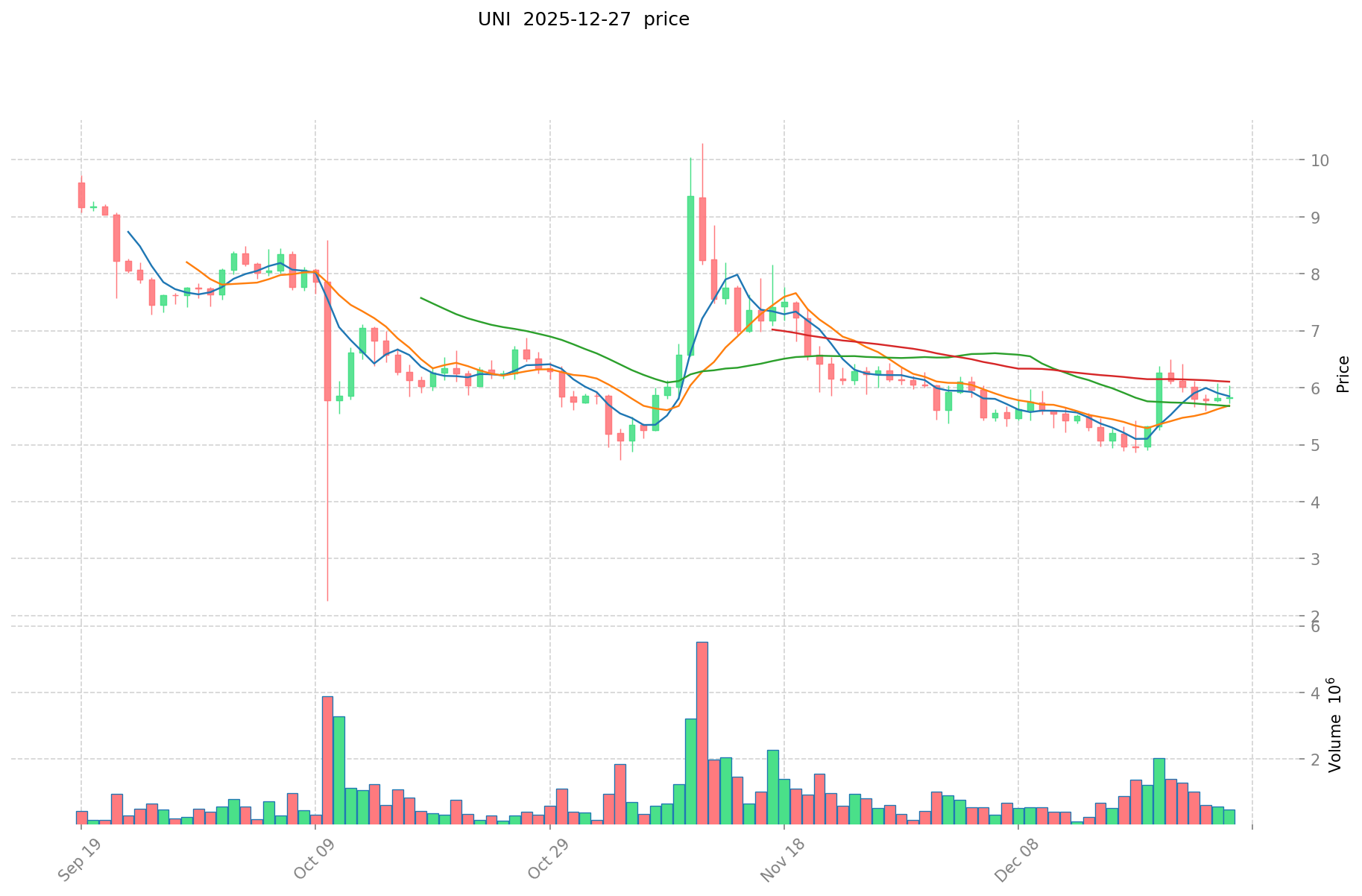
- September 17, 2020: Uniswap recorded its all-time low of $1.03 during the early phase of its market launch.
- May 3, 2021: Uniswap reached its all-time high of $44.92, reflecting substantial gains during the 2021 bull market.
- Comparison Analysis: Over its longer market lifespan, Uniswap has demonstrated more moderate volatility relative to its current price, while maintaining significant distance between its historical extremes.
Current Market Status (December 28, 2025)
- TEN Protocol current price: $0.005891
- Uniswap current price: $5.96
- 24-hour trading volume: TEN $27,609.20 vs Uniswap $2,295,687.91
- Market emotion index (Fear & Greed Index): 23 (Extreme Fear)
View real-time prices:
II. Core Factors Affecting Investment Value of TEN vs UNI
Tokenomics Comparison
- TEN: Supply mechanism information not available in provided reference materials
- UNI: Supply mechanism information not available in provided reference materials
- 📌 Historical Pattern: Supply mechanism data required for analyzing price cycle dynamics
Institutional Adoption and Market Application
- Institutional Holdings: Comparative data not available in reference materials
- Enterprise Adoption: Application comparison in cross-border payments, settlement, and investment portfolios not provided
- National Policy: Regulatory stance from different countries regarding both tokens not available in reference materials
Technology Development and Ecosystem Building
- TEN Technology Upgrades: Technical development information not available in reference materials
- UNI Technology Development: Technical development information not available in reference materials
- Ecosystem Comparison: DeFi, NFT, payment, and smart contract implementation status data not provided
Macroeconomic Environment and Market Cycles
- Performance Under Inflation: Comparative analysis data not available in reference materials
- Macroeconomic Monetary Policy: Impact of interest rates and US Dollar Index on both tokens not provided in reference materials
- Geopolitical Factors: Cross-border transaction demand and international situation analysis not available in reference materials
III. 2025-2030 Price Forecast: TEN vs UNI
Short-term Forecast (2025)
- TEN: Conservative $0.00460-$0.00590 | Optimistic $0.00618-$0.00619
- UNI: Conservative $4.41-$5.96 | Optimistic $6.61-$6.61
Medium-term Forecast (2026-2028)
- TEN may enter consolidation phase, expected price range $0.00400-$0.00849
- UNI may enter growth phase, expected price range $4.40-$11.60
- Key drivers: institutional capital inflows, ETF adoption, ecosystem development
Long-term Forecast (2029-2030)
- TEN: Base scenario $0.00655-$0.00977 | Optimistic scenario $0.00812-$0.00909
- UNI: Base scenario $8.38-$11.51 | Optimistic scenario $8.64-$15.01
View TEN and UNI detailed price predictions
TEN:
| 年份 |
预测最高价 |
预测平均价格 |
预测最低价 |
涨跌幅 |
| 2025 |
0.00618975 |
0.005895 |
0.0045981 |
0 |
| 2026 |
0.007492545 |
0.006042375 |
0.00549856125 |
2 |
| 2027 |
0.0070381584 |
0.00676746 |
0.0052786188 |
14 |
| 2028 |
0.008490455316 |
0.0069028092 |
0.004003629336 |
17 |
| 2029 |
0.00977472296766 |
0.007696632258 |
0.0065421374193 |
30 |
| 2030 |
0.009085104717343 |
0.00873567761283 |
0.008124180179931 |
48 |
UNI:
| 年份 |
预测最高价 |
预测平均价格 |
预测最低价 |
涨跌幅 |
| 2025 |
6.61005 |
5.955 |
4.4067 |
0 |
| 2026 |
7.9159815 |
6.282525 |
4.3977675 |
5 |
| 2027 |
10.080939615 |
7.09925325 |
6.7442905875 |
19 |
| 2028 |
11.596630183875 |
8.5900964325 |
6.786176181675 |
44 |
| 2029 |
11.50643417133375 |
10.0933633081875 |
8.377491545795625 |
69 |
| 2030 |
15.011859248267268 |
10.799898739760625 |
8.6399189918085 |
81 |
IV. Investment Strategy Comparison: TEN vs UNI
Long-term vs Short-term Investment Strategies
- TEN: Suitable for investors focusing on emerging privacy layer solutions with high risk tolerance and longer investment horizons to capture potential ecosystem development
- UNI: Suitable for investors seeking established DeFi infrastructure exposure with relatively stable market positioning and proven protocol adoption
Risk Management and Asset Allocation
- Conservative investors: TEN 5% vs UNI 95%
- Aggressive investors: TEN 25% vs UNI 75%
- Hedging tools: Stablecoin allocation, options strategies, multi-asset diversification
V. Potential Risk Comparison
Market Risk
- TEN: Extreme price volatility with 95.6% decline from all-time high; limited trading liquidity ($27,609.20 daily volume) creates slippage concerns; early-stage project with uncertain market adoption trajectory
- UNI: Established protocol but subject to DeFi sector-wide market cycles; regulatory uncertainty affecting centralized exchange partnerships; competitive pressures from emerging AMM protocols
Technology Risk
- TEN: Reliance on Trusted Execution Environments (TEEs) technology requires continuous security audits; privacy layer implementation complexities; potential adoption barriers in regulated markets
- UNI: Smart contract vulnerability management; network congestion during high-volume periods; dependency on Ethereum layer 1 scalability
Regulatory Risk
- Global regulatory policies pose greater uncertainty for privacy-focused protocols like TEN, particularly regarding institutional finance applications in jurisdictions with stricter AML/KYC requirements; UNI faces ongoing DeFi regulatory scrutiny but operates within more established compliance frameworks
VI. Conclusion: Which Is the Better Buy?
📌 Investment Value Summary:
- TEN Advantages: Innovative privacy layer positioning; multi-sector application potential (gaming, DeFi, AI, institutional finance); early-stage project with potential asymmetric upside for risk-tolerant investors
- UNI Advantages: Established market leadership in DEX infrastructure; proven protocol with higher trading liquidity; longer track record of ecosystem development and institutional integration
✅ Investment Recommendations:
- Beginner investors: Prioritize UNI due to established market positioning, higher liquidity, and lower volatility; allocate only speculative capital to TEN if pursuing privacy-theme exposure
- Experienced investors: Consider UNI as core position for portfolio stability; allocate tactical positions to TEN based on privacy sector thesis and risk tolerance, with strict stop-loss discipline
- Institutional investors: UNI aligns with infrastructure exposure and regulatory clarity; TEN requires extensive compliance review and risk assessment before institutional allocation consideration
⚠️ Risk Disclaimer: Cryptocurrency markets demonstrate extreme volatility. This article does not constitute investment advice. Investors should conduct independent research and consult financial advisors before making investment decisions.
FAQ
TEN和UNI分别是什么?它们各自有什么用途?
UNI是Uniswap协议的治理代币,用于去中心化交易和流动性挖矿。TEN是Tenon Network的代币,主要用于网络治理和生态激励。两者都是Web3生态中的重要协议代币,各自服务不同的DeFi功能模块。
TEN与UNI有什么主要区别和优劣势?
TEN是Layer2扩容方案,主打低成本和高效率;UNI是去中心化交易协议,专注流动性和交易深度。TEN优势在扩容性能,UNI优势在生态成熟度和交易额规模。选择取决于应用场景需求。
TEN和UNI应该如何选择?适用场景分别是什么?
TEN适合看好治理代币长期价值、参与生态治理的用户。UNI适合交易量大、追求流动性挖矿收益的用户。两者均具投资潜力,选择需结合个人投资策略和风险偏好。
TEN和UNI在性能、成本、安全性等方面如何对比?
TEN采用创新的第二层解决方案,性能更高、gas费用更低,交易额处理能力强。UNI作为成熟DEX,安全性经过检验但gas成本较高。TEN在成本效率和扩展性上更具优势,适合高频交易者。两者都具备良好的安全基础,选择需根据使用场景决定。
* The information is not intended to be and does not constitute financial advice or any other recommendation of any sort offered or endorsed by Gate.








