This comprehensive guide compares TFUEL and TRX, two distinct blockchain tokens serving different market niches. TFUEL powers Theta Network's decentralized video streaming infrastructure, while TRX ranks 9th globally with $29 billion market capitalization supporting payment infrastructure, stablecoin settlements (USDT-TRC20), and DeFi applications. The article examines historical price performance, tokenomics differences, institutional adoption patterns, and technical development trajectories to help investors understand each token's positioning. Through detailed analysis of supply mechanisms, ecosystem applications, and competitive landscapes, readers gain insights into which asset aligns with their investment objectives. Predicted price trajectories from 2026-2031 show divergent growth patterns reflecting market maturity differences. Strategic allocation frameworks accommodate conservative, aggressive, and experienced investor profiles, while comprehensive risk assessment addresses market, technical, and re
Introduction: Investment Comparison Between TFUEL and TRX
In the cryptocurrency market, the comparison between TFUEL vs TRX has become an increasingly relevant topic for investors. Both assets represent distinct positioning within the crypto ecosystem, with notable differences in market capitalization rankings, application scenarios, and price performance.
TFUEL (ThetaFuel): Launched in 2018 as part of the Theta blockchain network, TFUEL serves as the operational token for network service fees and transactions, designed to support a decentralized video streaming infrastructure.
TRX (TRON): Since its launch in 2017, TRON has established itself as a major public blockchain platform, currently ranking 9th by market capitalization with over 219 million holders and a market cap exceeding $29 billion.
This article provides a comprehensive analysis of TFUEL vs TRX, examining historical price trends, supply mechanisms, ecosystem development, and future prospects to address the critical question investors frequently ask:
"Which presents more compelling investment potential in the current market environment?"
Through systematic evaluation of technical fundamentals, market performance, and adoption metrics, we aim to provide investors with data-driven insights for informed decision-making between these two distinct cryptocurrency assets.
I. Historical Price Comparison and Current Market Status
Historical Price Trends of TFUEL (Coin A) and TRX (Coin B)
- 2021: TFUEL experienced significant price movement, reaching its all-time high of $0.68159 on June 9, 2021, driven by increased adoption of the Theta network's video delivery infrastructure.
- 2020: TFUEL recorded its all-time low of $0.00090804 on March 13, 2020, reflecting broader market weakness during the early pandemic period.
- 2024: TRX achieved its all-time high of $0.431288 on December 4, 2024, supported by expanding ecosystem developments and increased network activity.
- 2017: TRX recorded its all-time low of $0.00180434 on November 12, 2017, shortly after its initial launch period.
- Comparative Analysis: During the 2021 market cycle, TFUEL surged from approximately $0.001 to $0.68159 before declining, while TRX demonstrated relatively stable growth patterns, reaching its peak in late 2024 at $0.431288.
Current Market Situation (January 16, 2026)
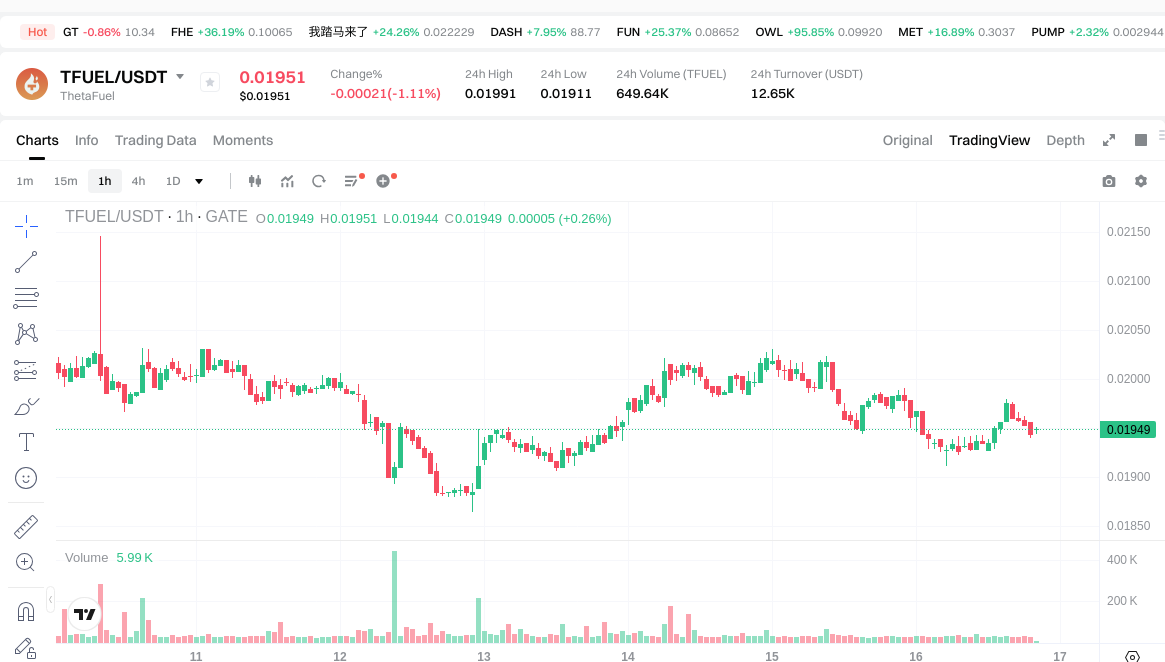
- TFUEL current price: $0.01944
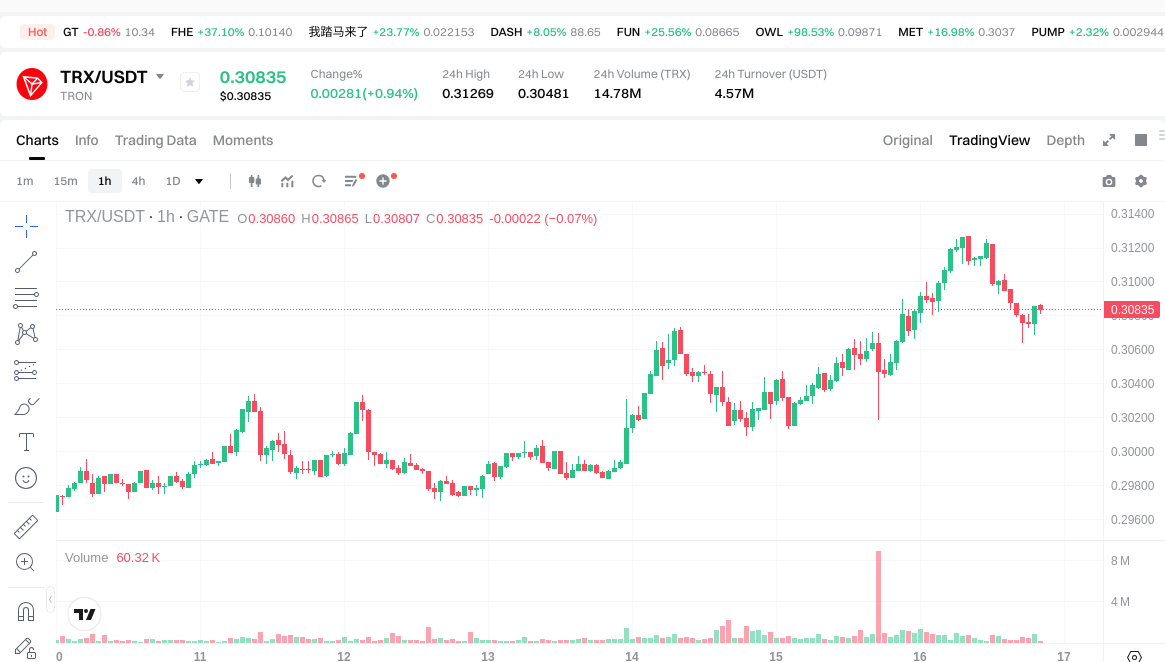
- TRX current price: $0.30855
- 24-hour trading volume: TFUEL $12,630.63 vs TRX $4,573,037.01
- Market Sentiment Index (Fear & Greed Index): 49 (Neutral)
Check real-time prices:
II. Core Factors Influencing TFUEL vs TRX Investment Value
Supply Mechanism Comparison (Tokenomics)
- TFUEL: Operates within Theta Network's dual-token system, where TFUEL serves as the operational token for network transactions, smart contract execution, and content delivery incentives. The token design focuses on utility within decentralized video streaming infrastructure.
- TRX: Utilizes a Delegated Proof of Stake (DPoS) consensus mechanism, where TRX functions as TRON ecosystem's governance and utility token. The supply mechanism supports network resource allocation and validator rewards through its super representative system.
- 📌 Historical Pattern: Supply mechanisms influence price cycles through network adoption rates and resource consumption patterns, particularly visible in TRC-20 stablecoin usage for TRX and content delivery activity for TFUEL.
Institutional Adoption and Market Applications
- Institutional Holdings: TRX demonstrates broader institutional recognition through its integration with major exchanges and stablecoin infrastructure, particularly USDT-TRC20 adoption.
- Enterprise Adoption: TRX shows extensive application in cross-border payments and stablecoin settlements, supported by low transaction costs. TFUEL focuses on entertainment industry adoption and decentralized content delivery networks.
- Regulatory Environment: Regulatory frameworks regarding stablecoins and cross-border payments significantly impact TRX ecosystem usage, while TFUEL faces considerations related to decentralized network scalability and entertainment sector adoption.
Technical Development and Ecosystem Construction
- TFUEL Technical Position: Functions as network fuel for executing transactions, running smart contracts, and incentivizing content sharing within Theta's decentralized video transmission infrastructure. Network scalability remains a key development factor.
- TRX Technical Evolution: TRON network supports thousands of transactions per second (TPS) with minimal costs, optimized for payment, cross-border transfers, and gaming applications. The platform supports TRC-10 and TRC-20 token standards, facilitating widespread stablecoin circulation.
- Ecosystem Comparison: TRX maintains extensive application across DeFi, payment systems, and smart contracts, with particular strength in stablecoin infrastructure. TFUEL concentrates on video streaming, content distribution, and entertainment-focused decentralized applications.
Macroeconomic Environment and Market Cycles
- Performance Context: TRX demonstrates utility in high-frequency payment scenarios and stablecoin settlement infrastructure, while TFUEL's value correlates with entertainment industry adoption patterns and decentralized network growth.
- Monetary Policy Impact: Interest rate adjustments and dollar index movements affect both assets through broader cryptocurrency market dynamics and cross-border transaction demand patterns.
- Competitive Landscape: TRX faces competition from alternative layer-1 platforms and layer-2 solutions such as Solana, BSC, and Ethereum scaling solutions. TFUEL encounters competition from other blockchain-based content delivery platforms and traditional streaming infrastructure providers.
III. 2026-2031 Price Prediction: TFUEL vs TRX
Short-term Prediction (2026)
- TFUEL: Conservative $0.0148 - $0.0195 | Optimistic $0.0195 - $0.0209
- TRX: Conservative $0.253 - $0.309 | Optimistic $0.309 - $0.423
Medium-term Prediction (2028-2029)
- TFUEL may enter a gradual growth phase, with projected prices ranging from $0.0154 to $0.0330
- TRX may enter a consolidation phase, with projected prices ranging from $0.250 to $0.486
- Key drivers: institutional capital flows, ETF developments, ecosystem expansion
Long-term Prediction (2030-2031)
- TFUEL: Baseline scenario $0.0158 - $0.0304 | Optimistic scenario $0.0304 - $0.0362
- TRX: Baseline scenario $0.282 - $0.552 | Optimistic scenario $0.552 - $0.668
View detailed price predictions for TFUEL and TRX
Disclaimer
TFUEL:
| Year |
Predicted High Price |
Predicted Average Price |
Predicted Low Price |
Price Change |
| 2026 |
0.0208757 |
0.01951 |
0.0148276 |
0 |
| 2027 |
0.025039134 |
0.02019285 |
0.0115099245 |
3 |
| 2028 |
0.02894846976 |
0.022615992 |
0.01537887456 |
16 |
| 2029 |
0.0330012555264 |
0.02578223088 |
0.015469338528 |
32 |
| 2030 |
0.031449165227424 |
0.0293917432032 |
0.022631642266464 |
51 |
| 2031 |
0.036200340516221 |
0.030420454215312 |
0.015818636191962 |
56 |
TRX:
| Year |
Predicted High Price |
Predicted Average Price |
Predicted Low Price |
Price Change |
| 2026 |
0.422782 |
0.3086 |
0.253052 |
0 |
| 2027 |
0.47905521 |
0.365691 |
0.3291219 |
18 |
| 2028 |
0.48572907075 |
0.422373105 |
0.28298998035 |
36 |
| 2029 |
0.48583466402625 |
0.454051087875 |
0.24972809833125 |
47 |
| 2030 |
0.634422882533343 |
0.469942875950625 |
0.399451444558031 |
52 |
| 2031 |
0.668141283882801 |
0.552182879241984 |
0.281613268413412 |
78 |
IV. Investment Strategy Comparison: TFUEL vs TRX
Long-term vs Short-term Investment Strategies
- TFUEL: May suit investors focused on decentralized content delivery infrastructure and entertainment sector blockchain adoption, with consideration for network growth cycles and video streaming industry developments.
- TRX: May appeal to investors interested in payment infrastructure, stablecoin ecosystem participation, and high-frequency transaction utility, particularly those evaluating cross-border settlement applications.
Risk Management and Asset Allocation
- Conservative Investors: Potential allocation framework could consider TFUEL 20-30% vs TRX 70-80%, reflecting TRX's broader market capitalization and established infrastructure.
- Aggressive Investors: Alternative allocation might explore TFUEL 40-50% vs TRX 50-60%, accounting for potential growth scenarios in specialized network applications.
- Hedging Tools: Stablecoin reserves, diversified cryptocurrency portfolios, and cross-asset positioning strategies may complement holdings in both tokens.
V. Potential Risk Comparison
Market Risks
- TFUEL: Price volatility influenced by adoption rates within decentralized video streaming sector, competition from alternative content delivery networks, and broader entertainment industry blockchain integration trends.
- TRX: Market dynamics affected by stablecoin regulatory developments, competition from other layer-1 platforms and layer-2 scaling solutions, and shifts in cross-border payment infrastructure preferences.
Technical Risks
- TFUEL: Network scalability considerations, dependency on Theta ecosystem development trajectory, and adoption challenges within decentralized content distribution infrastructure.
- TRX: Network resource allocation under DPoS consensus mechanism, validator concentration patterns, and smart contract security considerations across expanding ecosystem applications.
Regulatory Risks
- Global regulatory frameworks regarding stablecoins, cross-border transactions, and decentralized network operations may affect both assets differently. TRX faces particular considerations related to payment infrastructure regulations, while TFUEL encounters frameworks governing decentralized content platforms and entertainment sector blockchain applications.
VI. Conclusion: Which Is the Better Buy?
📌 Investment Value Summary:
- TFUEL Characteristics: Specialized positioning within decentralized video streaming infrastructure, operational token utility within Theta network ecosystem, and potential correlation with entertainment industry blockchain adoption patterns.
- TRX Characteristics: Established presence in stablecoin infrastructure (particularly USDT-TRC20), extensive payment and cross-border settlement applications, higher market capitalization ranking (9th position), and broader ecosystem spanning DeFi, gaming, and smart contract platforms.
✅ Investment Considerations:
- Beginning Investors: May consider starting with assets demonstrating broader market recognition and established infrastructure, evaluating transaction utility and ecosystem maturity alongside market capitalization metrics.
- Experienced Investors: Could explore portfolio diversification across different blockchain use cases, balancing payment infrastructure exposure against specialized network applications, while monitoring technical development trajectories and adoption metrics.
- Institutional Participants: May evaluate regulatory clarity, liquidity depth, infrastructure maturity, and specific use case alignment with organizational objectives when considering exposure to either asset.
⚠️ Risk Disclosure: Cryptocurrency markets demonstrate substantial volatility. This analysis does not constitute investment advice. Individuals should conduct independent research and consult qualified financial advisors before making investment decisions.
VII. FAQ
Q1: What is the fundamental difference between TFUEL and TRX in terms of blockchain functionality?
TFUEL serves as the operational token within Theta Network's decentralized video streaming infrastructure, while TRX functions as the native currency of TRON's general-purpose blockchain platform. TFUEL specifically powers transactions, smart contract execution, and content delivery incentives within Theta's dual-token ecosystem, focusing on entertainment and video distribution use cases. In contrast, TRX operates under a Delegated Proof of Stake (DPoS) consensus mechanism, supporting a broader range of applications including payment processing, DeFi protocols, gaming platforms, and most notably, stablecoin infrastructure (particularly USDT-TRC20). TRX's architecture enables thousands of transactions per second with minimal costs, making it suitable for high-frequency payment scenarios, whereas TFUEL's design prioritizes network resource allocation for decentralized content delivery services.
Q2: Which cryptocurrency demonstrates stronger market performance and adoption metrics?
TRX exhibits significantly stronger market performance and adoption metrics compared to TFUEL. As of January 16, 2026, TRX ranks 9th by market capitalization with over 219 million holders and a market cap exceeding $29 billion, while trading at $0.30855 with 24-hour volume of $4,573,037.01. TFUEL trades at $0.01944 with considerably lower 24-hour volume of $12,630.63. TRX achieved its all-time high of $0.431288 on December 4, 2024, demonstrating sustained growth, whereas TFUEL's all-time high of $0.68159 occurred during the 2021 market cycle before experiencing substantial decline. TRX's widespread integration across major exchanges, extensive stablecoin infrastructure adoption, and diverse ecosystem applications spanning DeFi, payments, and smart contracts indicate broader market acceptance. TFUEL's more specialized positioning within decentralized video streaming results in narrower adoption patterns tied specifically to entertainment industry blockchain integration.
Q3: What are the key risks investors should consider when comparing TFUEL and TRX?
TFUEL faces specific risks including network scalability limitations, dependency on Theta ecosystem development, competition from alternative content delivery networks, and adoption challenges within the entertainment sector's blockchain integration. Price volatility correlates closely with adoption rates in decentralized video streaming applications. TRX encounters different risk factors including regulatory scrutiny of stablecoin infrastructure and cross-border payment applications, competition from other layer-1 platforms (such as Solana, BSC) and layer-2 scaling solutions, potential validator concentration under its DPoS consensus mechanism, and smart contract security considerations across its expanding ecosystem. Both assets remain subject to broader cryptocurrency market volatility, macroeconomic conditions, and evolving regulatory frameworks. TRX's extensive payment infrastructure usage makes it particularly sensitive to international financial regulations and cross-border transaction policies, while TFUEL's specialized focus creates concentration risk tied to decentralized content platform adoption trajectories.
Q4: How do the tokenomics and supply mechanisms differ between TFUEL and TRX?
TFUEL operates within Theta Network's dual-token architecture, functioning as the operational token for network transactions, smart contract execution, and content delivery incentives, with supply dynamics influenced by video streaming activity and content distribution demands. TRX utilizes a Delegated Proof of Stake (DPoS) consensus mechanism where the token serves dual purposes as both governance instrument and utility currency. TRX's supply mechanism supports network resource allocation through its super representative system, with validator rewards distributed to elected block producers. The fundamental difference lies in use case focus: TFUEL's tokenomics center on incentivizing decentralized video infrastructure participation and network resource consumption patterns specific to content delivery, while TRX's economic model supports broader blockchain functionality including payment processing, resource staking for bandwidth and energy, and governance participation. These distinct supply mechanisms create different inflationary pressures and demand drivers—TFUEL correlates with entertainment industry adoption, whereas TRX demand stems from payment infrastructure usage, stablecoin settlements, and diverse ecosystem applications.
Q5: What investment allocation strategy might suit different investor profiles when considering TFUEL vs TRX?
Conservative investors might consider allocating 20-30% to TFUEL versus 70-80% to TRX, reflecting TRX's established market infrastructure, higher liquidity, and broader ecosystem maturity. This approach prioritizes the ninth-ranked market capitalization asset with extensive payment and stablecoin infrastructure adoption while maintaining limited exposure to specialized decentralized video streaming applications. Aggressive investors exploring higher-risk opportunities could evaluate allocations of 40-50% TFUEL versus 50-60% TRX, accounting for potential growth scenarios in niche network applications while maintaining substantial exposure to TRX's payment infrastructure utility. Beginning investors may benefit from focusing on assets demonstrating broader market recognition and established use cases, suggesting initial emphasis on TRX given its extensive holder base (219+ million), proven transaction infrastructure, and diverse application ecosystem. Experienced investors might diversify across different blockchain use cases, balancing payment infrastructure exposure (TRX) against specialized content delivery networks (TFUEL) while monitoring technical development milestones, adoption metrics, and regulatory developments affecting each ecosystem's growth trajectory.
Q6: How do price predictions for 2026-2031 compare between TFUEL and TRX?
Price projections indicate divergent trajectories reflecting each asset's market positioning. For 2026, TFUEL forecasts range from $0.0148 (conservative low) to $0.0209 (optimistic high), while TRX predictions span $0.253 (conservative low) to $0.423 (optimistic high). By 2031, TFUEL projections extend to $0.0158-$0.0362, whereas TRX forecasts reach $0.282-$0.668. TRX demonstrates expectations for more substantial absolute price appreciation, supported by its established infrastructure, extensive stablecoin integration, and broader ecosystem applications. TFUEL's projections reflect more modest growth potential tied to decentralized video streaming adoption rates and entertainment industry blockchain integration patterns. The predicted price change percentages show TRX achieving approximately 78% cumulative growth by 2031 compared to baseline 2026 levels, while TFUEL projects around 56% growth over the same period. These forecasts incorporate factors including institutional capital flows, ETF developments, ecosystem expansion trajectories, and sector-specific adoption patterns. However, cryptocurrency price predictions carry substantial uncertainty, and actual performance may vary significantly based on technological developments, regulatory changes, competitive dynamics, and broader market conditions.
Q7: What role does institutional adoption play in differentiating TFUEL and TRX investment potential?
Institutional adoption patterns significantly differentiate these assets' investment profiles. TRX demonstrates substantial institutional recognition through integration with major centralized exchanges, widespread USDT-TRC20 stablecoin infrastructure adoption, and extensive application in cross-border payment processing and settlement systems. The platform's support for thousands of transactions per second with minimal costs has attracted enterprise adoption for payment applications, particularly in markets requiring efficient, low-cost transaction infrastructure. Financial institutions and payment processors increasingly utilize TRON's network for stablecoin settlements, creating sustained demand for TRX as the network's utility token. TFUEL exhibits more limited institutional presence, with adoption primarily concentrated among entertainment industry participants, content creators, and organizations exploring decentralized video delivery infrastructure. The Theta network's specialized positioning in content distribution attracts different institutional participants—media companies, streaming platforms, and entertainment technology providers—rather than traditional financial institutions. This distinction affects liquidity profiles, regulatory considerations, and market depth: TRX benefits from broader institutional capital flows and payment infrastructure integration, while TFUEL's institutional adoption remains tied to specific entertainment sector blockchain applications and decentralized content delivery network implementations.
Q8: How do technical development trajectories compare between the TFUEL and TRX ecosystems?
Technical development paths reveal distinct strategic focuses. TRX evolution emphasizes scalability optimization, maintaining thousands of transactions per second (TPS) capacity with minimal costs, supporting both TRC-10 and TRC-20 token standards, and expanding smart contract functionality across DeFi, gaming, and payment applications. TRON's development roadmap prioritizes infrastructure improvements for high-frequency payment scenarios, stablecoin circulation efficiency, and ecosystem tool development for developers building on the platform. The network's DPoS consensus mechanism undergoes continuous refinement to balance decentralization with transaction throughput. TFUEL technical development concentrates on enhancing Theta Network's decentralized video delivery infrastructure, improving network scalability for content distribution, optimizing smart contract execution for entertainment applications, and incentivizing edge node participation in video streaming. Development priorities include bandwidth optimization, content caching efficiency, and integration tools for streaming platforms. While TRX pursues broad-spectrum blockchain utility across multiple sectors, TFUEL development remains specialized toward solving technical challenges specific to decentralized content delivery networks. These divergent technical trajectories reflect different market opportunities: TRX targeting general-purpose blockchain infrastructure needs versus TFUEL addressing specialized entertainment industry requirements.
* The information is not intended to be and does not constitute financial advice or any other recommendation of any sort offered or endorsed by Gate.