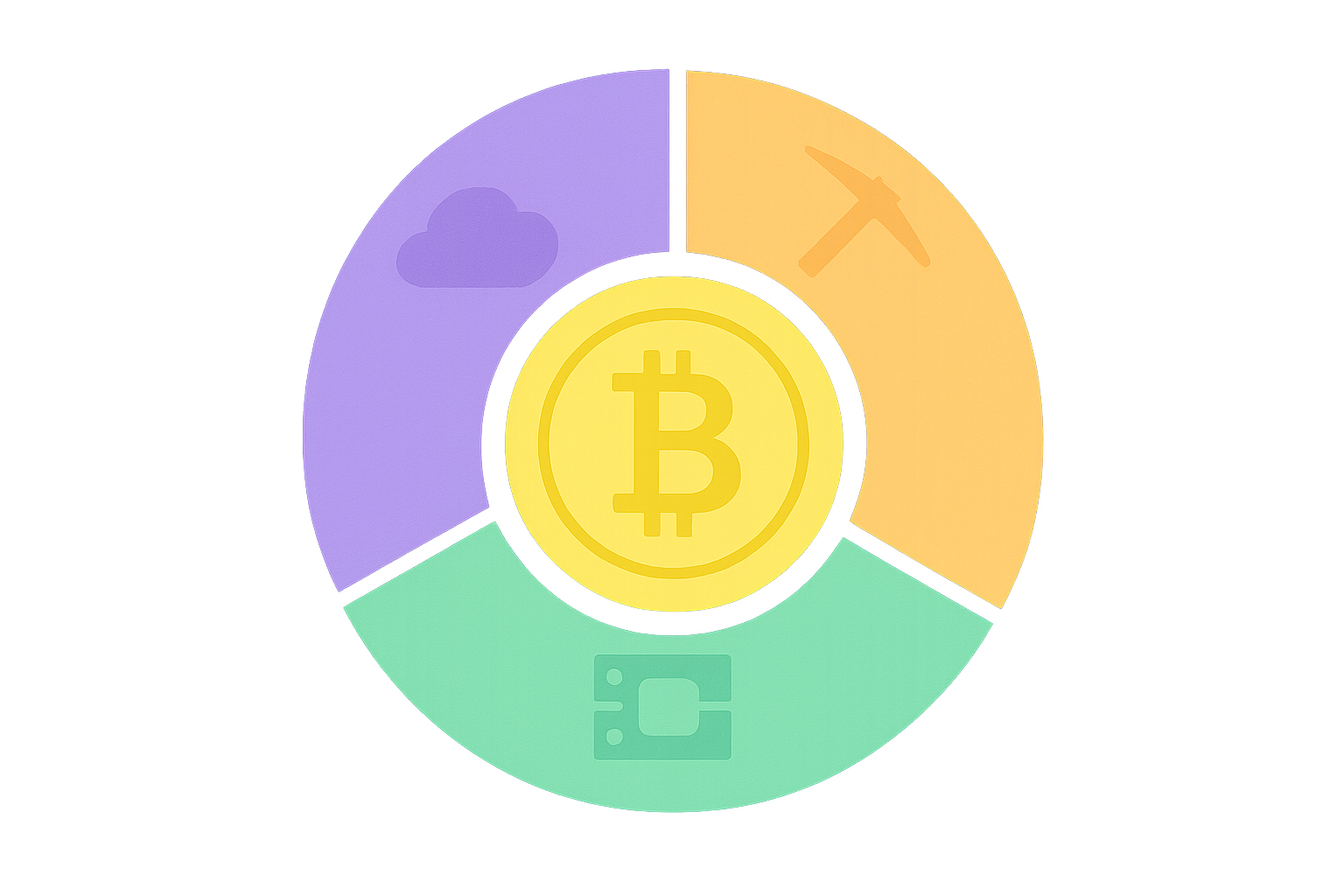
This comprehensive beginner's guide demystifies Bitcoin mining in 2024, covering everything from blockchain fundamentals to profitable mining strategies without massive capital investments. The article addresses whether truly free Bitcoin mining is feasible and explores accessible alternatives including cloud mining platforms like StormGain, entry-level ASIC hardware such as Antminer T9+, and popular mining software options. Readers will discover multiple mining techniques ranging from CPU and GPU mining to specialized ASIC operations, each with detailed pros and cons analysis. By comparing cloud mining, hardware selections, and software tools, this guide helps newcomers determine the most suitable mining approach aligned with their budget and technical expertise, while calculating realistic returns and understanding associated risks in the current cryptocurrency landscape.
What is Bitcoin Mining?
Bitcoin mining forms the backbone of the Bitcoin blockchain, serving as the fundamental process that keeps the entire network secure and operational. It involves a specialized group of computers, also known as miners, that validate transactions and protect the network from malicious attacks. Countries like Iceland, the United States, Iran, and Kenya have emerged as some of the best locations for cryptocurrency mining operations, revolutionizing our perspective on cryptocurrencies, particularly through the strategic use of renewable energy sources in the mining process.
Bitcoin miners solve complex mathematical puzzles that enable them to confirm transactions and create new coins. The first miner who successfully solves the puzzle updates the blockchain with a block of transactions. This block is then broadcast to the network so that other miners can validate it, ensuring the integrity of the entire system. In exchange for this computational work, the system generates newly minted BTC as a reward for the successful miner. Beyond the issuance of new BTC, miners also receive transaction fees related to the number of transactions included in each block, providing an additional incentive for maintaining network security.
Can You Mine Bitcoin for Free?
Many people are curious about mining Bitcoin for free, a concept that typically implies earning Bitcoin through mining activities without significant upfront investments. However, mining an entire Bitcoin for free is not feasible in practice, as the computational requirements and energy costs are substantial. That said, it is possible to mine small fractions of BTC without purchasing expensive hardware through alternative methods.
Platforms like StormGain offer cloud mining solutions that lower the barrier to entry. Using StormGain, users can mine Bitcoin daily without needing special hardware or draining their CPU or battery resources. This occurs through the StormGain trading app interface. After registration and setting up the mining function, StormGain manages the entire mining process on behalf of the user. However, it's important to note that the mining speed, which directly affects the rewards earned, is determined by the monthly trading volume on the platform, creating an incentive for active platform engagement.
In contrast, to determine whether traditional Bitcoin mining from home is profitable, one must carefully consider the investment in hardware and associated operational costs. A mining calculator becomes essential for evaluating cryptocurrency mining profitability, as it estimates earnings based on electricity costs, the miner's hash rate, and the current Bitcoin price. These calculations help potential miners make informed decisions about whether home mining operations make financial sense for their specific circumstances.
Bitcoin Mining Hardware for Home Use
For those new to Bitcoin mining, the Antminer T9+ represents an excellent starting point as a compact and affordable rig from Bitmain. This mining device offers a hash rate of 10.5 TH/s while consuming 1332W of power, striking a balance between performance and energy efficiency. Although it features an easy-to-use web interface that simplifies management for beginners, potential buyers should note that its power supply unit is sold separately, adding to the initial setup cost.
For beginners seeking even more accessible options, Bitmain's Antminer R4 presents another solid choice for entry-level mining operations. This device operates using Bitmain's BM1387 chip technology and produces 8.7 TH/s with a power consumption of 845W, making it particularly ideal for home mining setups where space and noise considerations are important. The R4's design focuses on quieter operation compared to industrial-grade miners, making it more suitable for residential environments. When selecting home mining hardware, beginners should consider factors such as initial cost, energy efficiency, noise levels, and cooling requirements to ensure their chosen equipment aligns with their home environment and budget constraints.
What Are the Most Popular Bitcoin Mining Software Options?
CGMiner
This software stands as one of the most popular and highly regarded mining software variants in the cryptocurrency community. It utilizes a command-line interface, which allows operators to control various aspects of their mining operations with simple keyboard commands. Versions are available for macOS, Windows, and Linux operating systems, ensuring broad compatibility. CGMiner functions as a multi-threaded miner that works with graphics processing units (GPUs) and application-specific integrated circuits (ASICs). Its lightweight design and straightforward approach enable it to deliver consistent performance across different hardware configurations.
Pros:
- Open-source software with transparent development
- Simple interface that experienced users appreciate
- Optimizes hash power scalability for improved efficiency
Cons:
- Not suitable for beginners due to command-line complexity
- The command-line interface can be difficult to read and interpret for newcomers
EasyMiner
EasyMiner represents a user-friendly mining software solution that enables beginners to enter the mining industry with minimal technical barriers. As open-source mining software built on a graphical user interface (GUI), it supports both solo mining and pool mining operations, providing flexibility for different mining strategies. This software includes a MoneyMaker feature designed to create Litecoin paper wallets and connect to private mining pools, expanding its functionality beyond Bitcoin mining.
The graphical interface eliminates the need for command-line knowledge, making it accessible to users without programming experience. EasyMiner automatically detects available mining hardware and suggests optimal settings, further simplifying the setup process for newcomers.
Advantages:
- Open-source software with community support
- Flexibility of use across different mining scenarios
- MoneyMaker mode for additional cryptocurrency options
Cons:
- Functions only on Windows operating systems
- May trigger Windows antivirus software due to mining-related processes
Awesome Miner
Awesome Miner simplifies the expansion of mining operations by allowing users to manage a diverse mix of hardware from a single centralized location. This software also enables remote monitoring of mining performance, providing flexibility for operators managing multiple locations or traveling frequently.
The software consolidates mining activities by controlling multiple mining engines and hardware rigs while managing pool mining operations. Its comprehensive dashboard displays critical metrics including hash rate, fan speed, device temperature, and earnings, giving operators complete visibility into their operations. Advanced features include profit switching, which automatically directs mining power to the most profitable cryptocurrency at any given time.
Awesome Miner runs on both Windows and Linux operating systems. Additionally, its cloud-based web version is accessible from any internet-connected device, offering management flexibility from virtually anywhere in the world, whether you're at home, in the office, or on the go.
Advantages:
- Can mine multiple cryptocurrencies simultaneously
- Compatible with Windows, Mac, and Linux systems
- Suitable for both ASIC and FPGA hardware
Cons:
- Not suitable for beginners due to complex features
- Lacks a simplified graphical interface for basic operations
Innovative Approaches to Bitcoin Mining: Exploring Hardware Solutions
Cloud Mining
Cloud mining has rapidly become one of the most popular mining methods, particularly among those seeking passive income opportunities. With this technique, users can mine cryptocurrencies without the need for hands-on hardware management or technical expertise.
Essentially, this technique involves renting cloud computing power from a third-party provider to perform Bitcoin mining operations. Cloud mining companies offer selected packages that allow others to participate in the mining process at an accessible price point. The challenges associated with purchasing equipment, paying electricity bills, or performing maintenance are minimized or eliminated entirely.
Cloud mining has gained popularity because it enables people to mine by leveraging the capacity of established operations. Users don't need to pay for equipment or electricity costs directly, and they receive profits when Bitcoin is successfully mined. Several cloud mining models are currently used in the industry. One such model is hosted mining, where the customer rents miners in a third-party facility. In this model, the customer maintains control over their mining operations while the hosting provider manages the physical infrastructure, cooling, and electricity supply.
CPU Mining
The CPU mining method utilizes computer processors to mine Bitcoin, representing the original approach to cryptocurrency mining. With this method, only your personal computer and some mining programs are required to begin operations. However, while it was a viable option in Bitcoin's early days, it is no longer a practical choice for serious mining operations.
CPU mining is also relatively unprofitable in the current mining landscape. Miners spend significant amounts on computer cooling and electricity, only to earn a few cents over months of continuous operation. Although it's possible to mitigate this problem by relocating to regions where low-cost electricity and abundant cooling are available, the fact that CPU mining is inherently slow means that operators must still contend with minimal profits. The difficulty adjustment in Bitcoin's protocol has made CPU mining economically unviable for all but the most unique circumstances.
GPU Mining
GPU mining is probably the most popular Bitcoin mining method among individual miners seeking a balance between investment and returns. It involves specially designed rigs built to facilitate efficient mining operations. This approach uses a computer's graphics processing unit to solve the mathematical puzzles required for Bitcoin mining.
The popularity of GPU mining stems from its efficiency and relative affordability compared to industrial-grade solutions. Although building a mining rig can be expensive initially, a GPU remains a good investment when considering its processing power and operational speed. GPU miners can also be repurposed for mining alternative cryptocurrencies if Bitcoin mining becomes unprofitable, providing flexibility. One of the most popular GPU miners is the NVIDIA GeForce GTX 1070, which offers an excellent balance of hash rate and energy efficiency for various cryptocurrency mining operations.
An ASIC (Application-Specific Integrated Circuit) is a specialized device designed explicitly for performing a single task with maximum efficiency. In the case of Bitcoin mining, these machines are built exclusively for mining operations, with every component optimized for hash calculation. Compared to CPUs and GPUs, ASICs have a significant advantage in terms of processing power and operational efficiency, often delivering hash rates hundreds of times higher than GPU alternatives.
ASIC miners dominate professional Bitcoin mining operations due to their superior performance characteristics. They consume less electricity per unit of hash power generated, making them more cost-effective for large-scale operations. However, the downside is that they represent the most expensive mining machines available on the market, with top-tier models costing thousands of dollars. Additionally, ASICs lack versatility—they can only mine cryptocurrencies using the specific algorithm they were designed for, meaning a Bitcoin ASIC cannot be repurposed for other mining tasks if Bitcoin mining becomes unprofitable.
Decoding Bitcoin Mining Techniques
Bitcoin mining remains a promising and potentially profitable activity in the current cryptocurrency market landscape. As Bitcoin's price has appreciated over time, demand for mining equipment continues to grow steadily. This opportunity in recent years represents a significant occasion for those aiming to bridge the supply gap or who desire to earn Bitcoin without trading or purchasing it directly on exchanges.
While completely free Bitcoin mining is not realistic due to inherent costs, there are simpler and more accessible ways to engage in mining activities without massive capital investments. Cloud mining platforms, entry-level hardware options, and pool mining all provide pathways for individuals to participate in the Bitcoin network's security and earn rewards. Although returns might be lower compared to substantial investments in industrial-scale operations, mining still offers a valid source of income for those willing to carefully calculate their costs and optimize their operations.
For prospective miners, success depends on thorough research, realistic expectations, and careful consideration of factors such as electricity costs, hardware efficiency, and market conditions. By understanding the various mining methods, selecting appropriate hardware and software, and choosing the right operational model, individuals can participate in Bitcoin mining in a way that aligns with their budget, technical expertise, and profit goals.
FAQ
Are there truly free Bitcoin mining methods in 2024?
Yes, free cloud mining platforms exist in 2024, though returns are typically modest. These services allow mining without equipment, but free options usually come with strict limitations and lower profitability compared to paid plans.
Cloud mining and free mining platforms carry significant risks including data breaches, virus infections, and lack of transparency. Many are potentially fraudulent schemes designed to steal personal information or cryptocurrency. Exercise extreme caution and verify platform legitimacy before participation.
Can personal computers or mobile phones mine Bitcoin for free?
Free Bitcoin mining on personal computers or phones is impractical. Modern mining requires specialized hardware due to high difficulty levels. Individual devices generate minimal returns and cannot compete with professional mining operations using dedicated equipment.
What is the revenue difference between free Bitcoin mining and paid mining?
Free mining typically generates 30-50% lower returns than paid mining. Paid mining offers better hardware efficiency, professional operations, and optimized electricity costs, while free methods face hardware limitations and higher operational constraints, resulting in significantly lower daily revenue accumulation.
Which method is more reliable among airdrops, faucets, and mining pools for obtaining free Bitcoin?
Airdrops and mining pools from established projects tend to be more reliable, as they're backed by trusted blockchain teams. Faucets carry higher risk of scams and unclear legitimacy. Airdrops offer better security through official project channels.
What fundamental knowledge do you need to understand to participate in Bitcoin mining?
To participate in Bitcoin mining, understand blockchain technology, hash rate (computational power), and specialized mining hardware requirements. Mining demands significant electricity consumption and involves joining mining pools for stable returns in competitive environments.
* The information is not intended to be and does not constitute financial advice or any other recommendation of any sort offered or endorsed by Gate.