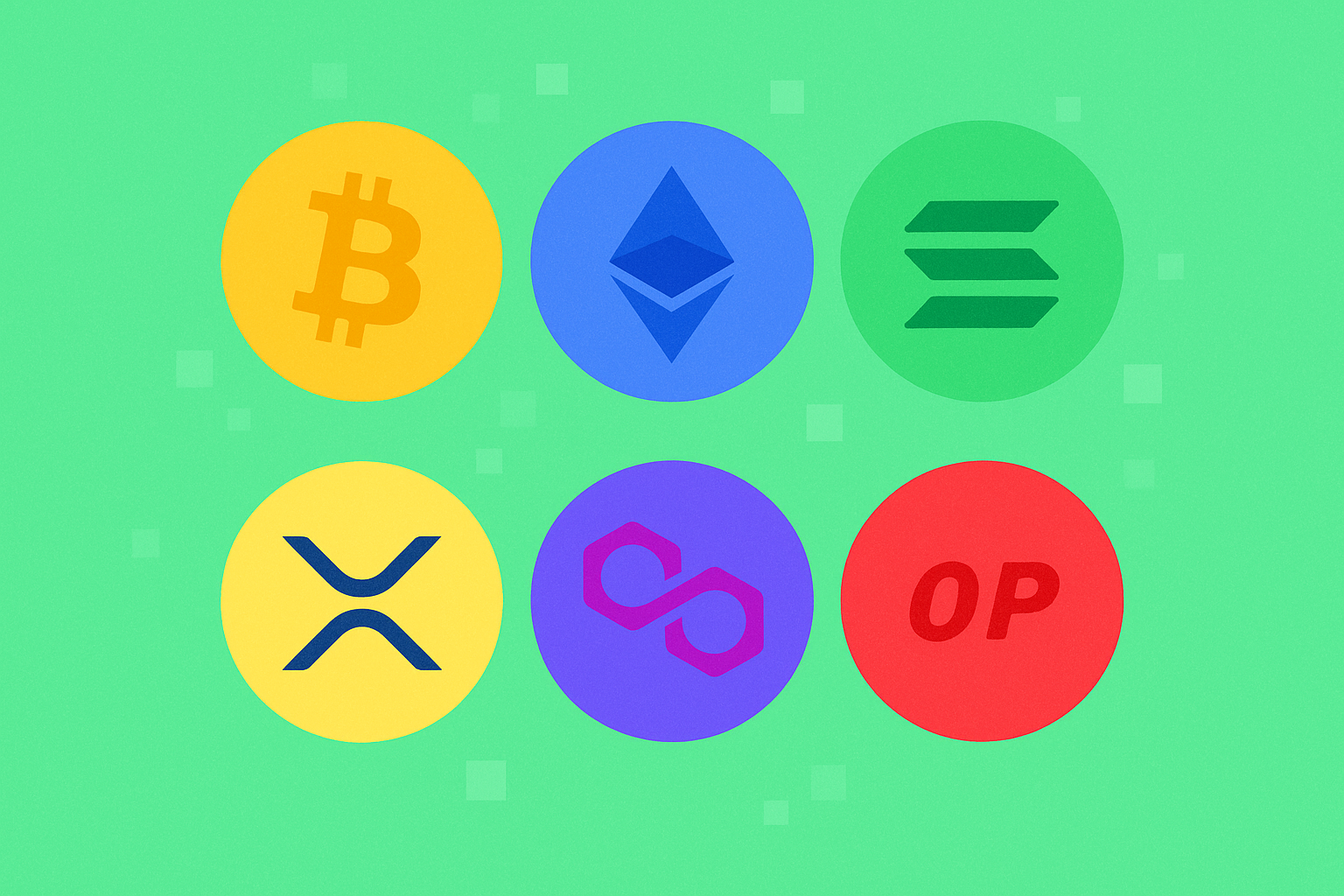
Which cryptocurrencies are worth considering in 2024? Explore expert insights into leading investment crypto assets such as Bitcoin, Ethereum, Solana, and XRP. Learn about high-potential altcoins, Layer 2 innovations, and trading on Gate. Find strategies for portfolio diversification tailored for investors.
Top Cryptocurrencies to Watch: Expert Picks
With the cryptocurrency market evolving at a rapid pace, selecting assets for investment is increasingly complex. The BeInCrypto editorial team consulted leading industry experts to determine which digital assets merit special attention from investors in the near term.
Rafik Mamin’s Perspective: Backing Proven Market Leaders
Rafik Mamin, CEO of Minestream, identifies Ethereum, XRP, Solana, and Bitcoin as the top candidates for maximum profit potential in the foreseeable future. According to Mamin, Bitcoin will continue to lead the crypto market, maintaining its status as digital gold and serving as the primary vehicle for institutional investors.
“I believe Bitcoin is well-positioned to reach $150,000, and with favorable conditions—sustained market momentum and regulatory progress—it could surpass $180,000.”
This forecast is rooted in several factors: growing institutional demand, Bitcoin’s capped supply, and the potential for network scaling through second-layer solutions such as the Lightning Network.
For Ethereum, Mamin emphasizes its foundational role as the framework for decentralized applications (dApps). Ethereum’s value proposition will remain strong, thanks to ongoing upgrades that enhance scalability and reduce energy consumption. In the near term, he sees potential for Ethereum to reach $5,700, and under highly favorable conditions, $5,800. These targets underscore Ethereum’s strength as a platform for smart contracts and DeFi applications.
The outlook for XRP is closely linked to the likely conclusion of Ripple’s dispute with US regulators. A favorable ruling could be a pivotal moment for the token.
“If Ripple prevails, it could be a powerful catalyst, driving XRP’s price to the $4–5 range. XRP has enormous potential for cross-border payments, and regulatory clarity is crucial here.”
A positive court outcome for Ripple could pave the way for wider adoption of XRP in banking and global payments.
Solana is expected to grow as a result of enhanced performance, infrastructure development, and a rising number of blockchain-based applications. The network is popular among developers for its high throughput (up to 65,000 TPS) and low transaction fees.
“I expect SOL’s price to fluctuate between $200–550, with a potential peak of $700 under optimal conditions.”
This optimism reflects Solana’s expanding ecosystem in DeFi, NFT, and decentralized application segments.
Alexey Bykov’s Recommendations: Diversifying Your Portfolio
Alexey Bykov, Head of Client Data Management at Strifor, presents a list of six cryptocurrencies for near-term investment, emphasizing a balance between established leaders and promising second-layer projects.
1. Ethereum
Ethereum continues to lead thanks to upcoming upgrades aimed at greater scalability, lower transaction costs, and improved energy efficiency. The transition to Proof-of-Stake has already cut network energy consumption substantially. Smart contracts and decentralized applications remain the network’s primary growth drivers. High innovation levels and a robust developer community make ETH attractive for long-term investment.
2. Optimism
This Layer 2 solution for Ethereum, powered by Optimistic Rollups technology, helps alleviate mainnet congestion and significantly reduces transaction fees. Major projects like Uniswap and Synthetix already utilize this platform, demonstrating its reliability and growth potential. Optimistic Rollups allow off-chain transaction processing while maintaining strong security.
3. StarkNet
StarkNet is another Layer 2 platform (Layer 2) built on Ethereum, using zk-rollups to boost transaction speed and security. Unlike Optimistic Rollups, zk-rollups provide instant transaction finality via zero-knowledge cryptographic proofs. With STRK token prices near historic lows, it’s an appealing long-term growth prospect.
4. Polygon
Polygon successfully tackles Ethereum’s scalability challenges by offering fast, inexpensive transactions. Its ecosystem is expanding rapidly, attracting developers and investors worldwide. Polygon supports a wide range of dApps in DeFi, NFT, and GameFi. Future upgrades, including the adoption of zkEVM technology, could further solidify Polygon’s market position.
5. Bitcoin
Despite steady gains in other altcoins, Bitcoin remains the crypto industry’s digital gold. It’s integrated into traditional finance through ETFs and is a reliable long-term investment asset. Its capped supply of 21 million coins and increasing institutional demand continue to underpin its value.
6. Solana
Solana’s network stands out for high transaction speed and low fees. The popularity of decentralized applications and NFTs on Solana continues to grow, sustaining demand for the token. The ecosystem is developing quickly, attracting new projects across DeFi, Web3, and the metaverse.
Ilya Makar’s Perspective: Bitcoin and Promising Altcoins
Financial expert and investor Ilya Makar unequivocally points to Bitcoin as the first cryptocurrency poised for growth. BTC’s outlook is supported by growing institutional interest, network scaling solutions, and limited supply.
Among altcoins, Makar highlights Ethereum, whose team is steadily advancing the technical capabilities of the asset. He draws particular attention to the rollout of sharding and other features to increase network throughput.
Makar also singles out Cardano as one of the most promising projects:
“In the near future, Cardano could become a leading platform for smart contracts and dApps, especially given the team’s focus on sustainability and social impact.”
Cardano’s research-driven development, based on peer-reviewed studies, makes it attractive to institutional investors and projects requiring strong security.
Among other standout altcoins for investors, Makar points to Polkadot, Chainlink, Solana, Avalanche, Polygon, Cosmos, and Near Protocol. He believes these cryptocurrencies could deliver strong growth soon, thanks to robust technical foundations and rising demand for platform solutions. Each offers distinct technological advantages: Polkadot enables cross-chain interoperability, Chainlink provides decentralized oracles, Avalanche offers high transaction speed, and Cosmos is building an “Internet of blockchains.”
Alexander Weiss’s Focus: Layer 2 and Core Technical Projects
Alexander Weiss, serial FinTech and DeFi entrepreneur, developer, and analyst, recommends investors pay close attention to Layer 2 coins and a range of fundamental projects with strong technical underpinnings. His top picks are TON, Solana, and Sui.
TON (The Open Network) stands out for its integration with Telegram and its massive user base potential. Solana continues to expand its ecosystem, attracting both projects and developers. Sui, a relatively new project, features an innovative blockchain architecture focused on high performance and developer usability.
Pavel Butenko’s Advice: Undervalued Assets and Emerging Trends
Pavel Butenko, crypto trading expert at Crypto Academy SoulTeam, recommends monitoring Ethereum, noting that its current price doesn’t fully reflect its true value considering its platform’s importance in the crypto ecosystem. He also highlights Arbitrum and Optimism tokens as promising Layer 2 solutions within Ethereum’s ecosystem, which could see significant growth as mainnet congestion increases.
Butenko also identifies RWA (Real World Assets)—tokenization of real-world assets—as a promising sector. This area is drawing increasing institutional interest by bringing traditional financial instruments onto the blockchain. Among RWA tokens, he highlights Lido Finance (Ethereum staking) and Synthetix (synthetic assets), both offering innovative solutions for income generation and access to financial instruments.
Within the DePIN (Decentralized Physical Infrastructure Networks) segment, Butenko recommends IOTA. IOTA specializes in Internet of Things (IoT) and provides solutions for machine-to-machine economies, a potentially crucial development area in the coming years.
Summary: Where to Invest in Crypto Next
Expert analysis highlights several key directions for cryptocurrency investment in the near term. Bitcoin remains the market’s flagship, with potential growth forecasts up to $150,000—and even $180,000 in favorable conditions. This projection reflects rising institutional demand, limited supply, and ongoing infrastructure improvements for scaling.
Ethereum’s popularity is supported by upgrades aimed at boosting scalability and lowering costs. The shift to Proof-of-Stake and the implementation of sharding reinforce its status as the foundation for decentralized applications. Experts expect Ethereum could reach $5,700–5,800 with positive market momentum.
XRP also looks promising, particularly if Ripple wins its case against US regulators. A favorable verdict could push XRP’s price to the $4–5 range and pave the way for broader adoption in banking.
Solana’s high throughput and low fees maintain its strong market position. Experts believe SOL could climb to $700 under optimal conditions, driven by ecosystem expansion and growing numbers of decentralized applications.
Promising Altcoins and Layer 2 Solutions
Beyond market leaders, experts recommend considering Ethereum Layer 2 solutions. Polygon, Optimism, StarkNet, and Arbitrum offer advantages such as enhanced scalability and low fees, making them appealing for long-term investment. These projects address Ethereum’s mainnet congestion and could see notable growth as demand rises.
Cardano stands out for its research-based development and sustainability focus. It could become a leader in smart contracts and dApps.
Ilya Makar also highlights Polkadot, Chainlink, Avalanche, and Cosmos, citing their strong technical profiles and rising demand for their solutions. These tokens may deliver solid growth, thanks to sustained ecosystem development and adoption of innovative technologies. Each project provides unique value: cross-chain interoperability, decentralized oracles, high throughput, and unified blockchain ecosystems.
Emerging Investment Themes
Experts also spotlight several areas with growth potential in the near future:
- TON, Sui, and Near Protocol — projects with innovative architecture and scalability potential
- RWA tokens (Lido Finance, Synthetix) — real-world asset tokenization, attracting institutional investors
- DePIN sector (IOTA) — decentralized physical infrastructure networks and IoT
Portfolio Construction Recommendations
Drawing on expert perspectives, investors might consider the following allocation strategy:
- Portfolio Core: Bitcoin and Ethereum as the most reliable, liquid assets (50–60% of portfolio)
- Promising Altcoins: Solana, XRP, Cardano for diversification (20–30%)
- Layer 2 Solutions: Polygon, Optimism, Arbitrum, StarkNet as higher-risk, high-potential assets (10–15%)
- Innovative Sectors: TON, Sui, RWA tokens, DePIN projects for the experimental portion (5–10%)
Keep in mind, the crypto market is highly volatile. Any investment should be based on careful analysis and reflect your own risk tolerance. Diversifying your portfolio and taking a long-term approach can help mitigate risk and improve your chances of success in this fast-evolving industry.
FAQ
Which cryptocurrencies are most promising for 2024–2025?
Bitcoin, Ethereum, and Solana rank as the top picks. Polygon, Optimism, and StarkNet are also noteworthy for their scalability advances and rising transaction volumes.
How should you select a cryptocurrency for investment and what criteria are important?
Review market capitalization, trading volume, technology, and the project team. Assess growth potential and alignment with your investment objectives. Study the whitepaper and check for strategic partnerships.
What risks are involved in cryptocurrency investing, and how can you minimize them?
Key risks include price volatility, cyberattacks, and regulatory shifts. Minimize risks by diversifying holdings, using hardware wallets, researching projects thoroughly, and investing only discretionary funds.
How do Bitcoin, Ethereum, and altcoins differ from an investment perspective?
Bitcoin is the first and most stable cryptocurrency by market cap. Ethereum offers a platform for smart contracts. Altcoins are alternatives with higher risk but potentially larger returns. Bitcoin and Ethereum are considered more conservative investments.
What is a suitable crypto investment strategy for beginners?
DCA (Dollar Cost Averaging) is ideal for newcomers. Invest fixed sums regularly and avoid emotional decisions. Start with major cryptocurrencies, then diversify as you gain experience.
How should you assess a new crypto project’s development potential before investing?
Evaluate the development team, technology, and project uniqueness. Read the whitepaper, review trading volume, and monitor community engagement. Check partnerships, licenses, and reputation, and compare with market competitors.
* The information is not intended to be and does not constitute financial advice or any other recommendation of any sort offered or endorsed by Gate.