Explore high-potential investment opportunities with XRP, a digital asset currently undervalued by the market. Understand how XRP powers cross-border payments, its increasing institutional adoption, and the potential to reshape the global financial landscape. Invest with Gate today to seize long-term growth prospects in both the cryptocurrency and decentralized finance sectors.
Why the XRP Market Remains Undervalued
The cryptocurrency market is frequently driven by speculation and short-term price swings, often resulting in undervaluation for assets with strong utility and long-term promise. XRP, a digital asset purpose-built for streamlining cross-border payments with high efficiency, exemplifies this pattern. Despite its compelling use case and rising adoption among major financial institutions, the market has yet to fully price in XRP’s intrinsic value.
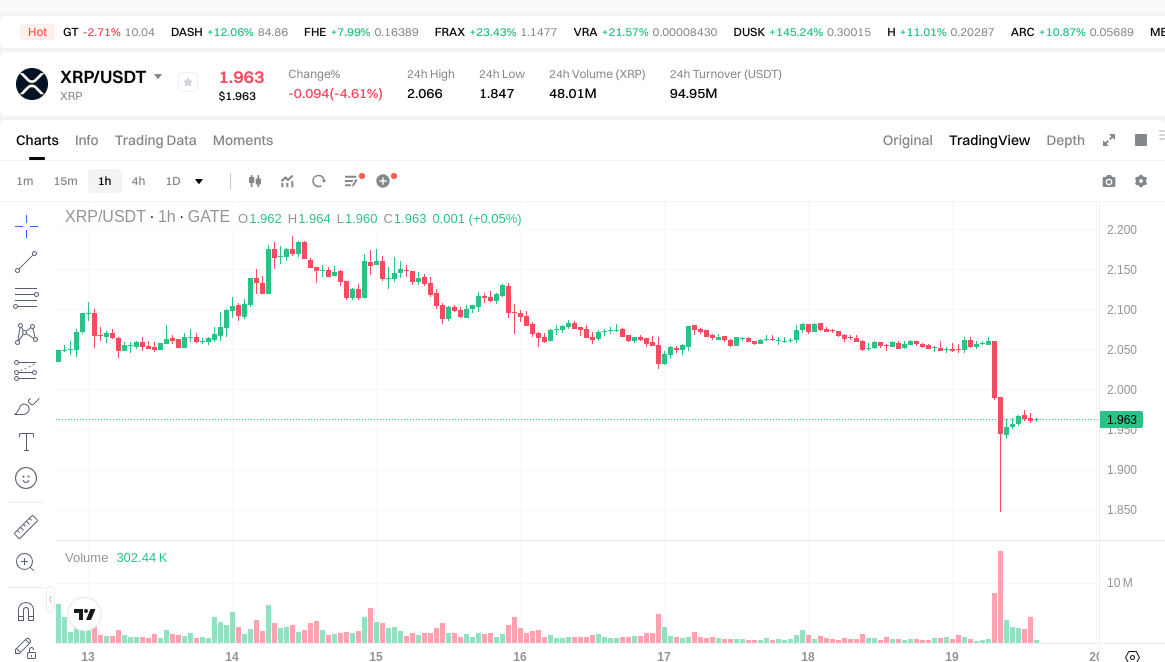
This undervaluation stems from several key factors, including an overemphasis on price speculation over real-world utility and persistent regulatory uncertainty that has undermined institutional investor confidence. Additionally, limited understanding of XRP’s role as a financial infrastructure asset continues to weigh on its valuation. This article examines the underlying causes of XRP’s undervaluation and its significant potential to reshape global finance.
XRP’s Function as a Bridge Asset for Cross-Border Payments
XRP serves as a unique bridge asset, enabling near-instant, ultra-low-cost cross-border transactions. Traditional financial systems typically rely on slow, complex international payment processes involving multiple intermediaries—such as correspondent banks and the SWIFT network—which drive up fees and can result in settlement delays of several days.
XRP addresses these structural inefficiencies by enabling settlement in seconds, cutting transaction costs by up to 60% versus legacy systems. This real-world utility makes XRP invaluable to financial institutions aiming to modernize payment infrastructure and deliver superior customer experiences. For example, a remittance provider can use XRP to send money from Europe to Asia in less than 5 seconds, compared to the 3–5 business days required by traditional systems.
How XRP Facilitates Cross-Border Transactions
XRP leverages its dedicated blockchain, the XRP Ledger, to enable high-efficiency transactions. As a neutral settlement intermediary, XRP lets financial institutions transfer value internationally without pre-funded nostro accounts, freeing up capital and reducing operational expenses.
The process is straightforward: the sender converts local currency to XRP, transfers XRP across the network in seconds, and then converts XRP into the recipient’s local currency. This approach slashes operating costs and unlocks trapped liquidity, positioning XRP as a game changer in global finance. The system also ensures full transparency and traceability, which enhances trust and security in every transaction.
The Market’s Misjudgment of XRP’s Value
XRP’s persistent undervaluation is largely due to widespread misunderstanding of its true value. Many investors—especially short-term speculators—focus solely on day-to-day price movements, overlooking XRP’s real function as a foundational financial infrastructure asset.
This narrow view ignores XRP’s long-term potential to boost global banking efficiency and drive financial innovation. Unlike many speculative cryptocurrencies, XRP has a proven use case for solving real-world pain points in traditional finance. Yet, this critical distinction is often lost amid media noise and short-term volatility.
Speculation’s Impact on XRP Valuation
The crypto market is notorious for extreme volatility and news-driven price swings, with hype and speculation often eclipsing fundamentals. XRP’s relative price stability—frequently misread as a weakness—actually reflects its current stage of infrastructure development and growing institutional adoption.
As real-world adoption by financial institutions increases and demand becomes utility-driven, XRP is likely to undergo a major market revaluation. Financial history shows that assets with strong utility eventually trade at values that reflect their real worth, and XRP is no exception. The current phase offers an opportunity for informed investors who recognize value beyond the speculative noise.
Regulatory Clarity and Its Role in XRP Adoption
Regulatory clarity is a crucial driver that directly shapes both adoption and valuation for XRP. In recent years, regulatory ambiguity has dampened institutional confidence and delayed broader adoption. However, regulators worldwide are now working to establish clear, comprehensive digital asset guidelines—including for XRP—which could unlock institutional adoption and fuel robust demand growth.
For instance, resolving regulatory uncertainty and establishing a clear legal framework would empower major financial institutions to integrate XRP into daily operations confidently and without legal concerns. Such a regulatory shift could prove pivotal for XRP’s market trajectory.
Why Regulatory Clarity Is Critical
Clear, stable regulation gives businesses and institutions the legal certainty they need, reducing operational and legal risk. For XRP, this translates into greater trust and legitimacy—both essential for mainstream banking adoption.
With regulatory progress in major markets, XRP may soon be valued based on utility rather than speculation. Banks and institutions that have remained on the sidelines can then enter the market with confidence, spurring demand and liquidity. This multiplying effect could further establish XRP as a trusted, stable financial asset.
Institutional Adoption and Financial Sector Partnerships
Out of the spotlight, institutional adoption of XRP is gaining steady momentum. Leading financial institutions and major banks worldwide are exploring XRP’s potential to streamline complex operations and significantly reduce costs.
These strategic partnerships highlight growing global recognition of XRP as a dependable and efficient bridge asset. Many international banks have already piloted XRP for currency transfers and cross-border payments, reporting promising results in saving both time and money.
XRP’s Impact on Institutional Finance
XRP’s unique ability to deliver real-time, ultra-low-cost cross-border payments makes it highly attractive for institutions handling large volumes of international transactions. By integrating XRP, financial organizations can boost operational efficiency, cut costs, and enhance customer experiences through faster settlements.
Accelerating adoption underscores XRP’s potential to become a foundational layer in global financial infrastructure. XRP also gives institutions more flexibility in managing liquidity, reduces dependence on multiple international accounts, and streamlines operations to lower risk. The benefits go beyond cost savings, driving comprehensive financial system efficiency.
Tokenizing Real-World Assets and XRP’s Role in Global Finance
Tokenization of real-world assets is an emerging trend with the potential to radically transform traditional finance. It involves turning physical assets—like real estate, commodities, and securities—into digital tokens that can be traded on blockchain networks.
XRP is strategically positioned to serve as a neutral, efficient settlement intermediary for tokenized assets. This aligns with the global shift toward a more digital, connected, and inclusive financial system. XRP’s ability to settle tokenized asset transactions quickly and securely makes it essential to this new financial landscape.
How XRP Enables Tokenization
By offering a high-speed, secure, and cost-effective platform, XRP enables seamless, borderless exchange of tokenized assets. This is especially valuable in sectors like commercial real estate, global supply chains, and trade finance, where tokenization unlocks new efficiencies and investment opportunities.
For example, an investor in Europe can acquire a tokenized stake in an Asian commercial property and settle the deal within minutes using XRP, compared to the weeks or months required for conventional transactions. This expands access to new markets and increases liquidity in traditionally illiquid sectors, generating significant value for both investors and institutions.
On-Chain Metrics Reveal XRP’s Undervaluation
Multiple technical and on-chain metrics clearly indicate that XRP trades below its true utility and future adoption potential. These indicators provide deep insights into the network’s fundamental health and the asset’s underlying value, independent of market price swings.
For example, the Network Value to Transactions Ratio (NVT) and MVRV Z-Score show that XRP’s current market price doesn’t fully reflect its rising utility and demand. Professional analysts use these metrics to spot undervalued investment opportunities.
What On-Chain Data Shows About XRP
NVT Ratio: A low NVT ratio means XRP’s daily transaction volume is high relative to its market cap, strongly suggesting undervaluation and growth potential. High network usage compared to price is a positive signal for the asset’s fundamentals.
MVRV Z-Score: This advanced metric measures the difference between XRP’s market value and its realized value (the aggregate value based on last traded prices). A low MVRV Z-Score shows XRP is trading well below its fair value, offering a potential opportunity for long-term investors. Historically, low readings have preceded strong price rallies.
Together, these indicators strongly suggest the market has yet to fully price in XRP, leaving considerable room for upward revaluation.
Supply Dynamics: Escrow and Circulating Supply
XRP’s carefully managed supply also contributes to its undervaluation. A large share of total supply is securely locked in escrow or held by long-term strategic investors, meaning the amount actually available on the market is far less than commonly assumed.
This relative scarcity can drive upward price pressure as institutional and retail demand grows. When supply is tight and demand rises, basic economics point to higher prices ahead.
How XRP’s Escrow System Works
XRP’s innovative, transparent escrow system ensures new supply enters the market in a controlled, predictable manner, preventing sudden supply shocks that could destabilize prices. This structure provides stability and reliability, making XRP attractive to institutional investors seeking relatively stable assets.
The escrow system also delivers full transparency—anyone can track how much XRP is locked and the future release schedule on-chain. This fosters trust and reduces concerns about surprise inflation, which is critical for risk-conscious institutional investors.
XRP ETFs and Their Potential to Drive Institutional Demand
The launch of XRP-based exchange-traded funds (ETFs) could dramatically increase institutional demand. ETFs provide regulated, accessible exposure for both institutions and individuals, enabling large capital inflows and boosting liquidity.
Past experience with Bitcoin and Ethereum ETFs highlights how transformative these vehicles can be for demand and price. An XRP ETF would open the market to new investor classes previously unable or unwilling to buy digital assets directly.
Why XRP ETFs Matter
ETFs make crypto investing much easier for major financial institutions, pension funds, and retail investors by eliminating the complexity of digital asset custody and security.
As ETFs gain traction and regulatory approval in major markets, they can act as a powerful catalyst for broader adoption and sharp price appreciation. ETF approval also lends credibility, signaling regulatory acceptance and asset quality. Institutional inflows via ETFs could fundamentally reshape market dynamics and drive XRP closer to fair value.
Conclusion: The Outlook for XRP in Global Finance
XRP’s current undervaluation is the result of short-term speculative focus, regulatory uncertainty, and lack of broad understanding of its foundational utility.
However, with accelerating institutional adoption, greater regulatory clarity, and rising demand from major financial players, XRP’s true value could soon be realized. All the fundamentals point to substantial revaluation potential.
With its unique position as an efficient bridge for cross-border payments and its vast potential to drive innovation and efficiency in global finance, XRP is strategically positioned as a cornerstone of the digital economy’s future. The journey to unlocking this potential is underway, and investors who recognize the opportunity early may be best placed to benefit from future growth.
FAQ
What is XRP and what is its global financial role?
XRP is a digital currency that enables fast, efficient international money transfers. Banks and financial institutions use it to lower the cost and speed up cross-border payments, supporting global financial stability.
Why do some view XRP as undervalued, and where does its real value lie?
XRP is seen as undervalued because it delivers fast, affordable, and highly efficient transfers. Its true value is its ability to move money globally with low costs, boosting liquidity and providing practical benefits to the financial system.
XRP vs. Bitcoin and Ethereum: What are the advantages and disadvantages?
XRP offers faster transactions and lower fees than Bitcoin and Ethereum but lacks full decentralization due to Ripple’s oversight.
How is XRP applied to international and cross-border payments?
XRP facilitates ultra-fast, low-fee international money transfers, especially for small and large cross-border transactions, cutting costs and speeding settlement.
What’s the relationship between Ripple and XRP?
Ripple is a cross-border payment technology company, and XRP is its digital currency for improving transaction efficiency. XRP’s success is tied to Ripple’s ecosystem, but Ripple can operate independently of XRP.
What are the main risks and opportunities for investing in XRP?
Main risks include regulatory uncertainty and market volatility. Opportunities are found in global money transfers and business adoption of the tech. Strong growth is anticipated as digital payments infrastructure advances.
What’s the regulatory outlook for XRP, especially in the US?
XRP’s US regulatory status was clarified after a legal settlement with the SEC, eliminating previous uncertainty and greatly increasing investor confidence in its future.
What are XRP’s key technology innovations and consensus mechanism?
XRP uses a federated consensus protocol—no mining or staking required. The XRPL network offers high efficiency and extremely low global transaction costs.
What’s the future outlook and price forecast for XRP over the next 5–10 years?
XRP is projected to grow significantly in the coming years, with prices potentially reaching the $20–$30 range. Future progress depends on technology adoption and global financial partnerships.
How do you buy, store, and trade XRP?
Choose a reliable platform that supports XRP, complete identity verification, and purchase XRP with fiat. Transfer XRP to your personal wallet for secure storage. For trading, use available pairs and monitor price and volatility.
* The information is not intended to be and does not constitute financial advice or any other recommendation of any sort offered or endorsed by Gate.