This comprehensive guide compares TOWNS and NEAR, two leading blockchain ecosystems shaping Web3 development. TOWNS, launched in 2025, is a decentralized messaging protocol on Base network featuring revenue-generating Spaces, while NEAR, established in 2020, provides Layer-1 blockchain infrastructure with state sharding for scalability. The article analyzes historical price trends, current market status ($0.006329 vs $1.5033), and price projections through 2031. It examines tokenomics, institutional adoption, and technical capabilities to address which asset offers better investment value. Tailored investment strategies for conservative and aggressive investors highlight portfolio allocation recommendations. Risk assessments cover market volatility, technical challenges, and regulatory considerations, enabling readers to make informed decisions aligned with their risk tolerance and investment objectives in the cryptocurrency market.
Introduction: Investment Comparison Between TOWNS and NEAR
In the cryptocurrency market, the comparison between TOWNS vs NEAR has become a topic of interest for investors. The two tokens show notable differences in market cap ranking, application scenarios, and price performance, representing distinct positioning within the crypto asset landscape.
TOWNS: Launched in 2025, this decentralized real-time messaging protocol has gained attention for its focus on ownable, revenue-generating "Spaces" with on-chain memberships and encrypted messaging capabilities built on Base network.
NEAR (NEAR): Since its launch in 2020, NEAR Protocol has been recognized as a highly scalable blockchain infrastructure designed to support DApp operations, particularly on mobile devices, with state sharding technology enabling linear scalability.
This article will provide a comprehensive analysis of TOWNS vs NEAR investment value comparison, covering historical price trends, supply mechanisms, institutional adoption, technical ecosystems, and future outlook, attempting to address the question investors care about most:
"Which is the better buy right now?"
I. Price History Comparison and Current Market Status
TOWNS (Coin A) and NEAR (Coin B) Historical Price Trends
- 2022: NEAR reached an all-time high of $20.44 on January 17, 2022, during a period of broader market optimism. TOWNS had not yet launched during this timeframe.
- 2020: NEAR experienced price discovery following its launch, reaching a low of $0.526762 on November 5, 2020, reflecting early-stage market positioning.
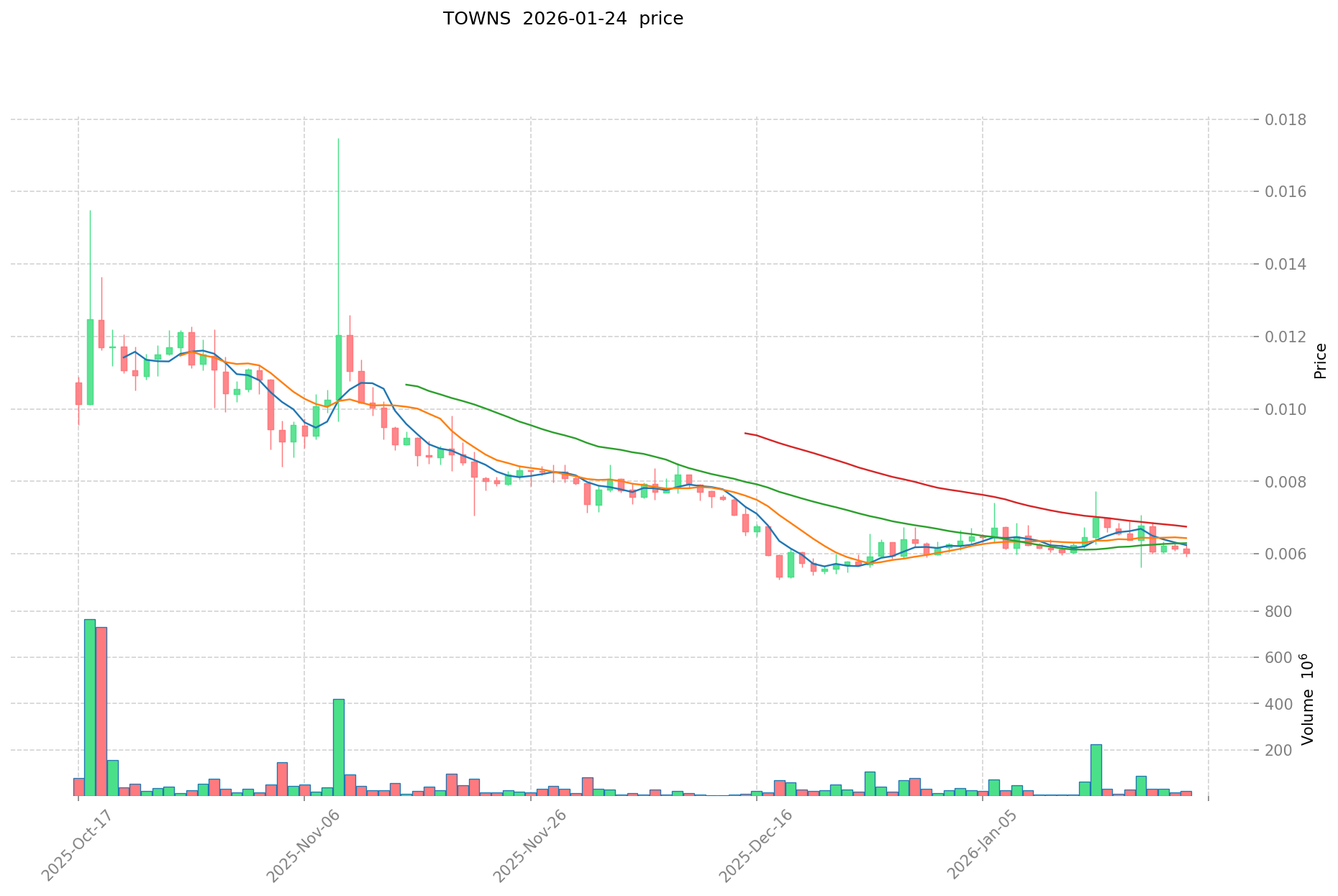
- 2025: TOWNS achieved its historical high of $0.06597 on August 5, 2025, shortly after its protocol launch in October 2024, while NEAR continued to experience volatility with significant corrections from previous peaks.
- Comparative Analysis: During the recent market cycle, NEAR declined approximately 92.65% from its historical high of $20.44 to its current price of $1.5033, while TOWNS declined approximately 90.41% from its peak of $0.06597 to $0.006329.
Current Market Status (2026-01-25)
- TOWNS Current Price: $0.006329
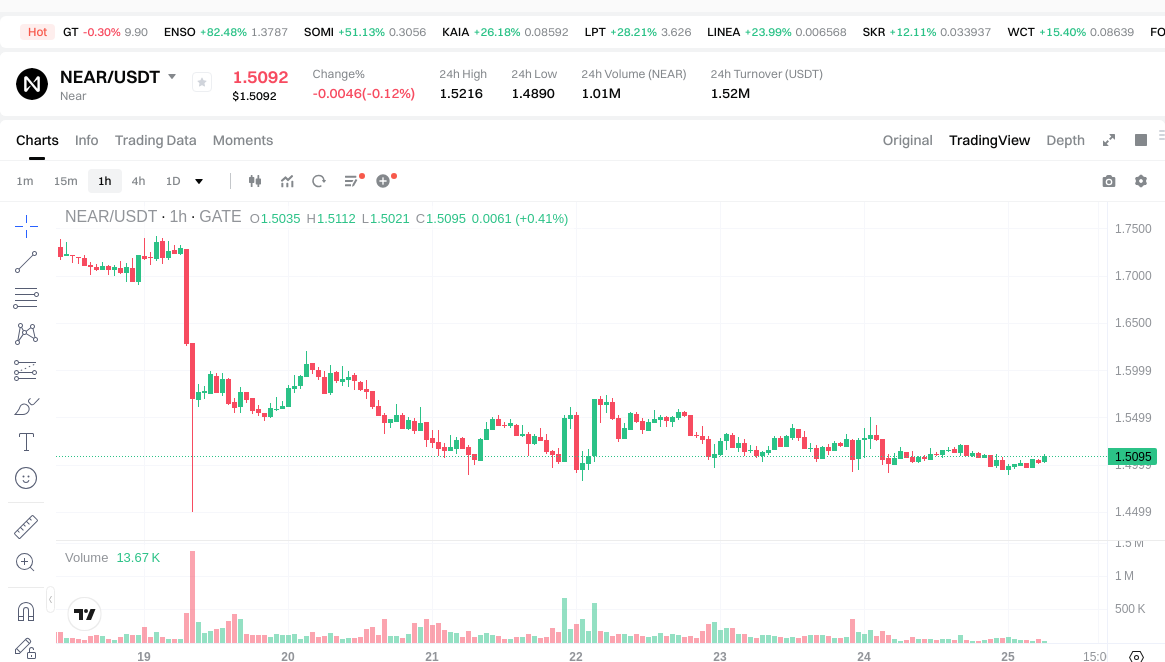
- NEAR Current Price: $1.5033
- 24-Hour Trading Volume: TOWNS $286,261.99 vs NEAR $1,516,762.80
- Market Sentiment Index (Fear & Greed Index): 25 (Extreme Fear)
View real-time prices:
II. Core Factors Affecting the Investment Value of TOWNS vs NEAR
Supply Mechanism Comparison (Tokenomics)
Due to the absence of specific tokenomics data in the provided materials, a detailed comparison of supply mechanisms cannot be conducted at this time.
Institutional Adoption and Market Application
Without available data regarding institutional holdings, enterprise adoption cases, or regulatory policies from different jurisdictions, a comprehensive analysis of market application cannot be provided.
Technology Development and Ecosystem Building
The provided materials do not contain information about technology upgrades, development roadmaps, or ecosystem applications in DeFi, NFT, payment systems, or smart contract implementations for either asset.
Macroeconomic Environment and Market Cycles
In the absence of historical performance data, macroeconomic correlation analysis, or geopolitical impact assessments, conclusions regarding inflation resistance properties or sensitivity to monetary policy cannot be drawn.
III. 2026-2031 Price Prediction: TOWNS vs NEAR
Short-term Prediction (2026)
- TOWNS: Conservative $0.00526 - $0.00633 | Optimistic $0.00633 - $0.00912
- NEAR: Conservative $0.797 - $1.50 | Optimistic $1.50 - $1.65
Mid-term Prediction (2028-2029)
- TOWNS may enter a consolidation phase, with projected price range of $0.00824 - $0.01135 in 2028, potentially reaching $0.00872 - $0.01077 in 2029
- NEAR may enter a growth phase, with projected price range of $1.54 - $1.87 in 2028, potentially reaching $1.37 - $2.25 in 2029
- Key drivers: institutional capital inflows, ETF developments, ecosystem expansion
Long-term Prediction (2030-2031)
- TOWNS: Baseline scenario $0.00641 - $0.01051 (2030) | Optimistic scenario $0.00980 - $0.01476 (2031)
- NEAR: Baseline scenario $1.03 - $2.02 (2030) | Optimistic scenario $1.89 - $3.32 (2031)
View detailed price predictions for TOWNS and NEAR
Disclaimer
TOWNS:
| Year |
Predicted High Price |
Predicted Average Price |
Predicted Low Price |
Price Change |
| 2026 |
0.00911952 |
0.006333 |
0.00525639 |
0 |
| 2027 |
0.0105849762 |
0.00772626 |
0.004249443 |
22 |
| 2028 |
0.011352966444 |
0.0091556181 |
0.00824005629 |
44 |
| 2029 |
0.0107670068856 |
0.010254292272 |
0.0087161484312 |
62 |
| 2030 |
0.01103618205774 |
0.0105106495788 |
0.006411496243068 |
66 |
| 2031 |
0.014759579671029 |
0.01077341581827 |
0.009803808394625 |
70 |
NEAR:
| Year |
Predicted High Price |
Predicted Average Price |
Predicted Low Price |
Price Change |
| 2026 |
1.65319 |
1.5029 |
0.796537 |
0 |
| 2027 |
1.87787355 |
1.578045 |
1.49914275 |
4 |
| 2028 |
1.866196017 |
1.727959275 |
1.53788375475 |
14 |
| 2029 |
2.2463470575 |
1.797077646 |
1.36577901096 |
19 |
| 2030 |
2.83039729245 |
2.02171235175 |
1.0310732993925 |
34 |
| 2031 |
3.323695106277 |
2.4260548221 |
1.892322761238 |
61 |
IV. Investment Strategy Comparison: TOWNS vs NEAR
Long-term vs Short-term Investment Strategies
- TOWNS: May suit investors interested in emerging communication protocols and early-stage projects with higher risk tolerance, given its recent launch in 2024 and focus on decentralized messaging infrastructure on Base network
- NEAR: May suit investors seeking exposure to established Layer-1 blockchain infrastructure with scalability features, particularly those interested in DApp development and mobile-optimized blockchain solutions since its 2020 launch
Risk Management and Asset Allocation
- Conservative Investors: TOWNS 10-20% vs NEAR 80-90%
- Aggressive Investors: TOWNS 40-50% vs NEAR 50-60%
- Hedging Tools: stablecoin allocation, options instruments, cross-asset portfolio diversification
V. Potential Risk Comparison
Market Risk
- TOWNS: Higher volatility exposure due to smaller market cap and lower trading volume ($286,261.99 in 24-hour volume), with historical decline of approximately 90.41% from peak levels
- NEAR: Experienced significant price corrections with approximately 92.65% decline from historical high of $20.44, though supported by larger trading volume ($1,516,762.80 in 24-hour volume)
Technical Risk
- TOWNS: scalability considerations, network stability as an emerging protocol
- NEAR: computing resource distribution, potential security vulnerabilities
Regulatory Risk
- Global regulatory policy developments may impact both assets differently based on their respective use cases, with TOWNS' messaging protocol and NEAR's blockchain infrastructure potentially subject to varying jurisdictional frameworks
VI. Conclusion: Which Is the Better Buy?
📌 Investment Value Summary:
- TOWNS Advantages: early-stage protocol with focus on decentralized communication and revenue-generating Spaces model, potential for growth in emerging Web3 messaging sector
- NEAR Advantages: established blockchain infrastructure since 2020, state sharding technology enabling scalability, longer operational history and larger market presence
✅ Investment Recommendations:
- Novice Investors: consider NEAR for exposure to established blockchain infrastructure with greater liquidity, while limiting allocation to higher-risk assets like TOWNS
- Experienced Investors: may consider diversified allocation between both assets based on risk appetite, with attention to technical developments and market cycles
- Institutional Investors: evaluate both projects based on long-term infrastructure potential, regulatory compliance frameworks, and portfolio diversification objectives
⚠️ Risk Warning: The cryptocurrency market exhibits high volatility. This article does not constitute investment advice.
VII. FAQ
Q1: What are the main differences between TOWNS and NEAR in terms of their core functionality?
TOWNS is a decentralized real-time messaging protocol launched in 2025, focusing on ownable, revenue-generating "Spaces" with on-chain memberships and encrypted messaging capabilities built on the Base network. NEAR, launched in 2020, is a Layer-1 blockchain infrastructure designed to support DApp operations with state sharding technology enabling linear scalability, particularly optimized for mobile devices. The fundamental difference lies in their use cases: TOWNS targets Web3 communication infrastructure, while NEAR provides a general-purpose blockchain platform for decentralized application development.
Q2: How do the current market positions of TOWNS and NEAR compare?
As of January 25, 2026, NEAR demonstrates significantly higher market presence with a current price of $1.5033 and 24-hour trading volume of $1,516,762.80, compared to TOWNS' price of $0.006329 and trading volume of $286,261.99. Both assets have experienced substantial corrections from their historical peaks, with TOWNS declining approximately 90.41% from its peak of $0.06597 (August 2025) and NEAR declining approximately 92.65% from its all-time high of $20.44 (January 2022). The trading volume differential indicates NEAR has established greater market liquidity and investor participation.
Q3: What are the projected price outlooks for TOWNS and NEAR through 2031?
For the short term (2026), TOWNS is projected to range between $0.00526-$0.00912 under conservative and optimistic scenarios, while NEAR is expected to trade between $0.797-$1.65. By 2031, long-term projections suggest TOWNS could reach $0.00980-$0.01476 in optimistic scenarios, representing potential growth from current levels. NEAR's projections for 2031 range from $1.89-$3.32 under optimistic conditions. These predictions factor in potential institutional adoption, ecosystem development, and broader market cycle dynamics, though actual performance may vary significantly based on execution and market conditions.
Q4: Which asset presents higher risk for investors?
TOWNS presents higher risk due to several factors: its recent launch in 2024, smaller market capitalization, lower trading volume ($286,261.99 vs NEAR's $1,516,762.80), and limited operational history. As an emerging protocol in the Web3 messaging sector, TOWNS faces scalability considerations and network stability challenges typical of early-stage projects. NEAR, while having experienced significant price corrections, benefits from an established presence since 2020, larger trading volume indicating better liquidity, and proven blockchain infrastructure. Both assets remain subject to cryptocurrency market volatility and regulatory uncertainties, but TOWNS carries additional early-stage project risks.
Q5: How should different investor profiles approach allocation between TOWNS and NEAR?
Conservative investors may consider a 10-20% allocation to TOWNS and 80-90% to NEAR, prioritizing the more established blockchain infrastructure with greater liquidity. Aggressive investors with higher risk tolerance might adopt a 40-50% TOWNS and 50-60% NEAR allocation, seeking exposure to emerging protocol potential while maintaining established blockchain exposure. Novice investors should prioritize NEAR for its longer operational history and larger market presence, limiting exposure to higher-risk assets like TOWNS. Experienced and institutional investors should evaluate allocation based on portfolio diversification objectives, risk appetite, technical development trajectories, and regulatory compliance frameworks, while maintaining appropriate hedging strategies through stablecoins or options instruments.
Q6: What factors should investors monitor when comparing TOWNS and NEAR?
Investors should monitor several critical factors: technical development progress for both protocols, including scalability improvements for TOWNS' messaging infrastructure and NEAR's sharding technology enhancements; ecosystem expansion, particularly DApp adoption on NEAR and adoption of TOWNS' Spaces model; trading volume trends indicating liquidity changes; regulatory developments affecting messaging protocols and blockchain infrastructure; institutional adoption patterns; and macroeconomic conditions impacting cryptocurrency markets. The current Fear & Greed Index at 25 (Extreme Fear) suggests market sentiment remains cautious, making these monitoring factors particularly important for timing investment decisions and managing risk exposure.
Q7: What are the primary use case scenarios for TOWNS versus NEAR?
TOWNS serves the Web3 communication infrastructure sector, enabling decentralized, encrypted messaging with revenue-generating community Spaces built on Base network, targeting users seeking ownership and monetization of communication channels. NEAR provides general-purpose blockchain infrastructure optimized for mobile DApp development, supporting various applications including DeFi protocols, NFT platforms, payment systems, and smart contract implementations across multiple industry verticals. The differentiation reflects TOWNS' specialized focus on messaging and community building versus NEAR's broader platform approach to decentralized application deployment, suggesting investors should evaluate which use case aligns better with their thesis on Web3 adoption patterns and infrastructure development priorities.
* The information is not intended to be and does not constitute financial advice or any other recommendation of any sort offered or endorsed by Gate.













