This comprehensive investment analysis compares TRON (TRX) and Cardano (ADA), two major blockchain platforms with distinct market positions and technical architectures. As of January 2026, TRX ranks 8th with a $28.41 billion market cap and near-complete token circulation, while ADA ranks 11th with $14.17 billion market cap and 81.52% circulation. The article examines historical price performance, tokenomics differences including TRX's DPoS mechanism versus ADA's Ouroboros PoS, institutional adoption patterns, and ecosystem development. TRX demonstrates stronger DeFi integration through Sun.io and JustLend DAO with significant corporate treasury holdings, while ADA emphasizes research-driven development and smart contract capabilities. The analysis provides detailed risk assessments, investment strategy recommendations for different investor profiles, and current market data available on Gate exchange. Suitable for both beginning and experienced investors evaluating blockchain platform exposure and risk-adjust
Introduction: TRX vs ADA Investment Comparison
In the cryptocurrency market, the comparison between TRX and ADA has always been a topic that investors cannot avoid. Both show significant differences in market cap ranking, application scenarios, and price performance, representing distinct positioning in the crypto asset space.
TRON (TRX): Launched in 2017, it has gained market recognition through its positioning in decentralized infrastructure and stablecoin ecosystem. As of January 2026, TRX ranks 8th with a market cap of approximately $28.41 billion and a circulating supply ratio near 100%.
Cardano (ADA): Since its launch in 2017, it has been positioned as a layered blockchain platform supporting smart contracts and financial applications. As of January 2026, ADA ranks 11th with a market cap of approximately $14.17 billion and a circulating supply ratio of about 81.52%.
This article will comprehensively analyze the investment value comparison between TRX and ADA, covering historical price trends, supply mechanisms, adoption scenarios, technical ecosystems, and future outlook, attempting to address the question investors care about most:
"Which presents different characteristics for investment consideration?"
I. Historical Price Comparison and Current Market Status
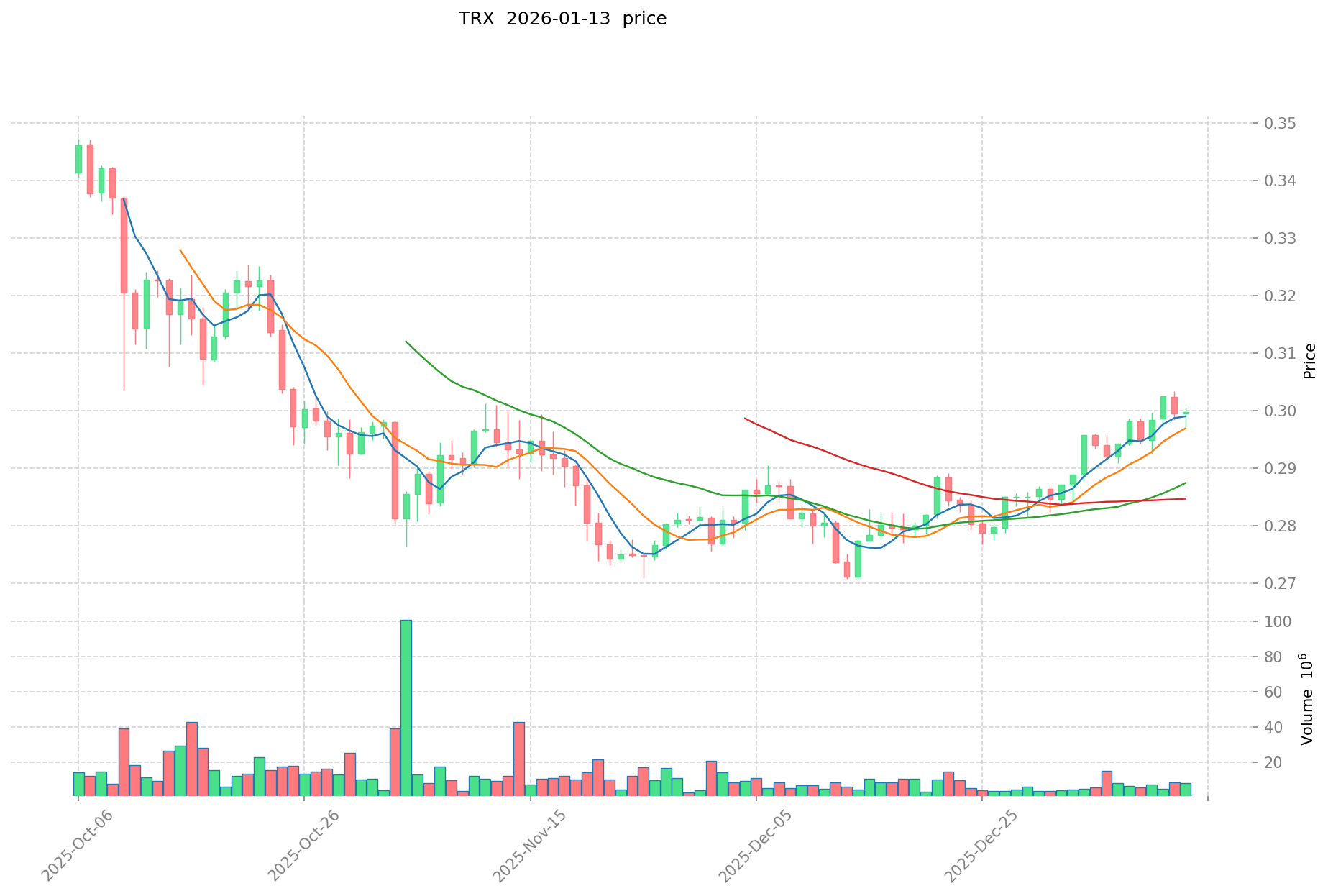
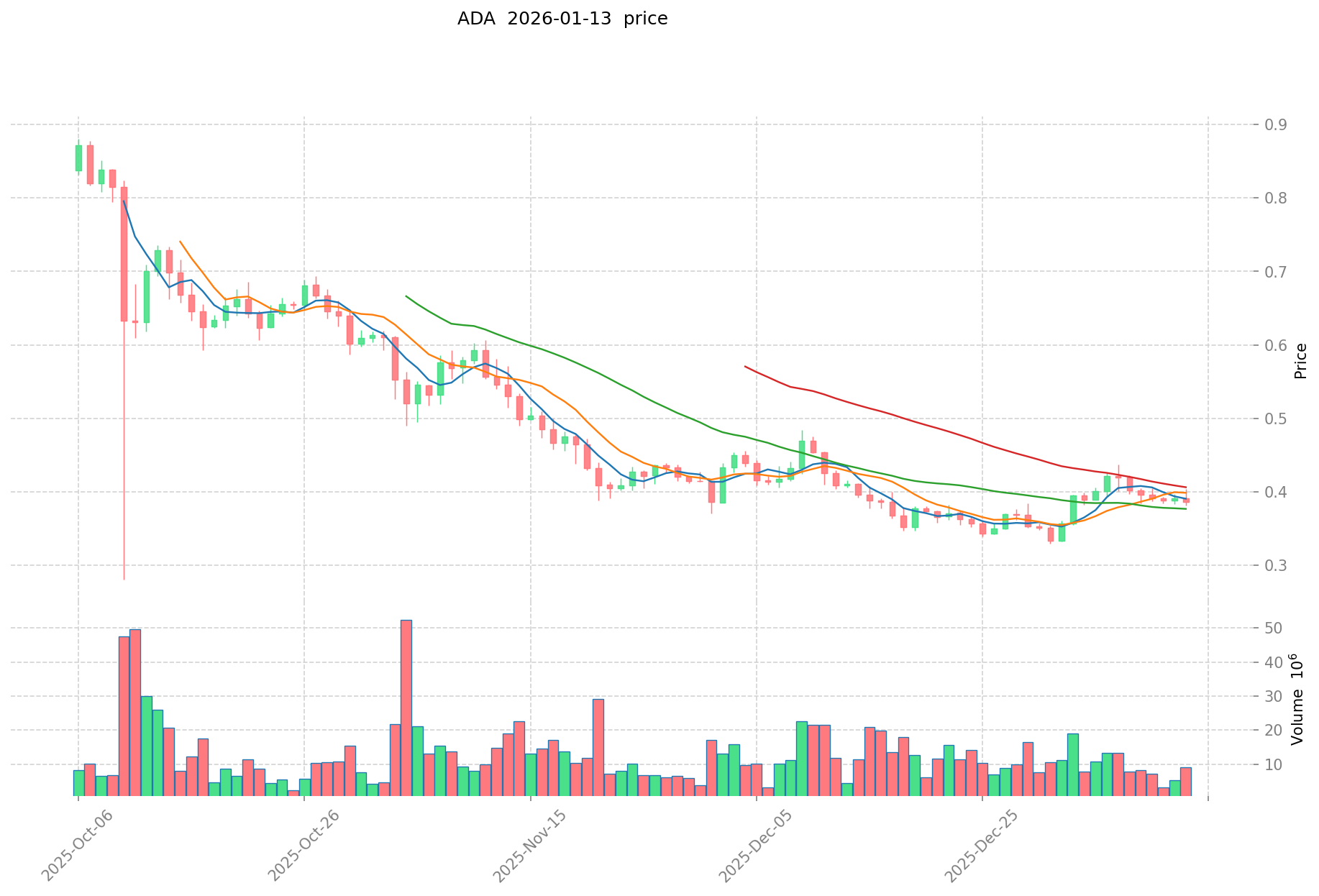
TRON (TRX) and Cardano (ADA) Historical Price Trends
-
2017: TRX launched in September 2017 with an initial price of $0.0015, while ADA launched in October 2017 at $0.0026, both entering the market during the cryptocurrency bull run of that period.
-
2021: TRX experienced moderate growth during the 2021 crypto market surge. ADA reached its all-time high of $3.09 in September 2021, driven by the introduction of smart contract functionality through the Alonzo upgrade.
-
2024: TRX recorded its historical peak at $0.431288 in December 2024, reflecting increased adoption of TRON's ecosystem and stablecoin infrastructure. ADA experienced significant price correction from its 2021 highs.
-
Comparative Analysis: During the 2021-2024 market cycle, ADA declined from its high of $3.09 to current levels around $0.39, representing a substantial correction. TRX demonstrated different dynamics, with its peak occurring later in December 2024 before moderating to current levels.
Current Market Status (January 13, 2026)
- TRX Current Price: $0.30002
- ADA Current Price: $0.3864
- 24-Hour Trading Volume: TRX $2,063,421.87 vs ADA $3,088,872.31
- Market Capitalization: TRX $28.41 billion (ranking 8th) vs ADA $14.17 billion (ranking 11th)
- 24-Hour Price Change: TRX +0.28% vs ADA -2.64%
- Market Sentiment Index (Fear & Greed Index): 26 (Fear)
View real-time prices:
II. Core Factors Influencing TRX vs ADA Investment Value
Tokenomics Comparison
-
TRX: TRON operates with a delegated Proof of Stake (DPoS) consensus mechanism where TRX holders elect Super Representatives to validate transactions and maintain network operations. Block producers receive 32 TRX rewards every 3 seconds, totaling 336,384,000 TRX annually. The supply mechanism includes deflationary elements through network penalties, such as consuming 9,999 TRX when applying to become a Super Representative candidate. Users can stake TRX to gain "Tron Power" for governance voting, with each 1 TRX staked generating 1 Tron Power.
-
ADA: Cardano utilizes an Ouroboros Proof of Stake (PoS) consensus algorithm with enhanced security features and scalability. ADA has a maximum supply of 45 billion tokens with approximately 35 billion in circulation (78% circulation rate). The staking mechanism allows holders to delegate tokens through wallets like Daedalus, Ledger, or Exodus to earn rewards while participating in network consensus.
-
📌 Historical Pattern: Supply mechanisms influence price cycles through staking participation rates and token velocity. Both networks demonstrate how consensus mechanisms affect token distribution and holder incentives over time.
Institutional Adoption and Market Applications
-
Institutional Holdings: TRX benefits from notable institutional support, including a U.S.-listed company that held over 670 million TRX as of November 2024. In June 2024, this entity staked 365 million TRX through JustLend DAO, with an additional $110 million investment in September adding 312.5 million TRX to treasury holdings.
-
Enterprise Adoption: TRX serves multiple functions within the TRON ecosystem including transaction fees for DApps, content creator compensation, and energy rental services through platforms like JustLend DAO. ADA positions itself as an enterprise-grade blockchain platform supporting smart contracts and decentralized governance, though specific enterprise partnerships were not detailed in available materials.
-
Regulatory Environment: Both cryptocurrencies face ongoing regulatory scrutiny across different jurisdictions. The materials note that understanding regulatory developments remains important for assessing long-term viability, though specific policy positions varied by region.
Technology Development and Ecosystem Construction
-
TRX Technology: TRON employs a three-layer architecture consisting of storage layer, core layer, and application layer. The network originally launched on Ethereum as an ERC-20 token before migrating to its independent blockchain in 2018. TRON maintains compatibility with Ethereum's Solidity programming language and EVM standards. The network processes transactions significantly faster than Bitcoin (7 TPS) or earlier Ethereum implementations (30 TPS).
-
ADA Technology: Cardano adopts a dual-layer architecture separating settlement and computation functions to enhance security while improving processing speeds. The network achieves approximately 250 TPS, surpassing both Bitcoin and earlier Ethereum implementations. Cardano supports sidechains for interoperability and smart contract functionality to prevent network forks.
-
Ecosystem Comparison: TRON's ecosystem includes Sun.io (DEX trading center integrating SunSwap, SunCurve, PSM stablecoin exchange, SunPump Meme platform, and SunPerp derivatives), JustLend DAO (lending protocol with staking and energy rental), stUSDT (RWA product), USDD (native stablecoin), BTTC (cross-chain protocol connecting TRON with Ethereum and BNB Chain), and AINFT (AI and NFT applications). Cardano's ecosystem development focuses on smart contracts and DeFi implementations, though materials noted that ecosystem maturity lags behind Ethereum, with total value locked (TVL) of approximately $320 million ranking 19th among blockchains as of late March 2025.
Macroeconomic and Market Cycles
-
Inflation Environment Performance: The materials did not provide specific comparative data on inflation hedge characteristics for TRX versus ADA. Both cryptocurrencies demonstrate correlation with broader crypto market cycles and Bitcoin price movements.
-
Monetary Policy Impact: Interest rate changes, U.S. dollar index movements, and broader monetary policy shifts affect cryptocurrency valuations. Market sentiment, investor interest, and trading volumes on both centralized and decentralized exchanges influence short-term price dynamics for both assets.
-
Geopolitical Factors: Cross-border payment functionality represents a use case for both networks. TRON's focus on digital entertainment content distribution and payment infrastructure, alongside Cardano's emphasis on financial inclusion and smart contract capabilities, position each network differently within global blockchain adoption trends. Specific geopolitical policy impacts on either network were not extensively detailed in available materials.
III. 2026-2031 Price Prediction: TRX vs ADA
Short-term Prediction (2026)
- TRX: Conservative $0.24-$0.30 | Optimistic $0.30-$0.38
- ADA: Conservative $0.38-$0.39 | Optimistic $0.39-$0.51
Mid-term Prediction (2028-2029)
- TRX may enter a growth phase, with estimated price range of $0.23-$0.58 in 2028 and $0.38-$0.51 in 2029
- ADA may enter a development phase, with estimated price range of $0.39-$0.60 in 2028 and $0.48-$0.63 in 2029
- Key drivers: institutional capital inflows, ETF developments, ecosystem expansion
Long-term Prediction (2030-2031)
- TRX: Baseline scenario $0.26-$0.51 | Optimistic scenario $0.51-$0.81
- ADA: Baseline scenario $0.44-$0.58 | Optimistic scenario $0.58-$0.76
View detailed price predictions for TRX and ADA
Disclaimer
TRX:
| Year |
Predicted High Price |
Predicted Average Price |
Predicted Low Price |
Price Change |
| 2026 |
0.3773196 |
0.29946 |
0.2365734 |
0 |
| 2027 |
0.487281312 |
0.3383898 |
0.226721166 |
12 |
| 2028 |
0.58209813396 |
0.412835556 |
0.2270595558 |
37 |
| 2029 |
0.5123908503294 |
0.49746684498 |
0.3780748021848 |
65 |
| 2030 |
0.610963905662187 |
0.5049288476547 |
0.262563000780444 |
68 |
| 2031 |
0.809022246154743 |
0.557946376658443 |
0.379403536127741 |
85 |
ADA:
| Year |
Predicted High Price |
Predicted Average Price |
Predicted Low Price |
Price Change |
| 2026 |
0.512028 |
0.3879 |
0.376263 |
0 |
| 2027 |
0.46796256 |
0.449964 |
0.4049676 |
16 |
| 2028 |
0.6012418968 |
0.45896328 |
0.3855291552 |
18 |
| 2029 |
0.630822080196 |
0.5301025884 |
0.47709232956 |
36 |
| 2030 |
0.76040565793038 |
0.580462334298 |
0.4353467507235 |
49 |
| 2031 |
0.730773055764467 |
0.67043399611419 |
0.38885171774623 |
73 |
IV. Investment Strategy Comparison: TRX vs ADA
Long-term vs Short-term Investment Strategies
-
TRX: May suit investors focused on stablecoin infrastructure, decentralized entertainment content distribution, and high transaction throughput ecosystems. The network's integration of Sun.io, JustLend DAO, and cross-chain protocols like BTTC positions it for applications requiring efficient payment processing and DeFi services. Short-term traders may consider TRX's transaction fee burning mechanism and institutional staking activity as factors influencing supply dynamics.
-
ADA: May appeal to investors interested in research-driven blockchain development, layered architecture design, and smart contract platforms with academic foundations. Cardano's focus on formal verification methods and gradual protocol upgrades through hard forks suggests positioning for long-term adoption in governance and financial applications. The dual-layer architecture separating settlement and computation functions offers distinct technical characteristics for consideration.
Risk Management and Asset Allocation
-
Conservative Investors: A balanced approach might allocate 40-50% to TRX and 50-60% to ADA, considering TRX's higher market capitalization and near-complete circulating supply alongside ADA's lower circulation rate (81.52%) and established staking infrastructure.
-
Aggressive Investors: Risk-tolerant portfolios could consider 60-70% TRX allocation based on recent institutional adoption patterns and ecosystem expansion, with 30-40% ADA allocation for exposure to smart contract platform development and academic research partnerships.
-
Hedging Tools: Stablecoin reserves in USDT or USDC (20-30% of crypto allocation), options strategies for downside protection during high-volatility periods, and cross-asset diversification including both Layer-1 platforms and complementary DeFi protocols can support risk management objectives.
V. Potential Risk Comparison
Market Risks
-
TRX: Trading volume concentration on specific exchanges may affect liquidity during market stress. The network's historical correlation with broader cryptocurrency market cycles suggests sensitivity to Bitcoin price movements and overall crypto sentiment shifts. As of January 13, 2026, the Fear & Greed Index reading of 26 (Fear) indicates cautious market conditions affecting both assets.
-
ADA: Price correction from September 2021 highs of $3.09 to current levels around $0.3864 reflects significant volatility characteristics. Total value locked of approximately $320 million (ranking 19th among blockchains as of late March 2025) suggests ecosystem adoption challenges that may influence price stability during market fluctuations.
Technical Risks
-
TRX: Network scalability depends on the delegated Proof of Stake (DPoS) mechanism with 27 Super Representatives. Centralization considerations arise from the limited number of block producers compared to more distributed consensus models. Cross-chain bridge security through BTTC connecting TRON, Ethereum, and BNB Chain introduces smart contract vulnerability exposure.
-
ADA: Ecosystem maturity gaps compared to Ethereum may affect developer adoption rates and DApp deployment. Smart contract functionality introduced through the Alonzo upgrade requires ongoing testing and optimization. Sidechain implementations for interoperability present additional security considerations requiring monitoring.
Regulatory Risks
- Both TRX and ADA face evolving regulatory frameworks across different jurisdictions. Securities classification debates, staking reward taxation policies, and cross-border payment regulations may impact network operations and token valuations differently based on each blockchain's primary use cases and geographic adoption patterns. Institutional involvement with TRX through treasury holdings by publicly-listed companies may attract heightened regulatory scrutiny compared to ADA's research institution partnerships.
VI. Conclusion: Which Is the Better Buy?
📌 Investment Value Summary:
-
TRX Characteristics: Higher market capitalization ($28.41 billion, ranking 8th), near-complete circulating supply approaching 100%, institutional treasury holdings exceeding 670 million tokens, integrated DeFi ecosystem including Sun.io and JustLend DAO, stablecoin infrastructure supporting USDD and stUSDT, and cross-chain connectivity through BTTC. Transaction processing speeds exceed earlier blockchain implementations.
-
ADA Characteristics: Research-driven development methodology, dual-layer architecture separating settlement and computation, Ouroboros Proof of Stake consensus with formal verification emphasis, smart contract capabilities through Alonzo upgrade, and maximum supply cap of 45 billion tokens with approximately 81.52% circulation. Processing capacity of approximately 250 TPS positions it above Bitcoin and earlier Ethereum versions.
✅ Investment Considerations:
-
Beginning Investors: May consider starting with smaller allocations to understand each network's transaction mechanics, staking processes, and ecosystem applications. Utilizing secure wallets supporting both TRX and ADA allows hands-on learning about delegated staking rewards and governance participation. Dollar-cost averaging approaches during Fear & Greed Index readings below 30 may help manage entry timing volatility.
-
Experienced Investors: Could evaluate portfolio positioning based on existing Layer-1 exposure, DeFi protocol preferences, and risk tolerance for ecosystem development timelines. TRX's stablecoin integration and payment infrastructure may complement portfolios emphasizing transaction utility, while ADA's smart contract platform development offers exposure to academic research methodologies and formal verification approaches.
-
Institutional Investors: May assess TRX's treasury management precedents set by publicly-listed companies and staking yield opportunities through platforms like JustLend DAO. ADA's governance model and long-term development roadmap present considerations for institutions prioritizing protocol stability and research-backed upgrades. Regulatory compliance frameworks, custody solutions, and liquidity depth across multiple exchanges remain important evaluation criteria for both assets.
⚠️ Risk Disclosure: Cryptocurrency markets demonstrate significant volatility characteristics. Price predictions contain inherent uncertainties influenced by technological developments, regulatory changes, macroeconomic conditions, and market sentiment shifts. This analysis does not constitute investment advice. Individuals should conduct independent research, assess personal financial situations, and consult qualified financial advisors before making investment decisions.
VII. FAQ
Q1: What is the main difference between TRX and ADA's consensus mechanisms?
TRX uses Delegated Proof of Stake (DPoS) with 27 Super Representatives, while ADA employs Ouroboros Proof of Stake (PoS) with broader validator participation. TRX's DPoS mechanism allows token holders to elect Super Representatives who validate transactions every 3 seconds and receive 32 TRX rewards per block, totaling 336,384,000 TRX annually. This creates a more centralized validator set with faster block production. Conversely, ADA's Ouroboros PoS enables holders to delegate tokens through wallets like Daedalus or Ledger to a more distributed validator network, emphasizing formal verification methods and security research. The architectural difference affects decentralization characteristics, with TRX prioritizing transaction speed through limited validators while ADA balances security considerations with network participation breadth.
Q2: Which blockchain has higher transaction processing capacity?
ADA processes approximately 250 transactions per second (TPS), while TRX's specific TPS was not quantified but noted as significantly faster than Bitcoin (7 TPS) and earlier Ethereum implementations (30 TPS). Both networks substantially exceed first-generation blockchain capabilities. TRON's three-layer architecture (storage, core, and application layers) optimizes for high-throughput applications including payment processing and content distribution. Cardano's dual-layer design separating settlement and computation functions aims to enhance processing speeds while maintaining security protocols. For applications requiring maximum transaction volume like payment systems or DeFi protocols, both platforms offer competitive throughput compared to older blockchain networks, though specific performance depends on network congestion and application design.
Q3: How do the staking rewards differ between TRX and ADA?
TRX staking generates "Tron Power" for governance voting at a 1:1 ratio with staked tokens, with network rewards distributed to Super Representatives who then share with delegators. ADA staking allows direct delegation through compatible wallets with rewards distributed proportionally based on stake pool performance and network participation. TRX's staking mechanism serves dual purposes of governance participation and earning potential through platforms like JustLend DAO, where institutional investors have staked over 365 million TRX. ADA's staking does not require locking periods in most implementations, providing liquidity flexibility while earning rewards. The specific annual percentage yields (APY) for both networks fluctuate based on total staked amounts, network activity, and validator commission rates, making reward comparisons time-dependent rather than fixed.
Q4: What accounts for TRX's higher market capitalization despite similar current prices?
TRX's market capitalization of $28.41 billion compared to ADA's $14.17 billion results primarily from circulating supply differences. TRX has approximately 100% of its supply in circulation, while ADA has released only 81.52% of its 45 billion maximum supply. At similar per-token prices ($0.30002 for TRX versus $0.3864 for ADA as of January 13, 2026), the larger circulating supply creates higher total market valuation. Additionally, TRX's historical price peak occurred in December 2024 at $0.431288, reflecting recent ecosystem expansion including institutional adoption and stablecoin infrastructure development. ADA experienced its all-time high of $3.09 in September 2021 but has undergone significant correction since then. Market capitalization reflects both supply dynamics and historical price performance rather than indicating superior investment value.
Q5: Which ecosystem offers more developed DeFi applications?
TRX demonstrates more extensive integrated DeFi infrastructure through Sun.io (DEX trading center), JustLend DAO (lending protocol with $110 million institutional participation), stUSDT (RWA product), USDD (native stablecoin), and cross-chain connectivity via BTTC. These components create an interconnected DeFi ecosystem supporting trading, lending, stablecoin operations, and bridge functionality. ADA's ecosystem focuses on smart contract platform development following the Alonzo upgrade, with total value locked approximately $320 million ranking 19th among blockchains as of late March 2025. While Cardano supports DeFi applications and emphasizes formal verification methods for security, materials indicate ecosystem maturity lags behind Ethereum and TRX's more established DeFi integrations. For investors prioritizing immediate DeFi utility and stablecoin infrastructure, TRX presents more developed options, whereas ADA offers smart contract platform potential with longer development timelines.
Q6: How does institutional adoption compare between TRX and ADA?
TRX has documented institutional support including a U.S.-listed company holding over 670 million TRX as of November 2024, with 365 million TRX staked through JustLend DAO in June 2024 and an additional $110 million investment adding 312.5 million TRX in September. This represents quantifiable treasury allocation by publicly-traded entities. ADA's institutional relationships focus more on research partnerships and academic collaborations rather than direct treasury holdings documented in available materials. The distinction reflects different positioning strategies: TRX attracts corporate treasury management and DeFi yield opportunities, while ADA emphasizes partnerships with research institutions and formal development methodologies. For investors evaluating institutional validation signals, TRX demonstrates clearer treasury adoption patterns, whereas ADA's institutional engagement centers on protocol research and long-term blockchain development rather than immediate capital allocation.
Q7: What regulatory considerations affect TRX versus ADA differently?
Both cryptocurrencies face evolving regulatory frameworks, but TRX's institutional treasury holdings by U.S.-listed companies may attract heightened securities classification scrutiny and disclosure requirements. TRX's positioning in payment infrastructure and stablecoin ecosystems intersects with cross-border transaction regulations and potential central bank digital currency (CBDC) policy developments. ADA's research institution partnerships and academic development approach may benefit from educational exemptions or research-focused regulatory frameworks in certain jurisdictions. Staking reward taxation policies affect both networks, though TRX's DPoS governance model with 27 Super Representatives presents different regulatory considerations than ADA's more distributed staking mechanism. Neither blockchain has received definitive securities classification across all major jurisdictions as of January 2026, creating ongoing regulatory uncertainty for both assets.
Q8: Which blockchain demonstrates better performance during market downturns?
Historical data shows different volatility patterns: ADA experienced significant correction from its September 2021 high of $3.09 to current levels around $0.3864, representing approximately 87% decline from peak. TRX recorded its historical peak more recently in December 2024 at $0.431288, with current prices around $0.30002 representing approximately 30% correction from that peak. As of January 13, 2026, market sentiment indicated by the Fear & Greed Index stands at 26 (Fear), affecting both assets. TRX showed +0.28% change over 24 hours while ADA declined -2.64% during the same period. However, single-day performance does not reliably indicate long-term downside resilience. Both cryptocurrencies demonstrate correlation with broader crypto market cycles and Bitcoin price movements, suggesting similar exposure to systematic market risks despite different ecosystem focuses and technical architectures.
* The information is not intended to be and does not constitute financial advice or any other recommendation of any sort offered or endorsed by Gate.