This comprehensive analysis compares TURTLE and DOGE across multiple investment dimensions to help cryptocurrency investors understand their distinct characteristics and value propositions. TURTLE, a Web3 distribution protocol launched in 2025, combines meme appeal with DeFi utility and operates with 15.47% circulation, while DOGE, established since 2013, maintains broader market recognition with $20.47 billion capitalization and 99.94% circulation. The article examines historical price trajectories showing TURTLE's higher volatility (82% decline) versus DOGE's measured decline from 2021 peaks, current market status with real-time pricing on Gate, and tokenomics differences between scarcity-driven and inflationary models. Investment strategies are presented for conservative, moderate, and aggressive investors, with detailed risk assessments covering market, technology, and regulatory considerations. Price projections through 2031 and allocation frameworks enable readers to evaluate which asset aligns with the
Introduction: TURTLE vs DOGE Investment Comparison
In the cryptocurrency market, the comparison between TURTLE and DOGE has become an increasingly relevant topic for investors. These two assets exhibit distinct differences in market capitalization ranking, application scenarios, and price performance, representing divergent positioning within the crypto asset landscape.
TURTLE: Launched in 2025, this distribution protocol monetizes Web3 activity by tracking user wallet interactions, including liquidity deployment, yield generation, swap routing, validator staking, and referral activities. TURTLE aims to align incentives among DeFi participants while providing a safeguarding layer for transparent liquidity deployment.
DOGE (Dogecoin): Originating in December 2013, this Scrypt-based cryptocurrency was conceived as an accessible and lighthearted alternative to Bitcoin. Despite its meme-inspired origins, DOGE has evolved into one of the world's most widely recognized cryptocurrencies by user base and trading volume.
This article provides a comprehensive analysis comparing TURTLE vs DOGE across multiple dimensions, including historical price trajectories, supply mechanisms, institutional adoption patterns, technological ecosystems, and future outlook. We examine these factors to address the fundamental question many investors face:
"Which presents a more compelling investment opportunity at this time?"
By evaluating these assets through objective metrics and market data, readers can better understand the distinct characteristics, risk profiles, and potential value propositions of each cryptocurrency.
I. Historical Price Comparison and Current Market Status
TURTLE (Coin A) and DOGE (Coin B) Historical Price Trends
-
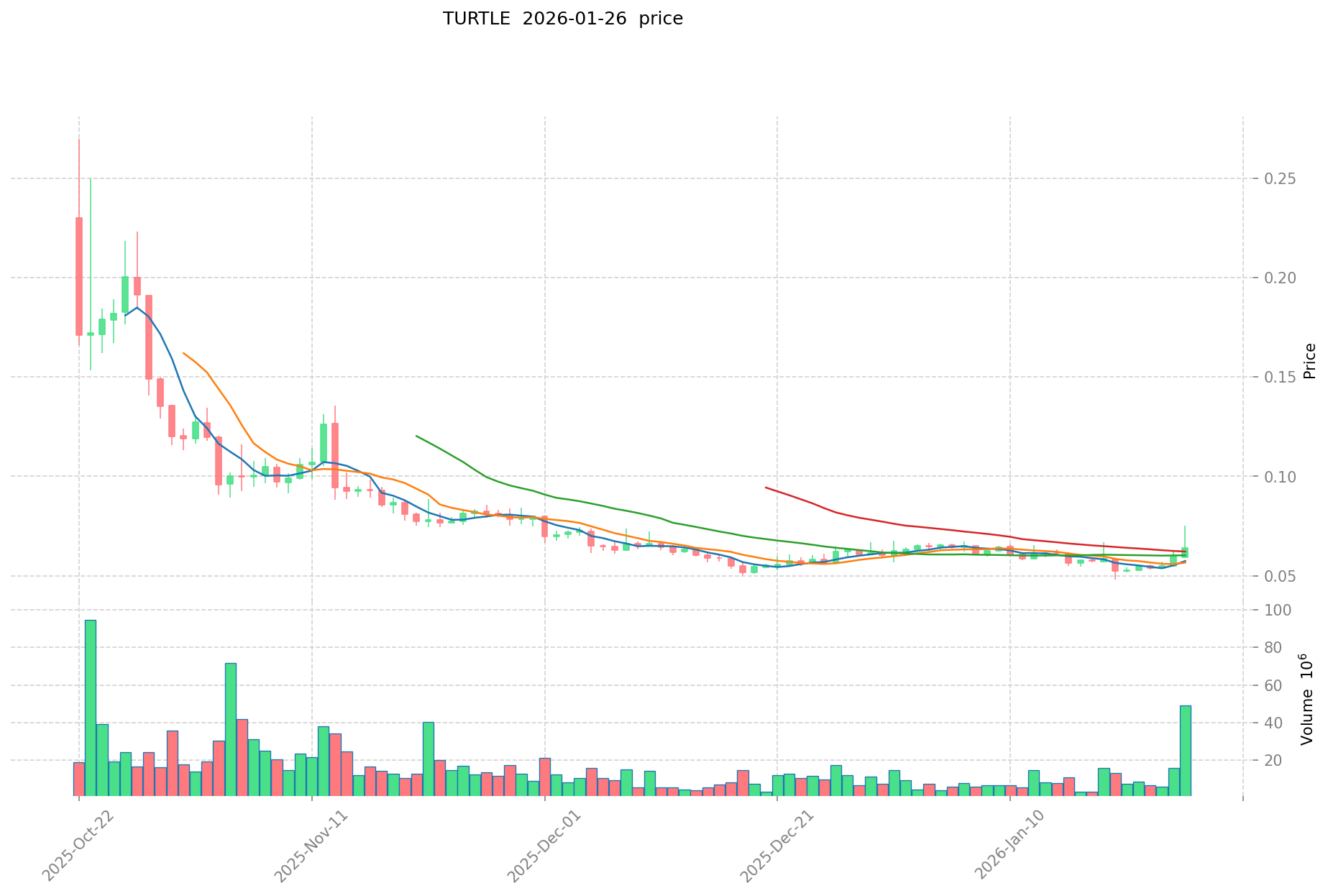
2025: TURTLE experienced significant volatility, reaching an all-time high of $0.26998 on October 22, 2025, following its initial launch in October 2025. The token demonstrated strong early momentum as the first Distribution Protocol monetizing Web3 activity.
-
2021: DOGE benefited from widespread social media attention and celebrity endorsements, with its price surging to an all-time high of $0.731578 on May 8, 2021. This represented a period of exceptional growth driven by retail investor enthusiasm and community-driven momentum.
-
2026: TURTLE declined from its peak of $0.26998 to a low of $0.04801 on January 19, 2026, representing a substantial correction. Meanwhile, DOGE has experienced a more gradual decline, with its current price reflecting a significant retreat from 2021 highs.
-
Comparative Analysis: During the recent market cycle, TURTLE demonstrated higher volatility with a sharp correction of approximately 82% from its all-time high to its low point. In contrast, DOGE has shown a more measured decline of approximately 83% from its 2021 peak, with its established market presence providing relatively more stability.
Current Market Status (January 26, 2026)
- TURTLE current price: $0.05871
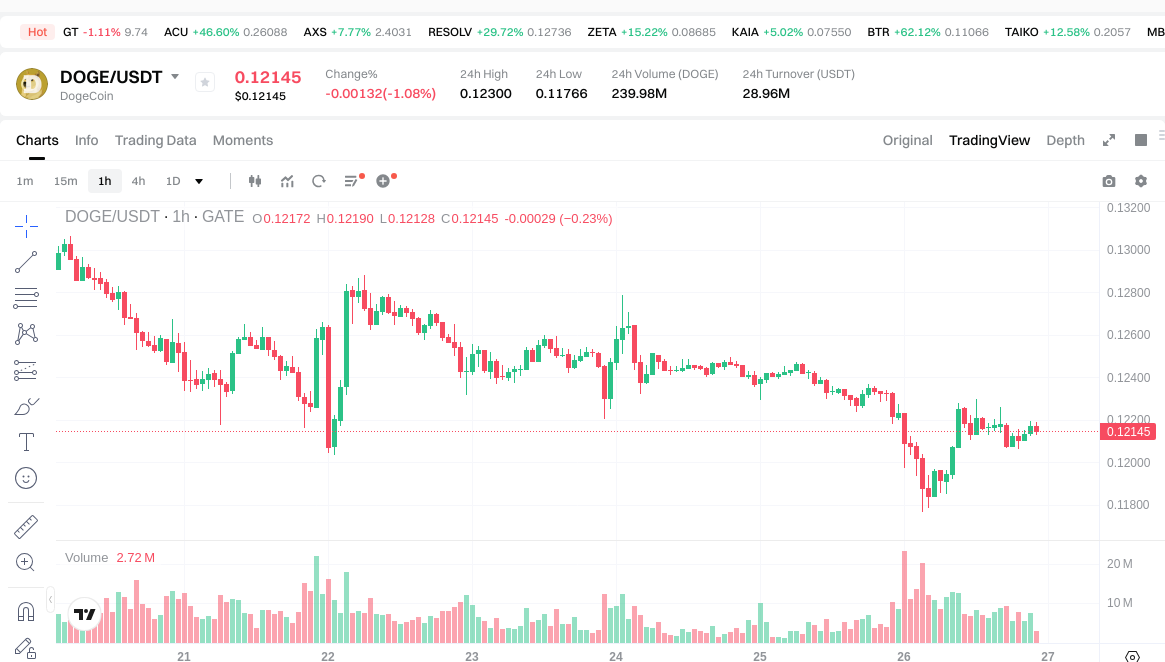
- DOGE current price: $0.12157
- 24-hour trading volume: TURTLE recorded $2,341,815.41, while DOGE demonstrated significantly higher liquidity with $29,052,980.46
- Market capitalization: TURTLE stands at $9.08 million with 15.47% circulation ratio, whereas DOGE maintains a substantially larger market cap of $20.47 billion with 99.94% circulation
- Market Sentiment Index (Fear & Greed Index): 20 (Extreme Fear)
- 24-hour price movement: TURTLE declined 12.93%, while DOGE decreased 1.02%
- Weekly performance: TURTLE increased 11.1%, while DOGE declined 5.14%
View real-time prices:
II. Core Factors Influencing TURTLE vs DOGE Investment Value
Tokenomics Comparison
-
TURTLE: The tokenomics model emphasizes supply scarcity mechanisms and circulation dynamics. Token economic design and circulation volume are identified as key price factors, with supply mechanisms potentially affecting value through controlled distribution.
-
DOGE: The supply mechanism follows an inflationary model without a fixed cap. Price dynamics are influenced by market sentiment and social media activity rather than scarcity-driven mechanisms.
-
📌 Historical Pattern: Supply mechanisms contribute to price cycle variations. TURTLE's value logic incorporates supply scarcity considerations, while DOGE's price movements are less constrained by supply limitations and more responsive to community-driven demand.
Institutional Adoption and Market Application
-
Institutional Holdings: Reference materials indicate that institutional investment represents a key factor for TURTLE's investment value assessment. DOGE's value is influenced by social media buzz and macroeconomic factors rather than institutional positioning.
-
Enterprise Adoption: TURTLE combines meme appeal with DeFi utility elements, potentially attracting traders seeking long-term exposure. DOGE's adoption has been driven by community engagement and social media platforms such as Twitter and Reddit.
-
National Policy: Regulatory news affects both cryptocurrencies' price fluctuations. The materials note that market sentiment and regulatory developments are influential factors for both assets.
Technology Development and Ecosystem Building
-
TURTLE Technology: As a Web3 distribution protocol, TURTLE's technological development and ecosystem advancement are identified as core competitiveness factors. The project combines meme characteristics with decentralized finance functionality.
-
DOGE Technology: DOGE's value logic relies primarily on community transmission and social media engagement rather than technological upgrades or ecosystem expansion.
-
Ecosystem Comparison: TURTLE integrates DeFi utility elements alongside meme appeal. DOGE maintains a community-focused model with emphasis on social media presence rather than extensive DeFi or smart contract applications.
Macroeconomic Environment and Market Cycles
-
Inflation Environment Performance: Macroeconomic environment represents a core factor affecting TURTLE's investment value. Both cryptocurrencies' prices respond to broader market conditions and sentiment shifts.
-
Macroeconomic Monetary Policy: Market sentiment and macroeconomic environment are identified as influential factors for TURTLE's price movements. DOGE's value is similarly affected by macroeconomic conditions.
-
Geopolitical Factors: Market environment and regulatory news influence both cryptocurrencies. Community engagement and market trends represent key value drivers alongside broader economic considerations.
III. 2026-2031 Price Prediction: TURTLE vs DOGE
Short-term Prediction (2026)
- TURTLE: Conservative $0.0416-$0.0586 | Optimistic $0.0586-$0.0856
- DOGE: Conservative $0.0936-$0.1216 | Optimistic $0.1216-$0.1325
Mid-term Prediction (2028-2029)
- TURTLE may enter a consolidation phase, with projected price range of $0.0444-$0.0984 in 2028 and $0.0844-$0.0915 in 2029
- DOGE may enter an expansion phase, with projected price range of $0.1086-$0.1967 in 2028 and $0.1254-$0.2061 in 2029
- Key drivers: institutional capital inflows, ETF developments, ecosystem expansion
Long-term Prediction (2030-2031)
- TURTLE: Baseline scenario $0.0609-$0.0965 | Optimistic scenario $0.0965-$0.1274
- DOGE: Baseline scenario $0.1681-$0.1955 | Optimistic scenario $0.1955-$0.2717
View detailed price predictions for TURTLE and DOGE
Disclaimer
TURTLE:
| Year |
Predicted High Price |
Predicted Average Price |
Predicted Low Price |
Price Change |
| 2026 |
0.085629 |
0.05865 |
0.0416415 |
0 |
| 2027 |
0.0865674 |
0.0721395 |
0.0577116 |
22 |
| 2028 |
0.098398278 |
0.07935345 |
0.044437932 |
35 |
| 2029 |
0.09154213992 |
0.088875864 |
0.0844320708 |
51 |
| 2030 |
0.1028382622344 |
0.09020900196 |
0.0658525714308 |
53 |
| 2031 |
0.127411194368304 |
0.0965236320972 |
0.060809888221236 |
64 |
DOGE:
| Year |
Predicted High Price |
Predicted Average Price |
Predicted Low Price |
Price Change |
| 2026 |
0.132544 |
0.1216 |
0.093632 |
0 |
| 2027 |
0.16646432 |
0.127072 |
0.12198912 |
4 |
| 2028 |
0.1966693344 |
0.14676816 |
0.1086084384 |
20 |
| 2029 |
0.20606249664 |
0.1717187472 |
0.125354685456 |
41 |
| 2030 |
0.2021129654544 |
0.18889062192 |
0.0982231233984 |
55 |
| 2031 |
0.271747493225208 |
0.1955017936872 |
0.168131542570992 |
60 |
IV. Investment Strategy Comparison: TURTLE vs DOGE
Long-term vs Short-term Investment Strategies
-
TURTLE: May appeal to investors seeking exposure to emerging DeFi protocols with meme characteristics. The asset's early-stage positioning and Web3 distribution protocol model could attract traders interested in nascent ecosystem development. The higher volatility profile suggests suitability for risk-tolerant participants with shorter investment horizons.
-
DOGE: May appeal to investors focusing on established market presence and community-driven assets. With its longer operational history since 2013 and broader recognition, DOGE presents characteristics that could align with participants seeking more established cryptocurrencies within the meme token category.
Risk Management and Asset Allocation
-
Conservative investors: A potential allocation framework could consider TURTLE: 10-20% vs DOGE: 80-90%, reflecting DOGE's larger market capitalization and higher liquidity levels. The allocation reflects TURTLE's early-stage characteristics and DOGE's more established market positioning.
-
Aggressive investors: A potential allocation framework could consider TURTLE: 40-50% vs DOGE: 50-60%, acknowledging TURTLE's higher volatility profile and potential for price movements. This approach incorporates both emerging protocol exposure and established asset positioning.
-
Hedging instruments: Asset allocation strategies may incorporate stablecoin holdings to manage volatility exposure, derivative instruments for risk mitigation, and cross-asset portfolio diversification to reduce concentration risk.
V. Potential Risk Comparison
Market Risk
-
TURTLE: The asset demonstrates substantial price volatility, with an approximate 82% decline from its all-time high to low point within several months. The limited circulation ratio of 15.47% and lower trading volume of $2.34 million indicate relatively constrained liquidity conditions. Market sentiment significantly influences price movements, as evidenced by the 12.93% decline within 24 hours during periods of extreme fear.
-
DOGE: Price movements remain influenced by social media trends and community sentiment rather than fundamental value drivers. The inflationary supply model without a fixed cap presents ongoing dilution considerations. Despite higher liquidity with $29.05 million in 24-hour trading volume, DOGE has experienced an approximate 83% decline from its 2021 peak, reflecting sensitivity to broader market cycles and sentiment shifts.
Technology Risk
-
TURTLE: As an emerging Web3 distribution protocol launched in 2025, the project faces execution risks associated with ecosystem development and technological implementation. Network stability during scaling phases and protocol security considerations remain areas requiring ongoing assessment.
-
DOGE: The technology infrastructure has operated since 2013, providing a longer operational track record. However, the Scrypt-based architecture and limited smart contract functionality present constraints on ecosystem expansion potential. Network security considerations and mining distribution patterns require monitoring.
Regulatory Risk
Global regulatory developments affect both cryptocurrencies, though with potentially different implications. TURTLE's DeFi protocol characteristics may face scrutiny from financial regulators examining decentralized finance applications. DOGE's classification and regulatory treatment as an established cryptocurrency could differ based on jurisdictional interpretations. Both assets remain subject to evolving regulatory frameworks affecting cryptocurrency markets, including securities classification considerations, taxation policies, and trading platform regulations.
VI. Conclusion: Which Is the Better Buy?
📌 Investment Value Summary:
-
TURTLE advantages: Early-stage positioning in Web3 distribution protocol space, combining meme appeal with DeFi utility elements. The limited circulation ratio of 15.47% indicates potential supply dynamics. Recent weekly performance showed 11.1% increase despite broader market volatility.
-
DOGE advantages: Established market presence since 2013 with significantly larger market capitalization of $20.47 billion. Higher liquidity with $29.05 million in 24-hour trading volume. Near-complete circulation at 99.94% provides supply transparency. Broader recognition within cryptocurrency markets.
✅ Investment Considerations:
-
Beginning investors: May consider focusing on assets with established market presence and higher liquidity levels. Understanding fundamental differences between emerging protocols and established cryptocurrencies remains essential before allocation decisions.
-
Experienced investors: May evaluate risk-return profiles across both assets, considering portfolio diversification objectives and individual risk tolerance levels. Assessment of technological development trajectories and market positioning differences informs allocation frameworks.
-
Institutional investors: Market capitalization differentials, liquidity considerations, and regulatory positioning represent key evaluation factors. Due diligence regarding technological infrastructure, custody solutions, and counterparty risk management remains essential.
⚠️ Risk Disclaimer: Cryptocurrency markets exhibit substantial volatility. This analysis does not constitute investment advice. Market participants should conduct independent research and consider individual circumstances before making investment decisions.
VII. FAQ
Q1: What are the main differences between TURTLE and DOGE's tokenomics models?
TURTLE emphasizes supply scarcity mechanisms with only 15.47% circulation ratio, while DOGE follows an inflationary model with 99.94% circulation and no fixed supply cap. TURTLE's tokenomics design incorporates controlled distribution as a value mechanism, potentially creating scarcity-driven price dynamics. In contrast, DOGE's unlimited supply model means new coins are continuously generated, with price movements driven primarily by community demand and social media sentiment rather than supply constraints. This fundamental difference means TURTLE's value proposition includes supply-side considerations, whereas DOGE relies predominantly on demand-side factors for price appreciation.
Q2: Which asset demonstrates higher liquidity and why does this matter?
DOGE demonstrates significantly higher liquidity with $29.05 million in 24-hour trading volume compared to TURTLE's $2.34 million. This approximately 12x difference in trading volume reflects DOGE's established market presence since 2013 and broader exchange availability. Higher liquidity matters because it enables investors to enter and exit positions with reduced slippage, provides more accurate price discovery, and reduces the risk of market manipulation. For institutional investors and larger position sizes, DOGE's superior liquidity represents a critical advantage in executing trades efficiently without substantial price impact.
Q3: How do the volatility profiles of TURTLE and DOGE compare?
TURTLE exhibits higher volatility with an 82% decline from its all-time high of $0.26998 (October 2025) to its low of $0.04801 (January 2026) within just several months. DOGE showed comparable percentage decline of 83% from its 2021 peak but over a longer timeframe, indicating more gradual price movements. Recent data demonstrates this pattern: TURTLE declined 12.93% in 24 hours while DOGE decreased only 1.02% during the same period. This volatility differential suggests TURTLE presents higher risk-return potential suitable for aggressive investors, while DOGE's relatively lower volatility may align better with conservative portfolio strategies.
Q4: What role does institutional adoption play in each cryptocurrency's value proposition?
Institutional adoption represents a key factor for TURTLE's investment value assessment as an emerging DeFi protocol seeking to establish credibility and attract capital. However, TURTLE's early-stage positioning means institutional participation remains limited. DOGE's value logic differs fundamentally, deriving primarily from community engagement and social media presence rather than institutional positioning. Neither asset currently demonstrates substantial institutional holdings comparable to major cryptocurrencies like Bitcoin or Ethereum. This means both remain predominantly retail-driven assets, though TURTLE's DeFi utility elements could potentially attract institutional interest in DeFi protocols, while DOGE's adoption pathway focuses on community expansion.
Q5: How should investors approach portfolio allocation between TURTLE and DOGE?
Portfolio allocation depends on individual risk tolerance and investment objectives. Conservative investors might consider a framework of 10-20% TURTLE and 80-90% DOGE, reflecting DOGE's larger market capitalization ($20.47 billion vs $9.08 million), higher liquidity, and more established market presence. Aggressive investors seeking higher risk-return profiles could evaluate a 40-50% TURTLE and 50-60% DOGE allocation, acknowledging TURTLE's early-stage potential and higher volatility characteristics. Both allocation frameworks should incorporate risk management tools including stablecoin holdings for volatility mitigation, stop-loss mechanisms, and regular portfolio rebalancing. Critical considerations include total portfolio cryptocurrency exposure, correlation with other holdings, and individual liquidity needs.
Q6: What are the primary regulatory risks facing TURTLE versus DOGE?
TURTLE faces regulatory scrutiny associated with DeFi protocols and decentralized finance applications, as financial regulators worldwide examine these emerging structures for securities classification, consumer protection requirements, and compliance obligations. As a Web3 distribution protocol launched in 2025, TURTLE operates in a rapidly evolving regulatory landscape where jurisdictions are actively developing frameworks for DeFi governance. DOGE's regulatory considerations differ, focusing on its classification as an established cryptocurrency and potential treatment under existing digital asset regulations. Both assets remain subject to taxation policies, trading platform regulations, and potential securities classification, though TURTLE's DeFi characteristics may attract additional regulatory attention regarding protocol operations, token distribution mechanisms, and participant protections.
Q7: Which cryptocurrency presents better long-term value potential through 2031?
Based on price predictions, DOGE demonstrates higher absolute price levels with projected 2031 ranges of $0.168-$0.272 compared to TURTLE's $0.061-$0.127. However, percentage appreciation potential differs: TURTLE's optimistic scenario suggests approximately 117% growth from current levels ($0.0587 to $0.127), while DOGE's optimistic projection indicates approximately 124% growth ($0.122 to $0.272). Long-term value assessment must consider that TURTLE operates as an emerging Web3 protocol requiring successful ecosystem development, technological execution, and user adoption. DOGE's value trajectory depends on sustained community engagement and broader cryptocurrency market conditions. Risk-adjusted returns favor DOGE for conservative strategies prioritizing established assets, while TURTLE may appeal to investors accepting higher execution risk for potential early-stage protocol appreciation.
Q8: How do market sentiment and social media influence each cryptocurrency differently?
Market sentiment affects both cryptocurrencies substantially but through different mechanisms. TURTLE's price movements respond to broader cryptocurrency market sentiment, DeFi sector developments, and protocol-specific news regarding ecosystem growth and partnerships. The current Fear & Greed Index of 20 (Extreme Fear) contributed to TURTLE's 12.93% 24-hour decline, demonstrating sensitivity to overall market conditions. DOGE's price dynamics are fundamentally driven by social media trends, celebrity endorsements, and viral community campaigns, with historical precedent from its 2021 surge to $0.731578 following widespread Twitter and Reddit activity. While TURTLE combines meme appeal with DeFi utility, DOGE's value logic relies predominantly on community-driven momentum and social media amplification, making it particularly responsive to sentiment shifts on platforms like Twitter, Reddit, and emerging social networks.
* The information is not intended to be and does not constitute financial advice or any other recommendation of any sort offered or endorsed by Gate.