This comprehensive comparison analyzes TYCOON and DYDX as decentralized exchange investments, examining two distinctly positioned cryptocurrency assets. TYCOON, launched in 2024, represents an emerging AI-powered investment simulation game combining financial education with gamification, currently ranked 1914 with $2.6 million market cap. DYDX, operating since 2021, functions as an established decentralized perpetual contract exchange on Cosmos blockchain, ranked 296 with $116.4 million market cap. The article evaluates both tokens through historical price trends, tokenomics mechanisms, institutional adoption levels, technical ecosystems, and projected forecasts through 2031. DYDX demonstrates superior liquidity with $463K daily volume versus TYCOON's $32K, while both experienced 96-97% declines from recent peaks. Investment decisions depend on risk tolerance—conservative investors may favor DYDX's established infrastructure, while aggressive investors might consider TYCOON's asymmetric return potential, with
Introduction: Investment Comparison Between TYCOON and DYDX
In the cryptocurrency market, the comparison between TYCOON vs DYDX has become a topic of interest for investors. Both tokens demonstrate notable differences in market cap ranking, application scenarios, and price performance, representing distinct positioning within the crypto asset landscape.
TYCOON (Dino Tycoon): Launched in 2024, this AI-powered investment simulation game aims to make financial education accessible through gamification. It combines entertainment, education, and blockchain transparency to create a sustainable ecosystem where users learn financial literacy while contributing to a data-driven Web3 economy.
DYDX (dYdX): Operating since 2021, dYdX has established itself as a decentralized perpetual contract exchange running on L2 blockchain systems. The protocol enables governance through its DYDX token and offers trading services with reduced fees.
This article will analyze the investment value comparison between TYCOON vs DYDX through historical price trends, supply mechanisms, institutional adoption, technical ecosystems, and future projections, attempting to address investors' most pressing question:
"Which is the better buy right now?"
As of January 31, 2026, TYCOON ranks 1914 with a market cap of approximately $2.6 million, while DYDX holds the 296th position with a market cap of around $116.4 million. Understanding their fundamental differences and market dynamics can help investors make informed decisions aligned with their risk tolerance and investment objectives.
I. Historical Price Comparison and Current Market Status
TYCOON (Coin A) and DYDX (Coin B) Historical Price Trends
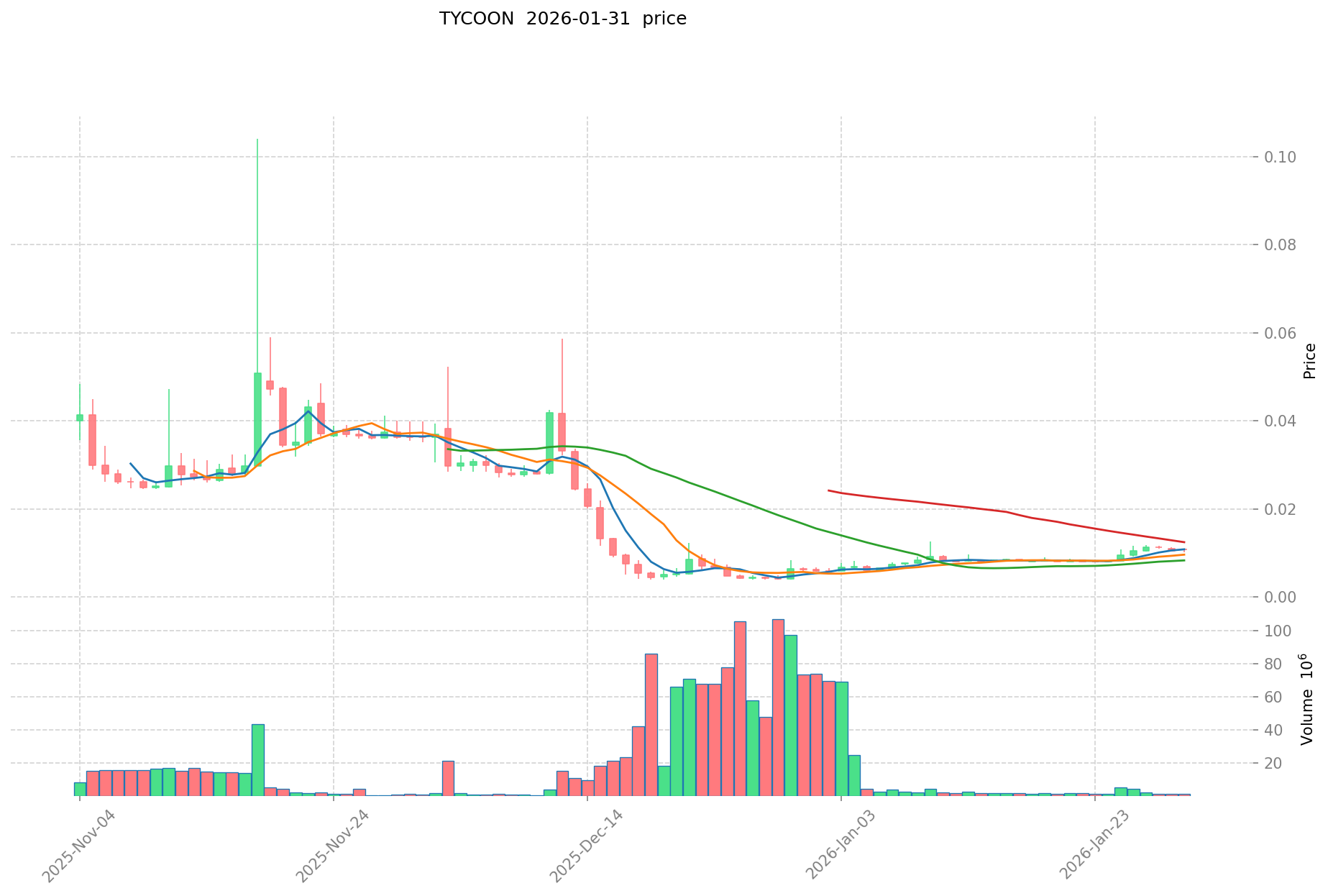
- 2025: TYCOON experienced significant volatility following its launch in November 2025, reaching an all-time high of $0.10412 on November 18, 2025, before declining substantially.
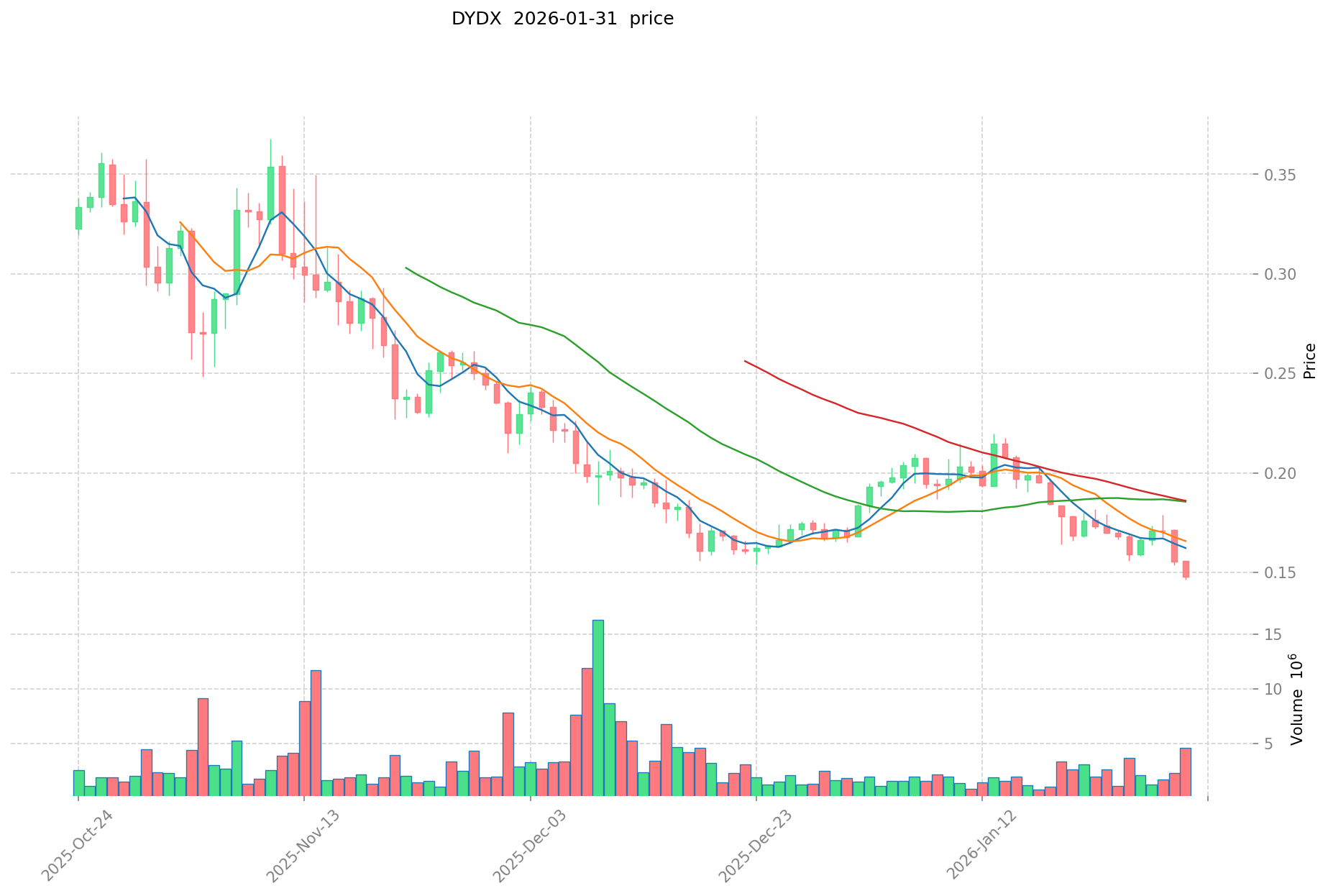
- 2024-2025: DYDX was affected by broader market conditions and platform migration developments, with its price declining from a high of $4.52 in March 2024 to a low of $0.126201 in October 2025.
- Comparative Analysis: During the recent market cycle, TYCOON dropped from its peak of $0.10412 to $0.0039 (its historical low recorded on December 29, 2025), representing a decline of over 96%, while DYDX experienced a decrease from $4.52 to $0.126201, reflecting a decline of approximately 97%.
Current Market Status (January 31, 2026)
- TYCOON Current Price: $0.011938
- DYDX Current Price: $0.1418
- 24-Hour Trading Volume: TYCOON $31,679.41 vs DYDX $463,396.50
- Market Sentiment Index (Fear & Greed Index): 20 (Extreme Fear)
Click to view real-time prices:
II. Core Factors Influencing TYCOON vs DYDX Investment Value
Supply Mechanism Comparison (Tokenomics)
-
DYDX: Maximum supply capped at 1 billion tokens with a permanent 2% inflation ceiling, reflecting strict supply management. The protocol implements a token buyback program allocating 25-75% of fees to repurchase tokens, which may reduce circulating supply and support price stability during volatility. As of late 2025, circulation ratio stands at approximately 82% (over 820 million tokens), with dilution risk mitigated by the supply cap.
-
TYCOON: Supply mechanism information not available in provided materials.
-
📌 Historical Pattern: DYDX experienced substantial volatility, reaching a peak of $4.52 in March 2024 before declining approximately 91.33% by October 2025 to near $0.126. The combination of controlled supply expansion and buyback mechanisms may influence recovery potential through supply reduction effects.
Institutional Adoption and Market Application
-
Institutional Holdings: DYDX attracts participants focused on derivatives DeFi, with institutional support evidenced through partnerships such as collaboration with StarkWare, achieving 25x capital efficiency. The platform's open interest reached $175-200 million by Q3 2025, indicating engagement from professional traders.
-
Enterprise Adoption: DYDX serves as a non-custodial decentralized exchange (DEX) specializing in perpetual futures, margin trading, and advanced order types. Its application centers on derivatives trading rather than cross-border payments or traditional settlement systems. The platform supports programmatic trading through bots and high leverage, appealing to professional market participants.
-
Regulatory Stance: Information regarding specific country-level regulatory attitudes toward DYDX or TYCOON not available in provided materials.
Technology Development and Ecosystem Building
-
DYDX Technical Upgrades: The protocol operates on dYdX Chain v4, launched in 2023 on Cosmos SDK utilizing CometBFT consensus for scalability. This represents an evolution from Ethereum Layer 2 (StarkEx ZK-rollups) to address gas fee and speed limitations. The technology stack combines Layer 1 sovereignty with off-chain order books for efficiency while ensuring security through on-chain settlement. Recent initiatives include spot trading expansion and liquidity incentives, highlighting transition toward a multi-asset DeFi hub. Zero gas fees for trading volumes below $100K and permissionless custody enhance accessibility.
-
TYCOON Technical Development: Technology development information not available in provided materials.
-
Ecosystem Comparison: DYDX demonstrates leadership in decentralized derivatives with daily on-chain trading volume exceeding $200 million by Q3 2025. The platform supports governance mechanisms allowing DYDX holders to influence protocol upgrades, fee structures, and risk parameters. Staking pools enhance network effects with proportional reward distribution, while the community treasury (5% initial supply) funds NFT initiatives, hackathons, and governance activities. Integration plans include Telegram for retail growth. The platform maintains presence across over 20 trading venues with approximately 45,361 holders and a market share of 0.0055%.
Macroeconomic Environment and Market Cycles
-
Performance Under Inflation: Information regarding anti-inflation properties of DYDX or TYCOON not available in provided materials.
-
Monetary Policy Impact: The broader market pressures contributing to DYDX's 91.33% annual decline in 2024 reflect sensitivity to macroeconomic conditions. Current metrics show price ranging between $0.167-$0.186 with market capitalization of $137-174 million and 24-hour trading volume of approximately $853K, positioning at rank 276.
-
Geopolitical Factors: Information regarding cross-border transaction demand or international situation impacts on DYDX or TYCOON not available in provided materials.
III. 2026-2031 Price Forecast: TYCOON vs DYDX
Short-term Forecast (2026)
- TYCOON: Conservative $0.0065 - $0.012 | Optimistic $0.012 - $0.0126
- DYDX: Conservative $0.134 - $0.141 | Optimistic $0.141 - $0.209
Mid-term Forecast (2028-2029)
- TYCOON may enter a gradual accumulation phase, with estimated price range of $0.0074 - $0.0197
- DYDX may enter a consolidation phase, with estimated price range of $0.173 - $0.246
- Key drivers: institutional capital flows, ETF developments, ecosystem expansion
Long-term Forecast (2030-2031)
- TYCOON: Baseline scenario $0.0115 - $0.0205 | Optimistic scenario $0.0174 - $0.0238
- DYDX: Baseline scenario $0.183 - $0.280 | Optimistic scenario $0.202 - $0.360
View detailed price predictions for TYCOON and DYDX
Disclaimer
Price predictions are based on historical data analysis and market trends. Cryptocurrency markets are highly volatile and subject to various risk factors. These forecasts should not be considered as investment advice. Past performance does not guarantee future results. Investors should conduct thorough research and consider their own risk tolerance before making any investment decisions.
TYCOON:
| Year |
Predicted High Price |
Predicted Average Price |
Predicted Low Price |
Price Change |
| 2026 |
0.0126399 |
0.012038 |
0.00650052 |
0 |
| 2027 |
0.013326066 |
0.01233895 |
0.006909812 |
3 |
| 2028 |
0.01565565976 |
0.012832508 |
0.00744285464 |
7 |
| 2029 |
0.0196568357544 |
0.01424408388 |
0.0126772346532 |
19 |
| 2030 |
0.020510056378812 |
0.0169504598172 |
0.011526312675696 |
41 |
| 2031 |
0.023787427784467 |
0.018730258098006 |
0.017419140031145 |
56 |
DYDX:
| Year |
Predicted High Price |
Predicted Average Price |
Predicted Low Price |
Price Change |
| 2026 |
0.20942 |
0.1415 |
0.134425 |
0 |
| 2027 |
0.2140612 |
0.17546 |
0.1473864 |
23 |
| 2028 |
0.237607932 |
0.1947606 |
0.179179752 |
37 |
| 2029 |
0.24645006324 |
0.216184266 |
0.1729474128 |
52 |
| 2030 |
0.2798937691902 |
0.23131716462 |
0.1827405600498 |
63 |
| 2031 |
0.360403708336191 |
0.2556054669051 |
0.201928318855029 |
80 |
IV. Investment Strategy Comparison: TYCOON vs DYDX
Long-term vs Short-term Investment Strategies
-
TYCOON: May appeal to investors seeking early-stage opportunities in gamified financial education platforms with high risk tolerance. The project's focus on AI-powered investment simulation represents an emerging niche in Web3 gaming and educational technology. Given limited market data and recent launch, this positioning suggests speculative rather than established value propositions.
-
DYDX: May suit investors interested in decentralized derivatives infrastructure with established market presence. The protocol's transition to its own blockchain, governance mechanisms, and institutional trading features position it for participants focused on DeFi trading platforms. The established ecosystem and operational history since 2021 provide more observable performance metrics compared to newer entrants.
Risk Management and Asset Allocation
-
Conservative Investors: Potential allocation framework could consider 10-20% TYCOON vs 80-90% DYDX, reflecting the maturity differential between a newly launched gaming token and an established derivatives protocol. Conservative approaches typically prioritize assets with operational history and measurable metrics.
-
Aggressive Investors: Potential allocation framework might explore 40-50% TYCOON vs 50-60% DYDX, accommodating higher exposure to early-stage opportunities while maintaining presence in established protocols. This approach reflects willingness to accept elevated volatility for potential asymmetric returns.
-
Hedging Tools: Portfolio management may incorporate stablecoin reserves (20-30% allocation during volatile periods), derivatives strategies through platforms like dYdX itself for directional hedging, and diversification across multiple protocol categories to mitigate concentration risk.
V. Potential Risk Comparison
Market Risk
-
TYCOON: Demonstrates substantial volatility with a 96% decline from peak ($0.10412) to low ($0.0039) within approximately six weeks following November 2025 launch. Limited trading volume ($31,679.41 daily) and low market cap ($2.6 million) suggest elevated liquidity risk and susceptibility to price manipulation. The token's ranking at 1914 indicates minimal market penetration and price discovery challenges.
-
DYDX: Experienced significant drawdowns with a 97% decline from March 2024 peak ($4.52) to October 2025 low ($0.126201), reflecting sensitivity to broader market conditions and platform transition impacts. Current market cap of $116.4 million and daily volume of $463,396.50 indicate deeper liquidity relative to TYCOON, though still subject to DeFi sector cyclicality and competitive pressures from centralized and decentralized derivatives platforms.
Technical Risk
-
TYCOON: Technical development details remain limited in available information, creating uncertainty regarding infrastructure robustness, security audit coverage, and scalability planning. The combination of AI integration, gaming mechanics, and blockchain components introduces multi-layered technical complexity that requires validation through operational track record.
-
DYDX: Migration from Ethereum Layer 2 to independent dYdX Chain v4 on Cosmos SDK represents significant architectural change with inherent transition risks. While the protocol demonstrates technical innovation through off-chain order books and zero gas fees for smaller volumes, the relatively newer blockchain infrastructure (launched 2023) requires continued monitoring for network stability, validator decentralization, and potential consensus vulnerabilities. The protocol's reliance on complex interactions between on-chain settlement and off-chain matching introduces systemic dependencies.
Regulatory Risk
- Both assets face evolving regulatory landscapes affecting cryptocurrency markets globally. DYDX's focus on derivatives trading may attract particular scrutiny from financial regulators examining decentralized alternatives to traditional futures markets. The protocol's decentralized governance structure and non-custodial architecture provide certain structural differences from centralized exchanges, though regulatory interpretation of these distinctions remains developing across jurisdictions. TYCOON's positioning in gaming and educational applications may encounter different regulatory considerations related to gaming tokens and user engagement mechanics. Investors should monitor jurisdiction-specific developments affecting both DeFi protocols and gaming tokens, recognizing that regulatory clarity remains limited across many markets as of early 2026.
VI. Conclusion: Which Is the Better Buy?
📌 Investment Value Summary:
-
TYCOON Characteristics: Represents early-stage exposure to gamified financial education within Web3, offering potential for significant appreciation if the platform achieves user adoption and ecosystem development. The project's novel approach combining AI, gaming, and financial literacy education positions it within emerging narratives, though with substantial execution risk given limited operational history and market validation.
-
DYDX Characteristics: Provides exposure to established decentralized derivatives infrastructure with observable metrics including daily trading volume exceeding $200 million, over 45,000 holders, and operational track record since 2021. The protocol's technical evolution to independent blockchain infrastructure, governance mechanisms, and institutional features reflect maturity relative to newer projects, though facing competitive pressures and market cycle sensitivity.
✅ Investment Considerations:
-
Novice Investors: May consider prioritizing assets with established operational history, observable metrics, and deeper liquidity. DYDX offers more historical data for analysis compared to TYCOON's limited post-launch period. Portfolio allocation should reflect individual risk capacity, with consideration for stablecoin reserves and diversification across multiple protocol categories rather than concentration in single assets.
-
Experienced Investors: Might evaluate both opportunities through distinct lenses - TYCOON as speculative exposure to emerging gaming/education narratives with asymmetric return potential but elevated execution risk, and DYDX as infrastructure play on decentralized derivatives with established metrics but facing competitive and cyclical challenges. Advanced strategies could incorporate derivatives hedging, staged entry approaches, and correlation analysis with broader DeFi and gaming sectors.
-
Institutional Participants: May focus on DYDX given its derivatives infrastructure positioning, governance participation opportunities, and measurable engagement metrics suitable for institutional evaluation frameworks. TYCOON's early stage and limited operational data present challenges for institutional due diligence processes, though some specialized funds focusing on early-stage gaming/Web3 projects might explore strategic allocations pending thorough technical and team evaluation.
⚠️ Risk Disclosure: Cryptocurrency markets demonstrate substantial volatility and significant loss potential. This analysis does not constitute investment advice, financial recommendations, or predictive guarantees. Both TYCOON and DYDX have experienced declines exceeding 90% from peak valuations, illustrating material downside risks. Investors should conduct independent research, evaluate personal risk tolerance, and consider consultation with qualified financial advisors before making investment decisions. Past performance does not indicate future results, and projected price forecasts remain subject to numerous uncertain variables.
VII. FAQ
Q1: What are the main differences between TYCOON and DYDX in terms of use cases?
DYDX operates as a decentralized perpetual contract exchange focused on derivatives trading, while TYCOON is an AI-powered investment simulation game designed for financial education through gamification. DYDX serves professional traders and institutions seeking non-custodial access to leveraged trading, margin positions, and advanced order types, with daily on-chain trading volume exceeding $200 million as of Q3 2025. The platform specializes in perpetual futures and has evolved from Ethereum Layer 2 to its own blockchain infrastructure on Cosmos SDK. In contrast, TYCOON combines entertainment, education, and blockchain transparency to create an accessible learning environment for financial literacy, representing an emerging niche in Web3 gaming and educational technology rather than trading infrastructure.
Q2: How do the supply mechanisms of TYCOON and DYDX differ?
DYDX implements a well-defined supply mechanism with a maximum cap of 1 billion tokens and a permanent 2% inflation ceiling, providing predictable supply dynamics. The protocol incorporates a token buyback program that allocates 25-75% of trading fees to repurchase tokens from the market, potentially reducing circulating supply and supporting price stability. As of late 2025, approximately 82% of tokens (over 820 million) are in circulation, with dilution risk mitigated by the hard supply cap. Unfortunately, detailed supply mechanism information for TYCOON is not available in current market data, creating uncertainty around tokenomics structure, emission schedules, and long-term supply dynamics that investors typically evaluate when assessing deflationary or inflationary pressures.
Q3: Which token demonstrates better liquidity and market depth?
DYDX exhibits significantly superior liquidity metrics compared to TYCOON. As of January 31, 2026, DYDX maintains a market capitalization of approximately $116.4 million with daily trading volume of $463,396.50, ranking 296th globally. The protocol supports presence across over 20 trading venues with approximately 45,361 holders, indicating broader market participation and distribution. TYCOON, by comparison, holds a market capitalization of approximately $2.6 million with daily trading volume of only $31,679.41, ranking 1914th. This substantial differential in trading volume (approximately 14.6x higher for DYDX) and market cap (approximately 44.8x larger for DYDX) translates to reduced slippage, easier position entry/exit, and lower manipulation risk for DYDX compared to TYCOON's more limited liquidity environment.
Q4: What are the primary technical risks associated with each protocol?
DYDX faces technical risks primarily related to its migration from Ethereum Layer 2 (StarkEx ZK-rollups) to its independent dYdX Chain v4 on Cosmos SDK with CometBFT consensus. This architectural transition introduces potential vulnerabilities in network stability, validator decentralization, and consensus mechanisms that require ongoing monitoring despite launching in 2023. The protocol's reliance on complex interactions between off-chain order books for efficiency and on-chain settlement for security creates systemic dependencies. For TYCOON, technical risk assessment is complicated by limited available information regarding infrastructure robustness, security audit coverage, and scalability planning. The combination of AI integration, gaming mechanics, and blockchain components introduces multi-layered technical complexity without sufficient operational track record for validation.
Q5: How have TYCOON and DYDX performed during recent market downturns?
Both tokens experienced severe drawdowns during recent market cycles, though at different timeframes and magnitudes. DYDX declined approximately 97% from its March 2024 peak of $4.52 to its October 2025 low of $0.126201, reflecting sensitivity to broader DeFi sector conditions, competitive pressures, and platform migration developments. This extended decline occurred over an 18-month period with the token trading at $0.1418 as of January 31, 2026. TYCOON demonstrated even more extreme volatility with a 96% decline from its all-time high of $0.10412 (reached November 18, 2025) to its historical low of $0.0039 (December 29, 2025) within approximately six weeks, currently trading at $0.011938. Both declines illustrate substantial downside risk, though TYCOON's compressed timeframe suggests elevated volatility relative to DYDX.
Q6: What institutional adoption exists for TYCOON versus DYDX?
DYDX demonstrates measurable institutional engagement through professional trader participation, with open interest reaching $175-200 million by Q3 2025. The protocol's partnership with StarkWare achieving 25x capital efficiency, support for programmatic trading through bots, and advanced order types attract institutional participants focused on derivatives DeFi. Features such as zero gas fees for trading volumes below $100K, permissionless custody, and governance mechanisms allowing DYDX holders to influence protocol parameters appeal to sophisticated market participants. The platform's evolution to independent blockchain infrastructure and established operational history since 2021 provide institutional-grade due diligence materials. In contrast, information regarding institutional adoption of TYCOON remains limited in available data, reflecting the project's early-stage positioning and focus on retail-oriented financial education rather than institutional trading infrastructure.
Q7: How do governance mechanisms differ between the two protocols?
DYDX implements comprehensive governance mechanisms allowing token holders to participate in protocol decisions including upgrades, fee structures, and risk parameters. The governance framework includes staking pools with proportional reward distribution, enhancing network effects and aligning stakeholder incentives. A community treasury allocated 5% of initial supply funds NFT initiatives, hackathons, and governance activities, demonstrating commitment to decentralized decision-making and ecosystem development. The protocol's governance structure evolved alongside its technical migration to independent blockchain infrastructure, providing token holders meaningful influence over platform direction. Information regarding TYCOON's governance mechanisms, voting structures, or community treasury allocations is not available in current market data, creating uncertainty about stakeholder participation rights and protocol evolution processes.
Q8: What allocation strategies might suit different investor profiles for TYCOON vs DYDX?
Conservative investors might consider allocation frameworks emphasizing established protocols with operational history, potentially structuring 10-20% TYCOON versus 80-90% DYDX to reflect maturity differentials. This approach prioritizes assets with measurable metrics and observable performance data while maintaining limited exposure to early-stage opportunities. Aggressive investors with higher risk tolerance might explore 40-50% TYCOON versus 50-60% DYDX allocations, accommodating elevated exposure to potential asymmetric returns from newer projects while maintaining presence in established infrastructure. Both approaches should incorporate portfolio management tools including stablecoin reserves (20-30% during volatile periods), derivatives strategies for directional hedging, and diversification across multiple protocol categories rather than concentration in single assets. Individual allocations should ultimately reflect personal risk capacity, investment timeframe, and correlation with existing portfolio holdings.
* The information is not intended to be and does not constitute financial advice or any other recommendation of any sort offered or endorsed by Gate.