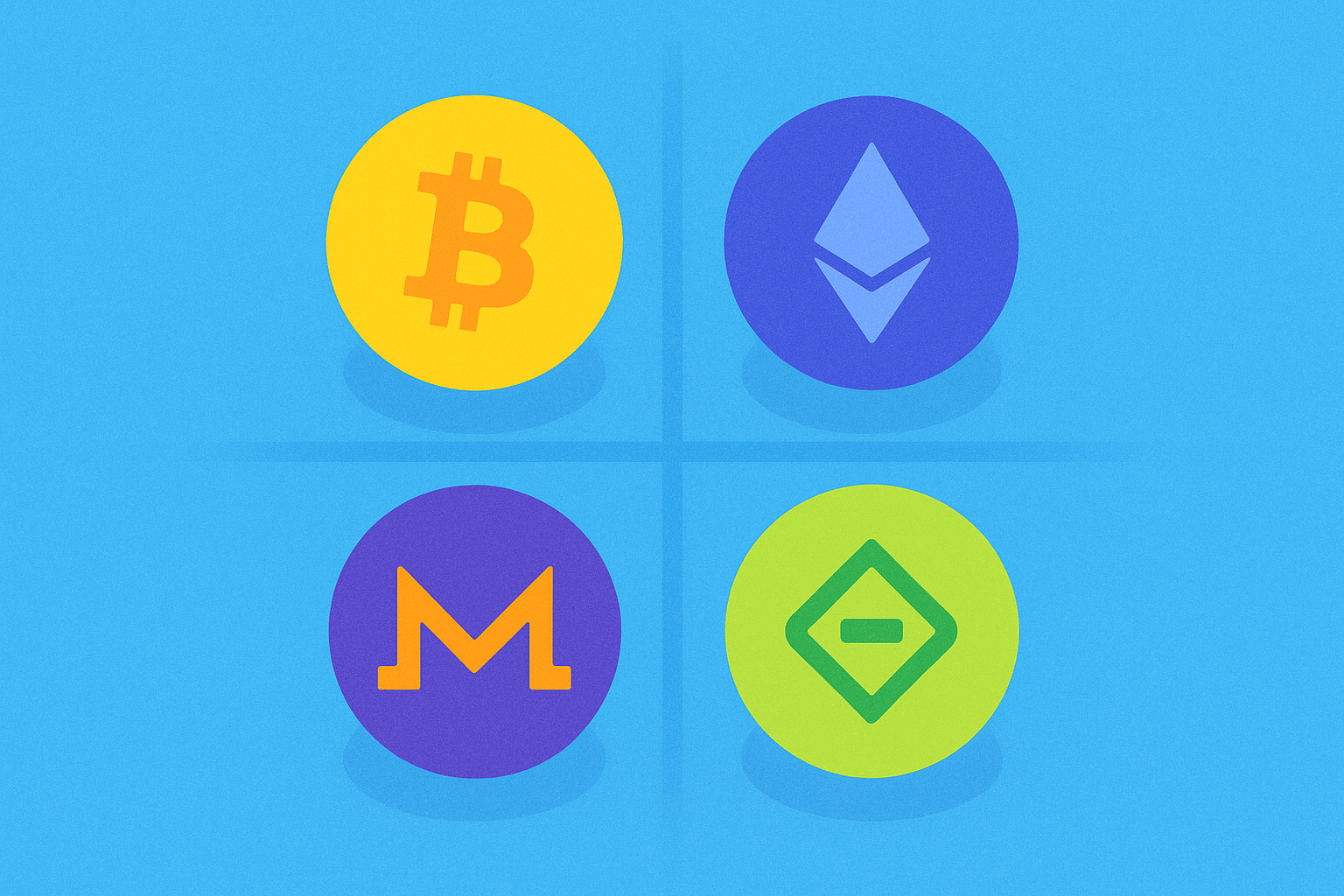
This comprehensive guide explores the diverse landscape of cryptocurrencies and their practical applications across multiple sectors. It covers fundamental classifications including centralized versus decentralized architectures, consensus mechanisms like Proof of Work and Proof of Stake, and specialized cryptocurrency categories including payment-focused coins, privacy coins, stablecoins, and DeFi tokens. Each section examines real-world use cases and distinguishes how different digital assets serve distinct purposes—from Bitcoin's role as digital gold to Ethereum's smart contract capabilities, privacy solutions like Monero, and DeFi platforms revolutionizing financial services. The article also addresses exchange tokens and utility tokens, providing readers with essential knowledge to understand cryptocurrency types, evaluate assets on Gate, and navigate the evolving blockchain ecosystem effectively.
Centralized and Decentralized Cryptocurrencies
Cryptocurrencies can be classified into centralized and decentralized categories based on their governance and validation mechanisms. Most cryptocurrencies utilize a distributed consensus mechanism, where multiple parties verify and record the same information across a network of nodes. This decentralized approach ensures transparency, security, and resistance to single points of failure.
However, it's important to note that many cryptocurrencies still lean toward centralized validation to varying degrees. Some projects maintain centralized control over network upgrades, token distribution, or governance decisions. The spectrum between full decentralization and centralization represents different trade-offs in terms of efficiency, security, and community governance. Understanding this distinction is crucial for evaluating the true nature and potential risks of any cryptocurrency project.
Cryptocurrencies by Generation Process
The fundamental models for mining, generating, and distributing cryptocurrencies include Proof of Work (PoW) and Proof of Stake (PoS). These consensus mechanisms determine how new tokens are created and how transactions are validated on the blockchain.
Proof of Work is a system that utilizes electrical energy as proof of computational work. This energy powers mining machines that perform complex mathematical calculations to validate transactions and secure the network. Bitcoin, the first cryptocurrency, pioneered this approach. While PoW provides robust security, it has faced criticism for its significant energy consumption and environmental impact.
Proof of Stake emerged as an energy-efficient alternative to PoW. Instead of relying on computational power and electricity, PoS uses token staking as the basis for network validation. Validators lock up their tokens as collateral, and the network selects them to create new blocks based on factors like stake size and holding duration. This mechanism significantly reduces energy consumption while maintaining network security, making it an increasingly popular choice for newer blockchain projects.
Payment-Focused Cryptocurrencies
Bitcoin was the pioneering cryptocurrency that introduced the concept of digital money to the world. The fundamental idea was to create a digital economy built on principles similar to the gold standard. Bitcoin's limited supply, combined with its periodic mining process through block rewards, was designed as an ideal economic system that mimics the scarcity and value preservation characteristics of precious metals.
As Bitcoin grew in adoption and network usage, scalability challenges and high transaction fees emerged as significant obstacles. These limitations prevented Bitcoin from functioning effectively as a medium of exchange for everyday transactions. Consequently, Bitcoin evolved to gain a reputation as an excellent store of value and "digital gold" rather than a payment currency.
To address these limitations, alternative cryptocurrencies were developed specifically for payment use cases. Bitcoin Cash emerged as a fork of Bitcoin with larger block sizes to enable faster and cheaper transactions. Litecoin was created with shorter block times and a different hashing algorithm to facilitate quicker payments. XRP and Stellar represent blockchain platforms specifically designed for cross-border payments and remittances, offering near-instant settlement times and minimal transaction costs. These payment-focused cryptocurrencies aim to fulfill the original vision of digital cash for global transactions.
Privacy Coins
Anonymity and fungibility are considered fundamental characteristics of sound money. In the cryptocurrency market, several privacy-oriented digital assets have emerged to address these specific needs.
Monero has gained significant recognition in privacy-focused communities, establishing itself as the leading privacy coin. It utilizes advanced cryptographic techniques like ring signatures, stealth addresses, and confidential transactions to ensure that sender, receiver, and transaction amounts remain private by default. This comprehensive privacy approach has made Monero the preferred choice for users seeking maximum transaction anonymity.
Zcash employs zero-knowledge proofs through its zk-SNARKs protocol, offering a dual address system that provides both private and transparent transaction options. Users can choose between shielded addresses for complete privacy or transparent addresses for regulatory compliance and auditability. This flexibility makes Zcash suitable for various use cases requiring different levels of privacy.
Dash focuses on optional privacy features combined with fast transaction speeds through its InstantSend technology. The project has been actively working on increasing adoption in Latin American countries, positioning itself as both a privacy coin and a practical payment solution for everyday transactions.
Stablecoins
Stablecoins represent the cryptographic version of fiat currencies, designed to maintain price stability by pegging their value to traditional assets. Most stablecoins are backed one-to-one by corresponding fiat currencies held in reserve, or by specific amounts of other assets such as gold, real estate, or cryptocurrency collateral.
The primary advantage of stablecoins lies in combining the benefits of cryptocurrency technology with price stability. Cryptocurrency transactions recorded on transparent blockchains offer greater transparency than traditional banking operations, while stablecoins eliminate the volatility typically associated with digital assets. This makes them ideal for trading, remittances, and as a stable medium of exchange within the crypto ecosystem.
The most popular stablecoins in the market include USDT (Tether), USDC (USD Coin), BUSD, DAI, and UST. Each operates with different backing mechanisms, ranging from fully fiat-backed reserves to algorithmic stability mechanisms. These stablecoins have become essential infrastructure in the cryptocurrency ecosystem, facilitating trading, lending, and cross-border transactions while maintaining price stability.
Exchange Tokens
Exchange tokens are blockchain-based utility tokens issued by cryptocurrency trading platforms. They typically operate on a "fee revenue" model, where token holders receive various benefits and privileges within the exchange ecosystem.
Major cryptocurrency platforms have launched their own native exchange tokens to incentivize user loyalty and platform engagement. These tokens often provide benefits such as reduced trading fees, priority access to new token listings, participation in platform governance, and exclusive features. For example, one leading exchange implements a quarterly token buyback and burn mechanism, using 20% of its profits to repurchase and permanently remove tokens from circulation. This deflationary approach reduces supply over time, potentially increasing token value for holders.
Exchange tokens serve multiple purposes beyond fee discounts. They can be used for staking to earn rewards, participating in token sales on launchpad platforms, and accessing premium services. The success of exchange tokens has demonstrated how utility tokens can create sustainable economic models that align the interests of platforms and their user communities.
Utility Tokens
Following Bitcoin's creation, visionaries recognized the potential of distributed consensus and blockchain technology beyond payment systems. Vitalik Buterin developed Ethereum, a blockchain-based platform designed to execute programmable smart contracts.
These programs run on a distributed network of nodes, forming a decentralized supercomputer capable of executing complex logic without centralized control. This innovation opened the door for countless decentralized applications (dApps) and utility tokens. Utility tokens created on these platforms serve various specific purposes beyond functioning as a medium of exchange.
Utility tokens can represent access rights to specific services, voting power in decentralized governance systems, rewards in gaming ecosystems, or units of computational resources. They enable new economic models where users, developers, and token holders participate in network growth and value creation. The programmability of smart contract platforms has made utility tokens a fundamental building block for the decentralized economy.
DeFi Tokens
Decentralized Finance (DeFi) applications replicate traditional financial models on decentralized networks, revolutionizing how people access financial services. These applications encompass lending, borrowing, savings, trading, insurance, payments, and more, all operating without traditional intermediaries.
DeFi represents a FinTech movement aimed at improving the financial system by eliminating central authorities, reducing intermediary costs, and building security and trust through transparent, auditable smart contracts. The composability of DeFi protocols allows different applications to interact seamlessly, creating an interconnected financial ecosystem often referred to as "money legos."
Prominent examples include lending platforms like Compound, which enable users to earn interest on deposited assets or borrow against collateral without credit checks. Decentralized exchanges such as Uniswap allow peer-to-peer token trading using automated market maker (AMM) mechanisms, eliminating the need for centralized order books. Other DeFi categories include yield farming platforms, decentralized insurance protocols, synthetic asset platforms, and algorithmic stablecoins. DeFi tokens often serve governance functions, allowing holders to vote on protocol parameters and future development directions, creating truly community-driven financial infrastructure.
FAQ
What is the difference between cryptocurrencies and tokens?
Cryptocurrencies like Bitcoin and Ethereum operate on independent blockchains. Tokens are built on existing blockchain platforms through smart contracts. Cryptocurrencies are decentralized systems, while tokens depend on underlying blockchain infrastructure.
What are the main types of cryptocurrencies such as Bitcoin and Ethereum?
The main cryptocurrencies include Bitcoin, Ethereum, Solana, and Dogecoin. These are the most popular and widely used digital assets in the market, each serving different purposes in the blockchain ecosystem.
What are ERC-20 tokens and other token standards?
ERC-20 is a technical standard for creating tokens on the Ethereum blockchain, defining rules for token compatibility. Other standards include ERC-721 for NFTs and ERC-1155 for multi-token contracts, each serving different purposes.
What are utility tokens and governance tokens respectively?
Utility tokens grant access to specific services or products within a blockchain ecosystem, like Filecoin for decentralized storage. Governance tokens enable holders to vote on protocol decisions and participate in platform management, such as Uniswap and Aave.
What is the purpose of stablecoins, and what are the main types?
Stablecoins provide price stability in crypto markets. Main types include fiat-collateralized, commodity-backed, crypto-collateralized, and algorithmic stablecoins. Each maintains stability through different mechanisms.
How to evaluate and select different types of crypto assets?
Assess the project whitepaper, team credibility, market metrics (trading volume, market cap, circulation supply), tokenomics, and real-world applications. Analyze price history and technical indicators. Research community engagement and partnerships. Compare market position among top-ranked cryptocurrencies for relative safety.
What are the different applications of tokens in DeFi, NFT, and other fields?
Tokens serve as liquidity and governance mechanisms in DeFi for lending, swapping, and staking. In NFTs, tokens represent unique digital ownership and enable trading of art, collectibles, and gaming assets. Across Web3, tokens facilitate value transfer and incentivize ecosystem participation.
* The information is not intended to be and does not constitute financial advice or any other recommendation of any sort offered or endorsed by Gate.