This comprehensive analysis compares UB and BAT cryptocurrencies across multiple investment dimensions to help market participants evaluate their portfolio allocation strategies. UB, launched in 2025, represents an emerging AI memory layer project built on multi-chain infrastructure, currently trading at $0.0367 with higher volatility characteristics. BAT, an established digital advertising utility token since 2017, trades at $0.2164 with a longer operational history. The article examines historical price trends, tokenomics, technical infrastructure, and risk factors while providing 2026-2031 price forecasts suggesting BAT's higher absolute growth potential. Investment strategies range from conservative allocations favoring BAT's stability to aggressive approaches balancing both tokens. For investors seeking exposure to nascent AI-blockchain integration with higher risk tolerance, UB presents opportunities; for those preferring established ecosystems with proven track records, BAT offers more predictable mark
Introduction: UB Investment Value, Price Prediction, and Risk Analysis
In the rapidly evolving cryptocurrency landscape, Unibase (UB) represents an emerging project at the intersection of artificial intelligence and blockchain technology. Launched in 2025, UB positions itself as a high-performance decentralized AI memory layer, aiming to provide long-term memory and cross-platform interoperability for AI agents. This approach targets a distinct niche within the crypto ecosystem, focusing on enabling intelligent agents to remember, collaborate, and self-evolve across different platforms.
Since its launch, UB has experienced notable price fluctuations. The token reached a peak of 0.092791 USD on October 28, 2025, and recorded its lowest point at 0.015082 USD on September 12, 2025. As of January 17, 2026, UB is trading at 0.0367 USD, with a market capitalization of approximately 91.75 million USD and a ranking of 376 among cryptocurrencies. The project maintains a circulating supply of 2.5 billion tokens out of a maximum supply of 10 billion, representing a 25% circulation ratio.
This analysis will examine UB from multiple perspectives, including:
- Historical price performance and market dynamics
- Token supply mechanism and economic model
- Technical infrastructure and ecosystem development
- Market positioning within the AI and blockchain sectors
- Risk factors and investment considerations
Through this comprehensive examination, we aim to provide investors with data-driven insights into UB's potential trajectory and associated risks in the cryptocurrency market.
I. Historical Price Comparison and Current Market Status
UB (Coin A) and BAT (Coin B) Historical Price Trends
- 2025: UB experienced significant price volatility after its launch in September 2025, with prices fluctuating between $0.015082 (recorded on September 12, 2025) and reaching a peak of $0.092791 on October 28, 2025.
- 2017-2021: BAT demonstrated notable price movement, starting from its all-time low of $0.072394 on July 16, 2017, and achieving its all-time high of $1.9 on November 28, 2021.
- Comparative Analysis: During their respective market cycles, UB showed a price range from its peak of $0.092791 to its low of $0.015082 within a short period, while BAT experienced a broader historical range, from $0.072394 to $1.9 over a multi-year period.
Current Market Status (January 17, 2026)
- UB Current Price: $0.0367
- BAT Current Price: $0.2164
- 24-Hour Trading Volume: UB at $345,937.80 vs BAT at $60,920.55
- Market Sentiment Index (Fear & Greed Index): 50 (Neutral)
View real-time prices:
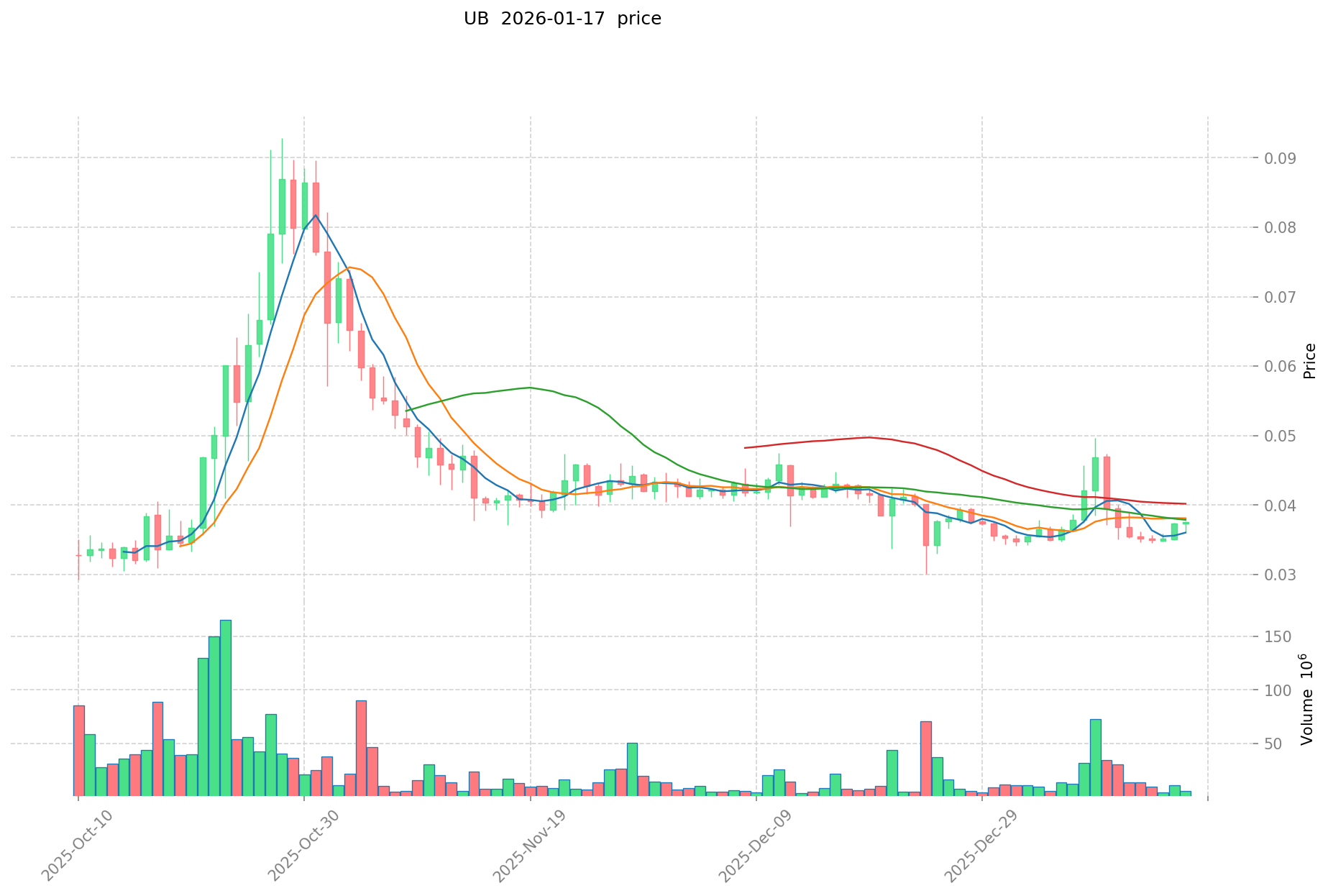
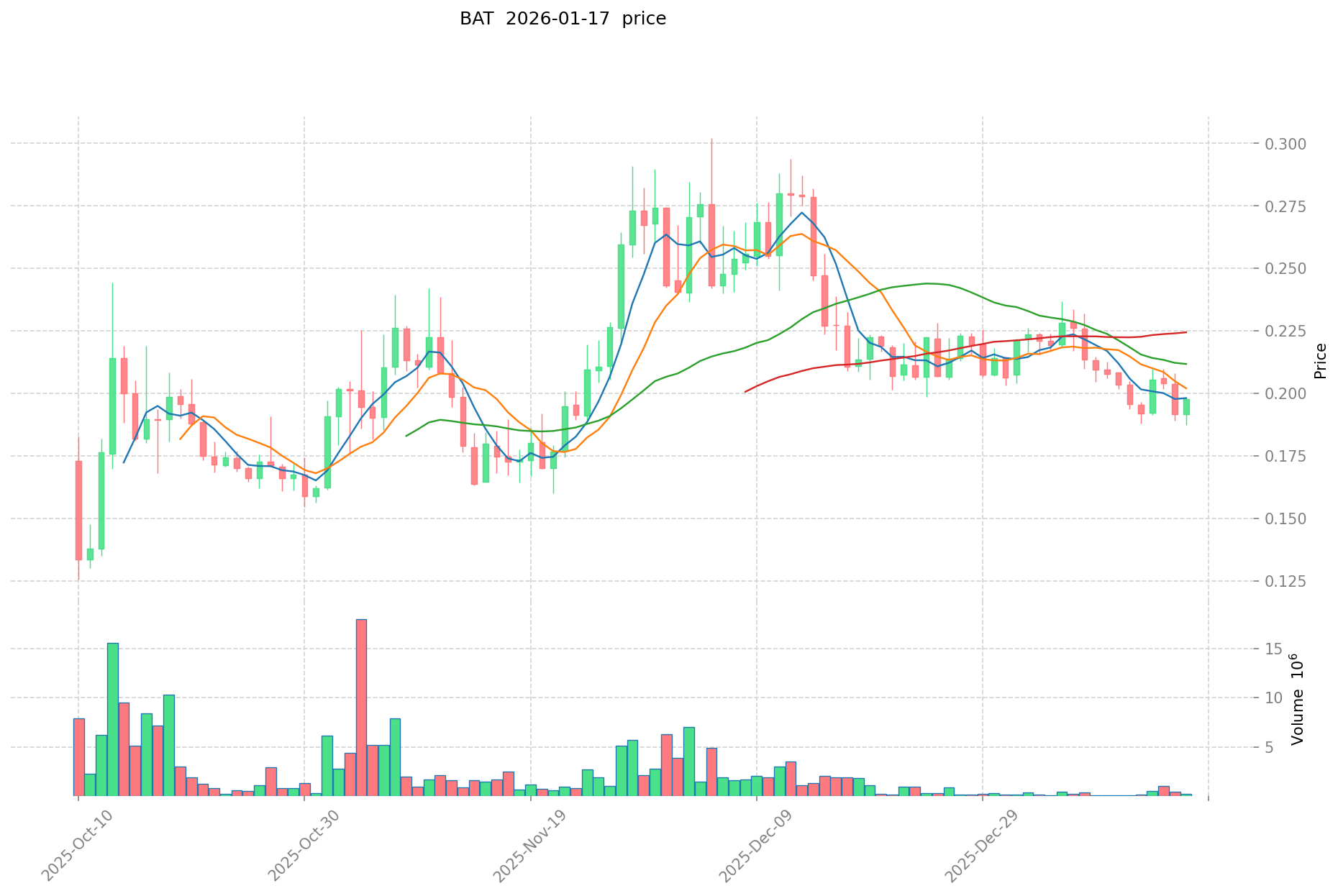
II. Core Factors Influencing Investment Value of UB vs BAT
Supply Mechanism Comparison (Tokenomics)
- UB: According to available materials, UB operates on Ethereum and Binance Smart Chain infrastructure, though specific supply mechanism details were not disclosed in the reference materials.
- BAT: The reference materials do not contain specific information regarding BAT's supply mechanism or tokenomics structure.
- 📌 Historical Pattern: Supply mechanisms influence price cycles through scarcity dynamics and market liquidity adjustments, though specific historical data for these tokens requires further research.
Institutional Adoption and Market Application
- Institutional Holdings: The reference materials do not provide comparative data on institutional preference between UB and BAT.
- Enterprise Adoption: Available materials mention UB's evaluation in terms of market potential and risk factors, but do not detail specific applications in cross-border payments, settlements, or investment portfolios for either token.
- National Policies: The materials do not contain specific information regarding different countries' regulatory attitudes toward UB or BAT.
Technology Development and Ecosystem Building
- UB Technology Foundation: Materials indicate that UB is built on Ethereum and Binance Smart Chain as its technical foundation, suggesting multi-chain compatibility.
- BAT Technology Development: Referenced materials mention BAT in context of AI investments, though specific technical developments related to the token itself were not detailed.
- Ecosystem Comparison: The reference materials do not provide sufficient information to compare DeFi, NFT, payment systems, or smart contract implementation between UB and BAT ecosystems.
Macroeconomic Factors and Market Cycles
- Performance in Inflationary Environment: The materials do not contain comparative analysis of anti-inflation properties for either UB or BAT.
- Macroeconomic Monetary Policy: While general corporate innovation and technology investment trends are mentioned in broader contexts, specific impacts of interest rates or dollar index movements on UB and BAT were not addressed in the reference materials.
- Geopolitical Factors: The materials discuss general themes of cross-border transactions and international situations in corporate contexts, but do not specifically address how these factors affect UB or BAT investment value.
III. 2026-2031 Price Forecast: UB vs BAT
Short-term Forecast (2026)
- UB: Conservative $0.0312 - $0.0367 | Optimistic $0.0367 - $0.0477
- BAT: Conservative $0.1471 - $0.2163 | Optimistic $0.2163 - $0.2725
Mid-term Forecast (2028-2029)
- UB may enter a consolidation phase, with projected prices ranging from $0.0267 to $0.0511
- BAT may enter a growth phase, with projected prices ranging from $0.2197 to $0.4811
- Key drivers: institutional capital inflows, ETF developments, ecosystem expansion
Long-term Forecast (2030-2031)
- UB: Baseline scenario $0.0290 - $0.0501 | Optimistic scenario $0.0563 - $0.0836
- BAT: Baseline scenario $0.2345 - $0.4187 | Optimistic scenario $0.2521 - $0.5462
View detailed price predictions for UB and BAT
Disclaimer
UB:
| Year |
Predicted High Price |
Predicted Average Price |
Predicted Low Price |
Price Change |
| 2026 |
0.047671 |
0.03667 |
0.0311695 |
0 |
| 2027 |
0.05313483 |
0.0421705 |
0.035844925 |
14 |
| 2028 |
0.0505118249 |
0.047652665 |
0.0266854924 |
29 |
| 2029 |
0.051045534748 |
0.04908224495 |
0.027486057172 |
33 |
| 2030 |
0.06858752909313 |
0.050063889849 |
0.02903705611242 |
36 |
| 2031 |
0.083649250354201 |
0.059325709471065 |
0.056359423997511 |
61 |
BAT:
| Year |
Predicted High Price |
Predicted Average Price |
Predicted Low Price |
Price Change |
| 2026 |
0.272538 |
0.2163 |
0.147084 |
0 |
| 2027 |
0.34951917 |
0.244419 |
0.13443045 |
13 |
| 2028 |
0.415756719 |
0.296969085 |
0.2197571229 |
37 |
| 2029 |
0.4810899177 |
0.356362902 |
0.21738137022 |
64 |
| 2030 |
0.5150334841155 |
0.41872640985 |
0.234486789516 |
93 |
| 2031 |
0.546249537969817 |
0.46687994698275 |
0.252115171370685 |
115 |
IV. Investment Strategy Comparison: UB vs BAT
Long-term vs Short-term Investment Strategies
- UB: May appeal to investors focused on emerging AI-blockchain integration projects with higher risk tolerance. The token's short trading history since September 2025 and substantial price volatility (ranging from $0.015082 to $0.092791) suggest it remains in an early development phase, potentially suitable for those seeking exposure to nascent technology sectors.
- BAT: May attract investors seeking exposure to established digital advertising ecosystems with longer market presence. With a trading history dating back to 2017 and historical price movements from $0.072394 to $1.9, BAT demonstrates a more mature market cycle pattern that may appeal to those preferring tokens with established track records.
Risk Management and Asset Allocation
- Conservative Investors: A potential allocation approach could consider UB at 10-20% and BAT at 80-90% of the cryptocurrency portion of a portfolio, given BAT's longer operational history and relatively established market position.
- Aggressive Investors: Those with higher risk tolerance might consider UB at 40-60% and BAT at 40-60%, balancing exposure between emerging AI-focused infrastructure and established digital advertising utility tokens.
- Hedging Tools: Stablecoin allocation for portfolio rebalancing, options strategies where available, and cross-token diversification within broader cryptocurrency holdings.
V. Potential Risk Comparison
Market Risks
- UB: The token exhibits considerable price volatility with a relatively limited trading history. Since launch in September 2025, UB has experienced fluctuations between $0.015082 and $0.092791, representing substantial percentage movements. The current market capitalization of approximately $91.75 million and ranking at position 376 suggest exposure to liquidity constraints and market sentiment shifts.
- BAT: While possessing a longer market history, BAT's price movements from historical ranges of $0.072394 to $1.9 indicate exposure to broader cryptocurrency market cycles. The current trading price of $0.2164 represents a notable distance from previous peaks, suggesting ongoing market adjustment dynamics.
Technical Risks
- UB: Operating on Ethereum and Binance Smart Chain infrastructure, the project may face scalability considerations inherent to these networks, including transaction throughput limitations and network congestion during peak usage periods. As an emerging AI memory layer project, technical implementation challenges related to cross-platform interoperability and AI agent integration may present development uncertainties.
- BAT: While specific technical infrastructure details were not extensively covered in reference materials, established tokens face ongoing considerations regarding network stability, protocol upgrades, and maintaining competitive technical capabilities within evolving blockchain ecosystems.
Regulatory Risks
- Both tokens operate within the global cryptocurrency regulatory landscape, which continues to evolve across different jurisdictions. Regulatory developments affecting blockchain infrastructure, AI applications, digital advertising platforms, and cryptocurrency classification may impact both projects differently based on their specific use cases and operational structures. Changes in compliance requirements, taxation frameworks, or jurisdictional restrictions could influence token utility and market accessibility.
VI. Conclusion: Which Is the Better Buy?
📌 Investment Value Summary:
- UB Characteristics: Focuses on emerging AI-blockchain integration with multi-chain infrastructure deployment. The project targets a specialized niche in decentralized AI memory layers, representing early-stage exposure to AI agent technology. Price forecasts suggest potential ranges from $0.0312 to $0.0836 through 2031, with notable volatility patterns since launch.
- BAT Characteristics: Represents a more established presence in the digital advertising and content reward ecosystem, with a longer operational track record since 2017. Price forecasts indicate potential ranges from $0.1471 to $0.5462 through 2031, reflecting a more mature market positioning.
✅ Investment Considerations:
- Beginning Investors: May consider starting with tokens having longer operational histories and more established market patterns. Understanding market dynamics through observation of price movements, trading volumes, and ecosystem developments before committing significant capital could provide valuable learning opportunities.
- Experienced Investors: Could evaluate allocation strategies balancing exposure between emerging technology sectors (represented by projects like UB) and more established utility tokens (such as BAT), while maintaining appropriate risk management protocols including position sizing and portfolio diversification.
- Institutional Participants: May assess both tokens within broader cryptocurrency portfolio strategies, considering factors such as liquidity requirements, regulatory compliance frameworks, technology infrastructure maturity, and alignment with investment mandates focused on specific blockchain applications or market segments.
⚠️ Risk Notice: Cryptocurrency markets demonstrate substantial volatility characteristics. This analysis does not constitute investment advice. Market participants should conduct independent research, assess personal risk tolerance, and consider consulting financial professionals before making investment decisions.
VII. FAQ
Q1: What is the main difference between UB and BAT in terms of their core functionality?
UB is a decentralized AI memory layer designed for AI agent interoperability, while BAT is an established digital advertising utility token. UB focuses on providing long-term memory and cross-platform capabilities for intelligent agents, targeting the emerging AI-blockchain integration sector. BAT, launched in 2017, operates within the digital advertising ecosystem, facilitating content rewards and user engagement. The fundamental distinction lies in their target applications: UB serves AI infrastructure needs, whereas BAT addresses digital advertising and content monetization challenges.
Q2: How do the price volatility patterns of UB and BAT compare for risk assessment?
UB exhibits significantly higher short-term volatility, while BAT demonstrates more established market cycle patterns. Since its September 2025 launch, UB has fluctuated between $0.015082 and $0.092791 within months, representing extreme percentage movements in a compressed timeframe. BAT, with a trading history dating to 2017, has ranged from $0.072394 to $1.9 over multiple years, showing more gradual price development. This suggests UB carries higher immediate volatility risk, while BAT presents risks associated with longer-term market cycles and ecosystem maturity phases.
Q3: What allocation strategy might be appropriate for conservative versus aggressive investors?
Conservative investors might consider a 10-20% UB and 80-90% BAT allocation within their cryptocurrency portfolio, while aggressive investors could allocate 40-60% to each token. Conservative approaches favor BAT's longer operational history and established market position, limiting exposure to UB's early-stage volatility. Aggressive strategies balance emerging technology sector exposure (UB) with established utility token positioning (BAT). Both approaches should incorporate broader portfolio diversification, stablecoin reserves for rebalancing, and position sizing aligned with individual risk tolerance and investment objectives.
Q4: What are the key technical infrastructure differences between UB and BAT?
UB operates on multi-chain infrastructure utilizing Ethereum and Binance Smart Chain, while BAT's specific technical foundation details were not extensively covered in available materials. UB's multi-chain deployment strategy aims to provide flexibility for AI agent operations across different blockchain networks, though this introduces considerations regarding cross-chain security and interoperability complexity. The dual-chain approach may offer redundancy benefits but also requires coordination across distinct network protocols. Understanding these technical foundations helps investors assess infrastructure-related risks and scalability potential for each project.
Q5: How do the price forecasts for 2026-2031 compare between UB and BAT?
BAT demonstrates higher absolute price projections across all timeframes, while UB shows more modest growth estimates. For 2026, UB forecasts range from $0.0312-$0.0477, whereas BAT projects $0.1471-$0.2725. By 2031, UB's optimistic scenario reaches $0.0836 compared to BAT's $0.5462. These projections suggest BAT may offer greater absolute price appreciation potential, though percentage gains depend on entry points. Investors should note that forecasts represent analytical estimates subject to market uncertainties, technological developments, and ecosystem adoption rates that may significantly alter actual outcomes.
Q6: What regulatory considerations should investors evaluate for UB versus BAT?
Both tokens face evolving global cryptocurrency regulations, though their specific use cases may attract different regulatory scrutiny. UB's AI infrastructure focus may encounter regulations specific to artificial intelligence applications, data handling, and cross-platform interoperability frameworks as governments develop AI governance policies. BAT's digital advertising utility could face regulations affecting content monetization, user privacy, and advertising technology platforms. Investors should monitor jurisdiction-specific developments, compliance requirement changes, and potential classification shifts that could impact token utility, market accessibility, or operational frameworks for either project.
Q7: What market capitalization and liquidity differences exist between UB and BAT?
UB currently maintains a market capitalization of approximately $91.75 million with a ranking of 376, while specific market cap data for BAT was not provided in reference materials. UB's 24-hour trading volume of $345,937.80 compared to BAT's $60,920.55 suggests UB currently experiences higher short-term trading activity despite its smaller market presence. However, liquidity patterns can fluctuate significantly, and investors should consider order book depth, exchange listings, and trading pair availability when assessing execution risks. Smaller market capitalizations like UB's may present greater price impact from large transactions compared to more established tokens.
Q8: How should investors approach timing strategies when considering UB versus BAT?
Timing strategies should consider each token's market cycle positioning and volatility characteristics rather than attempting to predict exact entry points. UB's early-stage status and recent launch suggest potential for significant price discovery movements as the AI-blockchain sector develops, though this creates timing uncertainty. BAT's established presence and distance from historical highs ($0.2164 current versus $1.9 peak) may indicate potential accumulation opportunities during market consolidation phases. Dollar-cost averaging approaches could mitigate timing risks for both tokens, while maintaining stablecoin reserves enables tactical position adjustments during market volatility periods aligned with individual investment strategies.
* The information is not intended to be and does not constitute financial advice or any other recommendation of any sort offered or endorsed by Gate.