The article "UDAO vs ZIL: The Battle of Next-Gen Blockchain Platforms for Enterprise Solutions" offers a comparative analysis of UDAO and ZIL, focusing on their investment value. It discusses their price history, technical ecosystems, and adoption levels, aiming to help investors determine which is the better buy. Key questions addressed include price performance and factors affecting value, such as supply mechanisms and institutional adoption. The article is structured to guide both novice and experienced investors in making informed decisions, with a focus on risk management and strategic investment allocation. Readers can access real-time pricing through links to Gate.
Introduction: UDAO vs ZIL Investment Comparison
In the cryptocurrency market, the comparison between UDAO vs ZIL has always been a topic that investors can't avoid. The two not only have significant differences in market cap ranking, application scenarios, and price performance, but also represent different cryptocurrency asset positioning.
UDAO (UDAO): Since its launch, it has gained market recognition for its Web3 platform for learning job-relevant skills and finding work.
Zilliqa (ZIL): Since its inception in 2018, it has been hailed as a high-throughput public blockchain platform, aiming to solve the problems of transaction speed and scalability in current blockchain systems.
This article will comprehensively analyze the investment value comparison between UDAO vs ZIL, focusing on historical price trends, supply mechanisms, institutional adoption, technical ecosystems, and future predictions, and attempt to answer the question that investors care about most:
"Which is the better buy right now?"
I. Price History Comparison and Current Market Status
UDAO and ZIL Historical Price Trends
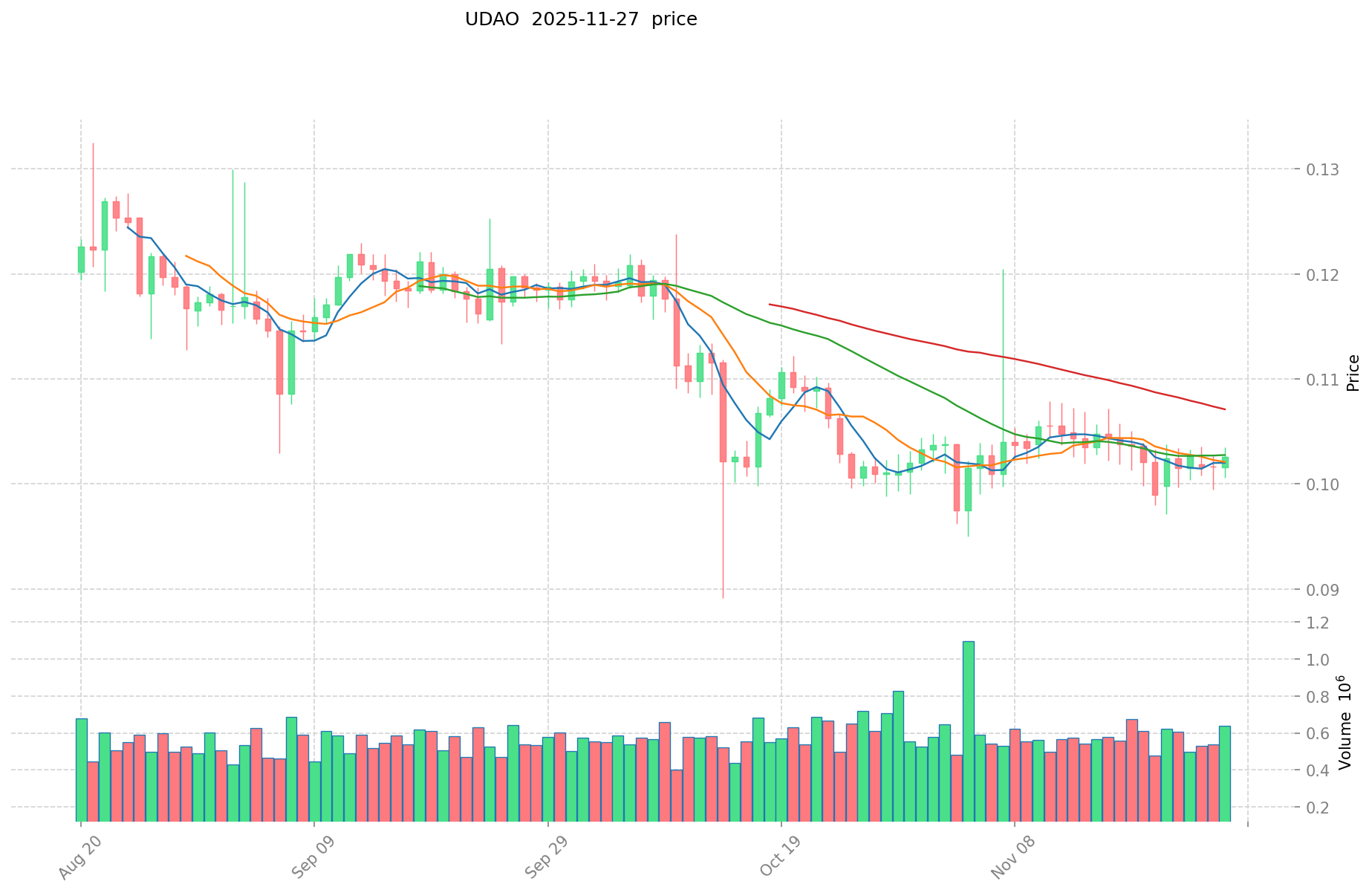
- 2025: UDAO reached its all-time high of $9 on July 30, 2025, and its all-time low of $0.0891 on October 14, 2025, showing significant price volatility within a short period.
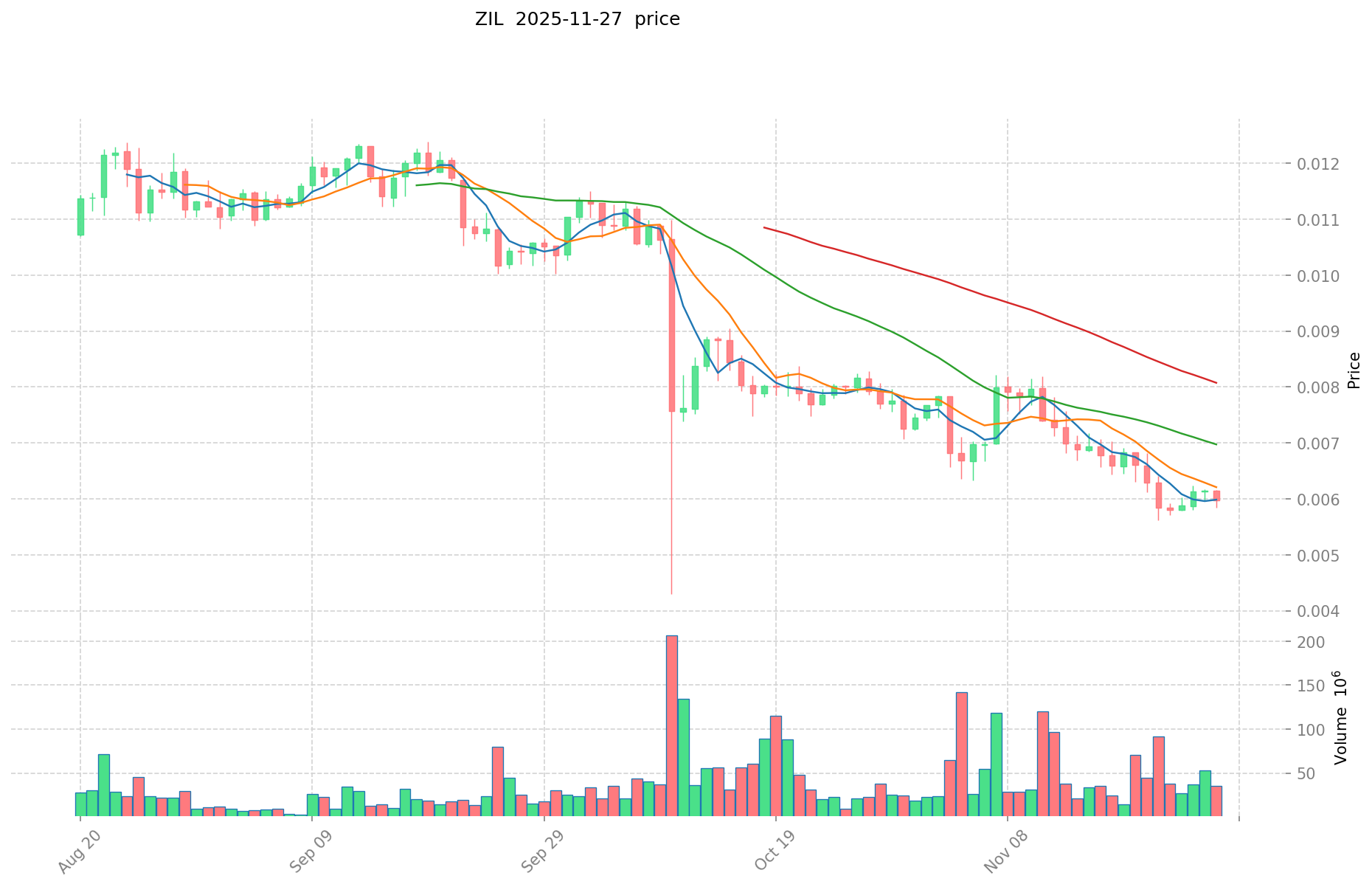
- 2021: ZIL reached its all-time high of $0.255376 on May 7, 2021, during the broader cryptocurrency bull market.
- Comparative analysis: Over the past year, UDAO has experienced a 23.9% price decline, while ZIL has seen a more substantial drop of 75.98% from its previous levels.
Current Market Situation (2025-11-27)
- UDAO current price: $0.10282
- ZIL current price: $0.005935
- 24-hour trading volume: UDAO $57,120.76 vs ZIL $207,236.04
- Market Sentiment Index (Fear & Greed Index): 22 (Extreme Fear)
Click to view real-time prices:
- View UDAO current price Market Price
- View ZIL current price Market Price
<>
二、项目概况比较
{UDAO(Coin A)} 概述
- 项目定位:{一句话描述}
- 主要特点:
- {特点1}
- {特点2}
- {特点3}
- 技术优势:{关键技术}
- 应用场景:{主要应用领域}
{ZIL(Coin B)} 概述
- 项目定位:{一句话描述}
- 主要特点:
- {特点1}
- {特点2}
- {特点3}
- 技术优势:{关键技术}
- 应用场景:{主要应用领域}
项目对比分析
| 对比项 |
{Coin A} |
{Coin B} |
| 市值 |
{数据} |
{数据} |
| 流通量 |
{数据} |
{数据} |
| 总供应量 |
{数据} |
{数据} |
| 技术架构 |
{特点} |
{特点} |
| 共识机制 |
{机制} |
{机制} |
| 生态系统 |
{描述} |
{描述} |
<
>
II. Core Factors Affecting Investment Value of UDAO vs ZIL
Supply Mechanism Comparison (Tokenomics)
-
UDAO: Initial circulation supply of 610 million tokens with a maximum supply cap of 10 billion tokens
-
ZIL: Total supply of 22.4 billion ZIL with approximately 15.1 billion tokens in circulation
-
📌 Historical Pattern: In general, tokens with lower circulating supply relative to maximum supply tend to have more potential for price appreciation when adoption increases.
Institutional Adoption and Market Applications
- Institutional Holdings: Limited institutional adoption for both tokens, with ZIL having a slightly longer market presence
- Enterprise Adoption: ZIL has more established partnerships including with Aqilliz, Nestlé, and JWT Mirum for blockchain marketing solutions
- Regulatory Attitudes: Both tokens operate in a challenging regulatory landscape with varying approaches across different jurisdictions
Technical Development and Ecosystem Building
- UDAO Technical Features: Focused on NFT marketplace, staking, governance, and creator economy functionality
- ZIL Technical Development: Utilizes sharding technology for scalability, has implemented Scilla smart contract language, and features a complete Web3 infrastructure
- Ecosystem Comparison: ZIL has a more developed ecosystem with DeFi protocols, NFT marketplaces, and dApps, while UDAO is building its ecosystem around creator economy and governance
Macroeconomic Factors and Market Cycles
- Inflation Performance: Neither token has established significant anti-inflation properties in the current market
- Macroeconomic Monetary Policy: Both tokens are subject to similar market pressures from interest rates and USD strength
- Geopolitical Factors: ZIL's Singapore-based development may provide regulatory advantages in certain Asian markets
III. 2025-2030 Price Prediction: UDAO vs ZIL
Short-term Prediction (2025)
- UDAO: Conservative $0.067815 - $0.10275 | Optimistic $0.10275 - $0.13563
- ZIL: Conservative $0.0044565 - $0.005942 | Optimistic $0.005942 - $0.00635794
Mid-term Prediction (2027)
- UDAO may enter a growth phase, with an estimated price range of $0.087187485 - $0.164410686
- ZIL may enter a volatile phase, with an estimated price range of $0.003795146487 - $0.008855341803
- Key drivers: Institutional capital inflow, ETF developments, ecosystem growth
Long-term Prediction (2030)
- UDAO: Base scenario $0.20117328905025 - $0.28968953623236 | Optimistic scenario $0.28968953623236+
- ZIL: Base scenario $0.010791337183949 - $0.011654644158664 | Optimistic scenario $0.011654644158664+
View detailed price predictions for UDAO and ZIL
Disclaimer: These predictions are based on historical data and current market trends. Cryptocurrency markets are highly volatile and subject to rapid changes. This information should not be considered as financial advice.
UDAO:
| 年份 |
预测最高价 |
预测平均价格 |
预测最低价 |
涨跌幅 |
| 2025 |
0.13563 |
0.10275 |
0.067815 |
0 |
| 2026 |
0.1299171 |
0.11919 |
0.0870087 |
15 |
| 2027 |
0.164410686 |
0.12455355 |
0.087187485 |
21 |
| 2028 |
0.1950508593 |
0.144482118 |
0.07802034372 |
40 |
| 2029 |
0.2325800894505 |
0.16976648865 |
0.159580499331 |
65 |
| 2030 |
0.28968953623236 |
0.20117328905025 |
0.11265704186814 |
95 |
ZIL:
| 年份 |
预测最高价 |
预测平均价格 |
预测最低价 |
涨跌幅 |
| 2025 |
0.00635794 |
0.005942 |
0.0044565 |
0 |
| 2026 |
0.0087329574 |
0.00614997 |
0.0057809718 |
3 |
| 2027 |
0.008855341803 |
0.0074414637 |
0.003795146487 |
25 |
| 2028 |
0.00961511524677 |
0.0081484027515 |
0.006111302063625 |
37 |
| 2029 |
0.012700915368763 |
0.008881758999135 |
0.00461851467955 |
49 |
| 2030 |
0.011654644158664 |
0.010791337183949 |
0.005503581963813 |
81 |
IV. Investment Strategy Comparison: UDAO vs ZIL
Long-term vs Short-term Investment Strategies
- UDAO: Suitable for investors focused on Web3 platforms and creator economy potential
- ZIL: Suitable for investors interested in blockchain scalability solutions and established ecosystems
Risk Management and Asset Allocation
- Conservative investors: UDAO: 30% vs ZIL: 70%
- Aggressive investors: UDAO: 60% vs ZIL: 40%
- Hedging tools: Stablecoin allocation, options, cross-currency combinations
V. Potential Risk Comparison
Market Risk
- UDAO: High volatility due to relatively new market presence
- ZIL: Susceptibility to broader cryptocurrency market trends
Technical Risk
- UDAO: Scalability, network stability
- ZIL: Mining centralization, potential security vulnerabilities
Regulatory Risk
- Global regulatory policies may have differing impacts on both tokens
VI. Conclusion: Which Is the Better Buy?
📌 Investment Value Summary:
- UDAO advantages: Focus on Web3 learning and job market, potential for growth in creator economy
- ZIL advantages: Established ecosystem, sharding technology for scalability, longer market presence
✅ Investment Advice:
- Novice investors: Consider a balanced approach, leaning towards ZIL for its more established presence
- Experienced investors: Explore UDAO for potential higher growth, while maintaining exposure to ZIL
- Institutional investors: Evaluate both for portfolio diversification, with emphasis on ZIL's ecosystem and UDAO's niche market potential
⚠️ Risk Warning: The cryptocurrency market is highly volatile. This article does not constitute investment advice.
None
VII. FAQ
Q1: What are the main differences between UDAO and ZIL?
A: UDAO is focused on a Web3 platform for learning job-relevant skills and finding work, while ZIL is a high-throughput public blockchain platform aimed at solving transaction speed and scalability issues. UDAO has a newer market presence, while ZIL has been around since 2018 and has a more established ecosystem.
Q2: Which coin has shown better price performance recently?
A: Over the past year, UDAO has experienced a 23.9% price decline, while ZIL has seen a more substantial drop of 75.98% from its previous levels. However, past performance does not guarantee future results.
Q3: What are the key factors affecting the investment value of UDAO and ZIL?
A: Key factors include supply mechanisms, institutional adoption, technical development, ecosystem building, macroeconomic factors, and market cycles. ZIL has a more developed ecosystem and established partnerships, while UDAO is building its ecosystem around the creator economy.
Q4: What are the price predictions for UDAO and ZIL in the coming years?
A: By 2030, UDAO's base scenario price range is predicted to be $0.20117328905025 - $0.28968953623236, while ZIL's base scenario range is $0.010791337183949 - $0.011654644158664. However, these predictions are subject to market volatility and should not be considered financial advice.
Q5: How should investors approach allocating between UDAO and ZIL?
A: Conservative investors might consider allocating 30% to UDAO and 70% to ZIL, while aggressive investors might opt for 60% UDAO and 40% ZIL. The exact allocation should depend on individual risk tolerance and investment goals.
Q6: What are the main risks associated with investing in UDAO and ZIL?
A: Both coins face market risks due to cryptocurrency volatility. UDAO has higher volatility due to its newer market presence, while ZIL is more susceptible to broader market trends. Technical risks include scalability and network stability for UDAO, and mining centralization for ZIL. Both also face regulatory risks from global policy changes.
* The information is not intended to be and does not constitute financial advice or any other recommendation of any sort offered or endorsed by Gate.










