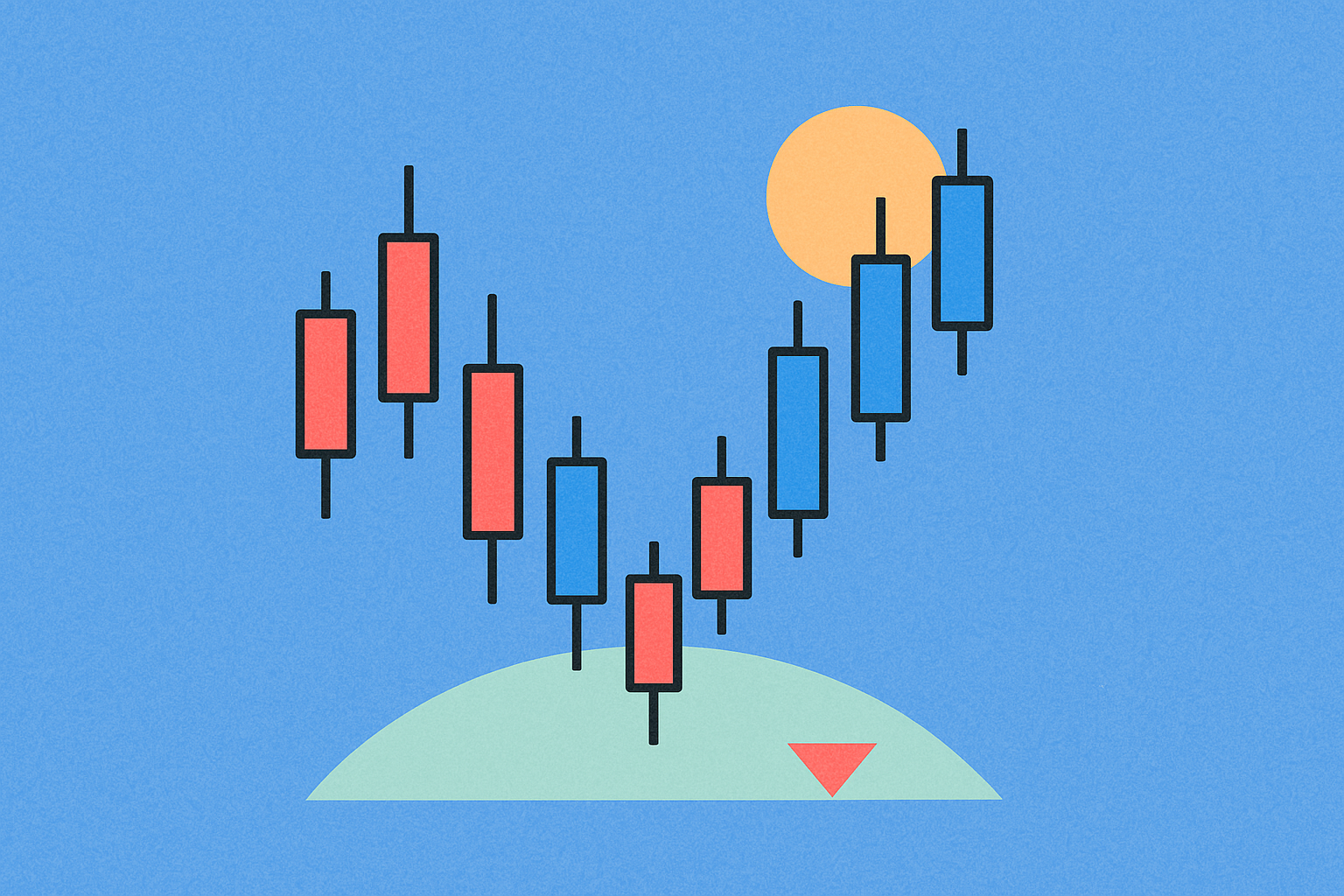
A comprehensive guide to analyzing eight key Japanese candlestick patterns for cryptocurrency trading on Gate. Discover how to interpret Hammer, Bullish Engulfing, Morning Star, and additional classic patterns to sharpen your crypto trading skills and improve your ability to forecast price movements.
Introduction to Candlestick Charts in Crypto Trading
Candlestick charts are a cornerstone of cryptocurrency trading, providing traders with a clear, visual depiction of price movements for smarter, faster decision-making. Beyond spot trading, candlestick patterns empower traders to forecast price trends of assets like Bitcoin, Ethereum, and other altcoins through market psychology and momentum analysis.
Understanding how to read and interpret candlestick charts equips traders to spot potential buy and sell opportunities and manage risk more effectively in the volatile crypto market. Each candlestick conveys the ongoing struggle between buyers and sellers within a specific timeframe—far more than just a data point.
What Is a Japanese Candlestick?
A candlestick reflects all price activity for an asset within a chosen timeframe, adjustable for any trading strategy (e.g., 1-minute for scalping, 1-hour for day trading, daily for swing trading, or monthly for long-term analysis). Each candlestick comprises four essential parts every trader should know:
- Open: The asset’s price at the start of the period, indicating initial market sentiment.
- Close: The asset’s price at the end of the period, showing which side ultimately prevailed.
- High: The highest price reached in that timeframe, reflecting buyers’ peak strength.
- Low: The lowest price touched in the timeframe, showing maximum selling pressure.
The body spans the distance between open and close, representing the net result of bulls versus bears. Shadows (or wicks) extend above and below the body, marking the high and low prices and illustrating session volatility. Candlesticks typically use distinct colors:
- Green (or white): Close above open, signaling an uptrend and bullish sentiment.
- Red (or black): Close below open, indicating a downtrend and dominant selling pressure.
Grasping the structure of each candlestick is the first step toward analyzing complex patterns and making precise trading decisions.
Why Use Candlestick Charts?
Developed by Japanese rice merchants in the 18th century, candlestick charts have evolved into a vital tool for traders worldwide. Their visual clarity and ability to express both price action and market sentiment make them superior to line and bar charts.
Key advantages include:
- Intuitive and easy to read: Distinct colors and shapes let traders quickly assess trends in seconds.
- Rich informational value: Each candlestick packs four crucial data points—open, high, low, close—into one symbol.
- Reveals market psychology: Body and shadow shapes show the battle between buyers and sellers.
- Versatile application: Suitable for any timeframe and asset, from stocks to cryptocurrencies.
- Seamless integration: Easily combines with other technical indicators to build robust trading systems.
Given crypto’s high volatility and around-the-clock trading, candlestick charts are more important than ever for tracking and responding to price swings.
How to Read Japanese Candlestick Patterns
Candlestick patterns emerge over time from sequences of consecutive candles, revealing potential trends, key reversals, or periods of indecision and consolidation. While an individual candlestick only shows price action for its timeframe and offers limited insight, combinations of candles form larger, more predictive patterns that help traders reliably anticipate market direction.
For effective pattern reading, traders should:
- Identify pattern location: Patterns at trend tops, bottoms, or mid-trend carry different implications.
- Monitor trading volume: Patterns with high volume are more trustworthy.
- Align with broader trend: Bullish patterns in an uptrend have a higher chance of success than in a downtrend.
- Await confirmation: Don’t trade immediately on pattern formation—wait for the next candle to confirm.
Frequent practice and analysis of historical charts will sharpen your speed and accuracy in pattern recognition.
8 Essential Japanese Candlestick Patterns for Crypto Trading
Bullish Candlestick Patterns
Bullish patterns typically appear at the end of a downtrend or in critical support zones, signaling a potential reversal or continuation of an uptrend. The five most important bullish patterns include:
Hammer
- Identification: Small body (green or red) at the top of the candle; very long lower shadow (at least twice the body length); little to no upper shadow.
- Interpretation: Sellers pushed the price down, but strong buying drove it back near the open, suggesting buyers are gaining control—a sign the downtrend may be ending.
- Trading signal: High probability of a price rise or reversal; wait for the next candle to close higher before entering a buy trade.
- Note: Most reliable after a prolonged decline and at key support levels.
Inverted Hammer
- Identification: Small body (green or red); very long upper shadow (at least twice the body); little to no lower shadow.
- Interpretation: Buyers tried to push prices up but faced strong selling; closing near the open shows buyers are accumulating strength.
- Trading signal: Potential start of an uptrend, especially after a downtrend.
- Note: Confirm with the next candle closing higher for greater reliability.
Bullish Engulfing
- Identification: Two-candle pattern: first is a small red candle, followed by a large green candle fully engulfing the previous red body. The green candle opens below the prior close and closes above the prior open.
- Interpretation: Strong buying overwhelms sellers, signaling a shift from bearish to bullish sentiment—one of the strongest reversal signals.
- Trading signal: Powerful bullish reversal, especially with high volume.
- Note: Most reliable at key support or after extended downtrends.
Morning Star
- Identification: Three-candle pattern: (1) long red candle (strong selling), (2) small-bodied candle (green or red) with long shadows (market indecision—“morning star”), (3) long green candle confirming reversal.
- Interpretation: Selling weakens after the first candle; the market stabilizes in the middle; buyers then push prices higher, confirming a bullish reversal.
- Trading signal: Very reliable bullish reversal, often leading to sustained gains.
- Note: Three-candle patterns take longer to form but offer higher reliability than single or double-candle setups.
Piercing Line
- Identification: Two-candle pattern: (1) long red candle (selling pressure), followed by (2) long green candle opening below the previous close (downward gap) and closing above the midpoint of the prior red body, ideally at the upper two-thirds.
- Interpretation: Strong buying reverses a negative start, “piercing” through most of the previous red candle, signaling a shift to bullish sentiment.
- Trading signal: Bullish reversal with strong buying and high probability of continued gains.
- Note: The higher the green candle closes (closer to the red candle’s open), the stronger the signal.
Bearish Candlestick Patterns
Bearish patterns often appear at the end of an uptrend or at key resistance levels, warning of possible reversals or corrections. Three key bearish patterns are:
Hanging Man
- Identification: Small body (green or red, with red more reliable) at the top; very long lower shadow (at least twice the body); little to no upper shadow.
- Interpretation: Despite a rising trend, sellers emerge and push prices down; closing near the open shows buyers are losing momentum and a reversal may be near.
- Trading signal: Signals potential bearish reversal or a sell opportunity, especially after a strong rally.
- Note: Confirm by waiting for the next candle to close lower. Shape is identical to Hammer, but Hanging Man appears at tops, Hammer at bottoms.
Shooting Star
- Identification: Small body (green or red) near the bottom; very long upper shadow (at least twice the body); little to no lower shadow.
- Interpretation: Buyers push prices up (long upper shadow), but sellers force a close near or below the open, indicating sellers are taking control and the uptrend is weakening.
- Trading signal: Bearish reversal after a sharp rise, especially at key resistance.
- Note: Similar in shape to Inverted Hammer, but appears at the top of trends (Shooting Star), not the bottom (Inverted Hammer).
Bearish Engulfing
- Identification: Two-candle pattern: first is a small green candle, followed by a large red candle fully engulfing the previous green body. The red candle opens above the prior close and closes below the prior open.
- Interpretation: Strong selling overwhelms buyers, signaling a shift from bullish to bearish sentiment—a powerful reversal signal.
- Trading signal: Initiates a downtrend with high probability of success, especially with high volume and at resistance zones.
- Note: The larger the red candle and the more previous green candles it engulfs, the stronger the signal.
Combining Japanese Candlestick Patterns with Other Indicators
Candlestick patterns gain maximum power when paired with technical indicators and complementary analysis. Professional traders rely on multiple confirmation to filter out false signals and improve trading decisions.
Effective combinations include:
-
RSI (Relative Strength Index): Bullish patterns alongside an RSI in the oversold zone (below 30) strengthen buy signals; bearish patterns plus an RSI in the overbought zone (above 70) reinforce sell signals.
-
Moving Averages (EMA, MA50, MA200): Patterns near major moving averages or at crossovers offer higher predictive value. For instance, a Bullish Engulfing pattern at MA200 with a price bounce is a strong buy signal.
-
Bollinger Bands: Bullish patterns at the lower band suggest a technical rebound; bearish patterns at the upper band signal a possible correction.
-
Volume: Patterns with a volume spike are far more reliable than those with low volume. Volume confirms strong market participation.
-
Support/Resistance: Patterns at key support or resistance levels have a higher probability of success than those in the middle of a trend.
-
MACD: Divergence between MACD and price, combined with reversal patterns, generates powerful signals.
Golden rule: Never trade based solely on a single candlestick pattern. Always require at least two or three confirmation factors for reliable signals.
Conclusion
Japanese candlestick patterns are indispensable tools for every crypto trader, providing in-depth insight into market psychology and near-term price prospects. Mastering both basic and advanced patterns can dramatically improve your trading strategy, from pinpointing optimal entry points to robust risk management.
Keep in mind: No technical analysis tool is flawless. Success in crypto trading demands a balanced combination of:
- Strong foundational knowledge: Understanding every candlestick pattern and its application
- Consistent practice: Analyzing hundreds of historical charts to sharpen pattern recognition
- Disciplined risk management: Always set stop-losses and never invest more than you can afford to lose
- Trading discipline: Stick to your plan and don’t let emotions dictate decisions
- Continuous learning: Markets evolve—traders must keep updating their knowledge
Combine candlestick patterns with technical indicators, fundamental analysis, and scientific capital management to boost the reliability of your signals. Above all, trade responsibly, use only risk-tolerant capital, and learn from both wins and losses.
The crypto market is packed with opportunity but carries significant risk. With thorough preparation—candlestick mastery and analytical tools—you’ll build a strong foundation for lasting success in your crypto trading journey.
FAQ
What Are the Core Components of a Candlestick? What Do Open, Close, High, and Low Prices Represent?
A candlestick consists of four main elements: open price marks the start of the trading session; close price marks the end; high price is the session’s peak; low price is its lowest point.
How Do You Identify Key Shapes in Candlestick Charts (Hammer, Engulfing, Morning Star, etc.)? What Do These Mean for Trading?
Identify shapes by examining body and shadow structure and price positioning. Hammer (small body, long lower shadow) signals bullish reversal in downtrends. Engulfing and Morning Star (three-candle formations) mark market momentum shifts and help pinpoint effective entry/exit points. Combine with trading volume for stronger confirmation.
What Do Red and Green Candles Mean in Crypto Trading? How Can You Tell Market Uptrends or Downtrends from Candlestick Charts?
Green candles mark uptrends (close above open); red candles signal downtrends (close below open). Multiple consecutive green candles indicate a rising market; red candles show a decline. Use moving averages and RSI to confirm trend strength.
What Is a Candlestick and What Are the Different Time Cycles (1 Minute, 5 Minutes, 1 Hour, 1 Day)? How Do You Choose the Right Timeframe for Trading?
Candlestick timeframes include 1 minute, 5 minutes, 1 hour, and 1 day. For short-term trades, use 1–5 minute candles; for longer-term strategies, use 1 hour or 1 day cycles—select based on your strategy and profit goals.
What Is the Function of a Candlestick’s Wick or Shadow? What Do Long and Short Wicks Reveal About the Market?
The wick shows price volatility during the session. Long wicks suggest intense competition between buyers and sellers—often signaling reversals. Short wicks indicate a clear trend. A long upper wick means strong selling pressure; a long lower wick points to robust buying support.
How Do You Combine Candlestick Charts with Technical Indicators (Moving Averages, RSI, MACD) for More Accurate Trading Decisions?
Pairing candlestick charts with RSI, MACD, or moving averages confirms trends and optimizes entry points. Using multiple indicators increases the reliability and accuracy of your trading signals.
What Are the Most Common Mistakes Beginners Make Using Candlestick Charts in Crypto Trading?
Beginners often skip stop-loss orders, overuse leverage, and ignore technical analysis. Insufficient candlestick knowledge leads to poor trade timing. Study patterns thoroughly and always manage risk to improve your success rate.
* The information is not intended to be and does not constitute financial advice or any other recommendation of any sort offered or endorsed by Gate.