This comprehensive analysis examines the cryptocurrency market's recent 0.8% decline to $3.57 trillion, exploring the multifaceted factors driving market volatility and consolidation. The article covers critical market metrics showing 80 of the top 100 cryptocurrencies in negative territory, while highlighting Bitcoin's oscillation between $97,000-$111,900 and Ethereum's relative strength. It analyzes institutional ETF outflows, retail investor resilience, and technical price levels that will determine near-term trajectories. The piece addresses major concerns including regulatory uncertainty, macroeconomic pressures, and the psychological significance of the $100,000 Bitcoin support level. Additionally, it explores emerging opportunities through institutional adoption trends, such as Taiwan's Bitcoin reserve evaluation, and provides actionable strategies for navigating current market conditions through dollar-cost averaging and long-term accumulation approaches.
Market Overview and Current Trends
The cryptocurrency market has experienced notable volatility in recent trading sessions, with the overall market capitalization declining by approximately 0.8% to reach $3.57 trillion. This downturn reflects broader market dynamics, as approximately 80 of the top 100 cryptocurrencies by market capitalization have registered price decreases over the past 24-hour period. The total trading volume across the cryptocurrency ecosystem stands at $183 billion, indicating sustained market activity despite the prevailing bearish sentiment.
The market correction has been characterized by several key metrics that paint a comprehensive picture of current conditions. The cryptocurrency market capitalization has decreased by 1.8% during the observed period, with 80 of the top 100 coins and 7 of the top 10 coins experiencing downward price movements. Bitcoin has decreased by 1.3% to trade at $103,080, while Ethereum has shown relative strength with a 0.8% increase to $3,502.
Both on-chain and off-chain signals indicate a market in a state of consolidation, with investors and traders maintaining a highly cautious stance. Until renewed capital inflows or a clear macroeconomic catalyst emerge, Bitcoin appears likely to continue oscillating within the $97,000 to $111,900 range. Interestingly, retail spot traders are demonstrating notable resilience despite recent price declines, suggesting a shift toward long-term accumulation strategies rather than speculative short-term trading.
In a significant development for institutional adoption, Taiwan is actively considering integrating Bitcoin into its national reserve strategy. The Executive Yuan and Central Bank have agreed to evaluate the world's leading cryptocurrency as a potential strategic asset and explore pilot holdings using seized Bitcoin that is awaiting auction.
Regarding exchange-traded fund activity, US Bitcoin spot ETFs recorded $277.98 million in outflows during recent trading sessions, while Ethereum ETFs experienced $183.77 million in outflows. In an innovative move, Canary Capital has filed to launch the first US ETF tied to MOG Coin, a memecoin on the Ethereum network. The cryptocurrency market sentiment has dropped slightly, remaining firmly within the fear territory as measured by market indicators.
Crypto Winners and Losers Analysis
During the observed trading period, 7 of the top 10 cryptocurrencies by market capitalization have experienced price decreases over the past 24 hours, representing a slight improvement from previous sessions. This mixed performance across major digital assets reflects the complex market dynamics at play.
Bitcoin, the world's largest cryptocurrency by market capitalization, has declined by 1.3% since the previous day, with current trading levels at $103,080. This price action demonstrates the continued consolidation phase that Bitcoin has been experiencing in recent weeks.
Ethereum has shown relative strength in the market, appreciating by 0.8% to trade at $3,502. This performance marks the second-highest increase among the top 10 cryptocurrencies, with Lido Staked Ether recording an identical percentage gain. The positive price movement in Ethereum suggests that investors may be rotating capital into alternative layer-1 platforms or viewing Ethereum as relatively undervalued compared to Bitcoin.
The highest gain in the top 10 category belongs to XRP, which has surged by 3.5% to reach $2.5. This significant appreciation may be attributed to ongoing developments in Ripple's legal proceedings and growing institutional interest in the asset. Conversely, Solana has experienced the steepest decline among major cryptocurrencies, falling 1.9% to trade at $155. Other top 10 coins have registered relatively modest changes, with some barely moving over recent trading sessions.
Expanding the analysis to the top 100 cryptocurrencies reveals that 80 of these assets are trading in negative territory. Among these declining assets, Canton and Pump.fun have experienced particularly severe corrections, dropping 11.6% and 10.2% to $0.1172 and $0.003883, respectively. These double-digit declines in smaller-cap cryptocurrencies often indicate heightened risk aversion among traders and investors.
On the positive side of the ledger, Quant has emerged as the strongest performer among the top 100 cryptocurrencies, rising 7.9% to reach a price of $89.91. This significant appreciation demonstrates that opportunities for gains still exist within the broader cryptocurrency market, even during periods of general weakness. Zcash follows closely behind with a 4% increase to $89.91, suggesting renewed interest in privacy-focused cryptocurrencies.
The divergent performance between traditional stock markets and cryptocurrency markets is particularly noteworthy. While equity markets have been reacting positively to the potential reopening of the US government following an extended shutdown, the cryptocurrency market has not been as easily moved by these developments. Instead, the digital asset market remains highly cautious, continuing to wait for clearer global macroeconomic and geopolitical signals before establishing a definitive trend direction.
In a significant development for institutional cryptocurrency adoption, Taiwan's government is advancing toward integrating Bitcoin into its national reserve strategy. The Executive Yuan and Central Bank have agreed to evaluate the world's leading cryptocurrency as a potential strategic asset. This evaluation includes exploring pilot holdings using seized Bitcoin that is awaiting auction, representing a potentially groundbreaking move that could influence other nations' approaches to cryptocurrency reserves.
Market Analysis: Consolidation Phase Continues
According to comprehensive analysis from Glassnode, a leading on-chain analytics platform, Bitcoin remains in what analysts characterize as "a mild bearish phase." The leading cryptocurrency is trading within a well-defined range between $97,000 and $111,000, with significant resistance near $116,000 marked by a top-buyers' supply cluster. This technical formation suggests that substantial selling pressure exists at higher price levels, potentially limiting upside momentum in the near term.
Both on-chain and off-chain signals consistently portray a market in a state of consolidation, with the ecosystem "stabilizing yet not yet ready to confirm a bullish reversal," according to Glassnode's weekly report. This assessment is based on multiple data points including exchange flows, whale wallet activity, and derivative market positioning. The convergence of these indicators suggests that the market is in a holding pattern, awaiting a catalyst to break the current equilibrium.
The analysis concludes that "until renewed inflows or a clear macro catalyst emerge, Bitcoin appears bound to oscillate within this $97,000 to $111,900 corridor, with $100,000 remaining the psychological line of defense." This price level has taken on significant importance in market psychology, serving as both a support level during downturns and a resistance level during rallies. The ability of Bitcoin to maintain trading above this threshold will likely be crucial for maintaining investor confidence in the near term.
Meanwhile, Greg Waisman, Chief Operating Officer at payment infrastructure platform Mercuryo, has provided valuable insights into retail market behavior during recent market volatility. Despite the recent sell-offs that have impacted cryptocurrency prices, "the retail market has not lost faith in cryptocurrency," according to Waisman's observations. This resilience in retail sentiment is particularly significant, as retail investors have historically been prone to panic selling during market downturns.
Notably, buying patterns among retail investors have remained "steady and resolute," with particular strength observed in XRP and USDC trading activity. These assets have been outperforming broader market trends, suggesting that retail investors are selectively accumulating specific cryptocurrencies rather than engaging in broad-based selling. Waisman noted that "Mercuryo has observed daily fluctuations of approximately 20 percent — both negative and positive — which is characteristic of normal market conditions. Overall, volumes remain robust."
The impact of previous market crashes continues to reverberate through the cryptocurrency ecosystem. October's significant market correction, which some have termed a "Black Friday crypto crash," affected approximately 1.6 million traders and eliminated nearly $800 billion from the total market capitalization. This event particularly "hit leveraged traders the hardest," with approximately $19 billion in positions being liquidated across various trading platforms and derivatives exchanges.
However, despite these challenging market conditions, "retail spot traders are showing notable resilience despite recent price falls," according to Waisman's analysis. This resilience may indicate a fundamental shift in retail investor behavior and market maturity. Waisman suggests that "what we're observing may indicate that retail investors are increasingly focused on long-term accumulation rather than speculative, short-term trading."
This behavioral shift represents a potentially significant evolution in cryptocurrency market dynamics. Waisman concludes that "some might say sentiment has rarely been more divided on the future price trajectory of the cryptocurrency market. In the face of such uncertainty, some retail investors appear to be placing regular buy orders as part of a more disciplined, long-term strategy." This dollar-cost averaging approach, commonly employed in traditional investment markets, suggests growing sophistication among cryptocurrency retail investors.
Critical Price Levels and Technical Outlook
During the observed trading period, Bitcoin is trading at $103,080, having experienced significant intraday volatility. The leading cryptocurrency saw a substantial decline from its highest daily point of $105,257 to a low of $100,992 before recovering somewhat to current levels. This price action demonstrates the ongoing tug-of-war between buyers and sellers, with neither side able to establish clear dominance.
Bitcoin's recent performance shows a decline of 0.4% over a one-week period, a more substantial decrease of 8.3% over a longer timeframe, and stands 18.3% below its all-time high. These metrics provide important context for understanding the current market position and the magnitude of the recent correction from peak levels.
Looking ahead at potential price trajectories, technical analysis suggests several critical levels that traders and investors should monitor closely. If Bitcoin slips below the $99,200 support level, it may trigger a deeper pullback toward $96,200, which represents the next significant support zone. Should selling pressure intensify further, the price could decline to $93,400, which is identified as a stronger historical support level based on previous price action and trading volume profiles.
Conversely, if Bitcoin can establish momentum and move above $104,000, the cryptocurrency could potentially rally toward $107,500 in the near term. A break above this level would likely open the path toward $110,900, which represents a significant resistance zone where previous selling pressure has emerged. Successfully breaking through these resistance levels would signal a potential shift in market sentiment and could attract additional buying interest.
Ethereum, the second-largest cryptocurrency by market capitalization, is trading at $3,502 during the observed period. Similar to Bitcoin, Ethereum has experienced notable intraday volatility, plunging from an intraday high of $3,583 to an intraday low of $3,374. However, unlike Bitcoin, Ethereum has demonstrated stronger recovery momentum, not only regaining lost ground but actually appreciating over the past 24-hour period.
Ethereum's recent performance shows an increase of 3.1% over a one-week period, though it remains down 12.9% over a longer timeframe and trades 29.2% below its all-time high. This relative outperformance compared to Bitcoin may reflect growing interest in Ethereum's ecosystem, particularly as activity in decentralized finance (DeFi) and non-fungible tokens (NFTs) continues to evolve.
Technical analysis indicates that Ethereum has found reliable support at the $3,200 level over recent trading sessions. This price level has repeatedly attracted buyers, preventing further declines and establishing a floor for the current trading range. Should Ethereum drop below this critical $3,200 support level, it could trigger a pullback toward the psychologically important $3,000 level, which would represent a significant test of investor confidence.
On the upside, a sustained bullish momentum would need to push Ethereum's price above $3,700 to confirm a potential trend reversal. Successfully breaking through this resistance level could open the path toward $3,850, which represents the next major resistance zone based on historical price action and trading volume analysis.
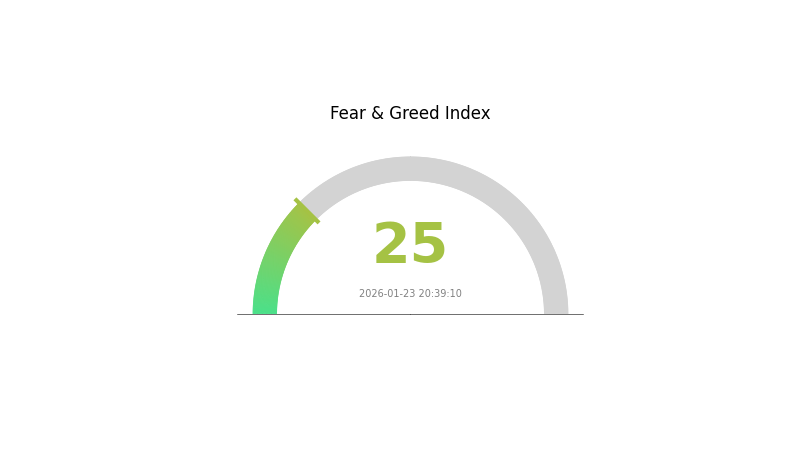
Meanwhile, broader market sentiment indicators continue to reflect investor caution and uncertainty. The cryptocurrency market sentiment has decreased marginally, maintaining a firm position within the fear zone. The widely-followed crypto fear and greed index has fallen to 25, compared to 26 observed during the previous trading session. This persistent fear sentiment suggests that investors remain concerned about potential downside risks and are hesitant to commit significant capital to the market.
It appears quite clear that investors and traders are awaiting additional signals that would indicate the market's near-term trajectory before making substantial portfolio adjustments. These signals could include macroeconomic data releases, regulatory developments, institutional adoption announcements, or technical breakouts from current trading ranges.
That said, the current price levels being experienced present a potential buying opportunity for long-term holders who maintain conviction in cryptocurrency's fundamental value proposition. Dollar-cost averaging strategies during periods of market weakness have historically proven effective for investors with extended time horizons, as they allow for accumulation at relatively lower prices compared to peak levels.
Exchange-Traded Fund Flows and Institutional Activity
The positive momentum in exchange-traded fund flows proved short-lived, as institutional investment vehicles returned to experiencing outflows. During recent trading sessions, US Bitcoin spot exchange-traded funds recorded $277.98 million in outflows, following a single day of notable inflows that had briefly interrupted the prevailing trend. Despite this setback, the total net inflow for Bitcoin ETFs remains substantial at $60.21 billion, still maintaining levels above the $60 billion threshold that represents significant institutional commitment to the asset class.
The distribution of outflows across Bitcoin ETF providers reveals important insights into institutional investor behavior. Four of the 12 Bitcoin ETFs experienced outflows during the period, while notably, no funds recorded positive inflows. This unanimous lack of inflows suggests a coordinated shift in institutional sentiment or potentially a response to broader market conditions affecting institutional investment decisions.
Fidelity's Bitcoin ETF experienced the highest outflows among all providers, recording $132.86 million in redemptions. This substantial outflow from one of the largest and most established fund managers indicates that even major institutional players are reassessing their cryptocurrency exposure in the current market environment. Following closely behind, Ark Invest and 21Shares' collaborative Bitcoin ETF recorded $85.18 million in outflows, representing the second-largest redemption activity among Bitcoin ETF providers.
The Ethereum ETF landscape presents an even more challenging picture, as these investment vehicles have continued their outflow streak without interruption. During recent trading sessions, Ethereum ETFs recorded an additional $183.77 million in outflows, extending a pattern of persistent redemptions that has characterized recent weeks. Consequently, the total net inflow for Ethereum ETFs has pulled back again, declining to $13.57 billion. This figure, while still substantial, represents a significant decrease from peak levels and raises questions about institutional appetite for Ethereum exposure through regulated investment vehicles.
Among the nine Ethereum ETF providers, four recorded negative flows during the observed period, while none experienced positive inflows. This pattern mirrors the Bitcoin ETF situation and suggests that institutional investors are broadly reducing their cryptocurrency exposure across multiple assets rather than rotating between different digital assets.
BlackRock and Grayscale, two of the largest and most influential cryptocurrency fund managers, accounted for the majority of Ethereum ETF outflows. BlackRock's Ethereum ETF experienced $91 million in redemptions, representing the largest single-fund outflow during the period. Grayscale's Ethereum ETF followed with $49.35 million in outflows, contributing significantly to the overall negative flow picture.
These substantial outflows from industry-leading fund managers are particularly significant, as these institutions typically have the most sophisticated risk management systems and access to the highest quality market intelligence. Their decision to reduce exposure, or their clients' decisions to redeem shares, may reflect concerns about near-term market conditions, regulatory uncertainty, or broader macroeconomic factors affecting risk asset allocation.
In a potentially groundbreaking development that could expand the cryptocurrency ETF landscape, Canary Capital, a specialized crypto fund manager, has filed to launch the first US ETF tied directly to MOG Coin, a memecoin operating on the Ethereum network. This represents Canary Capital's debut in launching a fund designed to track the price of a memecoin, a category of cryptocurrency that has gained significant attention and trading volume despite questions about fundamental value propositions.
The investment firm has formally submitted an S-1 registration statement with the US Securities and Exchange Commission (SEC), initiating the regulatory review process required for launching a new exchange-traded fund. This filing represents a significant expansion of the cryptocurrency ETF concept beyond established cryptocurrencies like Bitcoin and Ethereum, potentially opening the door for a broader range of digital assets to be accessible through regulated investment vehicles.
The timing of this filing is particularly interesting, as the US government is expected to reopen following an extended shutdown period. Once government operations resume, the SEC will return to its normal schedule of reviewing and deciding on pending ETF applications. This backlog includes a substantial number of XRP-linked ETF proposals that have been awaiting regulatory review. The SEC's decisions on these pending applications could have significant implications for the broader cryptocurrency market, potentially establishing precedents for how regulators approach cryptocurrency-based investment products beyond Bitcoin and Ethereum.
FAQ
What are the main reasons for cryptocurrency market downturns?
Cryptocurrency market downturns are primarily driven by regulatory uncertainty, macroeconomic factors like interest rate changes, reduced trading volume, negative sentiment, technological vulnerabilities, major project failures, and institutional investor withdrawal. Market volatility is also influenced by geopolitical events and shifts in risk appetite among participants.
How to identify signals of an imminent cryptocurrency market downturn?
Watch for decreasing trading volume, rising fear indices, weakening support levels, negative regulatory news, and declining whale activity. Technical resistance breaks and diverging price-volume patterns also signal potential downturns in crypto markets.
What strategies should investors adopt during cryptocurrency market downturns?
During market downturns, investors should consider dollar-cost averaging to reduce entry costs, diversify portfolio holdings, accumulate quality assets at discounted prices, and avoid panic selling. Review your investment thesis, strengthen risk management, and focus on long-term fundamentals rather than short-term volatility.
What is the difference between cryptocurrency market downturns and traditional stock market downturns?
Crypto markets are more volatile with 24/7 trading and larger price swings. They're driven by sentiment and technology shifts rather than company fundamentals. Crypto downturns can be more severe but recover faster due to higher trading activity and speculative nature.
What are the most severe cryptocurrency market downturns in history and their loss magnitude?
Major crypto downturns include the 2018 bear market (Bitcoin dropped 65% from peak), 2022 crypto winter (market cap fell from $3T to under $900B), and March 2020 pandemic crash (50% single-day decline). Total losses reached hundreds of billions in transaction value across these events.
How to reduce crypto market downturn risks through diversified investment?
Diversify across multiple cryptocurrencies with different use cases, combine crypto with traditional assets, allocate funds across various market caps, and invest in different blockchain sectors. This strategy spreads risk and captures gains from different market cycles during downturns.
* The information is not intended to be and does not constitute financial advice or any other recommendation of any sort offered or endorsed by Gate.