This comprehensive analysis examines the cryptocurrency market decline on November 14, 2025, when market capitalization decreased 5.6% to $3.38 trillion, with 96 of the top 100 cryptocurrencies recording losses. Bitcoin fell 6.2% to $97,033 while Ethereum dropped 9.2% to $3,208, driven by US dollar strength, rising Treasury yields, and long-term holder selling. The article identifies key market dynamics including $869.86 million in Bitcoin ETF outflows and $259.72 million in Ethereum ETF outflows, though institutional Bitcoin holdings exceed 4 million BTC. Technical analysis reveals critical support levels at $94,500 and $90,000 for Bitcoin, with market sentiment deepening into fear territory at 22 on the fear-greed index. The piece explores how Bitcoin DeFi adoption is positioning digital assets as yield-generating components of the global financial system, while highlighting the December 10th interest rate decision as a pivotal catalyst for potential market recovery and year-end rally prospects.
Market Overview
The cryptocurrency market has experienced significant volatility in recent trading sessions, with the overall market capitalization decreasing by 5.6% to reach $3.38 trillion. This downturn represents a continuation of the challenging conditions that have persisted since the market turbulence observed in previous months. According to Nic Puckrin, crypto analyst and co-founder of The Coin Bureau, "The crypto market has been struggling to regain momentum since October's pandemonium, and Bitcoin appears to be fighting one battle after another, dragged down by US dollar strength and higher Treasury yields, long-term holders selling, and macro uncertainty."
The widespread nature of this decline is evident in the fact that 96 of the top 100 cryptocurrencies by market capitalization have recorded losses over the past 24 hours. The total cryptocurrency trading volume during this period reached $254 billion, indicating sustained market activity despite the downward price pressure.
Key Market Dynamics:
- The cryptocurrency market capitalization decreased by 5.6% during recent trading sessions
- 96 of the top 100 coins and all top 10 coins experienced price declines
- Bitcoin (BTC) decreased by 6.2% to $97,033, while Ethereum (ETH) fell by 9.2% to $3,208
- Bitcoin continues to face multiple headwinds including dollar strength and Treasury yield increases
- An upcoming interest rate decision represents a critical test for market direction
- A notable divergence has emerged between crypto and technology stocks
- Despite recent price movements, institutional investment into digital assets has reached historic levels
- Bitcoin DeFi (Decentralized Finance) is positioning itself as a key component of the global financial system
- US Bitcoin spot ETFs experienced significant outflows of $869.86 million, while Ethereum ETFs recorded $259.72 million in outflows
- Canary Capital's XRPC, the first US spot XRP ETF, launched with strong initial trading volume
- Market sentiment indicators have declined further into fear territory
These market conditions reflect a complex interplay of macroeconomic factors, investor sentiment shifts, and evolving institutional participation in the cryptocurrency ecosystem. The sustained selling pressure suggests that market participants are reassessing risk exposures amid broader economic uncertainties.
Crypto Winners & Losers
The recent trading period has been characterized by widespread losses across the cryptocurrency market, with all top 10 coins by market capitalization experiencing price declines over the past 24 hours. This uniform downward movement indicates systemic selling pressure rather than asset-specific concerns.
Major Cryptocurrency Performance:
-
Bitcoin (BTC) has dropped by 6.2% since the previous trading session, currently trading at $97,033. As the largest cryptocurrency by market capitalization, Bitcoin's performance often sets the tone for the broader market. The decline reflects multiple pressures including US dollar strength, rising Treasury yields, and profit-taking by long-term holders who accumulated positions at lower price levels.
-
Ethereum (ETH) experienced the steepest decline among major cryptocurrencies, falling 9.2% to trade at $3,208. This represents the highest percentage drop in the top 10 category, alongside Lido Staked Ether (stETH), which tracks Ethereum's price movements. The larger decline in Ethereum compared to Bitcoin may reflect concerns specific to the Ethereum ecosystem or greater sensitivity to risk-off sentiment.
-
Solana (SOL) recorded the second-largest decline, dropping 8.6% to reach a price of $142. Solana has been one of the stronger performers in recent months, making this decline particularly notable as it suggests even momentum-driven assets are not immune to the current market conditions.
-
Tron (TRX) demonstrated relative resilience with the smallest decline among top 10 cryptocurrencies, falling just 2.3% to $0.2927. This outperformance may reflect Tron's different use case profile and investor base compared to other major cryptocurrencies.
Performance Among Top 100 Cryptocurrencies:
The broader cryptocurrency market showed similarly bearish characteristics, with only four coins among the top 100 by market capitalization recording gains during the period. This extremely limited number of winners underscores the pervasive nature of the selling pressure.
Notable Gainers:
-
Zcash (ZEC) led the gainers with the strongest appreciation, rising to $507. Zcash's privacy-focused features may have attracted buying interest from investors seeking alternative cryptocurrency use cases during the broader market downturn.
-
Leo Token (LEO) followed with a modest 2% increase to $9.17. Leo Token's relative stability may reflect its specific utility within the Bitfinex ecosystem and its different risk profile compared to general-purpose cryptocurrencies.
Notable Losers:
Three cryptocurrencies experienced double-digit percentage declines, indicating particularly severe selling pressure in these assets:
-
Story Protocol (STORY) suffered the largest decline, falling 15% to trade at $3.34. This steep drop may reflect the higher volatility typical of newer or smaller market cap cryptocurrencies during periods of market stress.
-
Aave (AAVE), a leading decentralized finance protocol token, declined 13.6% to $185. The significant drop in this DeFi blue-chip token suggests that the selling pressure extended across different cryptocurrency sectors, including established DeFi protocols.
-
Hedera (HBAR) rounded out the major losers with a 10.4% decline to $0.1606. Hedera's enterprise-focused blockchain platform has gained attention in recent periods, making this decline notable as it affects even fundamentally differentiated projects.
The concentration of losses across the market, with 96 of the top 100 coins declining, indicates that the current downturn is driven by broad-based factors affecting the entire cryptocurrency ecosystem rather than asset-specific issues. This pattern is typical of market-wide risk-off sentiment where investors reduce exposure across the board rather than making selective adjustments.
Bitcoin Appears To Be Fighting One Battle After Another
According to Nic Puckrin, crypto analyst and co-founder of The Coin Bureau, the cryptocurrency market has been struggling to regain the momentum it experienced during previous periods of strong performance. Bitcoin, as the market leader, finds itself confronting multiple simultaneous challenges that are constraining its price action.
"Bitcoin appears to be fighting one battle after another, dragged down by US dollar strength and higher Treasury yields, long-term holders selling, and macro uncertainty," Puckrin explains. This multi-faceted pressure creates a complex environment where Bitcoin must navigate various headwinds simultaneously.
The Dollar and Treasury Yield Dynamic:
The strengthening US dollar creates natural headwinds for Bitcoin and other cryptocurrencies. When the dollar appreciates, dollar-denominated assets like Bitcoin become more expensive for international buyers, potentially reducing demand. Additionally, rising Treasury yields make traditional safe-haven assets more attractive on a risk-adjusted basis, drawing capital away from alternative assets like cryptocurrencies.
Long-Term Holder Behavior:
The selling activity from long-term Bitcoin holders represents a significant shift in market dynamics. These holders, who accumulated Bitcoin at much lower prices, are taking profits at current levels. While this profit-taking is rational from an individual perspective, the aggregate effect creates substantial selling pressure that the market must absorb.
Divergence from Technology Stocks:
Puckrin finds it "unsettling" to observe cryptocurrency and technology stocks diverging when they typically demonstrate correlated movements. Historically, Bitcoin and the Nasdaq have shown strong positive correlation, moving in similar directions as both are considered risk assets sensitive to liquidity conditions and interest rate expectations.
This divergence reveals that Bitcoin "isn't just a proxy for the Nasdaq," according to Puckrin. Instead, Bitcoin demonstrates greater sensitivity to macroeconomic headwinds and liquidity concerns. However, this also means Bitcoin is "perfectly positioned to break out once those concerns dissipate." When macroeconomic conditions improve and liquidity concerns ease, Bitcoin's sensitivity could work in the opposite direction, potentially driving stronger gains than traditional risk assets.
Near-Term Outlook and Key Events:
Puckrin anticipates potential volatility in the coming weeks as economic data continues to be released and market participants digest new information. "As the US re-opens and data starts flooding back in, we may see the BTC price wobble over the coming weeks," he notes.
A critical upcoming event is an interest rate decision scheduled for December 10th. This decision could serve as a pivotal moment for Bitcoin and the broader cryptocurrency market. "The real test could be the interest rate decision in the US on 10 December," Puckrin states. "Still, it remains likely that the news will be positive, which could set the stage for a Santa rally in crypto and other risk assets."
The potential for a year-end rally reflects the historical pattern of improved market performance during the final weeks of the year, often referred to as a "Santa rally." If the interest rate decision and accompanying guidance prove favorable, it could catalyze a broad-based recovery in cryptocurrency prices.
Institutional Bitcoin Adoption and DeFi Evolution:
Dom Harz, co-founder of BOB, provides important context on institutional involvement in Bitcoin even as prices have pulled back from recent highs. "Despite recent price movement, recent years have marked a significant period of institutional investment into digital assets, with institutions now holding over 4 million BTC," Harz writes.
This institutional accumulation represents a fundamental shift in Bitcoin's holder base. Rather than being dominated by retail investors and early adopters, Bitcoin ownership now includes substantial positions held by institutional investors, including corporations, investment funds, and financial institutions.
These institutions are "increasingly looking to store excess cash in DeFi vaults for higher-yield opportunities," according to Harz. This behavior reflects a maturation of institutional cryptocurrency strategies beyond simple buy-and-hold approaches. Institutions are now seeking to generate returns on their Bitcoin holdings through decentralized finance protocols.
"These two movements are converging with Bitcoin DeFi; moving the world's biggest digital asset beyond a store of value and into a yield-generating asset," Harz explains. This evolution could fundamentally change Bitcoin's role in the financial system, transforming it from primarily a store of value and speculative asset into a productive asset that generates ongoing returns.
Harz continues: "As this mainstream appetite for DeFi grows, serious technological advancements are unlocking Bitcoin's utility. Key players in institutional crypto and Bitcoin DeFi adoption are opening up access to BTCFi, where institutions can leverage yield-bearing opportunities for their BTC holdings. Bitcoin DeFi is poised to be at the forefront of the global financial system – from Wall Street to Main Street."
This perspective suggests that while short-term price movements may be driven by macroeconomic factors and technical trading dynamics, longer-term fundamental developments in Bitcoin's utility and institutional adoption continue to progress. The growth of Bitcoin DeFi could create new sources of demand and new use cases that support higher valuations over time, even as near-term volatility persists.
Levels & Events to Watch Next
Bitcoin's recent price action has seen the cryptocurrency fall below the psychologically significant $100,000 level, currently trading at $97,033. This decline represents a notable retreat from recent highs and has captured the attention of market participants who are closely monitoring key technical levels and potential support zones.
Bitcoin Price Analysis:
During the recent trading session, Bitcoin experienced significant intraday volatility, moving from a high of $103,737 to a low of $96,170. This $7,567 range represents substantial price movement and reflects the uncertainty and competing forces in the current market environment.
From a broader timeframe perspective, Bitcoin is currently down 4.7% over the past week, 13.7% over the past month, and 22.9% from its all-time high. These declines across multiple timeframes indicate sustained selling pressure rather than a brief correction, suggesting that market participants are reassessing their risk exposures and valuations.
Key Technical Levels for Bitcoin:
Looking ahead, several important price levels merit attention:
-
Downside Scenarios: If selling pressure continues, Bitcoin may pull back toward the $94,500 level, which could serve as initial support. Should that level fail to hold, the next significant support zone lies around $90,000. A decline to this level would represent a substantial correction from recent highs but would still leave Bitcoin well above its levels from earlier in the year.
-
Upside Scenarios: Conversely, if market sentiment improves and buying interest returns, Bitcoin could climb back above the $100,000 threshold. This level has taken on increased psychological significance as a round number milestone. A sustained move above $100,000 could target the $103,000 level, which corresponds to recent resistance.
Ethereum Price Analysis:
Ethereum is currently trading at $3,208, having experienced a sharp decline from the session high of $3,545 to a low of $3,126. This intraday range of over $400 demonstrates the heightened volatility affecting the second-largest cryptocurrency by market capitalization.
Over the past week, Ethereum has been trading within a range of $3,172 to $3,633, establishing these levels as near-term support and resistance. The current price action shows Ethereum down 4.3% in a single day, 22.2% over the past month, and 35.1% from its all-time high.
Key Technical Levels for Ethereum:
-
Downside Scenarios: Ethereum faces the risk of continued decline in the near term. Should selling pressure persist, the cryptocurrency could retreat below the psychologically significant $3,000 level. This would represent a substantial decline from the near-$5,000 zone where Ethereum traded just weeks earlier, highlighting the magnitude of the recent correction.
-
Upside Scenarios: If market conditions improve and a rebound materializes, Ethereum could return to the $3,500 territory, with potential to test the $3,650 resistance level. A sustained move above these levels would indicate a shift in market sentiment and could attract additional buying interest.
Market Sentiment Analysis:
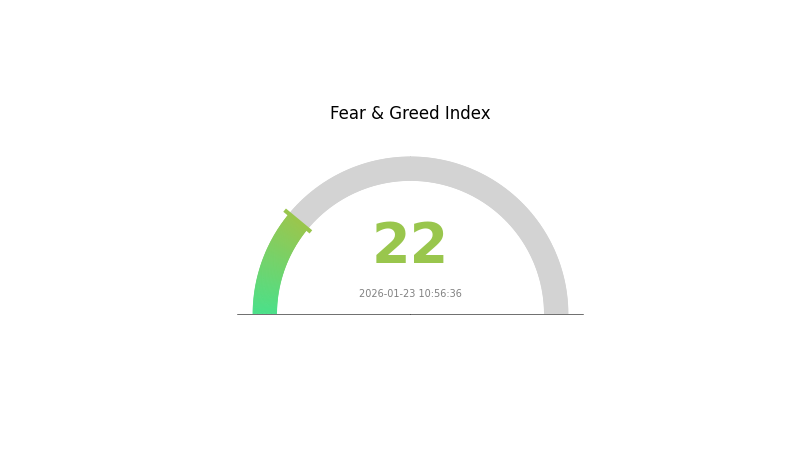
The cryptocurrency market sentiment, as measured by the widely-followed crypto fear and greed index, has deteriorated further in recent sessions. The index declined from 25 to 22, moving deeper into fear territory and approaching extreme fear levels.
This fear-dominated sentiment has several implications:
-
Selling Pressure: Many investors are reducing their cryptocurrency holdings, driven by fear and concern over continuously falling prices. This behavior can become self-reinforcing, as selling pressure drives prices lower, which in turn increases fear and prompts additional selling.
-
Potential Oversold Conditions: However, extreme fear can sometimes indicate oversold market conditions. When sentiment becomes excessively negative, it may signal that most sellers have already exited their positions, potentially setting the stage for a rebound when buying interest returns.
-
Buying Opportunities: For investors with longer time horizons and higher risk tolerance, periods of extreme fear and depressed prices may present potential buying opportunities. Assets trading at significant discounts to recent highs could offer attractive entry points for those confident in the long-term trajectory of the cryptocurrency market.
Exchange-Traded Fund Flows:
The recent period has witnessed significant outflows from US cryptocurrency exchange-traded funds, providing important insights into institutional investor behavior.
Bitcoin ETF Flows:
On a recent trading session, US Bitcoin spot ETFs recorded $869.86 million in outflows, representing the highest single-day outflow since February and the second-highest on record. This substantial withdrawal of capital indicates that institutional investors are reducing their Bitcoin exposure through these regulated investment vehicles.
Ten of the twelve Bitcoin ETFs recorded negative flows during this session, with no funds experiencing positive inflows. Among the largest outflows:
- Grayscale experienced outflows of $256.64 million
- BlackRock recorded outflows of $256.64 million
- Fidelity saw outflows of $119.93 million
Despite these significant outflows, the total net inflow into Bitcoin ETFs remains above $60 billion, standing at $60.21 billion. This indicates that while recent sessions have seen substantial withdrawals, the cumulative institutional investment through these vehicles remains substantial.
Ethereum ETF Flows:
US Ethereum ETFs continued their streak of outflows, recording another $259.72 million in withdrawals. This ongoing pattern of outflows has reduced the total net inflow to $13.31 billion, though this still represents significant institutional capital allocated to Ethereum through these investment vehicles.
Five of the nine Ethereum ETFs recorded outflows, with no funds experiencing positive flows:
- BlackRock led the outflows with $137.31 million in withdrawals
- Grayscale followed with $67.91 million in outflows
The sustained outflows from both Bitcoin and Ethereum ETFs suggest that institutional investors are reassessing their cryptocurrency allocations in response to recent market conditions and broader macroeconomic concerns.
XRP ETF Launch:
In a notable development for cryptocurrency market infrastructure, Canary Capital's XRPC made its debut as the first US spot exchange-traded fund offering direct exposure to XRP. The fund launched with $58 million in trading volume, representing a strong opening performance.
This notable initial trading activity indicates rising institutional appetite for exposure to major cryptocurrency assets beyond Bitcoin and Ethereum. The successful launch of an XRP ETF could pave the way for additional cryptocurrency ETFs, further expanding institutional access to digital assets and potentially driving increased adoption across the cryptocurrency ecosystem.
The ability of investors to gain regulated, convenient exposure to XRP through a traditional brokerage account could attract capital from institutional and retail investors who previously faced barriers to direct cryptocurrency ownership. As the ETF market for cryptocurrencies continues to expand beyond Bitcoin and Ethereum, it may contribute to greater market maturity and potentially reduced volatility over time.
FAQ
What are the main reasons for the recent cryptocurrency market downturn?
Recent cryptocurrency market downturns are primarily driven by macroeconomic factors including rising interest rates, inflation concerns, and reduced risk appetite. Additionally, regulatory uncertainties, large liquidations, and shifts in market sentiment from institutional investors contribute significantly to price declines across major digital assets.
How do macroeconomic factors such as rising interest rates and inflation affect cryptocurrency prices?
Rising interest rates increase opportunity costs of holding non-yielding assets like crypto, reducing demand. Inflation typically boosts crypto as a hedge, but aggressive rate hikes often dominate, causing price declines. Strong dollar correlation and reduced liquidity during tightening cycles further pressure crypto valuations downward.
What impact do cryptocurrency market downturns have on ordinary investors?
Market downturns reduce portfolio values and increase volatility. Investors face potential losses on holdings, tighter liquidity, and amplified emotional pressure. Long-term investors may find buying opportunities at lower prices, while short-term traders experience heightened risk from rapid price swings and margin pressures.
What investment strategy should be adopted during a cryptocurrency bear market?
During bear markets, consider dollar-cost averaging to reduce timing risk, accumulate quality assets at lower prices, diversify your portfolio, and maintain long-term conviction. Focus on projects with strong fundamentals and established use cases rather than speculative tokens.
How long does it typically take for the cryptocurrency market to recover after historical downturns?
Cryptocurrency market recoveries vary significantly, typically ranging from several months to 1-2 years depending on market conditions and the severity of the downturn. Major recoveries have historically occurred within 12-18 months, though some cycles extend longer based on macroeconomic factors and adoption growth.
How do policy and regulatory changes trigger cryptocurrency market fluctuations?
Regulatory announcements directly impact investor confidence and market sentiment. Stricter regulations reduce trading activity and liquidity, causing price volatility. Supportive policies boost adoption and drive prices higher. Sudden enforcement actions create uncertainty, triggering sell-offs. Market participants react quickly to regulatory news, amplifying price movements across cryptocurrencies.
What is the difference between cryptocurrency market downturns and traditional financial market downturns?
Crypto markets operate 24/7 with higher volatility and faster price movements than traditional markets. Crypto downturns are driven by sentiment, regulatory news, and tech factors, while traditional markets are influenced by economic data and corporate earnings. Crypto's decentralized nature creates rapid cascade effects, causing sharper corrections but also quicker recoveries.
* The information is not intended to be and does not constitute financial advice or any other recommendation of any sort offered or endorsed by Gate.